

The kanji: forest plus bathing
Shinrin-yoku is written 森林浴. The first two kanji make shinrin, forest. Look closely and you will see trees everywhere: 森, mori, is three trees, and 林, hayashi, is two. Shinrin is the formal, slightly technical word for forest, used in forestry, geography and the news, while mori is the everyday word for a forest you walk in.
The last kanji, 浴, means to bathe or be showered with. It appears in nyūyoku, taking a bath, and in the verb abiru, to be showered with, as in shawā o abiru, to take a shower. The water radical on its left shows its original link to washing.
| Kanji | Reading | Meaning | Other words |
|---|---|---|---|
| 森 | shin / mori | Forest, dense woods | 森 mori, 森林 shinrin |
| 林 | rin / hayashi | Grove, woods | 林 hayashi, 竹林 chikurin |
| 浴 | yoku / a(biru) | Bathe, be showered with | 入浴 nyūyoku, 浴びる abiru |
| 森林浴 | shinrin-yoku | Forest bathing | 森林浴をする shinrin-yoku o suru |
The yoku pattern: sunbathing, sea bathing and more
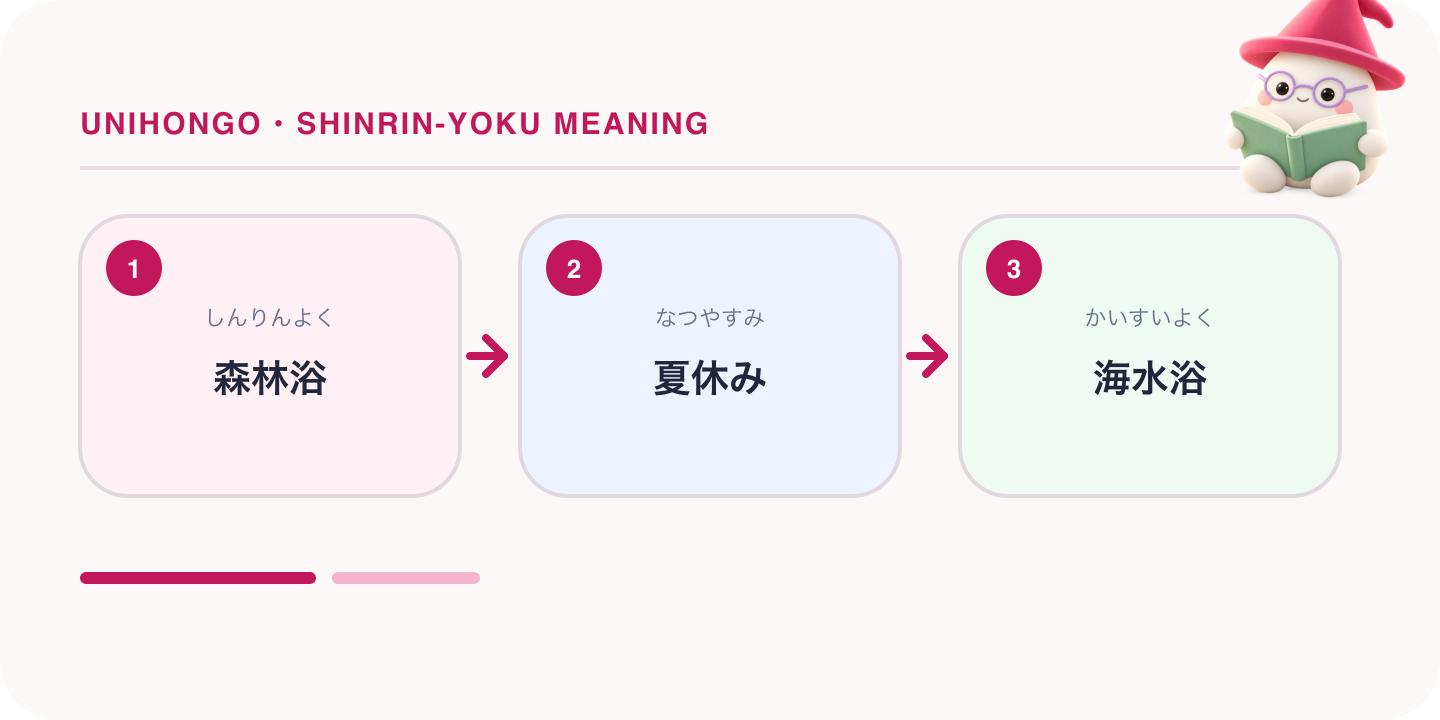
The clever part of shinrin-yoku is its word formation. Japanese already had compounds where yoku follows something you expose yourself to. Nikkōyoku is sunbathing, literally sunlight bathing. Kaisuiyoku is sea bathing, the ordinary word for a day swimming at the beach. Shinrin-yoku simply applies the same pattern to a forest.
Because of this, Japanese speakers hear the word as natural and easy to understand, not as poetic or exotic. The pattern is also productive: people make playful compounds for things they enjoy soaking in, especially in advertising and casual writing.
| Japanese | Romaji | Meaning |
|---|---|---|
| 夏休みに海水浴に行きました。 | Natsuyasumi ni kaisuiyoku ni ikimashita. | I went swimming at the beach in the summer holidays. |
| 猫が窓辺で日光浴をしている。 | Neko ga madobe de nikkōyoku o shite iru. | The cat is sunbathing by the window. |
| 週末に森林浴をしてきました。 | Shūmatsu ni shinrin-yoku o shite kimashita. | I went forest bathing at the weekend. |
| Word | Reading | Literal meaning | Everyday meaning |
|---|---|---|---|
| 日光浴 | nikkōyoku | Sunlight bathing | Sunbathing |
| 海水浴 | kaisuiyoku | Seawater bathing | Swimming at the beach |
| 森林浴 | shinrin-yoku | Forest bathing | Relaxing in a forest |
| 入浴 | nyūyoku | Entering a bath | Taking a bath |
| 岩盤浴 | ganban'yoku | Bedrock bathing | Lying on heated stone slabs at a spa |
Where the word came from
The term is usually traced to Japan's Forestry Agency in the early 1980s, when it was promoted to encourage people to visit and value the country's forests. Japan is heavily forested, and much of that forest lies in mountains close to cities, so the idea of a short trip to breathe forest air fitted everyday life well.
Later, Japanese researchers studied how forest environments relate to stress and relaxation, and the phrase shinrin serapī, forest therapy, came into use for health-focused programmes, including certified forest sites and trained guides. International interest grew from the 2010s onwards, and forest bathing became a wellness term in English, with guided walks, books and apps.
Be careful with claims. Research exists, but many popular articles overstate it. In Japanese, too, you will see marketing phrases like fitontchiddo, phytoncides, the aromatic compounds released by trees, and mainasu ion, negative ions, used loosely in adverts. Treat them as advertising words rather than settled science.
- Shinrin-yoku: the general idea of enjoying a forest's atmosphere.
- Shinrin serapī: forest therapy, structured programmes with a health focus.
- Serapī rōdo: therapy roads, marked walking routes at some forest therapy sites.
- Fitontchiddo: phytoncides, a word you will see on signs and in leaflets.
How common it is in Japan vs abroad
In Japan, shinrin-yoku is a familiar, everyday word, and to many people it sounds a little old-fashioned, like something from a travel brochure. Nobody needs it explained. People use it lightly: a hike, a walk in a shrine's woods or a picnic in a park with big trees can all be called shinrin-yoku. You might hear kimochi ii ne, shinrin-yoku da ne, this feels great, it's forest bathing, half as a joke.
Abroad, the word often names a specific, deliberate practice: walking very slowly, switching off your phone, noticing sounds and smells, sometimes with a guide. That practice exists in Japan too, especially in forest therapy programmes, but most Japanese speakers do not think of shinrin-yoku as a mindfulness technique. It is simply what you do when you go into the woods and feel refreshed.
| In Japan | Abroad |
|---|---|
| A familiar, slightly dated everyday word | A newer wellness term, often in italics |
| Any relaxing time among trees | Often a slow, guided, mindful walk |
| Used casually and sometimes jokingly | Presented as an ancient or special Japanese practice |
| Structured version called shinrin serapī | Structured version called forest bathing or forest therapy |
Nature words for a forest walk
The best way to use shinrin-yoku naturally is to pair it with the words Japanese people use to describe what they see and feel in a forest. Several of them have no neat English equivalent, which is part of their charm.
Komorebi is sunlight filtering through leaves. Shinryoku is the fresh green of new leaves in late spring and early summer, a word you will see in seasonal greetings and travel posters. Seseragi is the gentle murmur of a stream. Kōyō is autumn leaves changing colour.
| Japanese | Romaji | Meaning |
|---|---|---|
| 木漏れ日 | komorebi | Sunlight filtering through leaves |
| 新緑 | shinryoku | Fresh green of new leaves |
| 紅葉 | kōyō / momiji | Autumn leaves |
| せせらぎ | seseragi | The murmur of a stream |
| 鳥のさえずり | tori no saezuri | Birdsong |
| 苔 | koke | Moss |
| 杉並木 | sugi namiki | An avenue of cedar trees |
| 木漏れ日がきれいですね。 | Komorebi ga kirei desu ne. | The light through the leaves is beautiful. |
| 新緑の季節ですね。 | Shinryoku no kisetsu desu ne. | It's the season of fresh greenery. |
Describing how the forest makes you feel
Japanese has a set of very natural feeling words for time in nature. The most famous is kūki ga oishii, the air is delicious, which is how Japanese speakers say the air is fresh and clean. Iyasareru, to be soothed or healed, is used for anything calming: forests, hot springs, cats and music.
Rifuresshu, refresh, is also common: rifuresshu dekita, I feel refreshed. Kimochi ii, it feels good, works everywhere. For a quieter, more reflective tone, try kokoro ga ochitsuku, my mind feels settled.
| Japanese | Romaji | Meaning |
|---|---|---|
| 空気がおいしい! | Kūki ga oishii! | The air is so fresh! |
| 森の中を歩くと癒やされます。 | Mori no naka o aruku to iyasaremasu. | Walking in the forest soothes me. |
| 心が落ち着きますね。 | Kokoro ga ochitsukimasu ne. | It calms the mind, doesn't it. |
| いいリフレッシュになりました。 | Ii rifuresshu ni narimashita. | It was a good refresher. |
| マイナスイオンを浴びている気がする。 | Mainasu ion o abite iru ki ga suru. | I feel like I'm soaking up negative ions. |
| 鳥の声しか聞こえない。 | Tori no koe shika kikoenai. | All I can hear is the birds. |
The mainasu ion line is something Japanese people genuinely say near waterfalls and in forests, usually with a smile. You do not need to believe the science to use the phrase.
Inviting someone and talking about plans
When you suggest a trip to the woods, you can use shinrin-yoku directly or just say you want to walk in nature. Shizen, nature, is the everyday umbrella word, and shizen no naka de, in nature, is a phrase you will hear constantly.
| Japanese | Romaji | Meaning |
|---|---|---|
| 今度、森林浴に行きませんか。 | Kondo, shinrin-yoku ni ikimasen ka. | Would you like to go forest bathing sometime? |
| 自然の中でのんびりしたいです。 | Shizen no naka de nonbiri shitai desu. | I want to relax in nature. |
| 近くにいいハイキングコースはありますか。 | Chikaku ni ii haikingu kōsu wa arimasu ka. | Is there a good hiking trail nearby? |
| スマホを置いて、ゆっくり歩きましょう。 | Sumaho o oite, yukkuri arukimashō. | Let's put our phones away and walk slowly. |
| 神社の森は静かで気持ちいいです。 | Jinja no mori wa shizuka de kimochi ii desu. | The woods around the shrine are quiet and pleasant. |