
Hoshi, uchū and the night sky
星 (hoshi) is the everyday word for star, and it is also the building block of many space words. In compounds it is read sei: 惑星 (wakusei), planet, is literally a wandering star, and 衛星 (eisei), a satellite, is a guarding star. 宇宙 (uchū) is space as a whole, the universe.
Japanese often describes a clear night sky with 星がきれい (hoshi ga kirei), the stars are beautiful, and 星空 (hoshizora), a starry sky, is a word you will see in song titles and tourism brochures for mountain areas and islands.
| Japanese | Romaji | Meaning |
|---|---|---|
| 星がきれい | hoshi ga kirei | the stars are beautiful |
| 星空 | hoshizora | starry sky |
| 惑星 | wakusei | planet |
| 衛星 | eisei | satellite, moon of a planet |
| 銀河 | ginga | galaxy |
| 天の川 | amanogawa | the Milky Way (in the sky) |
Amanogawa, the river of heaven, is the Milky Way as you see it in the sky, and it is at the heart of Tanabata, the star festival in July, when two stars separated by the river are said to meet. The Milky Way as a galaxy in science is 銀河系 (gingakei).
The four words to start with
These four words cover most everyday talk about the sky. Sun and space use on'yomi compounds, while moon and star are short native words.
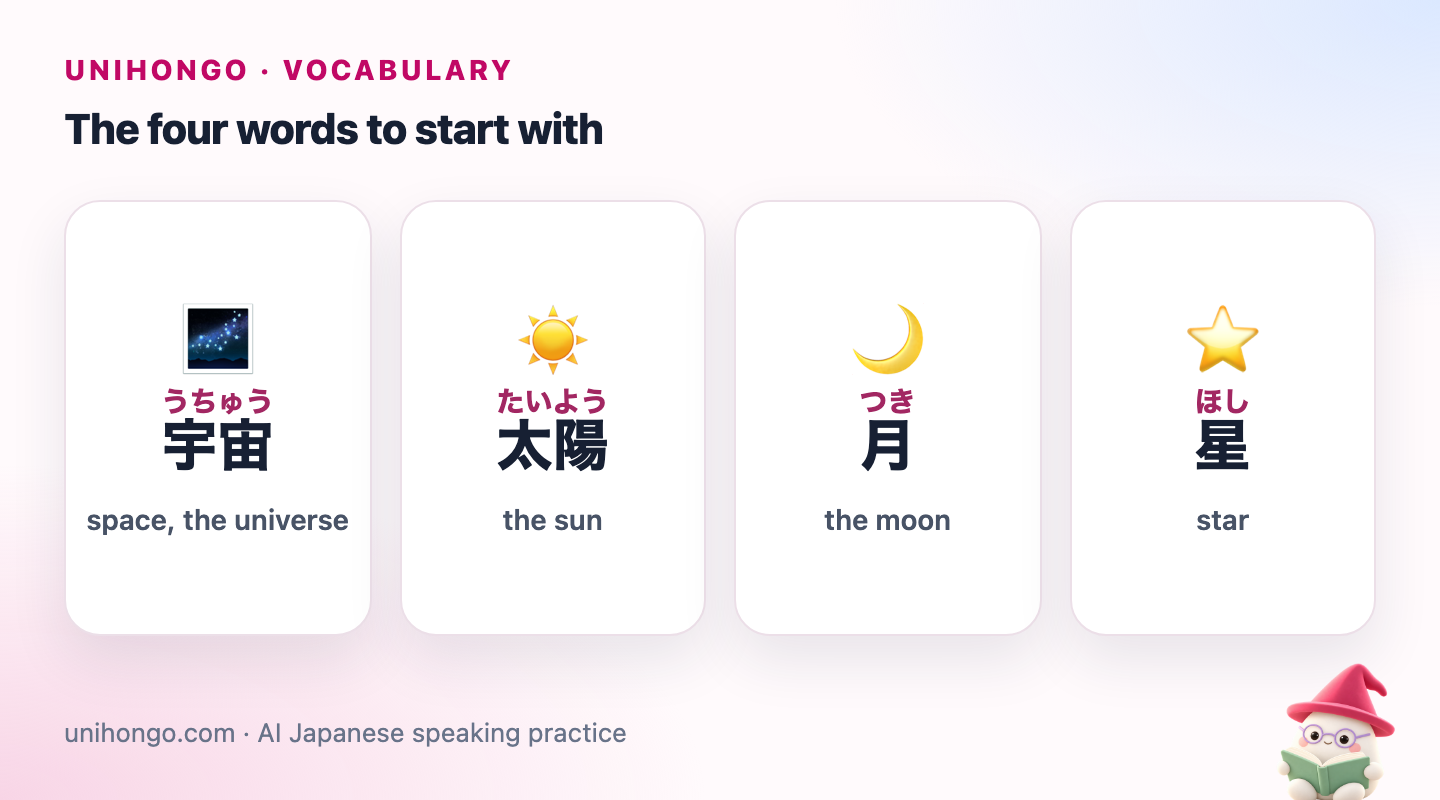
| Japanese | Romaji | Meaning |
|---|---|---|
| 宇宙 | uchū | space, the universe |
| 太陽 | taiyō | the sun |
| 月 | tsuki | the moon |
| 星 | hoshi | star |
| お日さま | ohisama | the sun (warm, said to children) |
| お月さま | otsukisama | the moon (warm, said to children) |
| 地球 | chikyū | Earth, the globe |
Ohisama and otsukisama, with the respectful お and さま, are affectionate words used with children and in picture books. Chikyū, Earth, literally means earth ball, and it is also the normal word for globe.
The eight planets and the weekday trick
The planet names are where Japanese pays off. The five planets known since ancient times share their first kanji with the weekdays, so if you know the days of the week you already know half the solar system. The outer two planets were named much later: Uranus is the heaven king star and Neptune the sea king star, translations of the Greek and Roman gods.
| Japanese | Romaji | Meaning |
|---|---|---|
| すいきんちかもくどってんかい | suikinchikamokudottenkai | the planets in order, as a children's chant |
| 冥王星 | meiōsei | Pluto |
| 準惑星 | junwakusei | dwarf planet |
| 土星の輪 | dosei no wa | Saturn's rings |
| 火星に行ってみたい。 | Kasei ni itte mitai. | I'd love to go to Mars. |
| Planet | Japanese | Kanji meaning | Weekday with the same kanji |
|---|---|---|---|
| Mercury | 水星 (suisei) | water star | 水曜日, Wednesday |
| Venus | 金星 (kinsei) | metal or gold star | 金曜日, Friday |
| Earth | 地球 (chikyū) | earth ball | None |
| Mars | 火星 (kasei) | fire star | 火曜日, Tuesday |
| Jupiter | 木星 (mokusei) | wood star | 木曜日, Thursday |
| Saturn | 土星 (dosei) | soil star | 土曜日, Saturday |
| Uranus | 天王星 (tennōsei) | heaven king star | None |
| Neptune | 海王星 (kaiōsei) | sea king star | None |
The moon: phases and moon-viewing
The moon has a special place in Japanese culture. In autumn, many people enjoy 月見 (tsukimi), moon-viewing, with dumplings and pampas grass, and the full moon of mid-autumn is called 十五夜 (jūgoya). Instead of a man in the moon, Japanese tradition sees a rabbit pounding rice cakes, an image you will meet in picture books and seasonal sweets.
| Japanese | Romaji | Meaning |
|---|---|---|
| 満月 | mangetsu | full moon |
| 三日月 | mikazuki | crescent moon |
| 半月 | hangetsu | half moon |
| 新月 | shingetsu | new moon |
| 月見 | tsukimi | moon-viewing |
| 今日は満月ですね。 | Kyō wa mangetsu desu ne. | It's a full moon tonight, isn't it? |
| 月にうさぎがいるんだよ。 | Tsuki ni usagi ga iru n da yo. | There's a rabbit on the moon, you know. (to a child) |
| 月がきれいですね。 | Tsuki ga kirei desu ne. | The moon is beautiful, isn't it? (also a famous indirect I love you) |
Mikazuki literally means the moon of the third day, from the old lunar calendar. Because the romantic story is so well known, some people smile or tease you a little when you say tsuki ga kirei desu ne. If you only mean the view, kyō no tsuki, kirei da ne, tonight's moon is pretty, sounds more like a comment on the sky.
Shooting stars, comets and eclipses
These words turn up in the news whenever there is something to see in the sky. Japanese TV and websites announce meteor showers and eclipses in advance, and in some places people gather in parks and on rooftops to watch.
| Japanese | Romaji | Meaning |
|---|---|---|
| 流れ星 | nagareboshi | shooting star |
| 流星群 | ryūseigun | meteor shower |
| 彗星 | suisei | comet |
| 隕石 | inseki | meteorite |
| 日食 | nisshoku | solar eclipse |
| 月食 | gesshoku | lunar eclipse |
| 流れ星に願い事をする | nagareboshi ni negaigoto o suru | to make a wish on a shooting star |
Suisei for comet uses the kanji 彗, a broom, because a comet's tail looks like a broom sweeping the sky. It sounds identical to 水星, Mercury, so in conversation people rely on context or say Harē suisei, Halley's Comet, with the name.
Rockets, astronauts and space science
| Japanese | Romaji | Meaning |
|---|---|---|
| ロケット | roketto | rocket |
| 宇宙飛行士 | uchū hikōshi | astronaut |
| 人工衛星 | jinkō eisei | artificial satellite |
| 宇宙ステーション | uchū sutēshon | space station |
| 宇宙人 | uchūjin | alien, extraterrestrial |
| ブラックホール | burakku hōru | black hole |
| 打ち上げ | uchiage | launch (of a rocket) |
| 望遠鏡 | bōenkyō | telescope |
| 将来、宇宙飛行士になりたいです。 | Shōrai, uchū hikōshi ni naritai desu. | I want to be an astronaut one day. |
Here Japanese mixes native kanji words and loanwords freely. Rocket and black hole are katakana, while astronaut and satellite are kanji compounds that are easy to read once you know 宇宙 and 衛星. Uchiage also means an after-party held when a project or a performance is finished, so the meaning comes from context.
A night of stargazing
Stargazing is 星を見る (hoshi o miru) in casual talk and 天体観測 (tentai kansoku), astronomical observation, in a more formal or hobby sense. Many towns, mountain areas and islands promote their dark skies, and planetariums, プラネタリウム (puranetariumu), are a popular date and family outing in cities.

| Japanese | Romaji | Meaning |
|---|---|---|
| 今夜、流星群が見えるらしいよ。 | Kon'ya, ryūseigun ga mieru rashii yo. | Friend: Apparently we can see a meteor shower tonight. |
| 本当?見に行こうよ。 | Hontō? Mi ni ikō yo. | You: Really? Let's go and see it. |
| 山のほうが暗くてよく見えるね。 | Yama no hō ga kurakute yoku mieru ne. | Friend: It's darker in the mountains, so we'll see better. |
| あ、流れ星! | A, nagareboshi! | You: Oh, a shooting star! |
| 願い事した? | Negaigoto shita? | Friend: Did you make a wish? |
| 速すぎて間に合わなかった。 | Hayasugite maniawanakatta. | You: It was too fast, I didn't make it in time. |
Learn the solar system with Mocchi
Start with /kanji 星 and Mocchi gives you the meaning, the readings hoshi and sei, and words such as wakusei and ryūsei. Then ask: Quiz me on the planets in Japanese, in random order. Mocchi notices which ones you hesitate over, perhaps tennōsei and kaiōsei, and folds them into your next review instead of starting from scratch.
Afterwards, make cards with /create-flashcards and fly them in Mocchi Flight: steer Mocchi through the gate with the right planet name.
Common learner mistakes
- Using uchū for space in a room. A free space or parking space is supēsu.
- Saying hoshi for planets. Hoshi works casually, but a planet is wakusei.
- Mixing up 水星 (Mercury) and 彗星 (comet). They sound the same; the kanji tell them apart.
- Reading 土星 as tosei. It is dosei.
- Saying tsuki ga kirei desu ne to someone you just met. The romantic meaning is well known, so expect a reaction.