
What kokoro covers
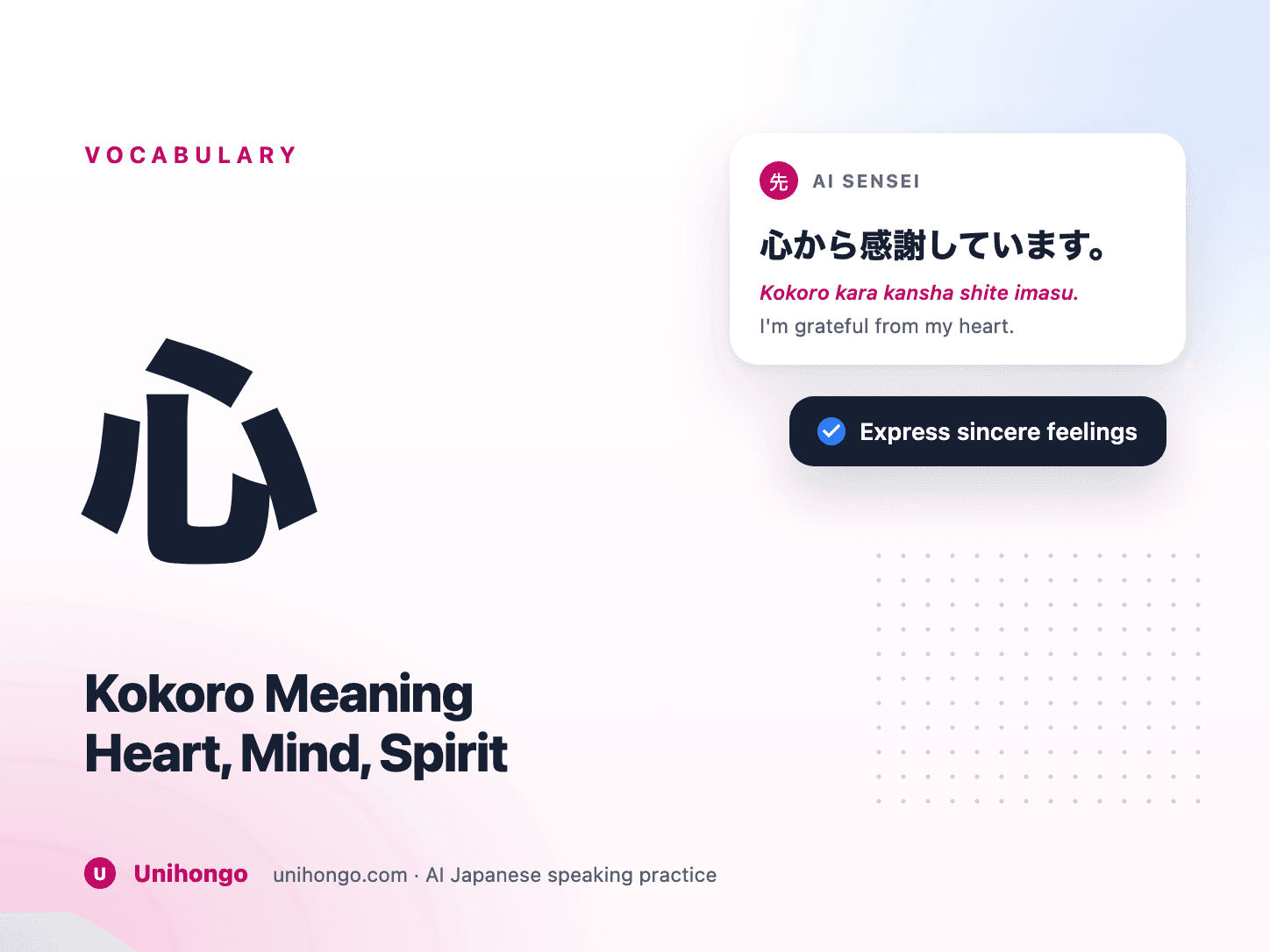
Kokoro is the inner self. It holds emotions, such as happiness and pain, but also thoughts, intentions, sincerity and character. Kokoro no yasashii hito is a kind-hearted person; kokoro no naka de omotta means I thought it to myself, in my mind. English uses heart for the first and mind for the second, but Japanese uses the same word.
Kokoro is not the physical organ. The heart that beats is shinzō, and a heart attack is shinzō mahi or shinkin kōsoku in medical language. If you say kokoro ga itai at a clinic, it will be understood as emotional pain, not a medical symptom.
| Japanese | Romaji | Meaning |
|---|---|---|
| 心 | kokoro | Heart, mind, spirit; the inner self |
| 心の中で | kokoro no naka de | Inwardly, in my mind |
| 心の優しい人 | kokoro no yasashii hito | A kind-hearted person |
| 心を込めて | kokoro o komete | With all my heart, with care |
| 心臓 | shinzō | The physical heart |
| 心身 | shinshin | Mind and body |
Kokoro kara and sincere feelings
Kokoro kara, from the heart, makes a feeling sincere and complete. It is common with thanks, apologies, congratulations and wishes. The written, more formal version is kokoro yori, which you will see in letters, emails and speeches.
Because it is strong, kokoro kara is best saved for meaningful moments. Using it for small favours can sound exaggerated. Kokoro o komete, with heart, describes doing something carefully and with feeling, such as cooking or writing a card.
| Japanese | Romaji | Meaning |
|---|---|---|
| 心から感謝しています。 | Kokoro kara kansha shite imasu. | I am grateful from the bottom of my heart. |
| 心からお詫び申し上げます。 | Kokoro kara owabi mōshiagemasu. | I sincerely apologise. (very formal) |
| 心よりお祝い申し上げます。 | Kokoro yori oiwai mōshiagemasu. | My heartfelt congratulations. (written, formal) |
| 心から楽しめた。 | Kokoro kara tanoshimeta. | I truly enjoyed it. |
| 心を込めて作りました。 | Kokoro o komete tsukurimashita. | I made it with love and care. |
When the heart hurts, moves or opens
Many expressions describe what happens to kokoro. Kokoro ga itai, my heart hurts, expresses emotional pain or guilt, for example when you hear sad news or feel bad about something you did. Kokoro o utsu, to strike the heart, means to move someone deeply.
Kokoro o hiraku, to open your heart, is about trusting someone. Kokoro ga oreru, the heart breaks, is closer to losing the will to continue than to romantic heartbreak; for a broken heart in love, people often say shitsuren, a lost love. These collocations are fixed, so it is best to learn them as whole phrases.
| Japanese | Romaji | Meaning |
|---|---|---|
| そのニュースを聞いて心が痛い。 | Sono nyūsu o kiite kokoro ga itai. | Hearing that news hurts my heart. |
| 彼のスピーチに心を打たれた。 | Kare no supīchi ni kokoro o utareta. | I was deeply moved by his speech. |
| やっと心を開いてくれた。 | Yatto kokoro o hiraite kureta. | They finally opened up to me. |
| 心が折れそう。 | Kokoro ga oresō. | I feel like I'm about to give up. |
| 心に残る | kokoro ni nokoru | To stay in your heart; memorable |
| 心が温まる話 | kokoro ga atatamaru hanashi | A heart-warming story |
Kokoro-zuyoi and kokorobosoi
Two adjectives built on kokoro are especially useful. Kokoro-zuyoi, literally heart-strong, means reassuring or encouraging: something that makes you feel supported. It usually describes a person, a presence or a situation, not your own bravery.
Kokorobosoi, heart-thin, is its opposite: feeling uneasy, helpless or alone because you lack support. It is the natural word for being alone in a new country, travelling without a phone signal or starting a job where you know nobody.
| Japanese | Romaji | Meaning |
|---|---|---|
| 一緒に来てくれて心強いです。 | Issho ni kite kurete kokoro-zuyoi desu. | It's reassuring to have you come with me. |
| 経験者がいると心強い。 | Keikensha ga iru to kokoro-zuyoi. | Having someone experienced here is reassuring. |
| 一人で心細かった。 | Hitori de kokorobosokatta. | I felt uneasy on my own. |
| 知り合いがいなくて心細い。 | Shiriai ga inakute kokorobosoi. | I feel lost without anyone I know. |
| 心強いお言葉、ありがとうございます。 | Kokoro-zuyoi okotoba, arigatō gozaimasu. | Thank you for your encouraging words. |
A common mistake is using kokoro-zuyoi to mean I am brave. For personal courage, Japanese uses words such as yūki ga aru, to have courage, or tsuyoi, strong.
More everyday kokoro words
Kokoro appears in many compound words and fixed phrases you will meet in daily life, advertising and news. Some use the reading kokoro, others the reading shin.
| Japanese | Reading | Meaning |
|---|---|---|
| 心配 | shinpai | Worry, concern |
| 安心 | anshin | Relief, peace of mind |
| 心当たり | kokoroatari | An idea of what it might be; a clue |
| 心がける | kokorogakeru | To keep in mind, to make a point of |
| 心地いい | kokochi ii | Comfortable, pleasant |
| 心残り | kokoronokori | Regret, something left undone |
| 心の準備 | kokoro no junbi | Mental preparation |
| 真心 | magokoro | Sincerity, true heart |
Kokoroatari is especially practical: kokoroatari wa arimasen ka, do you have any idea, is a standard question at lost-property counters, and kokoroatari ga nai means I have no idea.
Kokoro versus ki
Ki is the word learners most often confuse with kokoro. Both deal with the inner world, but ki is about mood, attention, intention and energy in the moment, while kokoro is deeper and more lasting. Ki ni suru, to worry about something, and ki ga tsuku, to notice, are about attention; kokoro ga itamu, the heart aches, is about deep feeling.
A rough rule: if English would say mood, attention or feel like doing, choose ki. If English would say heart, sincerity or soul, choose kokoro. The separate list of thirty phrases built on ki covers that side in detail.
| Japanese | Romaji | Meaning |
|---|---|---|
| 気にしないで。 | Ki ni shinaide. | Don't worry about it. (attention) |
| 行く気がしない。 | Iku ki ga shinai. | I don't feel like going. (mood) |
| 心が広い | kokoro ga hiroi | Generous, open-minded (character) |
| 気が長い | ki ga nagai | Patient (temperament) |
Kokoro versus mune
Mune, the chest, is where Japanese places physical sensations of emotion. Mune ga itai can mean chest pain or an ache of sadness, mune ga dokidoki suru is a pounding heart from nerves or excitement, and mune ga ippai means your heart is full. Mune describes the felt, bodily side of emotion.
Kokoro describes the emotion itself or the inner self that has it. Compare mune ga itamu, my chest aches with sorrow, with kokoro ga itamu, my heart grieves: both are used and close in meaning, but mune feels more physical and immediate. For literal chest pain at a doctor's, use mune ga itai, not kokoro.
| Word | Focus | Example |
|---|---|---|
| 心 kokoro | Inner self, feelings, sincerity | kokoro kara, from the heart |
| 気 ki | Mood, attention, energy | ki ni naru, to be on your mind |
| 胸 mune | Felt emotion in the chest | mune ga ippai, heart full |
| 心臓 shinzō | The physical heart | shinzō no byōki, heart disease |