

How the word is built
Tsundoku is wordplay. Tsunde oku means to pile something up and leave it there: tsumu is to stack or load, and oku is to put down or leave. Doku is the Sino-Japanese reading of the kanji for reading, the same doku as in dokusho, reading books.
The joke is that tsunde oku sounds a little like tsundoku, so swapping the final part for the kanji for reading creates a new word that means stacking up instead of reading. It is written 積ん読, with a small n from the verb, or 積読 without it.
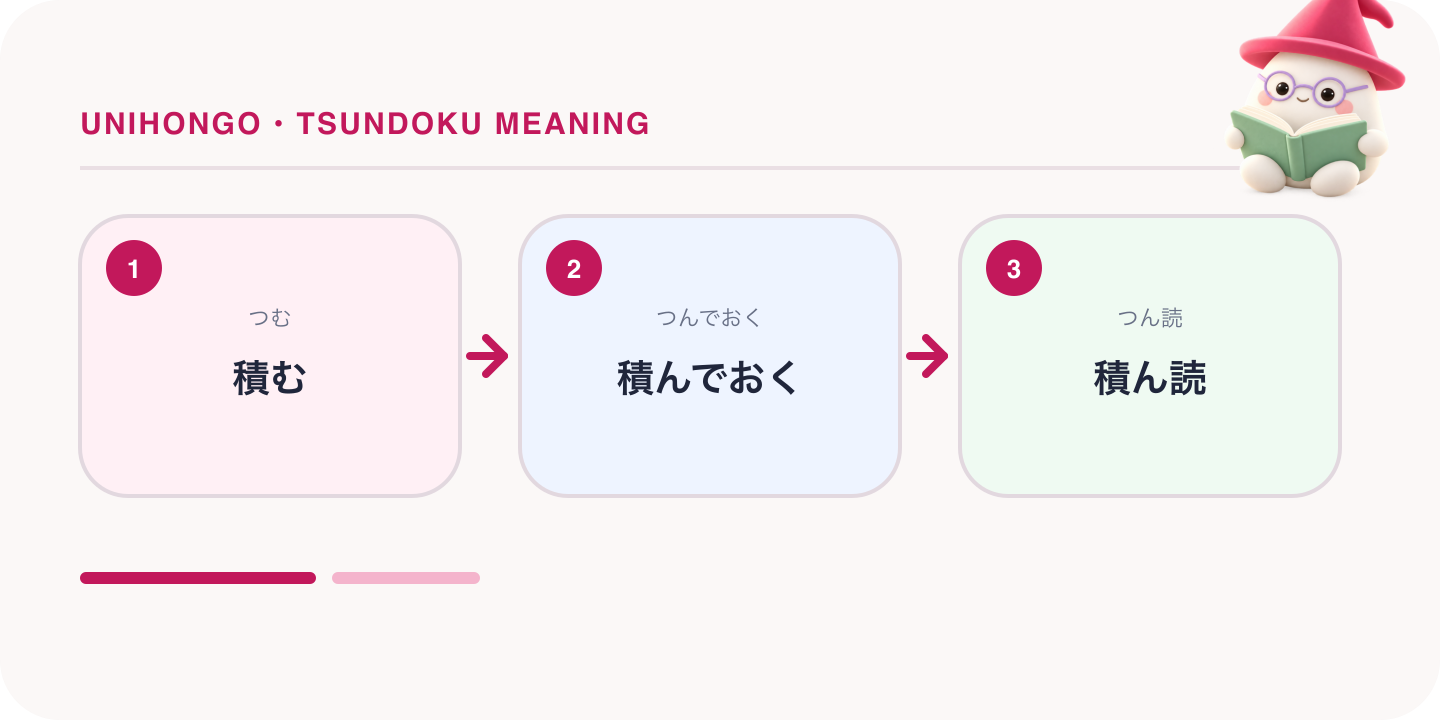
| Part | Reading | Meaning |
|---|---|---|
| 積む | tsumu | To pile up, to stack |
| 積んでおく | tsunde oku | To stack up and leave |
| 読 | doku | Reading (as in 読書 dokusho) |
| 積ん読 | tsundoku | Books bought and left unread |
Where tsundoku comes from
The word is generally traced back to the Meiji period, in the late nineteenth century, when printed books and magazines were spreading quickly in Japan and owning more books than you read became a familiar joke. It has been in steady use ever since.
In recent years tsundoku has also become well known in English, often appearing in lists of Japanese words with no English equivalent. Unlike some borrowed words, its meaning did not change on the way: the English and Japanese uses are essentially the same.
- It began as a playful pun, not a formal term.
- It describes both the habit and the physical pile.
- The English use closely matches the Japanese one.
- It is humorous and self-deprecating in both languages.
How Japanese people use tsundoku today
Japanese readers post photos of their tsundoku on social media, write about tsundoku kaishō, clearing the backlog, and describe themselves as having a lot of tsundoku. It is a friendly word that invites the listener to admit they do the same.
The word works as a noun, and people also turn it into a verb with suru or naru, as in the book becoming tsundoku.
| Japanese | Romaji | Meaning |
|---|---|---|
| 積ん読がどんどん増えている。 | Tsundoku ga dondon fuete iru. | My unread pile keeps growing. |
| 買ったまま積ん読になっている。 | Katta mama tsundoku ni natte iru. | I bought it and it's just sitting on the pile. |
| 今年こそ積ん読を解消したい。 | Kotoshi koso tsundoku o kaishō shitai. | This year I really want to clear my unread pile. |
| 本屋に行くと、つい買っちゃう。 | Hon'ya ni iku to, tsui katchau. | Whenever I go to a bookshop, I can't help buying something. |
| 積ん読も読書のうちだよ。 | Tsundoku mo dokusho no uchi da yo. | Owning unread books counts as reading too. |
The last line is a popular half-joking defence: having books around means you might read them, and choosing them is already part of the pleasure.
Book and reading vocabulary
Tsundoku opens the door to a useful set of words about books, many of which have no neat English equivalent because they describe Japanese book formats and habits. Bunkobon are small, cheap paperbacks; tankōbon are standalone volumes, including collected manga; shinsho are slim non-fiction books on a single topic.
| Word | Reading | Meaning |
|---|---|---|
| 文庫本 | bunkobon | Small pocket paperback |
| 単行本 | tankōbon | Standalone book or collected manga volume |
| 新書 | shinsho | Slim non-fiction book on one topic |
| 古本 | furuhon | Second-hand book |
| 電子書籍 | denshi shoseki | E-book |
| 読みかけ | yomikake | Half-read, in the middle of reading |
| 読了 | dokuryō | Finished reading |
| 立ち読み | tachiyomi | Reading in a shop without buying |
| 帯 | obi | Paper band around a new book with blurbs |
Ways of reading in Japanese
Japanese also has precise words for how you read, which are useful when you talk about your own study. Tadoku, extensive reading, means reading a lot of easy material for enjoyment. Seidoku, intensive reading, means reading carefully and analysing every word. Many learners have a tsundoku problem because they only try seidoku.
| Japanese | Romaji | Meaning |
|---|---|---|
| 多読 | tadoku | Extensive reading, reading a lot of easy material |
| 精読 | seidoku | Close, careful reading |
| 速読 | sokudoku | Speed reading |
| 音読 | ondoku | Reading aloud |
| 読書家 | dokushoka | Keen reader, bookworm |
| この本、途中で挫折しました。 | Kono hon, tochū de zasetsu shimashita. | I gave up on this book halfway through. |
Why learners' Japanese books end up unread
Almost every Japanese learner has a small tsundoku pile: a novel bought in a Tokyo bookshop, a stack of manga, a graded reader set, a grammar book. The reasons are usually the same, and knowing them is half the fix.
- The book is too far above your level, so every page is a dictionary exercise.
- You try to understand every word instead of the story.
- There are no furigana, so unknown kanji block you completely.
- You wait for a long free block of time that never comes.
- The book is something you feel you should read, not something you want to read.
A plan to read the Japanese books you bought
Clearing a Japanese tsundoku pile is less about willpower and more about matching books to your level and making the habit tiny. Sort your pile first, then commit to a small amount every day.
Start with the easiest book, not the most impressive. Graded readers for learners, children's books with furigana and manga you already know in translation all work well. If a book has more than a few unknown words per line, put it back for later rather than forcing it; you have not failed, you have just found your next goal.
Read one page, or even half a page, every day. Guess unknown words from context and look up only the ones that keep appearing. Reading aloud, ondoku, helps you notice words you only half know and trains your pronunciation at the same time.
- Sort your pile into now, later and much later.
- Pick one book from now and keep it where you will see it.
- Read at least one page a day, even on busy days.
- Look up only repeated words; guess the rest.
- Keep a short list of new words and review them the next day.
- Say one sentence about what you read, out loud, in Japanese.
Talking about your reading in Japanese
Books are an easy and friendly topic of conversation in Japanese. These lines let you confess your tsundoku, recommend a book and ask for recommendations.
| Japanese | Romaji | Meaning |
|---|---|---|
| 積ん読が多くて困っています。 | Tsundoku ga ōkute komatte imasu. | I have far too many unread books. |
| 今、この本を読みかけです。 | Ima, kono hon o yomikake desu. | I'm partway through this book right now. |
| やっと読み終わりました。 | Yatto yomiowarimashita. | I've finally finished it. |
| どんな話ですか。 | Donna hanashi desu ka. | What's it about? |
| おすすめの本はありますか。 | Osusume no hon wa arimasu ka. | Do you have any book recommendations? |
| 初心者でも読みやすい本を探しています。 | Shoshinsha demo yomiyasui hon o sagashite imasu. | I'm looking for a book that's easy for beginners to read. |