
Ninja or shinobi: one kanji, two readings
Ninja is 忍者: nin (忍), to act in secret, plus ja (者), person. The older word is shinobi (忍び), short for shinobi no mono (忍びの者), which uses the native Japanese reading of the same kanji. In historical records shinobi is the usual term; ninja is generally said to have spread in the twentieth century, when novels, films and manga made the figure a star.
Both are understood by everyone today. Ninja is the neutral, everyday word. Shinobi sounds older and cooler, which is why fiction loves it.
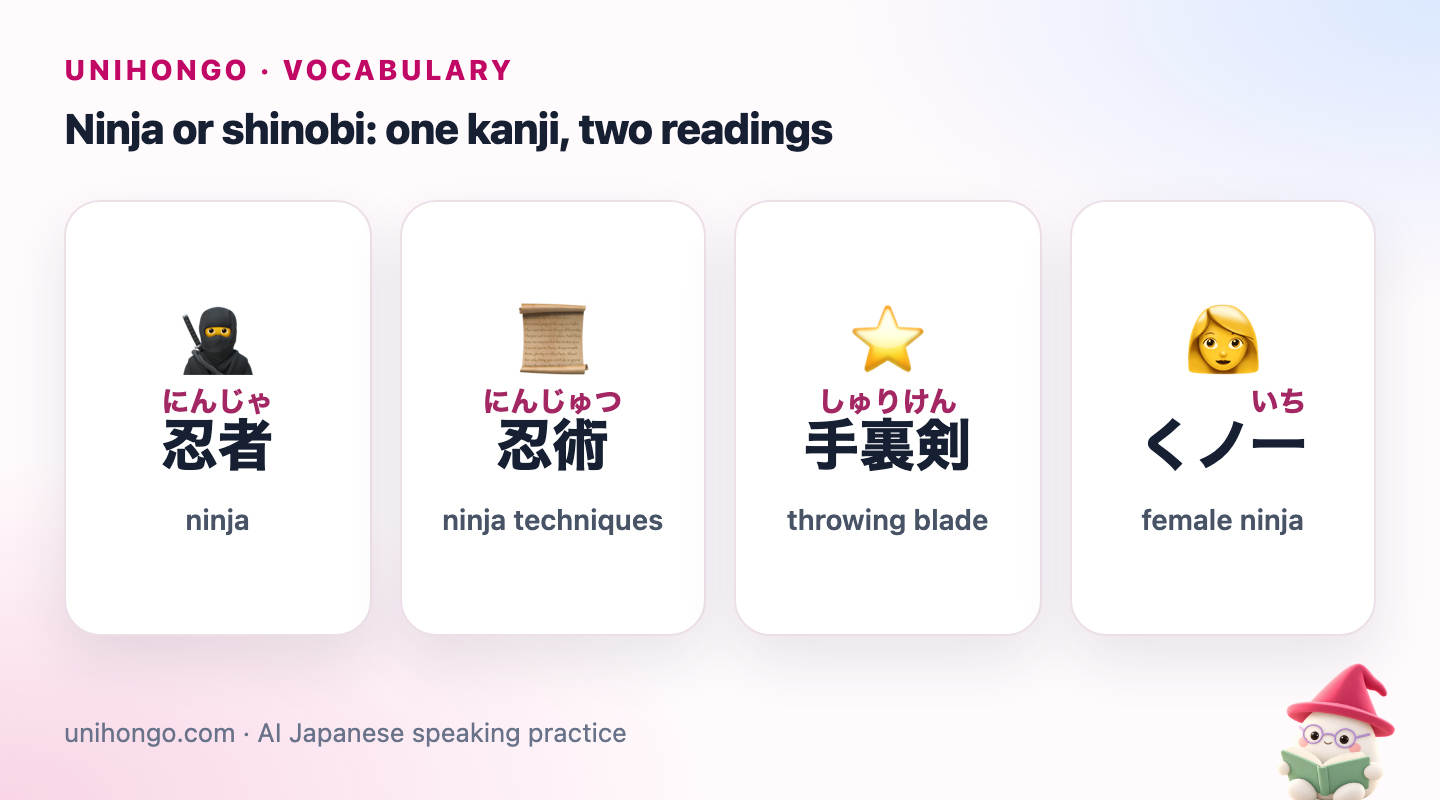
| Japanese | Romaji | Meaning |
|---|---|---|
| 忍者 | ninja | ninja |
| 忍術 | ninjutsu | ninja techniques |
| 手裏剣 | shuriken | throwing blade |
| くノ一 | kunoichi | female ninja |
| 忍び | shinobi | ninja (the older word) |
| 忍びの者 | shinobi no mono | one who goes in secret |
Shuriken (手裏剣) is worth reading kanji by kanji: 手 hand, 裏 the back or hidden side, 剣 sword. A blade hidden in the hand.
The kanji 忍: a blade over a heart
The kanji 忍 stacks 刃, blade, on top of 心, heart. Teachers like to explain it as holding still with a blade above your heart, and whether or not that is the true history of the character, it is a good memory hook for the two meanings.
The first meaning is to endure. The second is to hide or do something unseen. The verb shinobu (忍ぶ) carries both, and so does the kanji in compounds. Read as nin, it appears in ninja, ninjutsu and nintai (忍耐), patience. Read as shino, it appears in shinobi and shinobiashi (忍び足), stealthy steps.
Why kunoichi is written くノ一
Kunoichi mixes three scripts in three characters: hiragana く, katakana ノ and the kanji 一. That looks strange until you write the kanji 女, woman. Its stroke order is a bent stroke like く, a falling stroke like ノ, and a horizontal line like 一. Kunoichi is simply 女 spelled out stroke by stroke, a piece of old wordplay.
As a word for a female ninja it owes its fame to modern fiction. Historians are cautious about how far the image of the trained female agent matches the records, so treat kunoichi as a word from stories first.
Tools and techniques you hear in anime and games
Technique names follow one pattern: a noun, then no jutsu (の術), the art of. Jutsu (術) is the same kanji as in gijutsu (技術), technology, and shujutsu (手術), surgery.
| Japanese | Romaji | Meaning |
|---|---|---|
| 分身の術 | bunshin no jutsu | the clone technique |
| 隠れ身の術 | kakuremi no jutsu | the art of hiding yourself |
| 変装 | hensō | disguise |
| 巻物 | makimono | scroll |
| 煙玉 | kemuridama | smoke bomb |
| 印を結ぶ | in o musubu | to form hand signs |
| 手裏剣を投げる | shuriken o nageru | to throw a shuriken |
| 忍者屋敷 | ninja yashiki | ninja house with trick doors |
Bunshin (分身) literally means a divided body. Outside fiction it means an alter ego or a second self: a novelist may call a character jibun no bunshin, my other self.
Comedy ninja often say nin nin and end sentences with de gozaru, an old-fashioned form of desu. Both are costume language. Nobody speaks that way, but everyone recognises it.
Iga and Kōka: the two names always said together
Two neighbouring regions are famous for shinobi: Iga (伊賀), in today's Mie Prefecture, and Kōka (甲賀), in Shiga Prefecture. Fiction usually makes them rivals. Both towns now welcome visitors with ninja museums and old houses fitted with revolving walls and hidden stairs.
The best-known name linked to Iga is Hattori Hanzō (服部半蔵), a real retainer of Tokugawa Ieyasu. Hanzōmon, a gate of the old Edo Castle and now a Tokyo subway station, is said to be named after him.
| Japanese | Romaji | Meaning |
|---|---|---|
| 伊賀 | Iga | Iga, in Mie Prefecture |
| 甲賀 | Kōka | Kōka, in Shiga Prefecture |
| 忍者の里 | ninja no sato | ninja homeland |
Fiction and history, said carefully
The honest summary is that shinobi were real and the superpowers were not. The table gives the cautious version.
| Image | In fiction | What can be said safely |
|---|---|---|
| The job | Assassin and superhuman fighter | Mostly scouting, gathering information, infiltration and raids at night |
| Black outfit | Standard uniform with a mask | Little evidence; often traced to theatre, where stagehands wear black to be ignored |
| Shuriken | The signature weapon, thrown by the dozen | Real throwing blades existed in several martial traditions; a minor weapon |
| Hand signs | They trigger magic | Ritual gestures borrowed from Buddhist practice; the magic is story |
| Clones and vanishing | Everyday techniques | Fiction, though smoke and distraction are described in old manuals |
Manuals written in the Edo period, the best known being the Bansenshūkai, collect the knowledge of the Iga and Kōka traditions. They spend more pages on disguise, weather and human psychology than on fighting.
Shinobu, kakureru and other everyday stealth words
Here is the part you will use. The verb shinobu survives in set expressions, while the plain words for hiding are kakureru (隠れる), to hide yourself, and kakusu (隠す), to hide something.
| Japanese | Romaji | Meaning |
|---|---|---|
| 忍耐 | nintai | patience, endurance |
| 耐え忍ぶ | taeshinobu | to bear, to endure |
| 人目を忍ぶ | hitome o shinobu | to avoid being seen |
| 忍び込む | shinobikomu | to sneak in |
| 隠れる | kakureru | to hide (yourself) |
| 隠す | kakusu | to hide (something) |
| かくれんぼ | kakurenbo | hide-and-seek |
| 猫が忍び足で近づいてきた。 | Neko ga shinobiashi de chikazuite kita. | The cat crept up silently. |
| 子どもがカーテンの後ろに隠れています。 | Kodomo ga kāten no ushiro ni kakurete imasu. | The child is hiding behind the curtain. |
| 語学には忍耐が必要です。 | Gogaku ni wa nintai ga hitsuyō desu. | Language study takes patience. |
Asking about ninja in polite conversation
At a museum or a ninja house, staff are used to questions. These are polite and short enough to say on the spot.
| Japanese | Romaji | Meaning |
|---|---|---|
| 忍者に興味があります。 | Ninja ni kyōmi ga arimasu. | I'm interested in ninja. |
| 忍者は本当にいたんですか。 | Ninja wa hontō ni ita n desu ka. | Did ninja really exist? |
| 忍者体験をしてみたいです。 | Ninja taiken o shite mitai desu. | I'd like to try a ninja experience. |
| 手裏剣を投げてみてもいいですか。 | Shuriken o nagete mite mo ii desu ka. | May I try throwing a shuriken? |
| 伊賀と甲賀、どちらが有名ですか。 | Iga to Kōka, dochira ga yūmei desu ka. | Which is more famous, Iga or Kōka? |