
One sound, several jobs
Japanese tolerates homophones more comfortably than English does, because kanji keeps them apart on the page and context keeps them apart in speech. Kaeru is one of the busiest examples. A colleague saying mō kaerimasu is leaving for home, a librarian saying kaeshite kudasai wants the book back, and a friend saying kaeta hō ga ii wa suggesting you change something. Nothing in the sound distinguishes them, and yet no native speaker hesitates.
The reason is that each verb travels with its own nouns. 帰る goes with uchi, jikka, kuni and kaisha. 返す goes with hon, okane, kasa and kagi. 変える goes with yotei, kangae, iro and namae. Learning the collocation rather than the isolated verb is what makes the choice fast, which is why every section below gives you the noun and the verb glued together.
There is a second, separate difficulty hiding underneath. Two of these verbs are godan and the rest are ichidan, so the same dictionary form kaeru produces two different te-forms. Learners who sort out the meanings often still say kaete when they mean kaette. The last third of this guide is devoted to that alone.
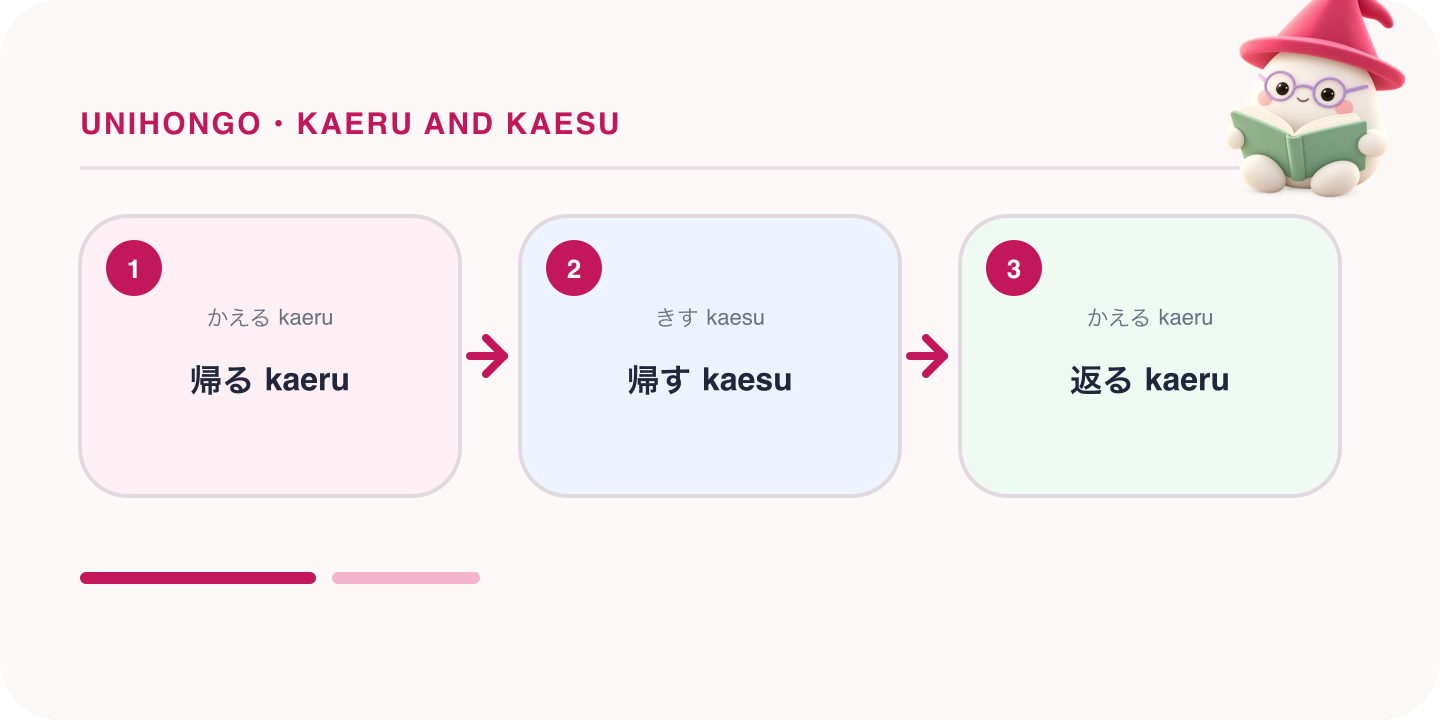
The kaeru family at a glance
| Verb | Class | Type | Core meaning | Example |
|---|---|---|---|---|
| 帰る kaeru | Godan | Intransitive | Go back to where you belong: home, your country | 家に帰ります Uchi ni kaerimasu |
| 帰す kaesu | Godan | Transitive | Send a person home | 子どもを帰します Kodomo o kaeshimasu |
| 返る kaeru | Godan | Intransitive | A thing comes back, a state is restored | 財布が返ってきました Saifu ga kaette kimashita |
| 返す kaesu | Godan | Transitive | Give something back, repay | 本を返します Hon o kaeshimasu |
| 変わる kawaru | Godan | Intransitive | Something changes on its own | 時間が変わりました Jikan ga kawarimashita |
| 変える kaeru | Ichidan | Transitive | Change something into a different state | 予定を変えます Yotei o kaemasu |
| 替わる kawaru | Godan | Intransitive | One item takes another's place | 選手が替わりました Senshu ga kawarimashita |
| 替える kaeru | Ichidan | Transitive | Swap in a fresh one of the same kind | 電池を替えます Denchi o kaemasu |
| 換える kaeru | Ichidan | Transitive | Exchange for something of another kind | 円をドルに換えます En o doru ni kaemasu |
| 代わる kawaru | Godan | Intransitive | Stand in for someone | 私が代わります Watashi ga kawarimasu |
| 代える kaeru | Ichidan | Transitive | Substitute one thing for another | ご挨拶に代えます Goaisatsu ni kaemasu |
Read the table in pairs rather than as a list of eleven items. Every row ending in -waru or -ru describes something happening by itself, and every row ending in -su or -eru describes somebody doing it. That is the same intransitive and transitive machinery you already meet in aku and akeru or hairu and ireru, so the pattern is familiar even when the vocabulary is not.
The three kanji 替, 換 and 代 overlap enough that Japanese writers themselves hesitate, and kana is genuinely common for all of them. Do not lose speaking time over the choice. Say kaemasu with confidence and let the kanji question wait until you are writing.
Going home with kaeru and kaesu
帰る is not a general word for going. It means returning to a place that counts as yours: your home, your parents' house, your home country, and by extension your own company after visiting a client. That is why iku and kaeru are not interchangeable. Tōkyō ni ikimasu says you are travelling there, while Tōkyō ni kaerimasu says Tokyo is where you live.
帰す is the transitive partner, and it needs a person as its object. A manager sends staff home, a school sends pupils home, a host lets a guest leave. Because it carries a hint of authority, you do not use it about yourself; for that you simply say kaerimasu. The noun kaeri, from the masu-stem, is heard constantly in questions about what time somebody will be back.
| Japanese | Romaji | Meaning |
|---|---|---|
| 今日は早く家に帰ります。 | Kyō wa hayaku uchi ni kaerimasu. | I am going home early today. |
| もう帰ってもいいですか。 | Mō kaette mo ii desu ka? | May I go home now? |
| お盆に実家に帰るつもりです。 | Obon ni jikka ni kaeru tsumori desu. | I plan to go back to my parents' place for Obon. |
| 来月、国に帰ります。 | Raigetsu, kuni ni kaerimasu. | I am going back to my country next month. |
| 台風なので社員を早めに帰しました。 | Taifū na node shain o hayame ni kaeshimashita. | Because of the typhoon, we sent the staff home early. |
| 子どもを一人で帰さないでください。 | Kodomo o hitori de kaesanaide kudasai. | Please do not send the child home on their own. |
| 日本に帰ったら連絡します。 | Nihon ni kaettara renraku shimasu. | I will get in touch once I am back in Japan. |
| 帰りは何時ごろになりますか。 | Kaeri wa nan-ji goro ni narimasu ka? | Around what time will you be back? |
Giving things back with kaesu
返す is the verb for anything that must go back to its owner: a borrowed book, an umbrella, money, a key, a favour. It is one of the highest-value verbs a learner can own, because borrowing is such a frequent social act and the polite request forms around it are fixed. Kashite kudasai asks to borrow, kaeshimasu promises to return, and kaeshite kudasai asks for something back.
返る, the intransitive half, is much rarer in daily speech and usually appears with kuru: kaette kimashita means it came back. It also survives in a few set expressions about states being restored, such as ware ni kaeru, to come to your senses, and ikikaeru, to come back to life, which is what people say about themselves after a cold drink on a hot day.
| Japanese | Romaji | Meaning |
|---|---|---|
| この本を図書館に返します。 | Kono hon o toshokan ni kaeshimasu. | I am returning this book to the library. |
| 借りたお金は来週返します。 | Karita okane wa raishū kaeshimasu. | I will pay back the money I borrowed next week. |
| 金曜日までに返してください。 | Kin'yōbi made ni kaeshite kudasai. | Please return it by Friday. |
| 財布が交番に返ってきました。 | Saifu ga kōban ni kaette kimashita. | My wallet came back to me via the police box. |
| まだ返事が返ってきていません。 | Mada henji ga kaette kite imasen. | No answer has come back yet. |
| 名前を呼ばれて我に返りました。 | Namae o yobarete ware ni kaerimashita. | Someone called my name and I came to my senses. |
| いつかご恩を返したいです。 | Itsuka goon o kaeshitai desu. | I would like to repay your kindness one day. |
Changing something with kawaru and kaeru
変わる and 変える are the pair you will use most often, and they follow the standard intransitive and transitive split exactly. Something that changes by itself takes ga and 変わる: shingō ga kawarimashita, the light changed. Something you change takes o and 変える: yotei o kaemashita, I changed the plan. Learners who translate the English word change, which covers both, tend to reach for 変える even when nobody caused the change.
This pair is also the polite engine for renegotiating anything. Kaete mo ii desu ka asks permission to change something, kaete itadakemasu ka asks somebody else to change it, and kaeta hō ga ii desu is the gentle suggestion that something should be different. The related noun henkō is the stiffer written form you will meet on booking sites and forms.
| Japanese | Romaji | Meaning |
|---|---|---|
| 予定を変えてもいいですか。 | Yotei o kaete mo ii desu ka? | Would it be all right to change the plan? |
| 会議の時間が変わりました。 | Kaigi no jikan ga kawarimashita. | The meeting time has changed. |
| やっぱり考えを変えました。 | Yappari kangae o kaemashita. | I have changed my mind after all. |
| 信号が青に変わりました。 | Shingō ga ao ni kawarimashita. | The light turned green. |
| パスワードを変えたほうがいいですよ。 | Pasuwādo o kaeta hō ga ii desu yo. | You had better change your password. |
| 話を変えましょう。 | Hanashi o kaemashō. | Let us change the subject. |
| あの店は何も変わっていません。 | Ano mise wa nani mo kawatte imasen. | That shop has not changed at all. |
| 少し声の大きさを変えてみてください。 | Sukoshi koe no ōkisa o kaete mite kudasai. | Try changing your volume a little. |
Swap, exchange, and substitute
替える covers replacing something with a fresh one of the same kind. Batteries, towels, tyres, water in a vase and a shirt all take 替える, and nothing about the category changes, only the individual item. 換える moves across categories: yen becomes dollars, points become a voucher, a seat becomes a different class. The idea is trade rather than refresh.
代える is about people and roles more than objects. Somebody stands in for somebody else, one thing serves in place of another, and the very common noun kawari, meaning a substitute or a replacement, comes from the same root. Kawari ni is worth learning as a fixed phrase in its own right, because it does the job of the English instead of without any verb at all.
On the telephone, kawarimasu is the standard way to hand a call to a colleague. You will hear shōshō omachi kudasai followed by tantōsha ni kawarimasu, and the caller understands at once that a different voice is about to arrive. The same verb works when you offer to take over from somebody: watashi ga kawarimashō ka asks whether you should step in, and it is a genuinely useful thing to be able to say at work.
| Japanese | Romaji | Meaning |
|---|---|---|
| 電池を替えてください。 | Denchi o kaete kudasai. | Please change the batteries. |
| タイヤを冬用に替えました。 | Taiya o fuyuyō ni kaemashita. | I changed the tyres for winter ones. |
| 円をドルに換えたいです。 | En o doru ni kaetai desu. | I would like to change yen into dollars. |
| どこでお金を換えられますか。 | Doko de okane o kaeraremasu ka? | Where can I change money? |
| 席を替わっていただけませんか。 | Seki o kawatte itadakemasen ka? | Would you mind swapping seats with me? |
| 少々お待ちください。担当者に代わります。 | Shōshō omachi kudasai. Tantōsha ni kawarimasu. | One moment please. I will pass you to the person in charge. |
| 部長の代わりに出席します。 | Buchō no kawari ni shusseki shimasu. | I will attend in place of the manager. |
| バターの代わりにオリーブオイルを使います。 | Batā no kawari ni orību oiru o tsukaimasu. | I use olive oil instead of butter. |
The conjugation trap: two classes, one sound
The usual shortcut says that a verb ending in eru or iru is ichidan, and it works most of the time. 帰る breaks it, and so does 返る. Both are godan verbs, which means the ru is part of the stem and the te-form is built with the small tsu: kaette. 変える, 替える, 換える and 代える are genuine ichidan verbs, so the ru simply drops and the te-form is kaete.
That single sound difference carries the whole meaning. Kaette kudasai tells somebody to go home, which can sound blunt or even rude. Kaete kudasai asks them to change something. The same trap sits in the plain past: kaetta is went home, kaeta is changed it. Say both aloud in pairs until your mouth knows which one it is producing.
One consolation is that the two verbs collapse into the same form in the conditional. 帰れば and 変えれば are both kaereba, so that one line of the table needs no decision. Everywhere else the classes pull apart, and the potential forms pull apart most of all: kaeremasu is I can go home, kaeraremasu is I can change it.
| Form | 帰る kaeru (godan) | 変える kaeru (ichidan) | 返す kaesu (godan) |
|---|---|---|---|
| Dictionary | 帰る kaeru | 変える kaeru | 返す kaesu |
| Polite | 帰ります kaerimasu | 変えます kaemasu | 返します kaeshimasu |
| Te-form | 帰って kaette | 変えて kaete | 返して kaeshite |
| Plain past | 帰った kaetta | 変えた kaeta | 返した kaeshita |
| Plain negative | 帰らない kaeranai | 変えない kaenai | 返さない kaesanai |
| Potential | 帰れる kaereru | 変えられる kaerareru | 返せる kaeseru |
| Volitional | 帰ろう kaerō | 変えよう kaeyō | 返そう kaesō |
| Conditional ba | 帰れば kaereba | 変えれば kaereba | 返せば kaeseba |
| Imperative | 帰れ kaere | 変えろ kaero | 返せ kaese |
| Masu-stem | 帰り kaeri | 変え kae | 返し kaeshi |
Note also that 帰す and 返す are homophones all the way through: kaeshimasu, kaeshite and kaeshita serve both. Only the object tells you which is meant, and since one takes people and the other takes things, that is rarely a problem in practice.
Compound verbs that hide a kaeru
Once you can hear kaeru inside a longer verb, a whole layer of everyday vocabulary becomes transparent. Norikaeru is ride plus change, so it is changing trains. Kigaeru is wear plus change, so it is changing clothes. Iikaeru is say plus change, so it is rephrasing. Each of these keeps the ichidan class of 変える or 替える, so the te-forms are norikaete, kigaete and iikaete.
The verbs built on 返す and 返る keep the godan class instead. Kurikaesu, to repeat, orikaesu, to call back, hikikaesu, to turn back, and furikaeru, to look back on something, all conjugate like their parents: kurikaeshite, orikaeshite, hikikaeshite, furikaette. Learning them in these two groups saves you from guessing the class of every new compound.
| Japanese | Romaji | Meaning |
|---|---|---|
| 新宿で乗り換えます。 | Shinjuku de norikaemasu. | I change trains at Shinjuku. |
| 服を着替えてから出かけます。 | Fuku o kigaete kara dekakemasu. | I will get changed and then go out. |
| もっと簡単な言葉に言い換えてください。 | Motto kantan na kotoba ni iikaete kudasai. | Please put that in simpler words. |
| 後で折り返しお電話します。 | Ato de orikaeshi odenwa shimasu. | I will call you back later. |
| 同じ間違いを繰り返さないようにします。 | Onaji machigai o kurikaesanai yō ni shimasu. | I will try not to repeat the same mistake. |
| 一年を振り返ると、よく話せるようになりました。 | Ichinen o furikaeru to, yoku hanaseru yō ni narimashita. | Looking back on the year, I have become able to speak much better. |
| 雨がひどいので途中で引き返しました。 | Ame ga hidoi node tochū de hikikaeshimashita. | The rain was bad, so we turned back halfway. |
| 生まれ変わっても日本語を勉強したいです。 | Umarekawatte mo Nihongo o benkyō shitai desu. | Even if I were born again, I would want to study Japanese. |
Frogs, buying, and the other kaeru
Two more kaeru round out the set, and neither is a verb of returning. 蛙 kaeru is a frog, a word you meet early because of children's songs and rainy-season small talk. And kaeru is the potential form of kau, to buy, which conjugates as an ichidan verb: kaemasu, kaenai, kaete. That means kaemasu can mean I can buy as easily as I change it.
In standard Tokyo speech there is a pitch difference, with 帰る carrying an early drop and 変える staying flat, and it does help listeners. But you should not rely on producing it correctly as a beginner. Rely instead on the object and the particle, which resolve the sentence long before pitch does. Kippu ga kaemasu has a subject marked by ga and no object at all, so it can only be about being able to buy.
| Japanese | Romaji | Meaning |
|---|---|---|
| かえるが鳴いています。 | Kaeru ga naite imasu. | The frogs are croaking. |
| コンビニで切符が買えますか。 | Konbini de kippu ga kaemasu ka? | Can I buy a ticket at a convenience store? |
| アパートではペットが飼えません。 | Apāto de wa petto ga kaemasen. | I cannot keep pets in the flat. |
| 今日は何時に帰れますか。 | Kyō wa nan-ji ni kaeremasu ka? | What time can you get home today? |
| 終電がなくて帰れませんでした。 | Shūden ga nakute kaeremasen deshita. | I missed the last train and could not get home. |
How to make the choice automatic
- Learn every one of these verbs glued to a noun: uchi ni kaeru, hon o kaesu, yotei o kaeru, denchi o kaeru. The noun is the trigger that picks the kanji for you.
- Drill the te-forms as a minimal pair out loud, kaette and kaete, ten times a day until your mouth stops hesitating in mid-sentence.
- Memorise the godan exceptions as one short list, kaeru, hairu, hashiru, shiru, kiru and heru, since they break the eru and iru shortcut for potential forms too.
- Whenever you meet a new sentence, ask whether anybody caused the change. If not, you need kawaru, not kaeru.
- Keep 換える for money and points, 替える for a fresh item of the same kind, and 代える for people standing in. When you are unsure in writing, kana is a normal choice.
- Say both halves of each pair with the same noun in one breath, jikan ga kawarimashita and jikan o kaemashita, so the transitive and intransitive versions never collapse into one another.