
One verb, one core image
Behind every use of 切る is the same picture: something continuous is made to stop. A carrot stops being whole, a call stops connecting, a current stops flowing, a relationship stops running, water stops clinging to the noodles, a countdown stops being above three minutes. Once you hold that image, the senses that look unrelated in an English dictionary line up neatly, and you can guess new collocations rather than memorising each one as a separate word.
This matters because kiru appears constantly in service Japanese and workplace Japanese. Announcements ask you to switch a phone off, colleagues ask you to end a call, recipes ask you to drain water, and shop signs tell you an item has run out. All of them are the same verb, and none of them translates as cut.
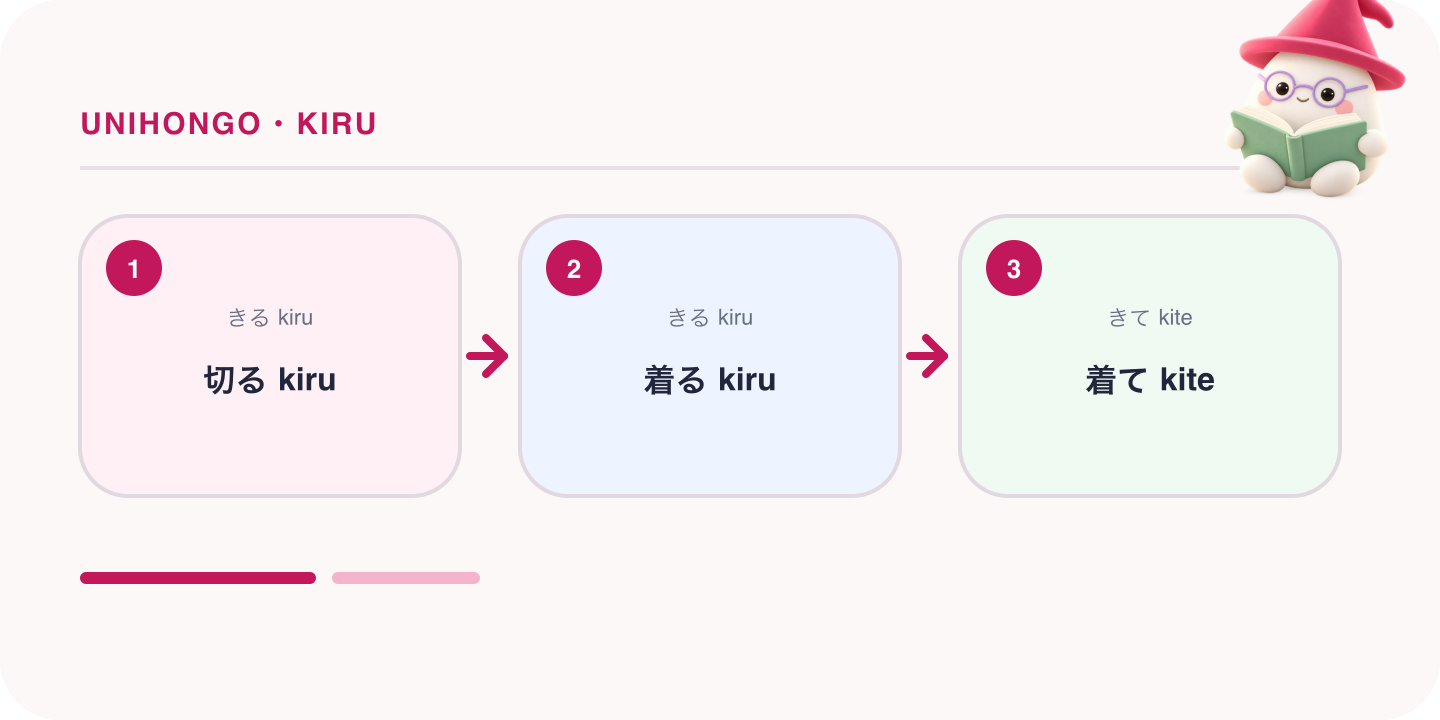
Kiru is godan, and the kiru that means to wear is not
切る kiru is a godan verb whose ru ending makes it look ichidan, so its te-form is kitte with a small tsu and its past is kitta. 着る kiru, meaning to wear, is a genuine ichidan verb and simply drops ru: kimasu, kite, kita, kinai. The two are separated in speech by the te-form and past, and by nothing at all in the -ba conditional, where both give kireba. Context sorts that one out.
Remember also that 着る covers garments worn on the upper body or the whole body, such as a shirt, a jacket or a kimono. Trousers and shoes take haku, hats take kaburu and glasses take kakeru, so kiru is not a general verb for putting clothes on. Keep the two verbs in one drill until kitte and kite come out of your mouth as different sounds.
| Form | 切る kiru (godan, cut) | 着る kiru (ichidan, wear) |
|---|---|---|
| Dictionary | 切る kiru | 着る kiru |
| Polite present | 切ります kirimasu | 着ます kimasu |
| Polite past | 切りました kirimashita | 着ました kimashita |
| Te-form | 切って kitte | 着て kite |
| Plain past | 切った kitta | 着た kita |
| Plain negative | 切らない kiranai | 着ない kinai |
| Potential | 切れる kireru | 着られる kirareru |
| Volitional | 切ろう kirō | 着よう kiyō |
| Conditional | 切れば kireba | 着れば kireba |
The senses of kiru at a glance
| Sense | Collocation | English |
|---|---|---|
| Slice or chop | 野菜を切る yasai o kiru | chop vegetables |
| Cut hair | 髪を切る kami o kiru | have a haircut |
| Trim | 爪を切る tsume o kiru | cut your nails |
| Injure | 指を切る yubi o kiru | cut your finger |
| End a call | 電話を切る denwa o kiru | hang up |
| Switch off | 電源を切る dengen o kiru | turn the power off |
| Stop an appliance | エアコンを切る eakon o kiru | turn the air conditioning off |
| Drain | 水を切る mizu o kiru | drain the water off |
| Shuffle | トランプを切る toranpu o kiru | shuffle the cards |
| Break off ties | 縁を切る en o kiru | cut someone off for good |
| Set a limit | 期限を切る kigen o kiru | put a deadline on it |
| Come in under | 三分を切る sanpun o kiru | get below three minutes |
| Steer | ハンドルを切る handoru o kiru | turn the wheel |
| Get going | スタートを切る sutāto o kiru | make a start |
| Run out of stock | しょうゆを切らす shōyu o kirasu | let the soy sauce run out |
| Betray | 期待を裏切る kitai o uragiru | let someone down |
The last two rows use relatives rather than kiru itself. 切らす kirasu is the causative-flavoured partner used for running out of a supply, and 裏切る uragiru, literally cutting from behind, is the ordinary verb for betraying a person or an expectation.
Cutting things you can hold
This is the sense every course teaches, and the useful grammar around it is the adverb of manner: komakaku kitte kudasai for finely, hanbun ni for in half, mijikaku for short. At a hairdresser, kami o kiru covers both cutting your own hair and having it cut, and the follow-up question you will hear is dono kurai kirimasu ka. Answer with a length or with kono kurai desu while showing with your fingers.
| Japanese | Romaji | Meaning |
|---|---|---|
| 野菜を細かく切ってください。 | Yasai o komakaku kitte kudasai. | Please chop the vegetables finely. |
| 半分に切りましょうか? | Hanbun ni kirimashō ka? | Shall I cut it in half? |
| パンを六枚に切ってもらえますか? | Pan o roku-mai ni kitte moraemasu ka? | Could you slice the bread into six? |
| 髪を短く切りたいです。 | Kami o mijikaku kiritai desu. | I would like my hair cut short. |
| どのくらい切りますか? | Dono kurai kirimasu ka? | How much shall I take off? (stylist) |
| 前髪だけ切ってください。 | Maegami dake kitte kudasai. | Just the fringe, please. |
| 爪を切るのを忘れました。 | Tsume o kiru no o wasuremashita. | I forgot to cut my nails. |
| 指を切ってしまいました。 | Yubi o kitte shimaimashita. | I have cut my finger. |
| このはさみはよく切れます。 | Kono hasami wa yoku kiremasu. | These scissors cut well. |
Hanging up and switching off
Denwa o kiru surprises learners because nothing is being cut in English, but it is the only natural way to say hang up. Announce it before you do it: sorosoro denwa o kirimasu ne, or in a business call shitsurei shimasu followed by silence. The intransitive denwa ga kiremashita is what you say when the call drops, and it is not your fault, so no apology beyond sumimasen is needed.
For machines, dengen o kiru switches something off at the power, and the same verb covers eakon, terebi and a laptop. A light is different: denki o kesu is turn off the light, using kesu, which also covers erasing writing and putting out a fire. Keeping kiru for power and kesu for lights and screens will save you a very common mistake.
| Japanese | Romaji | Meaning |
|---|---|---|
| そろそろ電話を切りますね。 | Sorosoro denwa o kirimasu ne. | I should hang up now. |
| 電話を切らないでください。 | Denwa o kiranaide kudasai. | Please do not hang up. |
| 電話が切れてしまいました。 | Denwa ga kirete shimaimashita. | The call got cut off. |
| すみません、電波が悪くて切れました。 | Sumimasen, denpa ga warukute kiremashita. | Sorry, the signal was bad and we were cut off. |
| 携帯電話の電源をお切りください。 | Keitai denwa no dengen o o-kiri kudasai. | Please switch off your mobile phone. (announcement) |
| パソコンの電源を切ってから帰ります。 | Pasokon no dengen o kitte kara kaerimasu. | I will shut the computer down and then go home. |
| エアコンを切ってもいいですか? | Eakon o kitte mo ii desu ka? | May I turn the air conditioning off? |
| 電気は消してください。 | Denki wa keshite kudasai. | Please turn the lights off. |
| 麺のお湯をよく切ってください。 | Men no o-yu o yoku kitte kudasai. | Drain the noodles well. |
| 水気を切ってから盛り付けます。 | Mizuke o kitte kara moritsukemasu. | Drain it well and then plate it up. |
Cutting a tie, a deadline, or a number
The abstract uses are the ones that make you sound fluent. En o kiru is strong language for ending a relationship permanently, so reserve it for serious contexts. Kigen o kiru means to put a time limit on something and is common in meetings. Crossing a number downwards also takes kiru: sanpun o kiru for a time, sen'en o kiru for a price. Handoru o kiru is the standard way to describe steering, and sutāto o kiru is the fixed phrase for making a start on something.
| Japanese | Romaji | Meaning |
|---|---|---|
| あの人とは縁を切りました。 | Ano hito to wa en o kirimashita. | I have cut ties with that person. |
| 期限を切って進めましょう。 | Kigen o kitte susumemashō. | Let us set a deadline and move ahead. |
| 五分を切りました。 | Go-fun o kirimashita. | We are under five minutes now. |
| 千円を切る値段でした。 | Sen'en o kiru nedan deshita. | The price came in under a thousand yen. |
| ゆっくり右にハンドルを切ってください。 | Yukkuri migi ni handoru o kitte kudasai. | Turn the wheel slowly to the right. |
| カードを切ってください。 | Kādo o kitte kudasai. | Please shuffle the cards. |
| いいスタートを切りました。 | Ii sutāto o kirimashita. | We got off to a good start. |
| 期待を裏切りたくないです。 | Kitai o uragiritaku nai desu. | I do not want to let them down. |
Kireru: when something is cut by itself
切れる kireru is both the potential of kiru and an intransitive verb of its own, so context decides. As an intransitive it says that something has run out, snapped, expired or dropped: a battery, a thread, a call, a visa, a best-before date. It also appears in two idioms worth knowing, iki ga kireru for being out of breath and atama ga kireru for being mentally sharp, which is a compliment. The related 切らす kirasu is what you use for a supply you have allowed to run out.
| Japanese | Romaji | Meaning |
|---|---|---|
| 電池が切れました。 | Denchi ga kiremashita. | The battery has died. |
| ビザの期限が切れています。 | Biza no kigen ga kirete imasu. | The visa has expired. |
| 賞味期限が切れていませんか? | Shōmi kigen ga kirete imasen ka? | Has the best-before date not passed? |
| 糸が切れてしまいました。 | Ito ga kirete shimaimashita. | The thread has snapped. |
| 息が切れました。 | Iki ga kiremashita. | I am out of breath. |
| しょうゆを切らしています。 | Shōyu o kirashite imasu. | We have run out of soy sauce. |
| 在庫が切れています。 | Zaiko ga kirete imasu. | It is out of stock. (staff) |
| あの人は頭が切れます。 | Ano hito wa atama ga kiremasu. | That person has a very sharp mind. |
The ~kiru suffix: doing it to the end
Attach kiru to the masu-stem of another verb and you get the meaning of doing that action completely, to the last drop or the final page. Tabe plus kiru gives tabekiru, tsukai plus kiru gives tsukaikiru. The compound stays godan, so it gives tabekirimasu, tabekitta, tabekitte. The potential negative ~kirenai is even more common in speech and means more than I can manage, which is why tabekiremasen is the polite way to leave food.
| Compound | Romaji | Meaning |
|---|---|---|
| 食べ切る | Tabekiru | eat every last bit |
| 使い切る | Tsukaikiru | use it up completely |
| やり切る | Yarikiru | see a job through to the end |
| 出し切る | Dashikiru | give absolutely everything |
| 走り切る | Hashirikiru | run the whole distance |
| 読み切る | Yomikiru | finish reading it |
| 言い切る | Iikiru | say it outright, state it flatly |
| 疲れ切る | Tsukarekiru | be completely worn out |
| 売り切れる | Urikireru | sell out |
| 食べ切れない | Tabekirenai | more than one can eat |
| 覚え切れない | Oboekirenai | more than one can memorise |
| 数え切れない | Kazoekirenai | too many to count |
| 思い切って | Omoikitte | taking the plunge, decisively |
| 締め切り | Shimekiri | deadline (noun) |
| 貸し切り | Kashikiri | booked out for private use (noun) |
The last three rows show the pattern hardening into fixed words. Omoikitte is an adverb you can drop into any sentence about doing something bold, and shimekiri and kashikiri are ordinary nouns you will read on notices long before you would think to build them yourself.
Saying the compounds out loud
These lines are worth memorising whole, because they solve real moments. Tabekiremasen is how you decline more food without seeming rude; add sumimasen, oishikatta desu ga to soften it. Yarikiritai desu is a strong, natural way to state commitment in an interview or a review. Omoikitte plus a past verb is how Japanese speakers describe a decision that took courage, including speaking to a stranger in a second language.
| Japanese | Romaji | Meaning |
|---|---|---|
| 全部食べ切れますか? | Zenbu tabekiremasu ka? | Can you finish all of it? |
| 多すぎて食べ切れません。 | Ōsugite tabekiremasen. | It is too much for me to finish. |
| ポイントを使い切りました。 | Pointo o tsukaikirimashita. | I have used up all my points. |
| 最後までやり切りたいです。 | Saigo made yarikiritai desu. | I want to see it through to the end. |
| 今日は力を出し切りました。 | Kyō wa chikara o dashikirimashita. | I gave everything I had today. |
| 一晩で読み切りました。 | Hitoban de yomikirimashita. | I finished reading it in one night. |
| できるとは言い切れません。 | Dekiru to wa iikiremasen. | I cannot say for certain that it is possible. |
| 今日は疲れ切っています。 | Kyō wa tsukarekitte imasu. | I am completely worn out today. |
| 数え切れないほどありました。 | Kazoekirenai hodo arimashita. | There were more than you could count. |
| 覚え切れないので書いておきます。 | Oboekirenai node kaite okimasu. | I cannot memorise it all, so I will write it down. |
| 思い切って話しかけました。 | Omoikitte hanashikakemashita. | I took the plunge and spoke to them. |
Signs and staff lines with kire
Because urikire, shimekiri and kashikiri are nouns, they turn up on signs and in fast staff speech where a verb would be too slow. Read them as a set. If you hear sochira wa urikire desu, the item is gone and the natural follow-up is ja, hoka no mono wa arimasu ka. A kashikiri sign on a restaurant door means the place is closed for a private booking that evening.
| Japanese | Romaji | Meaning |
|---|---|---|
| チケットはもう売り切れですか? | Chiketto wa mō urikire desu ka? | Are the tickets already sold out? |
| 申し訳ありません、売り切れました。 | Mōshiwake arimasen, urikiremashita. | I am very sorry, it has sold out. (staff) |
| 本日は貸し切りです。 | Honjitsu wa kashikiri desu. | The venue is booked privately today. (sign) |
| 締め切りはいつですか? | Shimekiri wa itsu desu ka? | When is the deadline? |
| 締め切りに間に合いませんでした。 | Shimekiri ni maniaimasen deshita. | I did not make the deadline. |
| では、他の物はありますか? | Dewa, hoka no mono wa arimasu ka? | In that case, do you have anything else? |
Mistakes to fix out loud
- Saying kirimashita for wearing something; that is kimashita, from the ichidan verb 着る.
- Producing kiite or kite for the te-form of cut; it is kitte with a small tsu, because kiru is godan.
- Using denki o kirimasu for a light switch; say denki o keshimasu, and keep dengen o kirimasu for devices.
- Translating hang up literally with a phrase about a receiver; denwa o kirimasu is the whole expression.
- Confusing denwa o kirimashita, which you did on purpose, with denwa ga kiremashita, which happened to you.
- Attaching ~kiru to a dictionary form; it joins the masu-stem, so it is tabekiru and tsukaikiru, never taberukiru.