
Practice Japanese Counters With Mocchi in Small Situations

Practice Japanese counters by choosing a clear object and a small quantity before learning the spoken form. Ask Mocchi to build a short situation around the expression, then check counter choice and pronunciation as separate steps.

Mocchi groups a few Japanese objects by shape and purpose before selecting a counter and quantity
What you need to know

Practice Japanese Counters With Mocchi in Small Situations

A large counter chart can hide several decisions: which counter fits the item, which number you need, and how the complete expression is read. Begin with familiar objects such as sheets of paper or books, and practice a useful request. Some readings involve sound changes, so verify the whole expression rather than assuming that a number and a counter always join mechanically. A focused lesson gives you something you can actually say and a clear way to diagnose mistakes.

Identify the item before selecting its counter.

Use a small range of quantities at first.

Check the reading of the complete expression.

Practice the expression in a short request or description.

Break the problem into item, quantity, and reading

Before answering, identify what is being counted. Then choose the quantity and check the full expression. Tell Mocchi which step feels difficult. If you select the right counter but cannot pronounce the combination, you need different practice from someone choosing a counter for the wrong kind of object. Separating the steps makes a small lesson easier to target.

Keep the first items concrete. A sheet of paper, a book, or a person is easier to picture than an abstract event count. Once the familiar expressions are available, add other situations gradually instead of trying to memorize every category in a single sitting.

Put a quantity into a useful request

紙を三枚ください asks for three sheets of paper. The request gives the counter a practical purpose and lets you practice the whole number expression. Compare it with another familiar item and counter, then ask Mocchi to check both the selection and reading. Do not use one successful example as a rule for every object that happens to look similar.
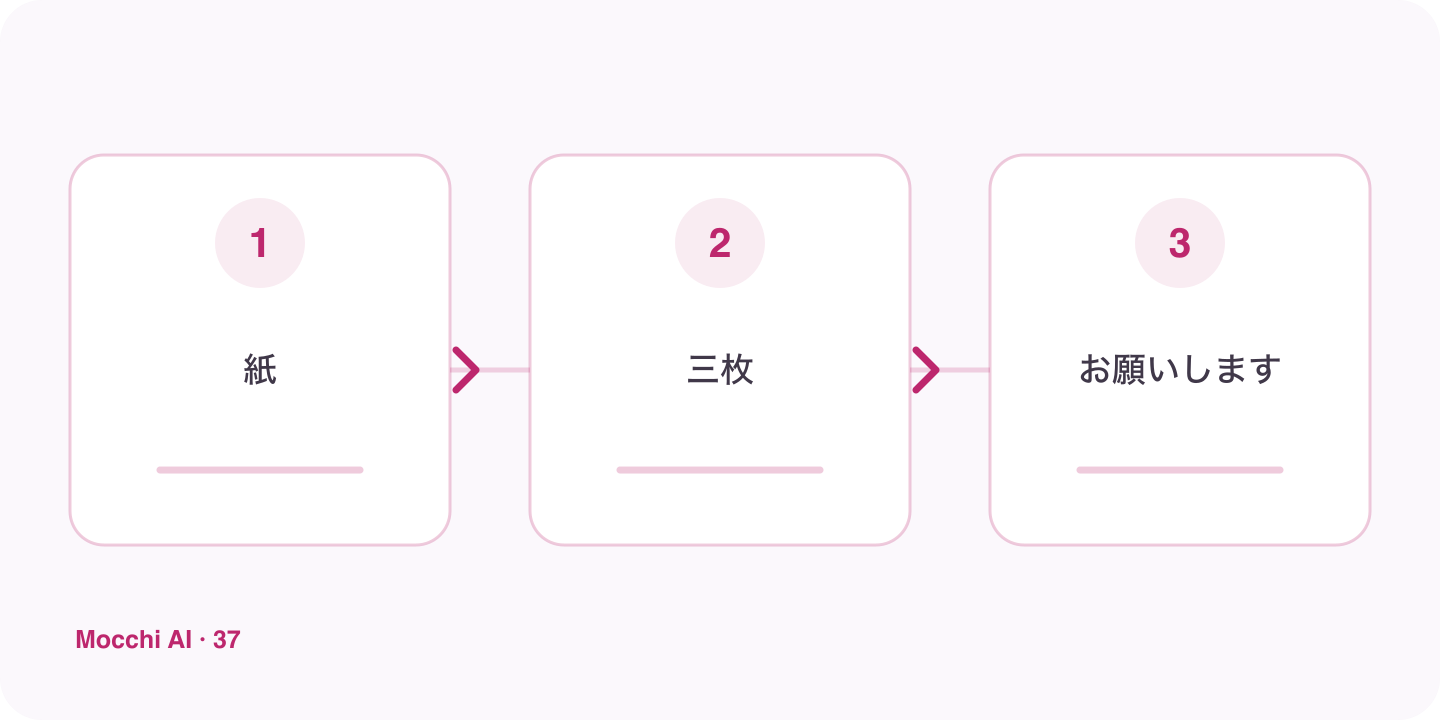
An object category leads to a counter, a quantity, and a short request using the complete expression
Choose what is being counted first, then check the reading of the complete number-and-counter expression.
JapaneseRomajiMeaning
紙を三枚ください。Kami o san-mai kudasai.Please give me three sheets of paper.
本を二冊買いました。Hon o ni-satsu kaimashita.I bought two books.

Learn sound changes in the complete expression

When a number phrase has a sound change, practice that complete phrase slowly and then inside its sentence. Ask for the reading rather than guessing from the separate parts. If you can read the written quantity but hesitate aloud, use a short pronunciation or recall activity. This gives the difficult sound sequence attention without requiring you to add more counter categories immediately.

Mix a few situations instead of one announced category

After practicing one counter, ask for a small mixed set with familiar items. Read the situation and choose the counter before the tutor shows it. If every question announces the category, part of the decision has already been made for you. A mixed set checks whether the item itself now supplies the relevant clue.

Keep the review focused on the actual error

Record whether you missed the category, the quantity, the reading, or the sentence structure. Bring that specific issue back to Mocchi for a fresh example. The goal is an expression you can retrieve in a meaningful situation, not a chart you recognize only when it is open. Use a trusted dictionary or learning reference to check an unfamiliar reading when the answer remains uncertain.

Key points

A practical way to improve

Choose three familiar items you might count in an everyday task. Ask Mocchi which counter fits each, then practice only a few quantities. Make a short request using one expression and check its reading. At a later session, mix the items so you must choose the counter from the situation before producing the number phrase. Keep a separate note if the counter is right but the sound change is difficult.

  1. 1

    Choose one clear goal

    Focus each session on a situation or skill you can actually use.

  2. 2

    Practice actively

    Say complete answers aloud instead of only reading or recognizing Japanese.

  3. 3

    Review and repeat

    Keep useful corrections and revisit the same skill until it feels natural.

FAQ

Frequently asked questions

Can I always join the usual number reading to the counter?

No. Some combinations have reading changes. Check the complete expression and practice it as a unit rather than assuming that the separate parts always retain their isolated sounds.

Should I learn every counter before using Japanese?

No. Begin with counters relevant to your current situations and expand as needed. You can ask for clarification or a useful alternative when you encounter an unfamiliar item.

What if the same object can be counted in different ways?

Context and what aspect of the item is being counted can matter. Ask about the intended situation rather than treating a beginner example as the only possible expression in every setting.

Count something you can picture

Use Mocchi to connect an object, a quantity, and a complete expression instead of starting with a huge table.