
The names you will see first
Wagashi is written with wa (和), Japan, and kashi (菓子), confectionery. Its opposite is yōgashi (洋菓子), Western sweets such as sponge cake and cream puffs. A department store food floor keeps the two in separate zones, and the wagashi side is where these names appear.
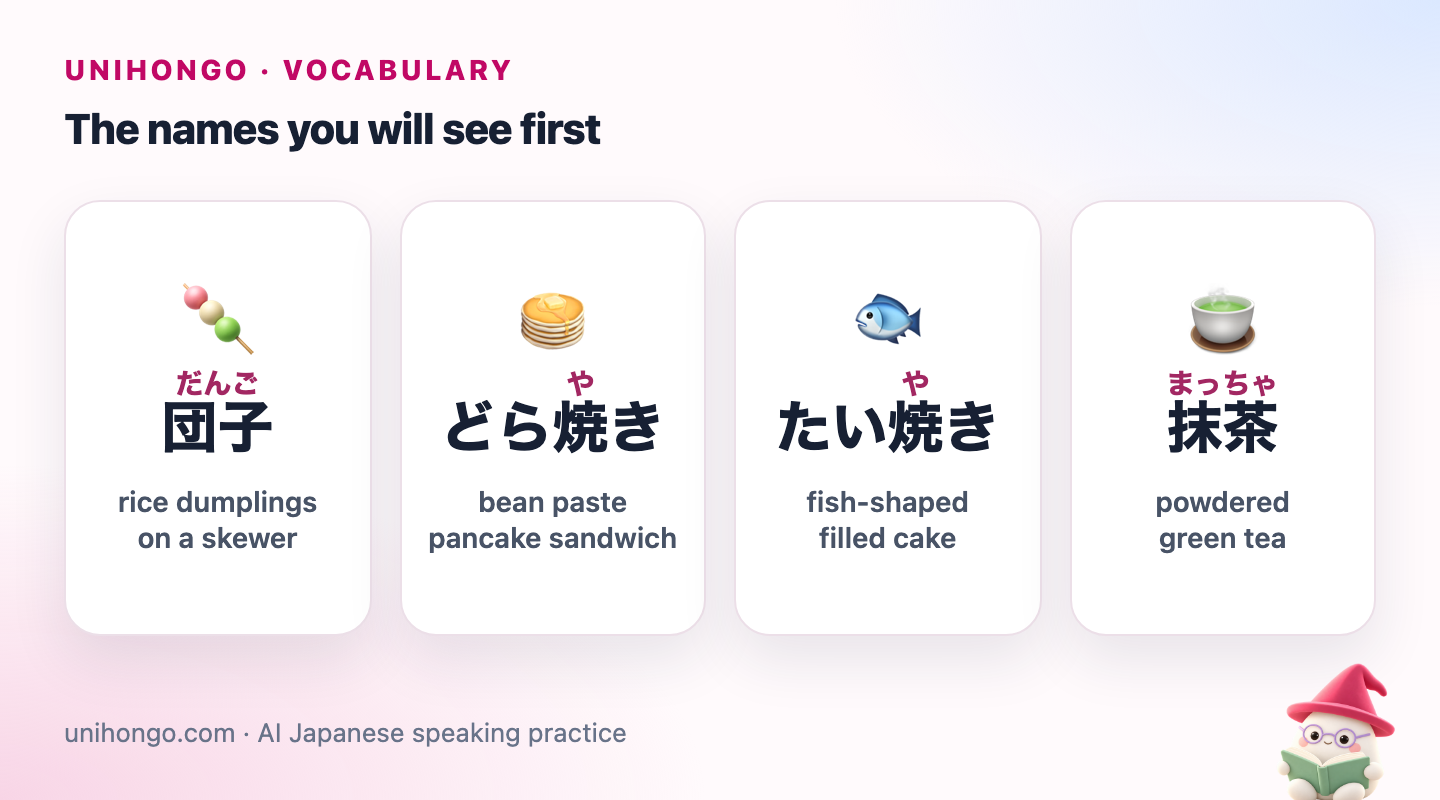
| Japanese | Romaji | Meaning |
|---|---|---|
| 団子 | dango | rice dumplings on a skewer |
| どら焼き | dorayaki | bean paste pancake sandwich |
| たい焼き | taiyaki | fish-shaped filled cake |
| 抹茶 | matcha | powdered green tea |
| 大福 | daifuku | soft rice cake filled with bean paste |
| 羊羹 | yōkan | firm sweet bean jelly |
| 最中 | monaka | crisp wafers filled with bean paste |
| 饅頭 | manjū | steamed bun with bean paste |
| わらび餅 | warabimochi | soft jelly-like cake dusted with kinako |
Shops often write the harder names in hiragana: ようかん, もなか, まんじゅう. Learn the sound first and either spelling will make sense.
Anko: tsubuan or koshian
Almost every sweet above contains anko (あんこ), a paste of azuki beans boiled with sugar. The label will say, or the clerk will ask, which kind you want. Tsubuan (つぶあん) keeps the beans partly whole, so it has skins and texture. Koshian (こしあん) is pressed through a sieve until smooth. People have firm preferences, and asking which one someone likes is reliable small talk.
Kinako (きなこ) is the other flavour to know: roasted soybean flour, tan, nutty and dry. It coats warabimochi and some dango, and usually comes with kuromitsu, a dark sugar syrup, to pour over.
| Japanese | Romaji | Meaning |
|---|---|---|
| あんこ | anko | sweet red bean paste |
| つぶあん | tsubuan | chunky bean paste |
| こしあん | koshian | smooth bean paste |
| 白あん | shiroan | white bean paste |
| きなこ | kinako | roasted soybean flour |
| 黒蜜 | kuromitsu | dark sugar syrup |
| つぶあんとこしあん、どちらが好きですか。 | Tsubuan to koshian, dochira ga suki desu ka. | Which do you like, chunky or smooth bean paste? |
Dango, daifuku and other soft rice sweets
Dango (団子) are small balls of rice-flour dough, usually three or four on a bamboo skewer. Mitarashi dango are grilled and glazed with a sweet soy sauce syrup. Sanshoku dango, three-colour dango in pink, white and green, are linked with cherry blossom viewing. Because they come on a stick, dango are counted with hon: ippon, nihon, sanbon.
Daifuku (大福) is a soft round of mochi, pounded rice cake, wrapped around anko; ichigo daifuku hides a whole strawberry inside. Warabimochi (わらび餅) is not really mochi: it is a cool, wobbly sweet made from starch, eaten in summer under a heap of kinako.
| Japanese | Romaji | Meaning |
|---|---|---|
| みたらし団子 | mitarashi dango | dango with sweet soy glaze |
| 三色団子 | sanshoku dango | three-colour dango |
| いちご大福 | ichigo daifuku | daifuku with a whole strawberry |
| みたらしを二本ください。 | Mitarashi o nihon kudasai. | Two mitarashi skewers, please. |
Baked, steamed and set: five more shapes
| Romaji | Outside | Inside | Good to know |
|---|---|---|---|
| dorayaki | Two small round pancakes | Anko, usually tsubuan | Sold wrapped one by one and easy to carry |
| taiyaki | Crisp cake shaped like a sea bream | Anko or custard | Sold hot from stalls; eat it at once |
| manjū | Soft steamed bun of wheat dough | Anko, often koshian | The classic souvenir of hot spring towns |
| monaka | Two thin crisp wafers made from rice | Anko, sometimes with chestnut | The wafer softens with time |
| yōkan | No shell: a firm block | Anko set with agar | Keeps well; sliced and served with tea |
Dorayaki is famous as the favourite food of Doraemon, the robot cat of manga and anime. The tai in taiyaki is sea bream, a fish linked with celebrations; the cake contains no fish at all.
Seasonal sweets: sakuramochi and kashiwamochi
Wagashi follow the calendar closely, and two sweets mark spring. Sakuramochi (桜餅) is pink rice cake around anko, wrapped in a salted cherry leaf, sold around the Doll Festival on 3 March and through blossom season. It comes in two styles: a thin crepe rolled around the filling, associated with Tokyo, and a ball of coarse, sticky rice, associated with Kansai. The leaf is edible, and whether to eat it is a matter of taste.
Kashiwamochi (柏餅) is white rice cake folded over anko and wrapped in an oak leaf, eaten for Children's Day on 5 May. This leaf is not eaten. Outside those weeks both sweets largely disappear, which is the point: a wagashi counter tells you the month.
| Japanese | Romaji | Meaning |
|---|---|---|
| 桜餅 | sakuramochi | cherry leaf rice cake |
| 柏餅 | kashiwamochi | oak leaf rice cake |
| 季節限定 | kisetsu gentei | available this season only |
| 季節のお菓子はどれですか。 | Kisetsu no o-kashi wa dore desu ka. | Which are the seasonal sweets? |
With matcha: sweet first, then tea
Wagashi are made to be eaten with green tea, and above all with matcha (抹茶), powdered green tea whisked with hot water. In the tea ceremony the sweet is eaten first and the tea follows, so that the sweetness left in the mouth meets the bitterness of the tea. Tea rooms at temples and gardens sell the pair as a set, and one sentence orders it.
| Japanese | Romaji | Meaning |
|---|---|---|
| 抹茶セットを一つお願いします。 | Matcha setto o hitotsu onegai shimasu. | One matcha set, please. |
| お菓子はどれになさいますか。 | O-kashi wa dore ni nasaimasu ka. | Which sweet would you like? |
| これでお願いします。 | Kore de onegai shimasu. | This one, please. |
Buying at a wagashi shop
Shop sweets are sold by the piece from a glass counter, so pointing works, and hitotsu zutsu (一つずつ), one of each, saves you from repeating the number. The question that matters is how long the sweet lasts. Fresh sweets such as daifuku and sakuramochi often need to be eaten the same day, and the clerk will say honjitsu-chū, within today. Dry and baked sweets last longer. The date on the label is the shōmi kigen (賞味期限), the best-before date.
| Japanese | Romaji | Meaning |
|---|---|---|
| これとこれを一つずつください。 | Kore to kore o hitotsu zutsu kudasai. | One each of this and this, please. |
| 日持ちしますか。 | Himochi shimasu ka. | Does it keep? |
| 賞味期限はいつまでですか。 | Shōmi kigen wa itsu made desu ka. | When is the best-before date? |
| 本日中にお召し上がりください。 | Honjitsu-chū ni o-meshiagari kudasai. | Please eat it today. |
| お土産なので、箱に入れてもらえますか。 | Omiyage na no de, hako ni irete moraemasu ka. | It is a gift, so could you put it in a box? |