
Three ways to say which one
Cardinal numbers and counters are covered in the numbers and counters guide, so this post assumes you can already say ichi, ni, san and attach basic counters. What changes here is that you are pointing at a position. Japanese has three devices for that, and they are not interchangeable. Banme is the general position marker, dai is the formal label placed in front, and me is a small ending that converts an existing counter into an ordinal.
The safest habit is to decide what you are counting first. If you are counting bare numbers in a row, use banme. If the thing already has a natural counter such as tsu, nin, kai or ka, put me on that counter instead. If you are naming a chapter, edition, round or article in a formal document, reach for dai.
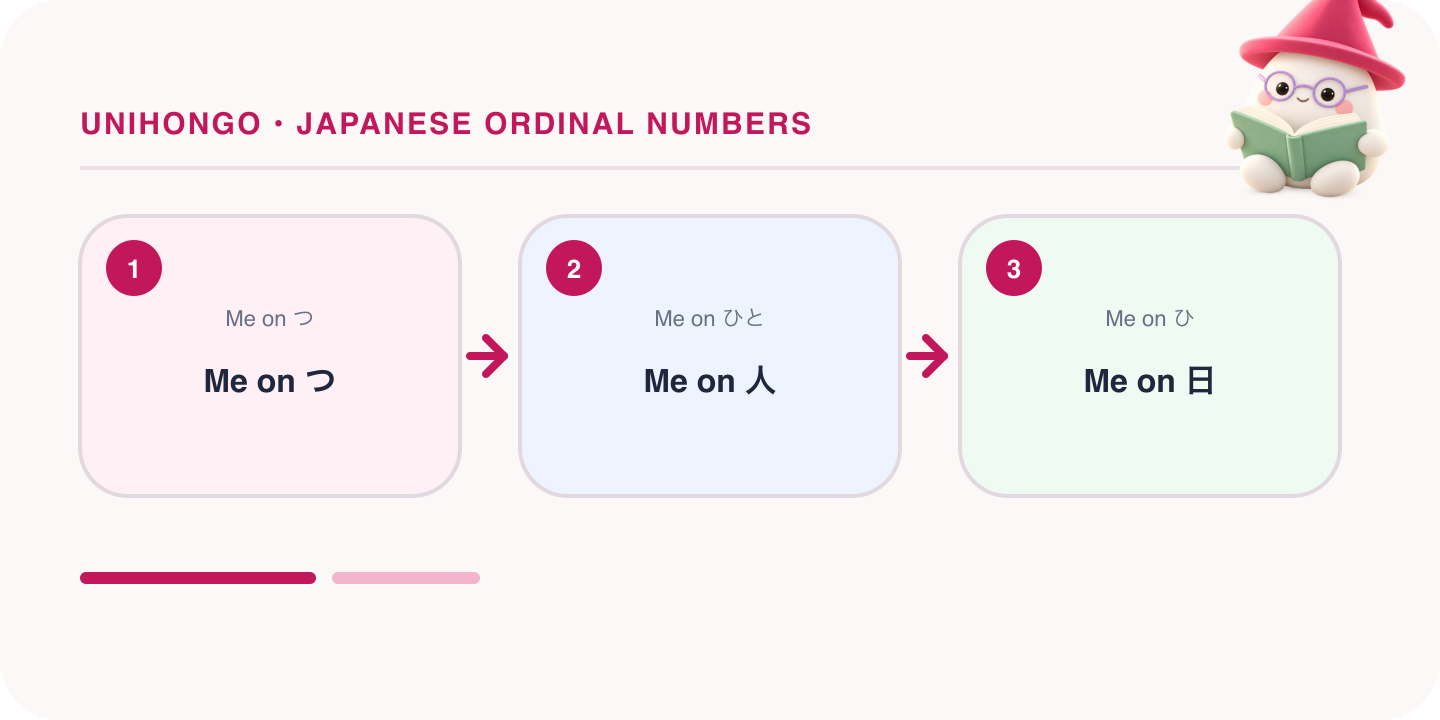
| Formation | Shape | Example | Meaning |
|---|---|---|---|
| Banme | Number + 番目 | 三番目 sanbanme | The third one in a row |
| Dai | 第 + number | 第三章 dai-sanshō | Chapter three |
| Me on つ | Counter + 目 | 二つ目 futatsume | The second one |
| Me on 人 | Counter + 目 | 三人目 sanninme | The third person |
| Me on 日 | Counter + 目 | 三日目 mikkame | The third day |
| Me on 回 | Counter + 目 | 一回目 ikkaime | The first time |
| Me on 本 | Counter + 目 | 一本目 ipponme | The first one (long object) |
| Me on 年 | Counter + 目 | 二年目 ninenme | The second year |
Ichiban and ichibanme are not the same word
Ichiban is one of the first words learners meet, usually as a superlative: ichiban takai means the most expensive, and ichiban suki na tabemono means my favourite food. In that use ichiban behaves like an adverb and takes no me. The moment you add me, the meaning changes to a place in a sequence, so ichibanme no hito is the person at the front of the line rather than the best person.
The same split runs through the whole set. Niban is often a label, as on a numbered ticket or a platform, while nibanme is the second item you counted. When a learner says nibanme no purattohōmu for platform two, a Japanese listener hears the second platform you happened to count from where you are standing, which is not what the sign says.
| Japanese | Romaji | Meaning |
|---|---|---|
| これが一番おいしいです。 | Kore ga ichiban oishii desu. | This one is the tastiest. |
| 右から一番目の人です。 | Migi kara ichibanme no hito desu. | It is the first person from the right. |
| 左から二番目の建物です。 | Hidari kara nibanme no tatemono desu. | It is the second building from the left. |
| 上から三番目の棚にあります。 | Ue kara sanbanme no tana ni arimasu. | It is on the third shelf from the top. |
| 前から四番目に座っています。 | Mae kara yonbanme ni suwatte imasu. | I am sitting fourth from the front. |
| 何番目ですか。 | Nanbanme desu ka. | Which one in the order is it? |
Banme with plain numbers
Banme attaches to the Sino-Japanese numbers, so it is ichibanme, nibanme, sanbanme, yonbanme, gobanme, rokubanme, nanabanme, hachibanme, kyūbanme, jūbanme. There are no sound changes to memorise, which is why banme is the ordinal to fall back on when you are unsure of the correct counter. It works with people, buildings, shelves, questions on a test and items on a menu.
In speech banme very often ends with no plus a noun, because you are usually pointing at something: sanbanme no mise, the third shop along. When the noun is already obvious from the situation you can drop it and simply finish with desu, which is why a shop assistant can answer a question with nibanme desu and nothing else. Banme also combines with ni to modify a verb, as in sanbanme ni hairimashita, I went in third.
| Japanese | Romaji | Meaning |
|---|---|---|
| 三番目の店に入りましょう。 | Sanbanme no mise ni hairimashō. | Let us go into the third shop. |
| 五番目の質問が難しかったです。 | Gobanme no shitsumon ga muzukashikatta desu. | The fifth question was difficult. |
| 列の七番目に並んでいます。 | Retsu no nanabanme ni narande imasu. | I am seventh in the queue. |
| 下から二番目でした。 | Shita kara nibanme deshita. | It was second from the bottom. |
| 一番目と三番目をお願いします。 | Ichibanme to sanbanme o onegai shimasu. | The first one and the third one, please. |
| 後ろから何番目ですか。 | Ushiro kara nanbanme desu ka. | How many back from the end is it? |
Me on a counter is the everyday ordinal
When the thing you are counting already has a counter, adding me is more natural than banme. Futatsu no kado sounds like two corners, while futatsume no kado is the second corner, and only the second version works for directions. The counter keeps whatever sound changes it normally has, so ikkai becomes ikkaime, hassatsu becomes hassatsume, and mikka becomes mikkame rather than a rebuilt regular form.
This is the ordinal you will hear most in ordinary conversation, because it carries the shape of the thing along with the position. Ninme counts people, kome counts small objects, maime counts flat things, honme counts long things, kenme counts buildings on a night out, and kaime counts attempts. Learners who only know banme end up sounding stiff.
| Japanese | Romaji | Meaning |
|---|---|---|
| 二つ目の角で待っています。 | Futatsume no kado de matte imasu. | I am waiting at the second corner. |
| 三人目のお客さんです。 | Sanninme no okyakusan desu. | This is the third customer. |
| 日本に来て三日目です。 | Nihon ni kite mikkame desu. | It is my third day in Japan. |
| これで二回目です。 | Kore de nikaime desu. | This is the second time. |
| 一本目の電車に乗りました。 | Ipponme no densha ni norimashita. | I took the first train. |
| 二枚目の紙を見てください。 | Nimaime no kami o mite kudasai. | Please look at the second sheet. |
| 二軒目はどうしますか。 | Nikenme wa dō shimasu ka. | What shall we do about the second place? |
| 四個目のたこ焼きです。 | Yonkome no takoyaki desu. | This is the fourth takoyaki. |
A reply you will hear a lot is Mō ikkaime desu ka, meaning is that already the second time, or Sore ga saisho desu, that is the first one. Notice that saisho and saigo, first and last, replace ordinals entirely at the two ends of a sequence, and they are often the more natural choice than ichibanme and the final number.
Dai for editions, chapters and formal series
Dai is written 第 and goes in front of the number. It labels a unit inside an organised system: lessons, chapters, articles of a contract, editions of an event, and the numbered wars and conferences of history. It is a written and formal register, so you see it far more than you say it, but it appears in spoken announcements at ceremonies and in the classroom.
The number after dai takes its normal Sino-Japanese reading with the usual gemination, so 第一課 is dai-ikka, 第八回 is dai-hakkai and 第十回 is dai-jukkai. Some fixed expressions have dropped the numeral feel entirely: daiichi inshō is a first impression, and daiichi ni is firstly when you are listing reasons.
| Japanese | Romaji | Meaning |
|---|---|---|
| 第一課を開いてください。 | Dai-ikka o hiraite kudasai. | Please open lesson one. |
| 第三章を読みました。 | Dai-sanshō o yomimashita. | I read chapter three. |
| 第五回の大会に出ます。 | Dai-gokai no taikai ni demasu. | I am taking part in the fifth tournament. |
| 第一印象がとても良かったです。 | Daiichi inshō ga totemo yokatta desu. | My first impression was very good. |
| 第一に、時間がありません。 | Daiichi ni, jikan ga arimasen. | Firstly, there is no time. |
| 第二次世界大戦について習いました。 | Dai-niji sekai taisen ni tsuite naraimashita. | We learned about the Second World War. |
Giving directions by corners and lights
Street directions in Japan are built almost entirely out of me ordinals, because addresses rarely help a pedestrian. The pattern is a counted landmark, then no, then the landmark noun, then the turn. Practise the four landmarks below until they arrive without thinking, and pair each one with migi ni or hidari ni magatte kudasai.
| Japanese | Romaji | Meaning |
|---|---|---|
| 一つ目の角を右に曲がってください。 | Hitotsume no kado o migi ni magatte kudasai. | Please turn right at the first corner. |
| 二つ目の信号を左に曲がります。 | Futatsume no shingō o hidari ni magarimasu. | Turn left at the second traffic light. |
| 三本目の通りをまっすぐ行ってください。 | Sanbonme no tōri o massugu itte kudasai. | Please go straight along the third street. |
| 二つ目の駅で降りてください。 | Futatsume no eki de orite kudasai. | Please get off at the second station. |
| いくつ目の角ですか。 | Ikutsume no kado desu ka. | Which corner is it? |
| 三つ目です。信号のところです。 | Mittsume desu. Shingō no tokoro desu. | The third one. It is at the traffic light. |
| Landmark | Japanese | Romaji | In a direction |
|---|---|---|---|
| Corner | 角 | kado | 二つ目の角 futatsume no kado |
| Traffic light | 信号 | shingō | 三つ目の信号 mittsume no shingō |
| Crossroads | 交差点 | kōsaten | 一つ目の交差点 hitotsume no kōsaten |
| Street | 通り | tōri | 二本目の通り nihonme no tōri |
| Building | ビル | biru | 三軒目のビル sangenme no biru |
| Station | 駅 | eki | 二つ目の駅 futatsume no eki |
| Stop | バス停 | basutei | 四つ目のバス停 yottsume no basutei |
| End of the road | 突き当たり | tsukiatari | 突き当たりを右 tsukiatari o migi |
Ikutsume desu ka is the question you should be ready to answer, and it is also the question to ask when someone gives you directions too fast. The asking-for-directions guide covers the wider conversation; here the goal is simply that the counted landmark comes out correctly.
Floors, exits and numbered signs
Floors use the counter kai, which has its own sound changes: ikkai, nikai, sangai, yonkai, gokai, rokkai, nanakai, hachikai, kyūkai and jukkai, with nangai as the question. Basements take chika in front, so chika ikkai is the first basement level. Floors are usually plain numbers rather than ordinals, because the number is the floor's name, not its position in something you counted.
The same is true of platforms, exits, carriages and counter windows. Sanbansen is platform three, niban deguchi is exit two, and gobanguchi is window five. Only add me when you genuinely counted along a row yourself, as in ue kara sanbanme no hikidashi, the third drawer from the top.
| Japanese | Romaji | Meaning |
|---|---|---|
| 三階のレストランに行きます。 | Sangai no resutoran ni ikimasu. | I am going to the restaurant on the third floor. |
| 地下一階に本屋があります。 | Chika ikkai ni honya ga arimasu. | There is a bookshop on the first basement floor. |
| 何階ですか。 | Nangai desu ka. | Which floor is it? |
| 十階でエレベーターを降ります。 | Jukkai de erebētā o orimasu. | I get out of the lift on the tenth floor. |
| 三番線から出発します。 | Sanbansen kara shuppatsu shimasu. | It departs from platform three. |
| 二番出口で会いましょう。 | Niban deguchi de aimashō. | Let us meet at exit two. |
| 上から三番目の引き出しです。 | Ue kara sanbanme no hikidashi desu. | It is the third drawer from the top. |
Rankings, results and finishing order
Results use the counter i, written 位, so first place is ichi-i, second is ni-i and third is san-i. It takes ni naru to say you came somewhere, and it combines with inai to mean within the top so many. Banme is possible but sounds like a description of a list rather than a result, so prefer i when there is a competition.
| Japanese | Romaji | Meaning |
|---|---|---|
| 一位になりました。 | Ichi-i ni narimashita. | I came first. |
| 二位でした。悔しいです。 | Ni-i deshita. Kuyashii desu. | I came second. I am frustrated. |
| 三位以内に入りたいです。 | San-i inai ni hairitai desu. | I want to finish in the top three. |
| 何位でしたか。 | Nan-i deshita ka. | What position did you come? |
| クラスで五番目に速いです。 | Kurasu de gobanme ni hayai desu. | I am the fifth fastest in the class. |
| 日本で二番目に大きい湖です。 | Nihon de nibanme ni ōkii mizuumi desu. | It is the second largest lake in Japan. |
The last two rows show a pattern worth copying: nibanme ni plus an adjective means the second most something. It is built directly on ichiban plus an adjective, which is the ordinary superlative, so the pair ichiban ōkii and nibanme ni ōkii are easy to drill together.
Days, years and anniversaries
For a stretch of time you are living through, the ordinal is me on the time counter. Nihon ni kite ninenme desu means this is my second year since coming to Japan, and it implies the year is still running. That is different from ninenkan, which is a finished span of two years. Learners often say ninen imasu when they mean ninenme desu, and the nuance of ongoing progress is lost.
Anniversaries use shūnen, so kekkon jusshūnen is a tenth wedding anniversary and sōritsu gojusshūnen is a fiftieth founding anniversary. The dates and calendar guide covers the days of the month themselves; what matters here is that mikkame counts days inside a trip while mikka names the third of the month.
| Japanese | Romaji | Meaning |
|---|---|---|
| 旅行の四日目です。 | Ryokō no yokkame desu. | It is the fourth day of the trip. |
| 入社二年目です。 | Nyūsha ninenme desu. | I am in my second year at the company. |
| 日本語を勉強して三年目です。 | Nihongo o benkyō shite sannenme desu. | This is my third year studying Japanese. |
| 結婚十周年をお祝いしました。 | Kekkon jusshūnen o oiwai shimashita. | We celebrated our tenth wedding anniversary. |
| 創立五十周年の記念日です。 | Sōritsu gojusshūnen no kinenbi desu. | It is the fiftieth anniversary of the founding. |
| 一週間目はとても大変でした。 | Isshūkanme wa totemo taihen deshita. | The first week was very hard. |
Asking and answering about position
Three questions cover almost everything: nanbanme desu ka for a plain sequence, ikutsume desu ka when a tsu counter is natural, and nankaime desu ka for attempts. Each one is answered by repeating the counter, which makes them ideal drill pairs. Practise them as short exchanges rather than as single lines, because the answer is where the sound changes bite.
| Japanese | Romaji | Meaning |
|---|---|---|
| これは何回目のチャレンジですか。 | Kore wa nankaime no charenji desu ka. | How many times have you tried this now? |
| 三回目です。今度は大丈夫だと思います。 | Sankaime desu. Kondo wa daijōbu da to omoimasu. | This is the third time. I think it will be fine now. |
| いくつ目のドアですか。 | Ikutsume no doa desu ka. | Which door is it? |
| 一つ目です。手前のドアです。 | Hitotsume desu. Temae no doa desu. | The first one. The nearer door. |
| 何人目のお客さんですか。 | Nanninme no okyakusan desu ka. | Which number customer is this? |
| 十人目です。今日は忙しいです。 | Jūninme desu. Kyō wa isogashii desu. | The tenth. We are busy today. |
| 何番目に発表しますか。 | Nanbanme ni happyō shimasu ka. | Where in the order do you present? |
| 最後から二番目です。 | Saigo kara nibanme desu. | Second from last. |
How to drill ordinals until they are automatic
- Take one counter a day and say its first five ordinals aloud: ikkaime, nikaime, sankaime, yonkaime, gokaime.
- Describe the objects on your desk from the left, forcing yourself to use hidari kara plus banme each time.
- Narrate a route you walk often, one me ordinal per sentence, and time yourself to keep it fluent.
- Read a table of contents aloud with dai in front of every chapter number to fix the gemination.
- Whenever you say a superlative with ichiban, immediately say the nibanme ni version of the same sentence.
- Record the questions nanbanme desu ka, ikutsume desu ka and nankaime desu ka, then answer them cold the next day.