
Four food names Japanese owners love
These four come up again and again when Japanese people talk about food names for pets. They are all traditional ingredients, they are all short, and each one points to a colour: white, pale brown, red-brown and speckled black-and-white.
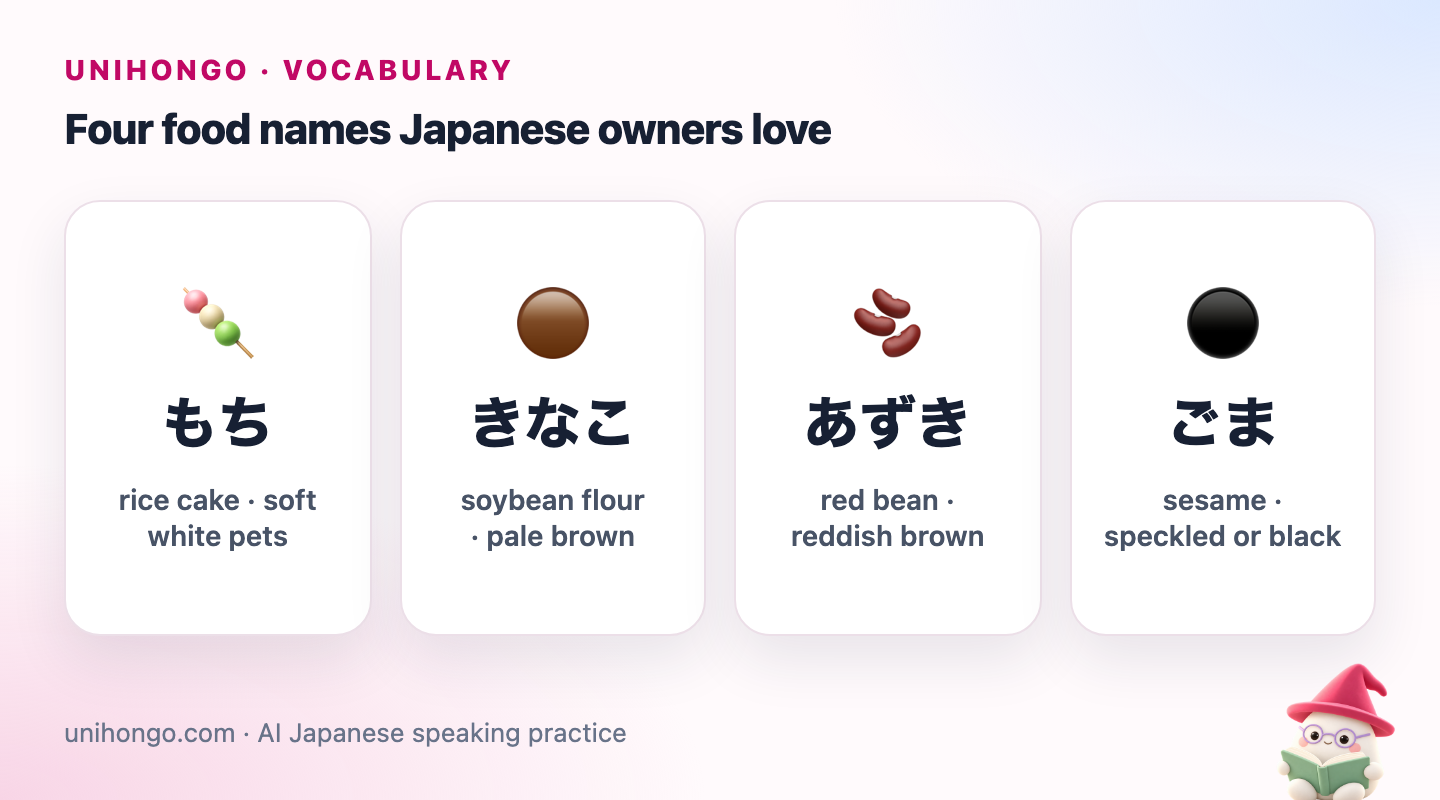
| Japanese | Romaji | Meaning |
|---|---|---|
| もち | Mochi | rice cake · soft white pets |
| きなこ | Kinako | soybean flour · pale brown |
| あずき | Azuki | red bean · reddish brown |
| ごま | Goma | sesame · speckled or black |
Many owners add the polite o- to mochi and say Omochi (おもち), which sounds even softer. Unihongo's study assistant Mocchi is named after mochi too, and is drawn as exactly what a pet called Omochi suggests: round, white and soft. Goma works for black cats (kurogoma, black sesame) and for white pets with dark specks.
Sweet names from wagashi
Wagashi (和菓子) are traditional Japanese sweets, and their names make some of the cosiest pet names. Each one has a clear shape and colour, so the name often fits the pet's look as well as its personality.
| Japanese | Romaji | Meaning |
|---|---|---|
| だいふく | Daifuku | mochi filled with bean paste · round pets |
| おはぎ | Ohagi | rice ball in red bean paste · dark brown |
| もなか | Monaka | wafer filled with bean paste · beige |
| わらび | Warabi | from warabimochi, jelly-like sweet · light |
| みたらし | Mitarashi | glazed dango · golden brown |
| だんご | Dango | rice dumplings on a stick · round |
| しらたま | Shiratama | small white rice dumplings · white |
Daifuku also contains the kanji for great luck, 大福, which makes it a doubly happy name. Mitarashi, from the sweet soy glaze on mitarashi dango, is a lovely name for a golden-brown dog. Shiratama, small white dumplings, suits a tiny white kitten or a hamster.
Staples and snacks
Everyday ingredients make friendly, slightly comic names. They sound homely, and Japanese people tend to find them charming on a pet.
| Japanese | Romaji | Meaning |
|---|---|---|
| こむぎ | Komugi | wheat · light golden coats |
| むぎ | Mugi | barley, grain · golden brown |
| のり | Nori | seaweed · black pets |
| おこげ | Okoge | crispy browned rice · dark patches |
| ちくわ | Chikuwa | fish-paste tube · long pets |
| おかか | Okaka | bonito flakes · light brown |
| おもち | Omochi | rice cake (polite o-) · white |
| あんこ | Anko | sweet red bean paste · dark brown |
| たまご | Tamago | egg · white or yellow pets |
Komugi and Mugi are names you will hear often for cats and dogs with wheat-coloured coats. Chikuwa, a tube-shaped fish cake, is a joke name usually given to long dogs such as dachshunds. Okoge, the crispy rice at the bottom of the pot, suits a pet with dark, toasty patches.
Many of these names are written in hiragana because the foods themselves are usually written that way, or in katakana on pet tags. Some, like okaka and okoge, start with an o- that sounds polite and homely, which is part of their charm. If you choose one, practise the short vowels: chi-ku-wa, o-ka-ka, with no stretched sounds.
Fruits, drinks and the sushi question
Fruit and nut names are gentle and bright, and several, like Yuzu, Kurumi and Momo, are also human girls' names, so they feel affectionate. Drink and dessert names from other languages, written in katakana, are popular for dogs with brown coats.
| Japanese | Romaji | Meaning |
|---|---|---|
| ゆず | Yuzu | yuzu citrus · yellowish or cheerful pets |
| みかん | Mikan | mandarin orange · orange coats |
| くるみ | Kurumi | walnut · brown |
| くり | Kuri | chestnut · brown |
| マロン | Maron | marron, chestnut · brown dogs |
| ココア | Kokoa | cocoa · chocolate brown |
| いくら | Ikura | salmon roe · orange |
| うに | Uni | sea urchin · spiky or orange pets |
And sushi? A pet called Sushi makes Japanese people smile, and that is part of the fun. It sounds a little like calling a dog Sandwich in English, because sushi is a whole dish rather than one ingredient. Japanese owners more often reach for a single topping, such as Ikura or Uni, or for a sweet. If you love the name Sushi, use it; just expect a laugh when you say it.
Matching a food name to a coat
This is the logic most Japanese owners use, so it is also the easiest way to guess why a pet has its name. The table gives a few choices for each coat colour.
| Coat | Food names | Why it fits |
|---|---|---|
| White | Mochi, Omochi, Shiratama, Daifuku | Soft, white, round rice sweets |
| Beige, light brown | Kinako, Monaka, Komugi, Okaka | Colours of soybean flour, wafers, wheat |
| Red-brown | Azuki, Kuri, Maron | Colours of red beans and chestnuts |
| Dark brown | Ohagi, Kokoa, Kurumi | Bean paste, cocoa, walnuts |
| Black | Nori, Goma, Kurogoma | Seaweed and black sesame |
| Orange | Mikan, Ikura, Uni | Citrus, salmon roe, sea urchin |
Owners sometimes break the rules for fun: a black cat called Mochi, or a huge dog called Shiratama. That contrast makes the name memorable, and Japanese people enjoy the joke. Some owners also pick a food simply because it is their favourite, and the colour match comes second. Either reason makes a good story to tell when someone asks.
Explaining a food name
Whenever you say your pet's food name in Japan, someone will ask why, or guess it from the colour. The pattern ... iro da kara, because it is the colour of ..., and ... mitai, like ..., will cover most answers.
| Japanese | Romaji | Meaning |
|---|---|---|
| 名前の由来は何ですか。 | Namae no yurai wa nan desu ka. | Where does the name come from? |
| きなこ色だから、きなこにしました。 | Kinako iro da kara, kinako ni shimashita. | It's kinako-coloured, so we chose Kinako. |
| おもちみたいに白くて柔らかいんです。 | Omochi mitai ni shirokute yawarakai n desu. | She's white and soft, like mochi. |
| おいしそうな名前ですね。 | Oishisō na namae desu ne. | What a delicious-sounding name. |
| 食べ物の名前、かわいいですよね。 | Tabemono no namae, kawaii desu yo ne. | Food names are so cute, aren't they? |
Oishisō na namae desu ne, a delicious-sounding name, is the classic friendly comment on a food name. It is a compliment, so smile and agree.
Mini dialogue: naming two puppies
Two friends have adopted puppies from the same litter, one beige and one reddish brown, and talk about names in casual Japanese.
| Japanese | Romaji | Meaning |
|---|---|---|
| 名前、もう決めた? | Namae, mō kimeta? | Friend: Have you decided on names yet? |
| 食べ物の名前にしたいんだ。 | Tabemono no namae ni shitai n da. | You: I want food names. |
| じゃあ、この子はきなこかな。 | Jā, kono ko wa Kinako ka na. | Friend: Then this one is Kinako, maybe. |
| いいね。こっちの赤っぽい子は、あずき! | Ii ne. Kotchi no akappoi ko wa, Azuki! | You: Nice. And this reddish one is Azuki! |
| きなことあずき、和菓子コンビだね。 | Kinako to Azuki, wagashi konbi da ne. | Friend: Kinako and Azuki, a wagashi duo. |
A food-name photo deck, then a round of Sushi Sort
Ask Mocchi, "Make flashcards for the food pet names in this post, with what each food is." You choose a photo for every card, the real kinako or the real ohagi, and Mocchi reviews them with you over the following days, bringing back the foods you keep forgetting.
Then play Sushi Sort: you read Japanese orders and send the right plate, which keeps food words like uni and ikura sharp in a different setting.
Mistakes to avoid with food names
- Writing a hiragana name in kanji by default. 黄粉 for kinako or 胡麻 for goma look heavy and are rarely used for pets.
- Mixing up azuki and anko. Azuki is the bean; anko is the sweet paste made from it. Both work as names, but they are different words.
- Saying mochi with a long o. It is mo-chi, short, and Omochi has a short o at the start too.
- Expecting Japanese people to find Sushi as sweet as you do. They will smile; it is a fun name, not a classic one.
- Forgetting the colour logic. If someone asks why your black cat is Mochi, you can say gyaku desu, it's the opposite, as a joke.