

Two spellings: sorrowful world and floating world
Ukiyo has two spellings with two different first kanji. The older one is 憂き世. Here uki is the attributive form of the classical adjective ushi, meaning sorrowful, painful or wretched, and yo means world or life. So 憂き世 is the sorrowful world, a world where things are hard and nothing lasts.
The newer spelling is 浮世. The kanji 浮 means to float, as in the verb uku, to float, and ukabu, to rise to the surface. Written this way, ukiyo becomes the floating world: drifting, unstable, but also light and free. The two words sound identical, and over time the second spelling absorbed the first.
Understanding that the two share a sound is the key to the word. Japanese speakers in the Edo period did not choose one meaning over the other; they played with both. The floating world is enjoyable precisely because it is fleeting, and it is fleeting because it is, underneath, the world of sorrow.
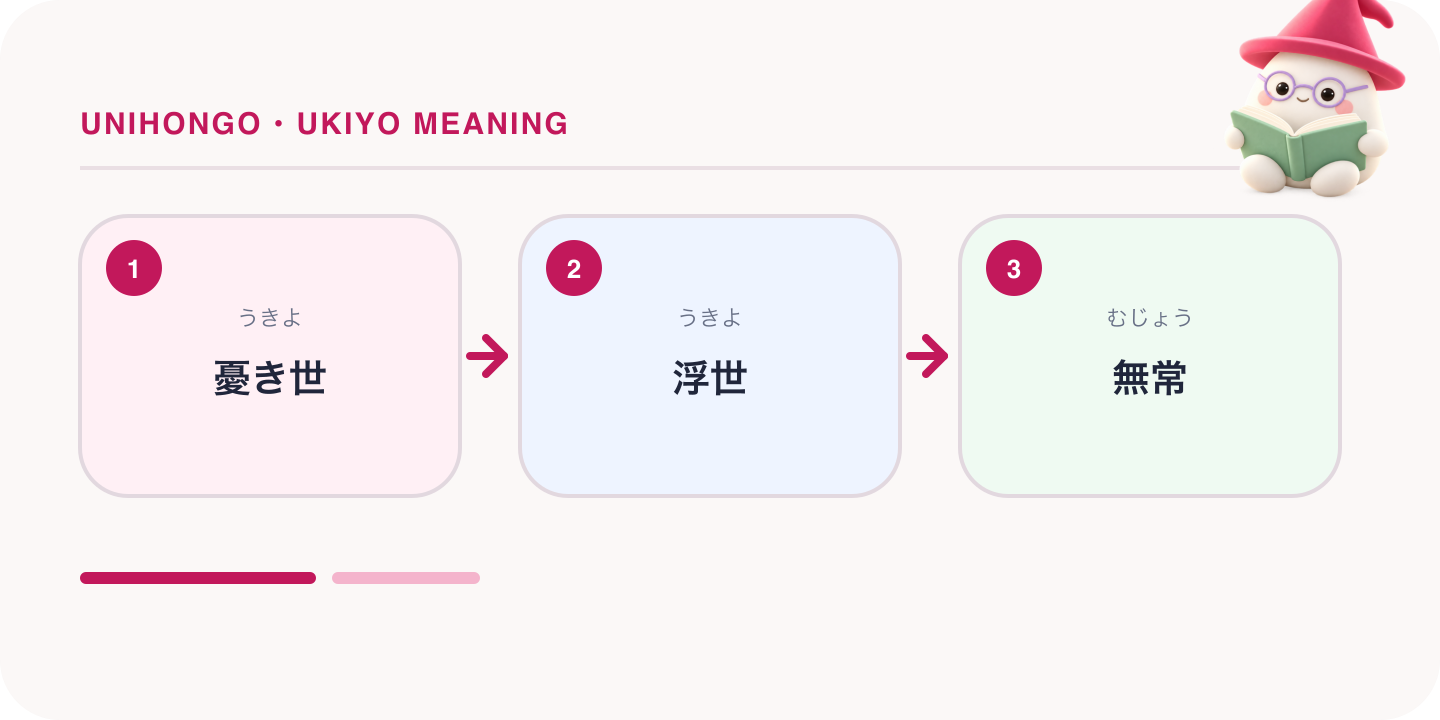
| Spelling | Reading | First kanji | Meaning |
|---|---|---|---|
| 憂き世 | ukiyo | 憂 grief, anxiety | The sorrowful world, a world of suffering |
| 浮世 | ukiyo | 浮 float, drift | The floating world, transient everyday life |
| 世 | yo / se | World, society, age | Appears in both spellings |
The Buddhist background of the sorrowful world
In medieval Japanese literature, 憂き世 expressed a view shaped by Buddhism: the world is impermanent, desire leads to suffering, and human life is short and uncertain. Poets and writers used it to lament loss, illness, war and separation.
This fits a group of related ideas that are still central to Japanese culture. Mujō is impermanence, the truth that everything changes. The famous opening of The Tale of the Heike speaks of shogyō mujō, all things are impermanent. Mono no aware, the gentle sadness of things passing, is the aesthetic side of the same idea.
| Japanese | Romaji | Meaning |
|---|---|---|
| 無常 | mujō | Impermanence |
| 諸行無常 | shogyō mujō | All things are impermanent |
| もののあわれ | mono no aware | The poignant beauty of passing things |
| 憂き世を離れる | ukiyo o hanareru | To leave the world of sorrow behind |
The Edo shift to the floating world
In the Edo period, as cities like Edo, Osaka and Kyoto grew rich and crowded, townspeople developed a lively culture of theatre, fashion, food and entertainment. The same sound, ukiyo, came to be written 浮世 and to mean the present-day world of pleasure and fashion: since life is fleeting, why not enjoy it?
A well-known passage in the early Edo-period book Ukiyo monogatari, by Asai Ryōi, captures this mood: living for the moment, enjoying the moon, snow, blossoms and autumn leaves, and floating along like a gourd carried on the river, without worrying. It is often quoted to explain the new sense of ukiyo.
Ukiyo also became a prefix meaning fashionable or contemporary. Ukiyo-zōshi were popular novels about city life and romance, with Ihara Saikaku as the best-known writer. Ukiyo-e were pictures of the same world.
- Ukiyo-e: pictures of the floating world, mainly woodblock prints and paintings.
- Ukiyo-zōshi: popular fiction about townspeople's lives and loves.
- Kabuki and the entertainment districts: the main subjects of the floating world.
- Fashion and celebrity: actors and famous beauties as trendsetters, much like modern stars.
Ukiyo-e: pictures of the floating world
Ukiyo-e is ukiyo plus e, picture. The earliest subjects were the heart of the floating world: kabuki actors, courtesans and fashionable women, and scenes from entertainment districts. Mass production with woodblocks made the prints affordable, so they worked like posters, souvenirs and celebrity images of their day.
Later, landscapes and travel became major themes. Katsushika Hokusai's views of Mount Fuji and Utagawa Hiroshige's series on the stations of the Tōkaidō road are among the most famous Japanese images in the world. Kitagawa Utamaro is known for portraits of women, and Hishikawa Moronobu is often named as an early master.
Ukiyo-e later influenced European artists, and today Japanese museums and exhibitions attract large audiences. In Japanese, ukiyo-e is a completely everyday word: children learn it at school, and you will see it on stamps, packaging and souvenirs.
| Japanese | Romaji | Meaning |
|---|---|---|
| 北斎の浮世絵が好きです。 | Hokusai no ukiyo-e ga suki desu. | I like Hokusai's ukiyo-e. |
| この浮世絵には富士山が描かれています。 | Kono ukiyo-e ni wa Fujisan ga egakarete imasu. | This print shows Mount Fuji. |
| 浮世絵展に行ってきました。 | Ukiyo-e ten ni itte kimashita. | I went to an ukiyo-e exhibition. |
| Japanese | Reading | Meaning |
|---|---|---|
| 浮世絵 | ukiyo-e | Pictures of the floating world |
| 木版画 | mokuhanga | Woodblock print |
| 役者絵 | yakusha-e | Prints of kabuki actors |
| 美人画 | bijinga | Pictures of beautiful women |
| 名所絵 | meisho-e | Pictures of famous places |
| 絵師 | eshi | The artist who designed the picture |
| 摺師 | surishi | The printer who made the impressions |
How ukiyo is used in modern Japanese
On its own, ukiyo sounds literary and a little old-fashioned. You will meet it in novels, song lyrics, essays and historical dramas, and people sometimes use it with a touch of humour, like saying this mortal world in English.
It is much more common in fixed expressions. Ukiyo-banare, detached from the world, describes someone unworldly or out of touch, often gently: an academic absorbed in research, or a rich person who does not know what things cost. Ukiyo no koto o wasureru, forgetting worldly cares, is a classic line for hot springs and rural inns.
| Japanese | Romaji | Meaning |
|---|---|---|
| 彼は少し浮世離れしている。 | Kare wa sukoshi ukiyo-banare shite iru. | He's a bit out of touch with the real world. |
| 浮世離れした美しさ | ukiyo-banare shita utsukushisa | Otherworldly beauty |
| 温泉で浮世のことを忘れる。 | Onsen de ukiyo no koto o wasureru. | Forget worldly cares at a hot spring. |
| 浮世の義理 | ukiyo no giri | Social obligations of everyday life |
| 浮世はつらいね。 | Ukiyo wa tsurai ne. | Life in this world is hard, isn't it. |
Other words for this world
Japanese has several words for the world of ordinary human life, each with its own tone. Yo no naka is the everyday one: society, the way the world is. Seken is the world of other people's eyes and opinions. Shaba is a Buddhist word for this world of endurance that became slang for life outside prison, or outside any restrictive place.
| Japanese | Romaji | Meaning |
|---|---|---|
| 世の中は厳しいね。 | Yo no naka wa kibishii ne. | The world is tough, isn't it. |
| 世間の目が気になる。 | Seken no me ga ki ni naru. | I worry about what people think. |
| 久しぶりの娑婆の空気だ。 | Hisashiburi no shaba no kūki da. | Fresh air of the outside world at last. |
| Word | Reading | Nuance |
|---|---|---|
| 世の中 | yo no naka | Society, the world in general; everyday and neutral |
| 世間 | seken | Public opinion, what people will think |
| 浮世 | ukiyo | The fleeting world; literary, old-fashioned |
| 俗世 | zokuse | The secular, worldly life, as opposed to religious life |
| 娑婆 | shaba | Buddhist term; now slang for the outside world |
The shaba line is often used jokingly, for example after finishing exams, leaving hospital or ending a long project at work.
The meaning abroad vs in Japan
Outside Japan, ukiyo is used as a name for bars, clothing brands and tattoos, often explained as living in the moment, detached from the bothers of life. That interpretation picks up one real thread of the Edo-period meaning, the pleasure of a fleeting world, and leaves out the sorrow underneath.
For Japanese speakers, ukiyo first brings to mind ukiyo-e and history, then the idea of this changeable human world. If you use the word in Japanese, remember both halves: it is a world worth enjoying because it will not last.
| Common use abroad | What Japanese speakers hear |
|---|---|
| Living in the moment | The fleeting, everyday human world |
| A calm, carefree mood | Both pleasure and impermanence, sometimes sorrow |
| A stylish modern name | A literary, old-fashioned word, closely tied to ukiyo-e |