
Kamoku, kyōka and jugyō
Two words translate as subject. 教科 (kyōka) is the official term for a subject area in the school curriculum, the word you see in education documents and on school websites. 科目 (kamoku) is more general and also covers university courses and exam subjects, so it is the safer word in conversation. A class, as in a lesson in the timetable, is 授業 (jugyō), and the timetable itself is 時間割 (jikanwari).
| Japanese | Romaji | Meaning |
|---|---|---|
| 好きな科目は? | Suki na kamoku wa? | What's your favourite subject? (casual) |
| 科目 | kamoku | subject, course |
| 教科 | kyōka | subject (official curriculum term) |
| 授業 | jugyō | class, lesson |
| 時間割 | jikanwari | timetable, class schedule |
| 一時間目は数学です。 | Ichijikanme wa sūgaku desu. | First period is maths. |
| 宿題 | shukudai | homework |
The core subjects
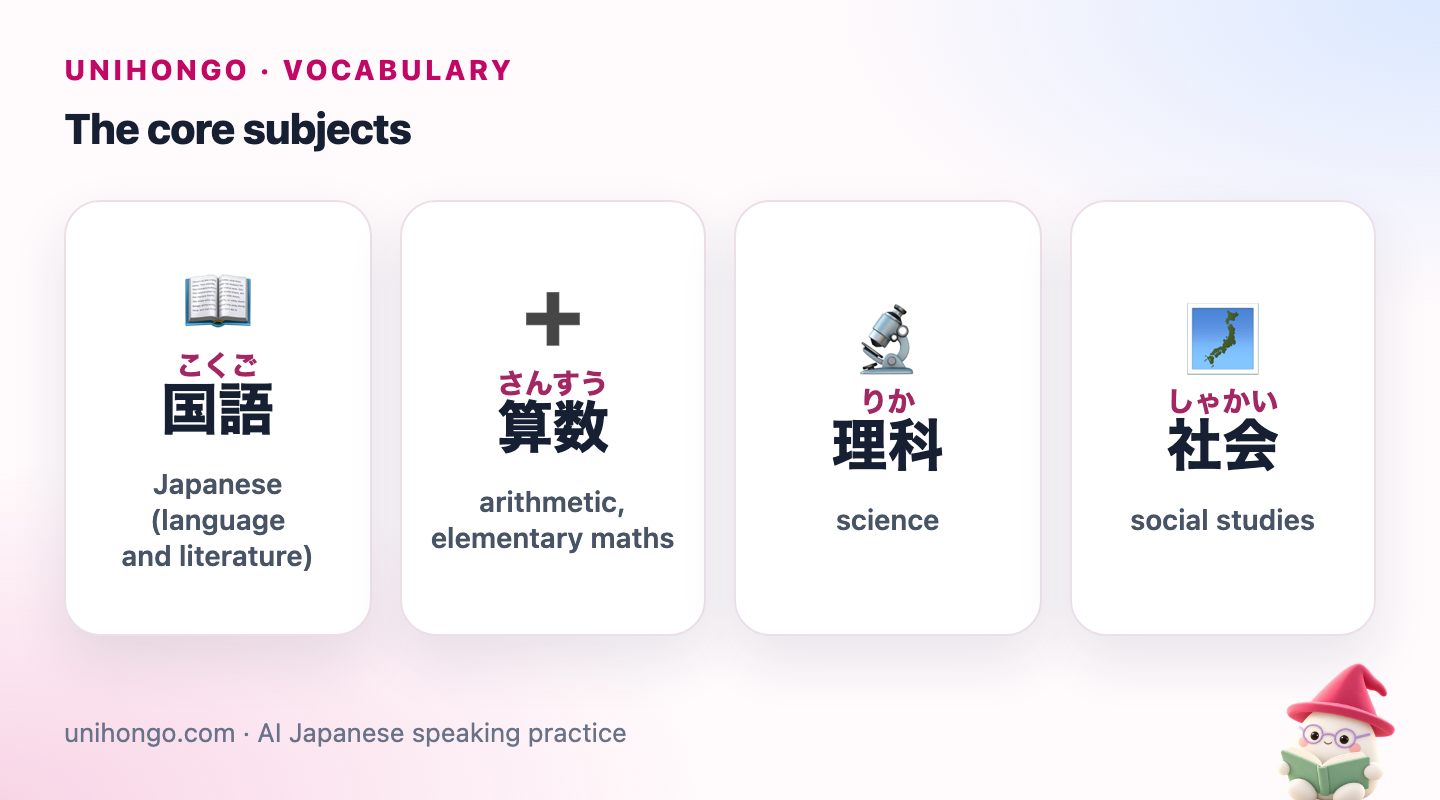
Four names cover the core of Japanese elementary school. Together with English, they also make up the five main exam subjects, 主要五教科 (shuyō go kyōka), that junior high students prepare for high school entrance exams.
| Japanese | Romaji | Meaning |
|---|---|---|
| 国語 | kokugo | Japanese (language and literature) |
| 算数 | sansū | arithmetic, elementary maths |
| 理科 | rika | science |
| 社会 | shakai | social studies |
| 英語 | eigo | English |
| 数学 | sūgaku | mathematics |
| 主要五教科 | shuyō go kyōka | the five main subjects |
Rika is the school name for science as a subject. The general word for science, as in science and technology, is 科学 (kagaku). Shakai literally means society, and as a subject it covers geography, history and civics. When a Japanese adult says shakai ga nigate datta, they mean they found history and geography hard at school.
Kokugo is also bigger than a language class in many learners' countries. It includes reading stories and essays, writing compositions, learning kanji, calligraphy practice with a brush in some grades and, later, classical texts. When Japanese friends complain about kanji tests, kokugo is the class they are remembering.
How subject names change by stage
The curriculum is revised from time to time, so treat this as the common picture rather than an exact list for every school. The biggest change learners notice is that the same subject can have a child's name in elementary school and an adult name later.
| Japanese | Romaji | Meaning |
|---|---|---|
| 図工 | zukō | arts and crafts (elementary) |
| 美術 | bijutsu | art (junior high and above) |
| 体育 | taiiku | PE, physical education |
| 家庭科 | kateika | home economics |
| 音楽 | ongaku | music |
| 道徳 | dōtoku | moral education |
| 総合 | sōgō | integrated studies (project time) |
| Subject | Elementary school (shōgakkō) | Junior high school (chūgakkō) |
|---|---|---|
| Maths | 算数 (sansū) | 数学 (sūgaku) |
| Art | 図画工作, shortened to 図工 (zukō), arts and crafts | 美術 (bijutsu), fine art |
| PE | 体育 (taiiku) | 保健体育 (hoken taiiku), health and PE |
| Home and technology | 家庭科 (kateika), home economics, in the upper grades | 技術・家庭 (gijutsu katei), technology and home economics |
| Life and nature | 生活 (seikatsu), life environment studies, in grades 1 and 2 | Covered by rika and shakai |
| English | 外国語 (gaikokugo), English activities and lessons | 英語 (eigo) |
Sōgō is short for 総合的な学習の時間, a period for projects and research on topics such as the local area or the environment. You will hear children use the short form. Dōtoku is a class about values and behaviour, often built around stories and discussion.
High school: science, history and Japanese split up
In high school, the broad subjects split into narrower ones, and students choose some of them, often according to whether they are on the arts track, 文系 (bunkei), or the science track, 理系 (rikei). The official course names have changed with recent curriculum reforms, but students and teachers still use the familiar short names below in everyday talk.
| Japanese | Romaji | Meaning |
|---|---|---|
| 現代文 | gendaibun | modern Japanese texts |
| 古文 | kobun | classical Japanese |
| 漢文 | kanbun | classical Chinese read in Japanese |
| 物理 | butsuri | physics |
| 化学 | kagaku | chemistry |
| 生物 | seibutsu | biology |
| 地学 | chigaku | earth science |
| 日本史 | nihonshi | Japanese history |
| 世界史 | sekaishi | world history |
| 地理 | chiri | geography |
| 情報 | jōhō | information studies, computing |
| 文系ですか、理系ですか。 | Bunkei desu ka, rikei desu ka. | Are you on the arts track or the science track? |
Bunkei and rikei are also used about adults, to describe whether someone studied humanities or sciences, and sometimes, a little jokingly, their way of thinking. 化学, chemistry, is pronounced exactly like 科学, science. To avoid confusion, people often read 化学 as ばけがく (bakegaku), using the other reading of 化. It is an informal nickname, not a mistake.
University faculties and majors
At university, subjects become faculties, 学部 (gakubu), and majors, 専攻 (senkō). Most fields end in 学 (gaku), study of, which makes them easy to build: 経済 (economy) plus 学 is economics. In a self-introduction, people usually give the university, the faculty and sometimes the year.
| Japanese | Romaji | Meaning |
|---|---|---|
| 専攻は何ですか。 | Senkō wa nan desu ka. | What's your major? |
| 経済学部の二年生です。 | Keizai gakubu no ninensei desu. | I'm a second-year in the faculty of economics. |
| 経済学 | keizaigaku | economics |
| 法学 | hōgaku | law |
| 文学 | bungaku | literature |
| 工学 | kōgaku | engineering |
| 医学 | igaku | medicine |
| 心理学 | shinrigaku | psychology |
| 教育学 | kyōikugaku | education |
| 情報工学 | jōhō kōgaku | computer engineering |
Talking about the subjects you liked
This is where subject names come alive. Japanese has two very useful words: 得意 (tokui), good at or strong in, and 苦手 (nigate), weak at or not comfortable with. They are softer and more natural than jōzu and heta when you talk about yourself. Add a reason with から (kara) and you have a complete answer.
School days are a friendly small-talk topic with host families, coworkers and language exchange partners. Everyone has a subject they hated, and admitting it usually gets a laugh and a story in return.
| Japanese | Romaji | Meaning |
|---|---|---|
| 得意な科目は何でしたか。 | Tokui na kamoku wa nan deshita ka. | Host mother: What subject were you good at? |
| 理科が得意でした。実験が好きだったんです。 | Rika ga tokui deshita. Jikken ga suki datta n desu. | You: I was good at science. I loved the experiments. |
| 私は数学が苦手で…。 | Watashi wa sūgaku ga nigate de... | Host mother: I was hopeless at maths... |
| 私もです。テストが怖かったです。 | Watashi mo desu. Tesuto ga kowakatta desu. | You: Me too. I dreaded the tests. |
| 体育は好きでしたか。 | Taiiku wa suki deshita ka. | Host mother: Did you like PE? |
| 走るのは嫌いでしたけど、球技は楽しかったです。 | Hashiru no wa kirai deshita kedo, kyūgi wa tanoshikatta desu. | You: I hated running, but ball games were fun. |
Nigate de... trailing off with de is a natural, modest way to admit a weakness without finishing the sentence. Use tokui and nigate about yourself; when you compliment someone else's skill, jōzu desu ne is the usual choice.
Learn the subject names with Mocchi
Ask Mocchi something like /quiz Japanese school subject names, elementary to university, and answer each question aloud before typing it. Mocchi explains the ones you miss, such as sansū versus sūgaku or the two readings of 化学, and remembers them, so the next /review comes back to exactly those. If you want to write a short paragraph about your own school days, send it with /correct and Mocchi fixes the grammar and the subject names.
For quick listening practice, Listen & Pick on the games page plays a word and asks you to choose it, a good way to catch the difference between kagaku and kakaku or rika and rikai.
Common learner mistakes
- Calling Japanese children's language class nihongo. For Japanese students it is kokugo.
- Using sansū for maths when you talk about your own university studies. As an adult subject, it is sūgaku.
- Saying watashi wa sūgaku ga jōzu desu. It sounds like boasting; sūgaku ga tokui desu is the natural way to say it.
- Mixing up 科学 (science) and 化学 (chemistry). They sound the same; use bakegaku or the context to make it clear.
- Saying supōtsu for PE class. The school subject is taiiku; supōtsu is sport in general.