

Yoshi as all right: deciding and starting
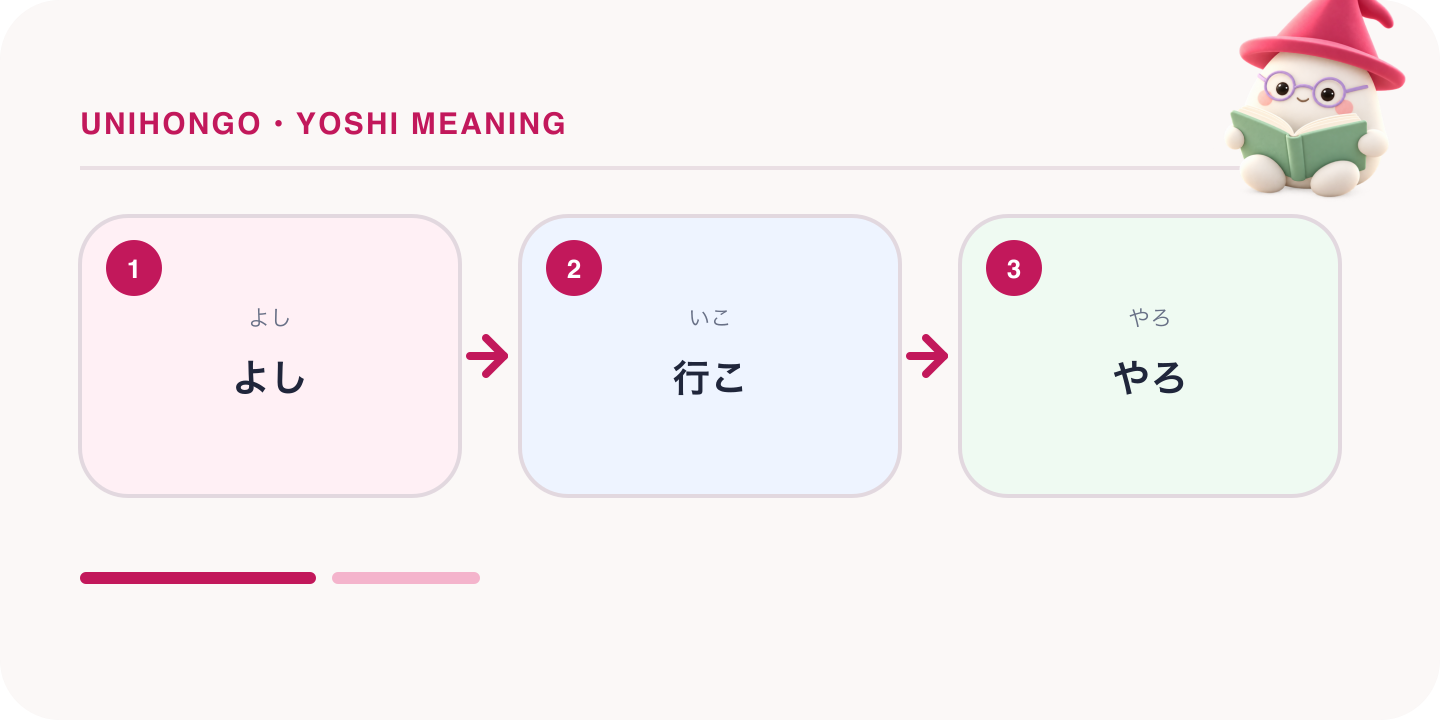
The most common use of yoshi is as a one-word self-command. You finish your coffee, stand up and say yoshi, and it means all right, time to get going. It marks the moment you make up your mind. Often it is followed by a volitional verb: yoshi, ikō, right, let's go, or yoshi, yarō, right, let's do it.
Yoshi is often said half to yourself. Japanese people frequently mutter it before a difficult task, when they pick up a heavy box or when they sit down to study. It is a verbal way of gathering energy, like rolling up your sleeves.
When it is said to a group, yoshi signals that the leader has decided. A coach who says yoshi, hajimeru zo is announcing that practice is starting. A friend who says yoshi, kimeta means right, I've made up my mind.
| Japanese | Romaji | Meaning |
|---|---|---|
| よし、行こう。 | Yoshi, ikō. | Right, let's go. |
| よし、やろう。 | Yoshi, yarō. | All right, let's do it. |
| よし、始めよう。 | Yoshi, hajimeyō. | OK, let's start. |
| よし、決めた。 | Yoshi, kimeta. | Right, I've decided. |
| よし、頑張るぞ。 | Yoshi, ganbaru zo. | All right, I'm going to give it my all. |
Yoshi as good, done: checking and finishing
Yoshi also marks completion and approval. When you finish packing, you look at your suitcase and say yoshi, OK, done. When a teacher checks your work and it is correct, they might say yoshi, good. It is the spoken equivalent of a tick.
In Japanese workplaces and on railways, a related practice called shisa kanko, pointing and calling, involves pointing at a signal or gauge and saying what you see, often ending with yoshi to confirm it is correct. Train staff saying shingō yoshi, signal clear, is a well-known example. You may notice this style of checking on platforms and in factories.
| Japanese | Romaji | Meaning |
|---|---|---|
| よし、できた。 | Yoshi, dekita. | There, done. |
| よし、これで大丈夫。 | Yoshi, kore de daijōbu. | Right, that should do it. |
| よし、完璧。 | Yoshi, kanpeki. | Good, perfect. |
| 忘れ物なし、よし。 | Wasuremono nashi, yoshi. | Nothing left behind, check. |
| 信号よし。 | Shingō yoshi. | Signal clear. (pointing and calling) |
Yosh and yossha: energy and celebration
Clip yoshi short and it becomes yosh, a sharp burst of energy you will hear constantly in anime, sport and games. It can mean yes! when something goes well, or let's go! as you start. Characters in shōnen manga say yosh before a battle; people in real life say it after winning a round of a game or passing a test.
Yossha, written よっしゃ, is stronger still, closer to yes!, get in! or woohoo! It is typically a shout of triumph, often with a fist pump, and it has a slightly rough, lively feel. It is common in Kansai speech but used all over Japan. Yatta, I did it!, is the other classic victory shout, and is more about achievement than energy.
| Japanese | Romaji | Meaning |
|---|---|---|
| よしっ! | Yosh! | Yes! Let's go! |
| よっしゃ! | Yossha! | Yes! Get in! |
| よっしゃ、勝った! | Yossha, katta! | Yes, we won! |
| やった! | Yatta! | I did it! Hooray! |
| よし、次! | Yoshi, tsugi! | Right, next! |
Yosh, yossha and yatta are casual and emotional. They are natural with friends, in sport and when talking to yourself. In a quiet office, a small yoshi under your breath is fine; a loud yossha may draw looks.
Yoshi yoshi: there, there and good boy
Repeated gently, yoshi yoshi becomes a soothing sound. Parents say it to calm a crying baby or a child who has fallen over, often while patting their back or head. It works like English there, there or it's all right.
It is also how people praise animals. Yoshi yoshi, ii ko da ne, good dog, what a good boy, is typical when stroking a pet. Between adults it is usually playful, used to tease or comfort a friend who is being a little dramatic, and some people find it slightly condescending if used seriously.
| Japanese | Romaji | Meaning |
|---|---|---|
| よしよし、泣かないで。 | Yoshi yoshi, nakanaide. | There, there, don't cry. |
| よしよし、いい子だね。 | Yoshi yoshi, ii ko da ne. | Good boy, what a good dog. |
| よしよし、大丈夫だよ。 | Yoshi yoshi, daijōbu da yo. | There, there, it's all right. |
| 頭をよしよしする | atama o yoshi yoshi suru | To pat someone on the head (affectionately) |
Yoshi, yoi and ii: the good family
Yoshi was the classical Japanese form of the adjective good. Over time it developed into yoi, which is still used in written, formal and set phrases, and ii, which is the everyday spoken form. So when you say ii desu ne, it's nice, you are using a descendant of the same word.
The link shows up in conjugations. Ii has no past or negative forms of its own, so it borrows them from yoi: yokatta, it was good, and yokunai, not good, both come from yoi. Yoshi as an interjection is a frozen remnant of the old form, much as English keeps old words in fixed expressions.
Yoshi also survives in classical phrases such as yoshi to suru, to consider something acceptable, and in the idiom yoshi ashi, good and bad points, where yoshi is the good side and ashi the bad side, from the old adjective for bad. It is still used today, often in the fixed phrase yoshi ashi da, it's a mixed blessing.
| Form | Where it is used | Example |
|---|---|---|
| よし yoshi | Classical adjective; modern interjection | Yoshi, ikō. Right, let's go. |
| 良い yoi | Formal, written, set phrases | Yoi o-toshi o. Have a good new year. |
| いい ii | Everyday speech | Ii tenki desu ne. Nice weather. |
| 良かった yokatta | Past of both yoi and ii | Yokatta! Thank goodness! |
| 良くない yokunai | Negative of both yoi and ii | Sore wa yokunai. That's not good. |
| 良し悪し yoshi ashi | Idiom: good and bad points | Benri da kedo yoshi ashi da. Handy, but a mixed blessing. |
Yoshi as a name
Yoshi is one of the most common elements in Japanese names. Given names include Yoshiko, Yoshio, Yoshiki, Yoshie, Yoshitaka and Yoshinori, and family names include Yoshida, Yoshimura, Yoshikawa and Yoshioka.
In names, yoshi can be written with many different kanji, each with its own meaning: 良 good, 義 righteousness, 吉 good fortune, 芳 fragrant, 善 virtue, 佳 beautiful, and others. You cannot know which one a person uses just from hearing the name, which is why Japanese people often explain their kanji when introducing themselves in writing contexts.
- 良 yoshi: good (as in 良子 Yoshiko)
- 義 yoshi: righteousness, duty (as in 義雄 Yoshio)
- 吉 yoshi: good fortune (as in 吉田 Yoshida)
- 芳 yoshi: fragrant, fine (as in 芳恵 Yoshie)
- 善 yoshi: virtue, goodness
- 佳 yoshi: beautiful, excellent
Politeness: what to say instead of yoshi
Yoshi is an interjection for yourself and for people close to you. It is not rude, but it does not work as a polite reply. If a customer or manager asks you to do something, answering yoshi sounds as if you are talking to yourself or giving orders. Use a polite acknowledgement instead.
When a superior gives an instruction, kashikomarimashita or shōchi shimashita, certainly or understood, are standard in business. Hai, wakarimashita is a simpler, still-polite reply. When you want to suggest starting in a group, sore dewa hajimemashō, shall we begin, is the polite version of yoshi, hajimeyō.
| Casual | Polite | Meaning |
|---|---|---|
| よし、わかった yoshi, wakatta | はい、わかりました hai, wakarimashita | All right, got it |
| よし、始めよう yoshi, hajimeyō | それでは始めましょう sore dewa hajimemashō | Let's begin |
| よし、オッケー yoshi, okkē | 承知しました shōchi shimashita | Understood |
| よし、行こう yoshi, ikō | では、参りましょう dewa, mairimashō | Shall we go? |
Common learner mistakes with yoshi
- Answering a customer or boss with yoshi instead of hai, kashikomarimashita.
- Using yoshi yoshi seriously with an adult, which can sound patronising.
- Shouting yossha in quiet or formal places where a soft yoshi would do.
- Confusing yoshi with yatta: yoshi is about deciding or approving, yatta about achieving.
- Thinking ii has its own past tense: yokatta and yokunai come from yoi.
- Assuming one kanji for Yoshi in names: always ask how a person writes theirs.