
Bochibochi in four lines
Bochibochi is a mimetic adverb. One common explanation links it to botsubotsu, a word for dots and things happening here and there, little by little. Whatever its origin, the feeling is the same: slow, steady and nothing special. That is why it can mean both so-so and gradually or soon.
In Kansai, the word has a warm, easy-going sound. Saying bochibochi with a little smile tells the other person that things are fine, you are not complaining, and you are not boasting either.
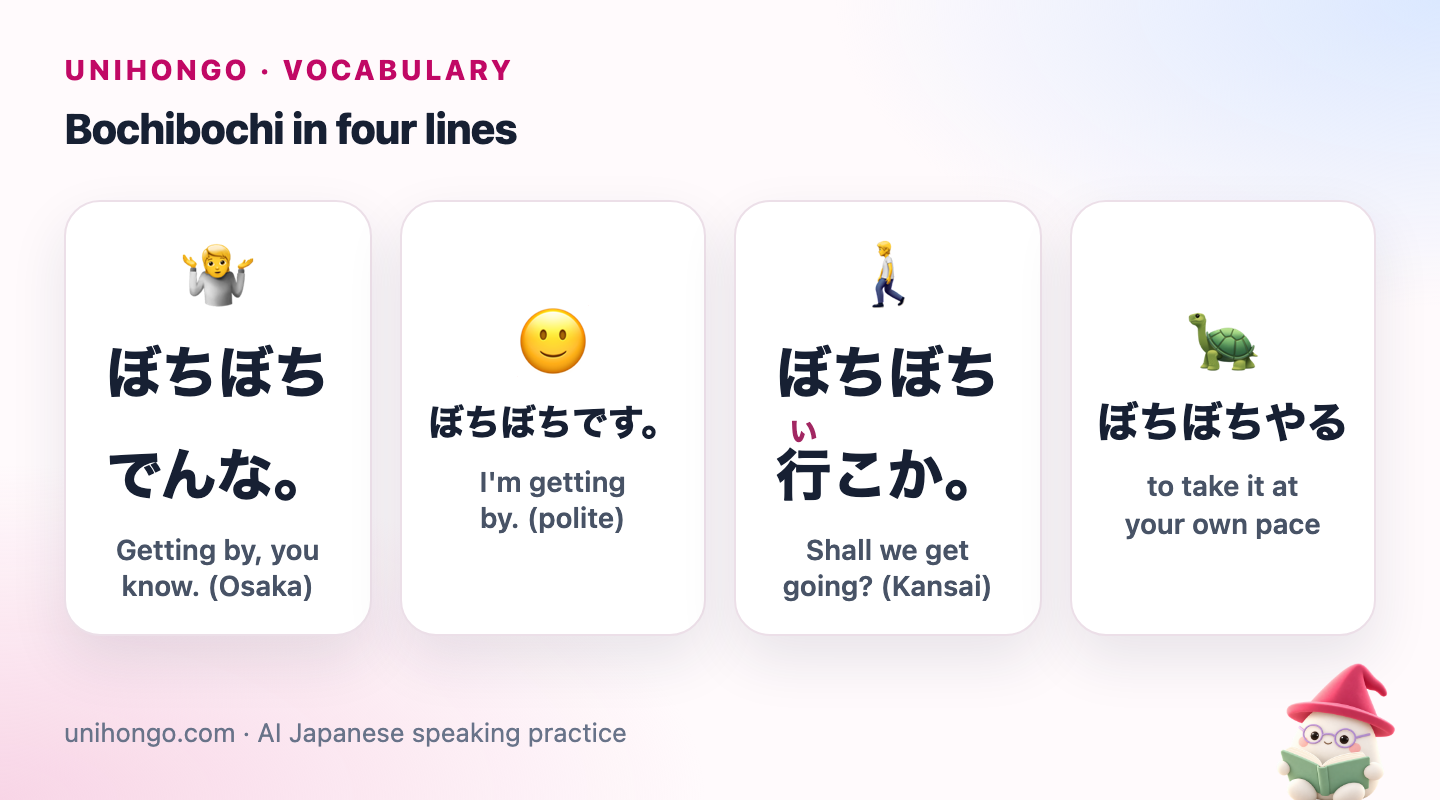
| Japanese | Romaji | Meaning |
|---|---|---|
| ぼちぼちでんな。 | Bochibochi denna. | Getting by, you know. (Osaka) |
| ぼちぼちです。 | Bochibochi desu. | I'm getting by. (polite) |
| ぼちぼち行こか。 | Bochibochi ikoka. | Shall we get going? (Kansai) |
| ぼちぼちやる | bochibochi yaru | to take it at your own pace |
Meaning one: so-so, getting by
When someone asks how you are, how work is going or how your Japanese is coming along, bochibochi is a modest, all-purpose answer. It sits in the middle: things are fine, nothing to report, no drama. Many people use it even when things are going well, because it avoids sounding proud.
In Kansai, it often comes with a dialect ending: bochibochi ya na (casual), bochibochi ya de, or the merchant-style bochibochi denna. In standard polite Japanese, bochibochi desu is understood everywhere, though in Tokyo the more common neutral answer is māmā desu or okagesama de.
| Japanese | Romaji | Meaning |
|---|---|---|
| 最近どう? | Saikin dō? | Friend: How have you been? |
| ぼちぼちやな。 | Bochibochi ya na. | You: Getting by. (Kansai, casual) |
| 日本語の勉強はどうですか。 | Nihongo no benkyō wa dō desu ka. | Neighbour: How are your Japanese studies going? |
| ぼちぼちです。まだまだですけど。 | Bochibochi desu. Mada mada desu kedo. | You: Getting there. I still have a long way to go. |
Mōkarimakka, bochibochi denna: the famous exchange
The best-known bochibochi line is the reply in a classic Osaka merchant exchange. Mōkarimakka, from mōkaru, to make a profit, means roughly are you making money? Bochibochi denna answers getting by, you know. The joke is that a merchant never admits to doing very well, and never admits to doing badly either.
Today, few people in Osaka greet each other this way in daily life, and the exchange is mostly used as a playful image of the city, in comedy, on souvenirs and by older shopkeepers who enjoy the old style. If a Kansai friend says mōkarimakka to you with a grin, answering bochibochi denna is the perfect joke reply.
| Japanese | Romaji | Meaning |
|---|---|---|
| もうかりまっか? | Mōkarimakka? | Making any money? (Osaka merchant, playful) |
| ぼちぼちでんな。 | Bochibochi denna. | Getting by, you know. (classic reply) |
| まあ、ぼちぼちやね。 | Mā, bochibochi ya ne. | Well, it's so-so. (Kansai, casual) |
Meaning two: little by little, and about time
The second meaning is about time and pace. Bochibochi hajimeyō ka means shall we get started, in an unhurried way, and bochibochi kaerō ka means shall we head home. It suggests that the moment has gradually arrived, like sorosoro in standard Japanese. This meaning is widely used outside Kansai too.
It can also describe slow, steady progress: bochibochi yatte imasu, I'm working on it bit by bit, or a new shop where customers are coming in bochibochi, a few at a time. As advice, bochibochi ikō, let's take it easy and keep going, is a gentle way to tell someone not to rush.
| Japanese | Romaji | Meaning |
|---|---|---|
| ぼちぼち始めましょうか。 | Bochibochi hajimemashō ka. | Shall we get started? (polite) |
| もう遅いし、ぼちぼち帰ろか。 | Mō osoi shi, bochibochi kaeroka. | It's late, so shall we head home? (Kansai) |
| 新しい店、お客さんがぼちぼち来てるよ。 | Atarashii mise, okyakusan ga bochibochi kiteru yo. | The new shop's getting a few customers now. |
| 焦らずぼちぼちいこう。 | Aserazu bochibochi ikō. | No rush, let's take it step by step. |
This pace meaning is a kind, encouraging word for learners too. If you tell a Kansai friend that Japanese is hard, you may hear bochibochi de ee yan, taking it bit by bit is fine, isn't it? It is a reminder that slow, steady progress counts.
More bochibochi lines you will hear in Kansai
Once you start listening, bochibochi turns up in many small moments. Shop owners use it about business, office workers about the end of the day, friends about plans that are slowly taking shape. It often comes with Kansai sentence endings such as ya (for da), de (a friendly emphasis) and yan (isn't it), so knowing those helps you catch it.
People also use it for weather and seasons changing gradually: the cherry trees are starting to bloom bochibochi, here and there. In this meaning it is very close to the standard botsubotsu or chirahora, a few here and there.
| Japanese | Romaji | Meaning |
|---|---|---|
| ぼちぼちええ時間やな。 | Bochibochi ee jikan ya na. | It's about that time, isn't it? (Kansai) |
| 桜がぼちぼち咲き始めたで。 | Sakura ga bochibochi sakihajimeta de. | The cherry blossoms are starting to come out here and there. (Kansai) |
| 仕事はぼちぼちやってるよ。 | Shigoto wa bochibochi yatteru yo. | Work's ticking along. |
Bochibochi next to māmā, sorosoro and botsubotsu
Each meaning of bochibochi has a standard partner, and choosing between them changes the tone. Māmā is the standard so-so, slightly flatter. Sorosoro is the standard about time and is used everywhere, in any register. Botsubotsu is the more standard-sounding form of the little-by-little meaning, and it also describes small dots or spots. Okagesama de is the polite, grateful answer to how are you.
| Japanese | Romaji | Meaning |
|---|---|---|
| まあまあです。 | Māmā desu. | It's OK. (standard) |
| そろそろ失礼します。 | Sorosoro shitsurei shimasu. | I'll be going soon. (polite, leaving) |
| おかげさまで、元気にしております。 | Okagesama de, genki ni shite orimasu. | Thanks to you, I'm well. (formal) |
| おかげさまで、順調です。 | Okagesama de, junchō desu. | Thanks to you, it's going smoothly. (to a client) |
| それでは、そろそろ始めます。 | Soredewa, sorosoro hajimemasu. | Well then, let's begin. (formal meeting) |
| Word | Main meaning | Where it fits |
|---|---|---|
| bochibochi | So-so, getting by; soon, bit by bit | Friendly talk, strong in Kansai |
| māmā | So-so, OK | Standard, everyday |
| sorosoro | It is about time, soon | Standard, casual to polite |
| botsubotsu | Little by little; dots | Standard, a little bookish |
| okagesama de | Fine, thanks to you | Polite, with clients and seniors |
Is bochibochi polite enough for work? Bochibochi desu is fine with friendly acquaintances, neighbours and coworkers you know well, especially in Kansai, where even business people use it lightly. In Tokyo offices and in formal situations, it can sound folksy or vague. A client asking how your project is going expects a clearer answer, such as junchō desu, it is going smoothly, or a short status update.
For the time meaning, bochibochi hajimemashō ka is acceptable in a relaxed meeting, but sorosoro hajimemasu is the safer choice when you chair a formal one.
Mini dialogue: at an Osaka market
Marco has been buying fish at the same stall in a covered Osaka market for a few months. The fishmonger likes to tease him with old Osaka phrases. Listen to the Kansai endings: ya for da, hen for nai, and the merchant-style denna.

| Japanese | Romaji | Meaning |
|---|---|---|
| おう、兄ちゃん。もうかりまっか? | Ō, niichan. Mōkarimakka? | Fishmonger: Hey, young man. Making any money? |
| ぼちぼちでんな。 | Bochibochi denna. | Marco: Getting by, you know. |
| ははは、よう知ってるなあ。 | Hahaha, yō shitteru nā. | Fishmonger: Ha ha, you know your Osaka! |
| 今日は何がおすすめですか。 | Kyō wa nani ga osusume desu ka. | Marco: What do you recommend today? |
| このサバ、ええで。今朝入ったばっかりや。 | Kono saba, ee de. Kesa haitta bakkari ya. | Fishmonger: This mackerel's good. It just came in this morning. |
| じゃあ、それを二匹ください。 | Jā, sore o nihiki kudasai. | Marco: Then two of those, please. |
Make sense of Kansai replies with Mocchi
Paste a line you heard, such as もう遅いし、ぼちぼち帰ろか, into Mocchi with /explain. Mocchi breaks it into pieces, points out the Kansai volitional kaero ka and the standard equivalent, and gives the meaning. Ask a follow-up, such as when should I say bochibochi instead of māmā, and Mocchi remembers the dialect points you have asked about.
Then take it to AI Sensei: ask Sakura-sensei to play an Osaka shopkeeper who greets you with mōkarimakka, and practise switching between the joke reply and polite standard Japanese.
Common learner mistakes
- Treating bochibochi as negative. It is modest; if things are bad, say ammari yoku nai.
- Answering a client with bochibochi desu. Use okagesama de or junchō desu instead.
- Greeting strangers with mōkarimakka. It is a joke between people who know each other, or a line to enjoy when someone says it to you.
- Overdoing Kansai endings outside Kansai. Bochibochi denna in a Tokyo office may sound like an imitation; bochibochi desu or māmā desu is safer.
- Forgetting the time meaning. Bochibochi ikō ka is not about how you feel; it means shall we go.