
The four words fans ask about first
Before the kanji, here is the heart of the vocabulary. A noroi is a curse. A jujutsushi is the sorcerer who fights curses. Ryōiki tenkai is the signature move, and tokkyū is the highest rank.
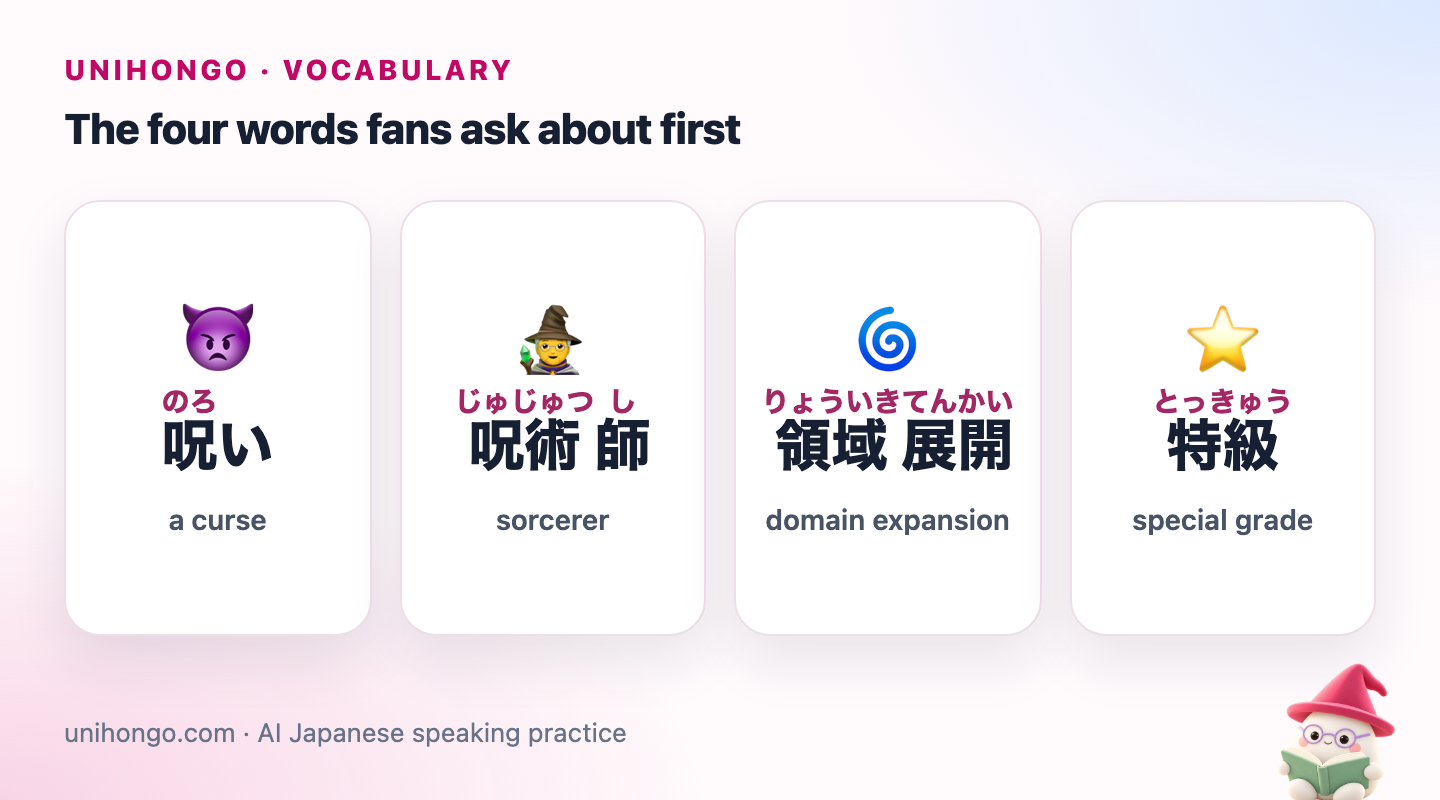
| Japanese | Romaji | Meaning |
|---|---|---|
| 呪い | noroi | a curse |
| 呪術師 | jujutsushi | sorcerer |
| 領域展開 | ryōiki tenkai | domain expansion |
| 特級 | tokkyū | special grade |
| 呪術 | jujutsu | sorcery, curse arts |
| 呪霊 | jurei | cursed spirit |
The title, one kanji at a time: 呪 術 廻 戦
The manga by Akutami Gege ran in Weekly Shōnen Jump. Its title is four kanji, read ju-jutsu-kai-sen.
- 呪 (ju): curse. The native verb is norou, to curse.
- 術 (jutsu): art, technique, skill. Also in shujutsu, surgery, gijutsu, technology, and bijutsu, fine art.
- 廻 (kai): to turn, to go around. It is a less common form of 回, the kanji in kaiten, rotation. You may notice it on the signs of some conveyor-belt sushi shops.
- 戦 (sen): battle, war. The native verb is tatakau, to fight.
Jujutsu is a dictionary word used by historians and anthropologists for magic and sorcery. Kaisen is the author's invention, so there is no single correct translation; it suggests a battle that comes around again.
Noroi, norou and the kanji 呪
The kanji 呪 has a mouth, 口, on its left, which fits: a curse begins as words. Read natively it gives noroi (呪い), a curse, and norou (呪う), to curse someone. In the passive, norowareru, to be cursed, is the form horror films love.
The same written word 呪い has a second, gentler reading, majinai, a charm or spell. With the polite o, omajinai is what a parent says over a child's scraped knee. And jumon (呪文) is a magic spell or incantation, a word every role-playing game uses.
| Japanese | Romaji | Meaning |
|---|---|---|
| 呪う | norou | to curse |
| 呪われる | norowareru | to be cursed |
| おまじない | omajinai | a good-luck charm or spell |
| 呪文 | jumon | a magic spell, incantation |
| この家は呪われている。 | Kono ie wa norowarete iru. | This house is cursed. |
Jujutsushi, jurei, juryoku: one kanji plus a suffix
The series makes its nouns by adding a common ending to ju. Shi (師) is a master or practitioner, as in biyōshi (美容師), hairdresser. Rei (霊) is a spirit, as in yūrei (幽霊), ghost. Ryoku (力) is power, as in tairyoku (体力), stamina.
Jutsushiki (術式), a sorcerer's inborn technique in the story, is a real word too: in hospitals it means a surgical method.
| Japanese | Romaji | Meaning |
|---|---|---|
| 呪力 | juryoku | cursed energy |
| 呪物 | jubutsu | cursed object |
| 術式 | jutsushiki | technique; surgical method |
| 美容師 | biyōshi | hairdresser |
| 幽霊 | yūrei | ghost |
| 体力 | tairyoku | stamina, physical strength |
Ryōiki tenkai: two office words in a battle cry
Ryōiki (領域) is an area under someone's control: a territory, a domain, a field of study. Tenkai (展開) is to spread out or develop. Companies tenkai new shops, plots tenkai in unexpected directions, and maths students tenkai brackets. Put together, the phrase means opening out your own territory.
This is the most reusable vocabulary in the series. Tenkai in particular appears in news and business writing every day, and it is a suru verb.
| Japanese | Romaji | Meaning |
|---|---|---|
| 領域 | ryōiki | domain, field, territory |
| 展開 | tenkai | development, rollout |
| 専門領域 | senmon ryōiki | field of expertise |
| 全国展開 | zenkoku tenkai | nationwide rollout |
| 話の展開が早いです。 | Hanashi no tenkai ga hayai desu. | The story moves fast. |
| 海外に事業を展開します。 | Kaigai ni jigyō o tenkai shimasu. | We will expand the business overseas. |
Tokkyū and the grade ladder
Sorcerers and curses are ranked from grade four up to grade one, with tokkyū (特級), special grade, at the top. A half step is marked with jun (準), semi: jun'ikkyū is semi-grade one.
Kyū (級) is the standard word for a level in Japanese tests of skill, from calligraphy to English exams, some of which also have jun levels. It also gives shokyū, chūkyū and jōkyū: beginner, intermediate and advanced.
| Japanese | Romaji | Meaning |
|---|---|---|
| 一級 | ikkyū | grade one |
| 準一級 | jun'ikkyū | semi-grade one |
| 初級 | shokyū | beginner level |
| 中級 | chūkyū | intermediate level |
| 上級 | jōkyū | advanced level |
| 同級生 | dōkyūsei | classmate, someone in your year |
Kōsen: a real kind of school
The students attend a jujutsu kōsen. Kōsen (高専) is the everyday abbreviation of kōtō senmon gakkō (高等専門学校), a type of college found across Japan. Pupils enter at about fifteen, after junior high school, and study for five years, mostly engineering and technology.
So to a Japanese reader the school's name sounds practical, almost dull: a technical college whose speciality happens to be curses. That mix of the official and the supernatural is typical of the series' naming.
| Japanese | Romaji | Meaning |
|---|---|---|
| 高専 | kōsen | college of technology |
| 高等専門学校 | kōtō senmon gakkō | college of technology (full name) |
| 一年生 | ichinensei | first-year student |
| 先輩 | senpai | senior student |
Which of these words matter in real life?
Be selective. Some of this vocabulary will serve you weekly, and some only when you talk about the series.
| Romaji | In the series | In real life | Priority for learners |
|---|---|---|---|
| tenkai | Half of domain expansion | Rollout, development, plot twist | High: news and business |
| ryōiki | A sorcerer's domain | Field, territory, area of expertise | High at intermediate level |
| kyū | Rank of sorcerers and curses | Level in tests and classes | High: you will see it on any exam |
| jutsu | Technique | Part of surgery, technology and art | High as a kanji |
| tokkyū | Special grade | Rare as a grade; the train word is a different kanji | Medium |
| noroi | A curse | Horror stories, jokes about bad luck | Medium |
| juryoku | Cursed energy | Not used | Low: fans only |
Talking about the series politely
These lines work with classmates, colleagues and language partners. The second is a pattern worth keeping for any word you do not know.
| Japanese | Romaji | Meaning |
|---|---|---|
| 呪術廻戦を見ていますか。 | Jujutsu Kaisen o mite imasu ka. | Are you watching Jujutsu Kaisen? |
| 領域展開ってどういう意味ですか。 | Ryōiki tenkai tte dō iu imi desu ka. | What does ryōiki tenkai mean? |
| この漢字は何と読みますか。 | Kono kanji wa nan to yomimasu ka. | How do you read this kanji? |
| ネタバレしないでくださいね。 | Netabare shinaide kudasai ne. | Please don't spoil it for me. |