

Teacher instructions you will hear every lesson
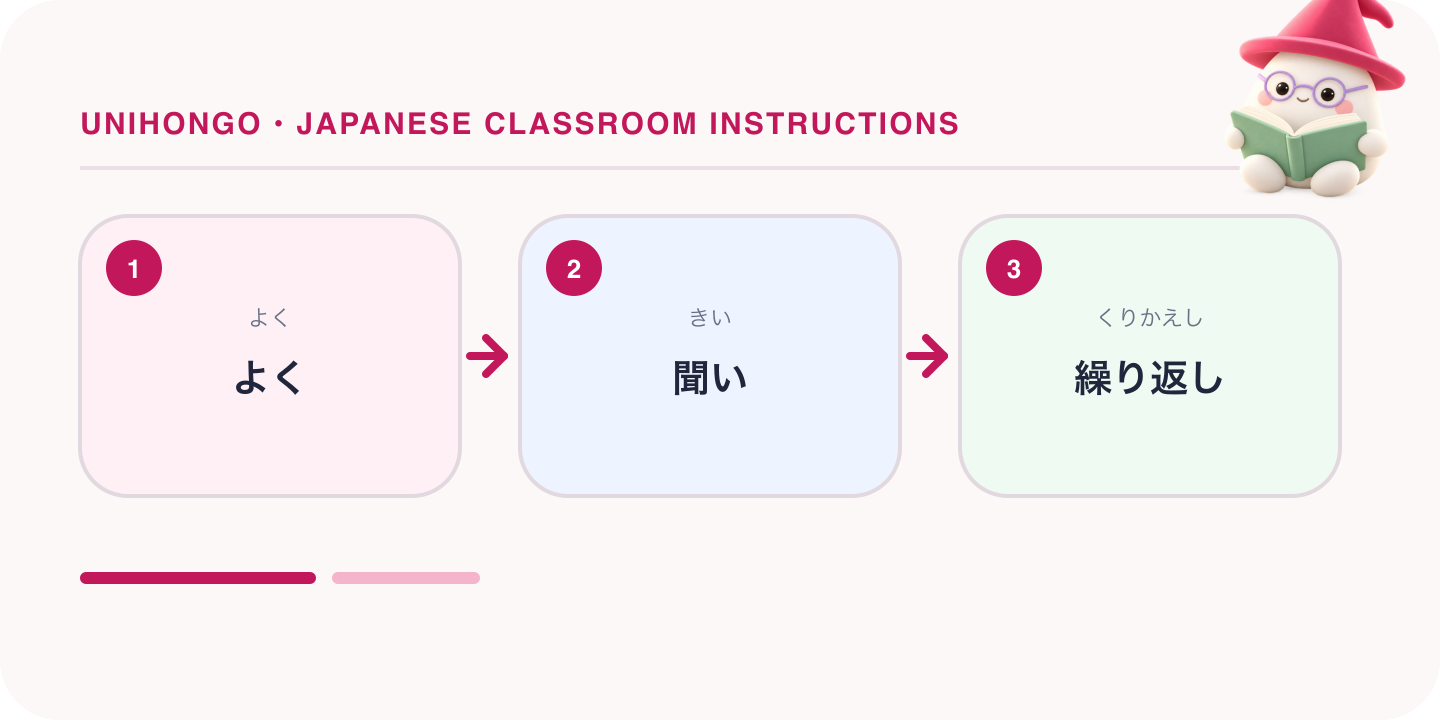
Almost every classroom instruction has the same shape: a verb in the te form plus kudasai. Once you can hear the verb stem, you know what to do even if the rest of the sentence is a blur. Kiite kudasai is listen, yonde kudasai is read, kaite kudasai is write, kurikaeshite kudasai is repeat, and mite kudasai is look. The teacher may drop kudasai with a group they know well and say only kiite or yonde, which sounds brisk rather than rude.
Instructions about the book use pēji, page, and hiraku, to open. Pēji o hiraite kudasai is open your book to the page, usually with a number in front: jūni pēji o hiraite kudasai, open to page twelve. Pair work is announced with pea ni natte kudasai, get into pairs, and group work with gurūpu ni natte kudasai. Tonari no hito, the person next to you, is the usual partner.
| Japanese | Romaji | Meaning |
|---|---|---|
| よく聞いてください。 | Yoku kiite kudasai. | Please listen carefully. |
| 私の後について繰り返してください。 | Watashi no ato ni tsuite kurikaeshite kudasai. | Please repeat after me. |
| 十二ページを開いてください。 | Jūni pēji o hiraite kudasai. | Please open your book to page twelve. |
| 三番を読んでください。 | Sanban o yonde kudasai. | Please read number three. |
| ノートに書いてください。 | Nōto ni kaite kudasai. | Please write it in your notebook. |
| 隣の人とペアになってください。 | Tonari no hito to pea ni natte kudasai. | Please pair up with the person next to you. |
| はい、ここまでです。 | Hai, koko made desu. | Right, that's it for now. |
Instruction verbs in one table
The verbs below cover most of what a teacher says while running an activity. The Reading column gives the te kudasai form as you will hear it. Learn them as sounds first: you will recognise them in class long before you can spell them.
| Word | Reading | Meaning |
|---|---|---|
| 聞いてください | kiite kudasai | please listen |
| 繰り返してください | kurikaeshite kudasai | please repeat |
| 読んでください | yonde kudasai | please read |
| 書いてください | kaite kudasai | please write |
| 見てください | mite kudasai | please look |
| 言ってください | itte kudasai | please say |
| 答えてください | kotaete kudasai | please answer |
| 開いてください | hiraite kudasai | please open (a book) |
| 閉じてください | tojite kudasai | please close (a book) |
| 立ってください | tatte kudasai | please stand up |
| 座ってください | suwatte kudasai | please sit down |
| 覚えてください | oboete kudasai | please memorise |
Two near-synonyms are worth separating. Yomu is to read and iu is to say; a teacher who wants you to read the text says yonde kudasai, but one who wants you to produce a sentence from memory says itte kudasai. Hiraku and akeru both mean open, but books and pages take hiraku, while doors and windows take akeru.
What you say as a student
Students need fewer phrases than teachers, but they need them instantly, in the middle of a lesson, when the brain is already busy. The four that matter most are mō ichido onegaishimasu, once more please; wakarimasen, I don't understand; shitsumon ga arimasu, I have a question; and sumimasen, which opens any of them politely. Wakarimashita, understood, and hai, yes, are the replies that tell the teacher they can move on.
Permission questions use te mo ii desu ka. Toire ni itte mo ii desu ka, may I go to the toilet, is the classic, and the same pattern gives jisho o tsukatte mo ii desu ka, may I use a dictionary, and hayaku kaette mo ii desu ka, may I leave early. For a word you do not know, ask X wa nihongo de nan to iimasu ka, how do you say X in Japanese, or X wa dō iu imi desu ka, what does X mean.
Wakarimasen and shirimasen are not the same. Wakarimasen means I do not understand or I cannot tell; shirimasen means I do not know the fact and can sound blunt. In class, when a teacher asks a question you cannot answer, wakarimasen is the natural choice.
| Japanese | Romaji | Meaning |
|---|---|---|
| すみません、もう一度お願いします。 | Sumimasen, mō ichido onegaishimasu. | Sorry, once more please. |
| もう少しゆっくりお願いします。 | Mō sukoshi yukkuri onegaishimasu. | A little slower, please. |
| すみません、よくわかりません。 | Sumimasen, yoku wakarimasen. | Sorry, I don't quite understand. |
| 質問があります。 | Shitsumon ga arimasu. | I have a question. |
| トイレに行ってもいいですか。 | Toire ni itte mo ii desu ka. | May I go to the toilet? |
| この言葉はどういう意味ですか。 | Kono kotoba wa dō iu imi desu ka. | What does this word mean? |
| 「deadline」は日本語で何と言いますか。 | 'Deadline' wa nihongo de nan to iimasu ka. | How do you say 'deadline' in Japanese? |
Grammar terms used in explanations
Grammar explanations in a Japanese-medium class use a set of technical words that most textbooks never teach directly. The parts of speech are meishi, noun; dōshi, verb; keiyōshi, adjective, split into i-keiyōshi and na-keiyōshi; fukushi, adverb; and joshi, particle. Katsuyō is conjugation, and the forms have names ending in kei: jisho-kei, dictionary form; masu-kei, masu form; te-kei, te form; nai-kei, negative form; and ta-kei, past form.
Sentence-level terms come up when the teacher corrects you. Shugo is the subject, jutsugo the predicate, and bun a sentence. Teinei-go is polite speech and futsū-tai is plain style. Rei is an example, so rei o mite kudasai means look at the example, and reibun is an example sentence. When a teacher says kono bun wa chotto fushizen desu, this sentence is a little unnatural, they mean it is grammatical but not what a native speaker would say.
| Word | Reading | Meaning |
|---|---|---|
| 名詞 | meishi | noun |
| 動詞 | dōshi | verb |
| 形容詞 | keiyōshi | adjective |
| 副詞 | fukushi | adverb |
| 助詞 | joshi | particle |
| 活用 | katsuyō | conjugation |
| 辞書形 | jisho-kei | dictionary form |
| て形 | te-kei | te form |
| 主語 | shugo | subject |
| 例文 | reibun | example sentence |
| 文法 | bunpō | grammar |
| 発音 | hatsuon | pronunciation |
The words are worth learning because teachers use them as shorthand. Dōshi o te-kei ni shite kudasai, put the verb into the te form, is a full instruction in five words, and once you know the terms you can also ask precise questions, such as kono joshi wa naze ga desu ka, why is this particle ga?
Homework, tests and deadlines
Shukudai is homework, and the verb is dasu, to hand out or hand in, depending on who is doing it: the teacher says shukudai o dashimasu, I'm setting homework, and later shukudai o dashite kudasai, hand in your homework. Teishutsu is the formal word for submission, so teishutsu-bi is the hand-in date and shimekiri is the deadline. Fukushū is reviewing what you have done and yoshū is previewing what is coming; a teacher who says yoshū shite kite kudasai wants you to look at the next chapter before class.
Tests come in sizes. A shō-tesuto is a small quiz, often weekly, and a shiken is a proper exam; the JLPT is a shiken. Chūkan shiken is the mid-term and kimatsu shiken the end-of-term exam. Results are seiseki, marks are ten, gōkaku is passing and fugōkaku is failing.
Attendance has its own vocabulary because schools track it closely. Shusseki is attendance, kesseki is absence, and chikoku is arriving late. Schools set a minimum shusseki-ritsu, attendance rate, and the figure varies, so ask the office.
| Japanese | Romaji | Meaning |
|---|---|---|
| 宿題は明日までに出してください。 | Shukudai wa ashita made ni dashite kudasai. | Please hand in the homework by tomorrow. |
| 来週、小テストがあります。 | Raishū, shō-tesuto ga arimasu. | There is a small quiz next week. |
| 試験の範囲はどこまでですか。 | Shiken no han'i wa doko made desu ka. | How far does the exam cover? |
| 第五課を復習してください。 | Dai-goka o fukushū shite kudasai. | Please review lesson five. |
| 明日は用事で欠席します。 | Ashita wa yōji de kesseki shimasu. | I'll be absent tomorrow because of an errand. |
| 締め切りを延ばしてもらえますか。 | Shimekiri o nobashite moraemasu ka. | Could you extend the deadline? |
Classroom objects and materials
A few nouns come up so often that they are worth a list of their own. Kyōkasho is the textbook and the school may call it simply hon or tekisuto. Purinto is a handout, and purinto o kubarimasu means I'm handing out sheets. Kokuban is a blackboard and howaitobōdo a whiteboard; teachers say kokuban o mite kudasai for either. Nōto is a notebook, enpitsu a pencil, keshigomu a rubber, and jisho a dictionary.
Kyōshitsu is the classroom, jugyō is a lesson or class, and kyūkei is a break. Sensei is the teacher and the polite way to address them, while gakusei or seito is a student. In a language school the office is jimusho.
- Kyōkasho: textbook; tekisuto is common too
- Purinto: handout; the teacher hands them out with kubarimasu
- Nōto, enpitsu, keshigomu: notebook, pencil, rubber
- Kokuban, howaitobōdo: blackboard, whiteboard
- Jisho: dictionary; denshi jisho is an electronic one
- Jugyō, kyūkei: lesson, break
- Kyōshitsu, jimusho: classroom, office
Counters follow the objects: pages take pēji, sheets of paper take mai, and books take satsu. Purinto o ichimai totte kudasai, take one handout, and kyōkasho o issatsu kaimashita, I bought one textbook, both come up in the first week.
Politeness in the classroom
Language school classrooms are polite but not formal. You speak to the teacher in desu and masu, and the teacher speaks to you the same way, sometimes dropping into plain forms for emphasis or humour. Address the teacher as sensei, never by name plus san. Classmates are usually first name or family name plus san, depending on the class culture.
Greetings frame the lesson. Ohayō gozaimasu at the start of a morning class, konnichiwa after noon, and at the end the teacher may say kyō wa koko made, that's all for today, or otsukaresama deshita. Reply with arigatō gozaimashita, past tense, because the lesson is over. When you leave the room before others, shitsurei shimasu is the phrase.
One pattern to avoid is answering a teacher's polite question in plain form. If the teacher asks wakarimashita ka, reply hai, wakarimashita rather than un, wakatta. The plain form is fine among classmates in pair work, but with the teacher, desu and masu keep the tone right.
| Japanese | Romaji | Meaning |
|---|---|---|
| 先生、おはようございます。 | Sensei, ohayō gozaimasu. | Good morning, teacher. |
| はい、わかりました。 | Hai, wakarimashita. | Yes, I understand. |
| ありがとうございました。 | Arigatō gozaimashita. | Thank you (for the lesson). |
| お先に失礼します。 | Osaki ni shitsurei shimasu. | Excuse me for leaving first. |
| 先生、ちょっといいですか。 | Sensei, chotto ii desu ka. | Teacher, do you have a moment? |
When you get lost in a lesson
Every learner loses the thread sometimes: the teacher moves fast, the page number is missed, or an instruction uses a verb you have not learned. The worst response is to freeze and copy your neighbour, because the teacher cannot help what they cannot see. Instead use the small repair phrases: sumimasen, ima nan to iimashita ka, sorry, what did you just say? Doko desu ka, where are we?
If you understand the words but not the task, say yarikata ga wakarimasen, and the teacher will show an example. If you understand the task but cannot answer, wakarimasen is enough. If you arrive late, say osoku natte sumimasen at the door and sit down quietly; a long apology interrupts more than the lateness did.
If you think a correction contradicts something the teacher said last week, ask rather than argue: dochira ga tadashii desu ka, which is correct? It usually turns out both are fine.
| Japanese | Romaji | Meaning |
|---|---|---|
| すみません、今どこですか。 | Sumimasen, ima doko desu ka. | Sorry, where are we now? |
| やり方がわかりません。 | Yarikata ga wakarimasen. | I don't understand how to do it. |
| もう一度説明していただけますか。 | Mō ichido setsumei shite itadakemasu ka. | Could you explain it once more? |
| 遅くなってすみません。 | Osoku natte sumimasen. | Sorry I'm late. |
| どちらが正しいですか。 | Dochira ga tadashii desu ka. | Which one is correct? |
| 例を見せてもらえますか。 | Rei o misete moraemasu ka. | Could you show me an example? |