
The idea in four famous examples
Read the digits of 39 one by one and you get san and kyū: sankyū, thank you. Read 4649 as yo, ro, shi, ku and you get yoroshiku. Read 29 as ni, ku and it is niku (肉), meat, which is why the 29th is meat day at many shops. And because a cat says nyan in Japanese and 2 is ni, February 22, ni ni ni, became cat day, neko no hi (猫の日).
That is goroawase: choosing, from the several readings each digit allows, the ones that spell a word.
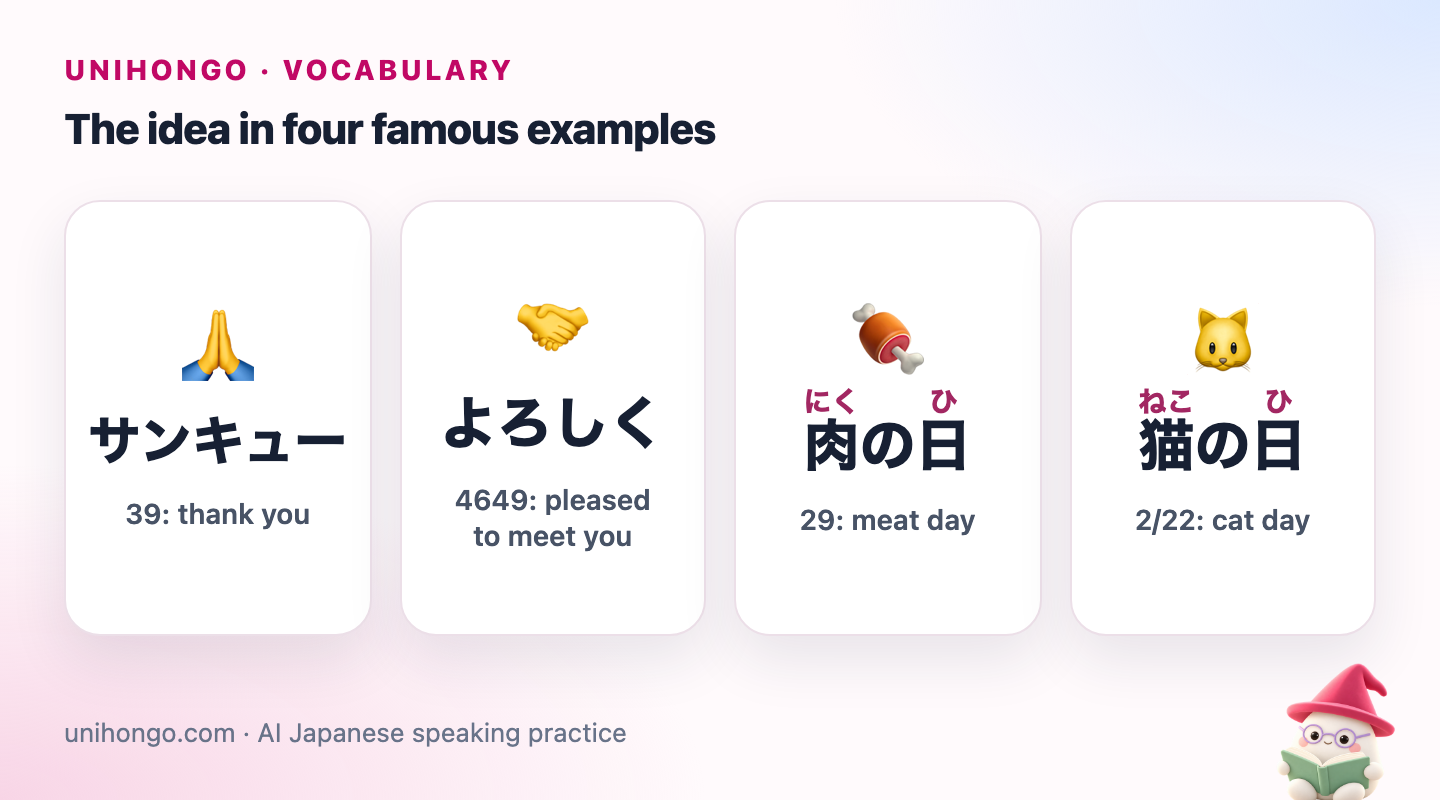
| Japanese | Romaji | Meaning |
|---|---|---|
| サンキュー | sankyū | 39: thank you |
| よろしく | yoroshiku | 4649: pleased to meet you |
| 肉の日 | niku no hi | 29: meat day |
| 猫の日 | neko no hi | 2/22: cat day |
The readings for each digit
The kit below covers almost every goroawase you will meet. Notice that readings may be cut short (ichi to i, roku to ro), voiced or unvoiced (ha to ba, go to ko), and that a long vowel can be added or dropped as needed.
| Digit | Reading | Where it comes from |
|---|---|---|
| 0 | re, o, maru, wa | Rei is zero; o is the shape of the letter; maru and wa both mean circle |
| 1 | i, hi, hito | Ichi, and the native hitotsu |
| 2 | ni, fu, futa, tsū | Ni, the native futatsu, and English two |
| 3 | sa, san, mi | San, and the native mittsu |
| 4 | yo, shi | Yon or shi, and the native yottsu |
| 5 | go, ko, itsu | Go, sometimes unvoiced to ko, and the native itsutsu |
| 6 | ro, mu | Roku, and the native muttsu |
| 7 | na, nana, shichi | Nana and shichi |
| 8 | ha, ya, pa, ba | Hachi, with ha also voiced to ba or pa, and the native yattsu |
| 9 | ku, kyū | The two standard readings of nine |
| 10 | tō, jū, te | The native tō, the standard jū, and English ten |
Messages written in digits
In the 1990s, before mobile phones could send text, Japanese teenagers sent each other digits on pagers, and goroawase became a writing system. A few of those codes are still widely recognised.
| Japanese | Romaji | Meaning |
|---|---|---|
| おはよう | ohayō | 0840: good morning |
| 何してる | nani shiteru | 724106: what are you doing? |
| ご苦労さん | gokurōsan | 5963: thanks for your hard work |
| ニコニコ | nikoniko | 2525: smiling |
In 0840 the zeros are read o, 8 is ha and 4 is yo. In 724106 the 10 is te, from English ten, and 6 is ru. Today you will see these mostly in usernames, on car number plates and in jokes, but nearly everyone understands a 39 at the end of a message.
Pun days on the calendar
Japan has hundreds of unofficial commemorative days, and a large share of them are goroawase on the date. They are not public holidays. Most were proposed by trade groups or companies, so you will meet them as shop promotions and social media posts.
| Japanese | Romaji | Meaning |
|---|---|---|
| いい夫婦の日 | ii fūfu no hi | November 22: good couple day |
| いい肉の日 | ii niku no hi | November 29: good meat day |
| いい風呂の日 | ii furo no hi | November 26: good bath day |
| 野菜の日 | yasai no hi | August 31: vegetable day |
| バナナの日 | banana no hi | August 7: banana day |
| 豆腐の日 | tōfu no hi | October 2: tofu day |
November is rich in these days because 11 reads ii, good: 11/22 is ii fūfu and 11/26 is ii furo. August 31 is ya-sa-i, August 7 is ba-nana, with 8 voiced to ba, and October 2 is tō-fu.
History dates and square roots: school mnemonics
Japanese students memorise dates and constants with goroawase sentences, and adults can still recite them decades later.
| Japanese | Romaji | Meaning |
|---|---|---|
| いい国つくろう鎌倉幕府 | Ii kuni tsukurō Kamakura bakufu | 1192: build a good country, Kamakura shogunate |
| 鳴くよウグイス平安京 | Naku yo uguisu Heian-kyō | 794: the warbler sings, Heian-kyō |
| 意欲に燃えるコロンブス | Iyoku ni moeru Koronbusu | 1492: Columbus, burning with ambition |
| 一夜一夜に人見頃 | Hitoyo hitoyo ni hitomigoro | 1.41421356: the square root of 2 |
Ii kuni is i-i-ku-ni, 1192, the year Minamoto no Yoritomo was appointed shogun. Many textbooks now treat 1185 as the start of the Kamakura shogunate, so today's students often learn ii hako tsukurō, i-i-ha-ko, instead. Naku yo is na-ku-yo, 794, when the capital moved to Heian-kyō, today's Kyoto. Iyoku ni is i-yo-ku-ni, 1492.
The square root phrase reads hito-yo-hito-yo-ni-hito-mi-go-ro: 1, 4, 1, 4, 2, 1, 3, 5, 6. The sentence means roughly night after night, a fine time for viewing, which has nothing to do with mathematics and is easy to remember for that very reason.
Phone numbers and price tags
Businesses choose phone numbers that read as an advertisement. A dentist may end the number in 4618, shi-ro-i-ha, white teeth, or 6480, mu-shi-ba-zero, no cavities. A florist may pick 8783, ha-na-ya-san, the flower shop. One long-running TV jingle for a hot-spring hotel told viewers to call 4126, yo-i-fu-ro, good bath. Advertisements usually print the reading in small kana above the digits so that nobody misses the joke.
Prices have their own spoken shorthand. A 298 yen tag is called nī-kyuppa and 398 yen san-kyuppa, clipped from ni-kyū-hachi and san-kyū-hachi. This is not quite goroawase, but it comes from the same habit of squeezing numbers into catchy sounds. Shops also like to price a thank-you sale at 390 or 3,900 yen.
Unlucky sounds: why 4 and 9 are avoided
The same sound-matching explains two famous superstitions. Shi, one reading of 4, sounds like shi (死), death, and ku, one reading of 9, sounds like ku (苦), suffering. Some hospitals and hotels skip room numbers containing 4, and many people avoid giving gifts in sets of four. It is one reason yon is the more common everyday reading of 4.
Not all number luck is about sound. Eight is liked because its kanji 八 widens toward the bottom, a shape associated with growing fortune.
How learners can use goroawase
- Learn both number sets first: ichi, ni, san and hito, futa, mi. Goroawase is the best reason to learn the native set properly.
- Write the number, then try the short readings from the table until a real word or phrase appears. A silly phrase is fine; silly is memorable.
- Say the phrase and the digits aloud together several times, so that one calls up the other.
- Collect real examples from signs, adverts and receipts in Japan. The small kana above a phone number tell you the intended reading.
- Keep 4649 and 39 for friends. They are playful and do not belong in formal writing.