
Where number talk breaks down
Most learners meet counters early and assume the number work is done. Then a shop sign says sanwaribiki, a pharmacist says the dose is a third of a tablet, and a colleague reports that sales are up two wari. None of those are counter problems. They are separate patterns with their own word order, and each one appears in ordinary speech far more often than the large numbers beginners drill.
The good news is that there are only four patterns to learn: bun no for fractions, pāsento and wari for proportions, ten for decimals, and bai for multiples. Around them sits a small vocabulary of change and comparison. Learn those together and price tags, weather forecasts and news headlines all open at once.
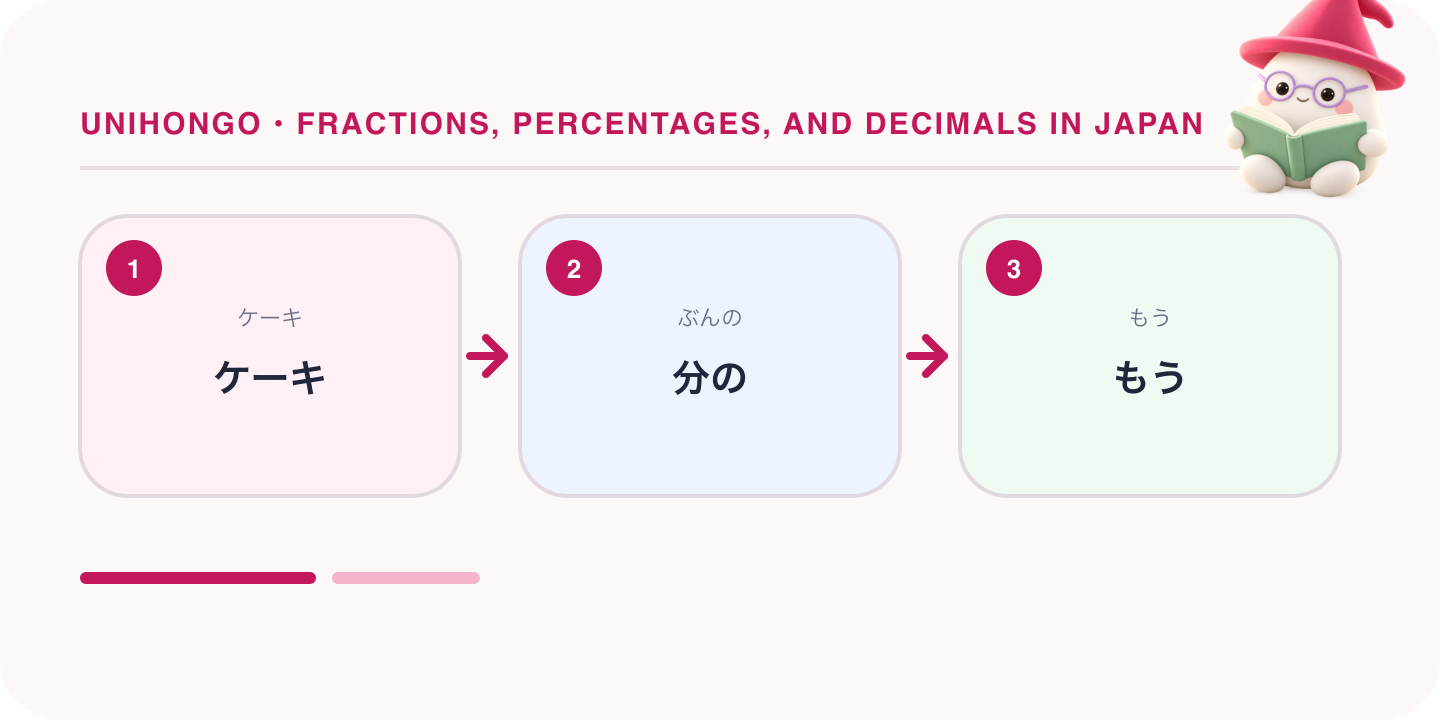
Fractions put the denominator first
The pattern is denominator plus bun no plus numerator. Sanbun no ichi is one third, and yonbun no san is three quarters. Note that 分 is read bun here, not fun as in minutes or bu as in the discount system below. The number readings stay in their common forms: yon for four, nana for seven, kyū for nine.
A fraction can sit anywhere a number sits. It takes no of its own before a noun, as in sanbun no ichi no ryō, meaning a third of the amount. When you are dividing something between people, add zutsu: sanbun no ichi zutsu means a third each.
| Japanese | Romaji | Meaning |
|---|---|---|
| ケーキを四分の一ください。 | Kēki o yonbun no ichi kudasai. | A quarter of the cake, please. |
| 三分の二はもう終わりました。 | Sanbun no ni wa mō owarimashita. | Two thirds of it is already done. |
| クラスの十分の一が休みです。 | Kurasu no jūbun no ichi ga yasumi desu. | A tenth of the class is absent. |
| 三分の一ずつ分けましょう。 | Sanbun no ichi zutsu wakemashō. | Let's split it into thirds. |
| Fraction | Japanese | Reading |
|---|---|---|
| 1/2 | 二分の一 | Nibun no ichi |
| 1/3 | 三分の一 | Sanbun no ichi |
| 2/3 | 三分の二 | Sanbun no ni |
| 1/4 | 四分の一 | Yonbun no ichi |
| 3/4 | 四分の三 | Yonbun no san |
| 1/5 | 五分の一 | Gobun no ichi |
| 1/6 | 六分の一 | Rokubun no ichi |
| 2/7 | 七分の二 | Nanabun no ni |
| 3/8 | 八分の三 | Hachibun no san |
| 4/9 | 九分の四 | Kyūbun no yon |
| 1/10 | 十分の一 | Jūbun no ichi |
| 1/100 | 百分の一 | Hyakubun no ichi |
| a half | 半分 | Hanbun |
Hanbun and the everyday half
Nibun no ichi is mathematically correct but rare in conversation. For a half you say hanbun, and it behaves like a noun: hanbun ni kiru, to cut in half, hanbun dake, only half, hanbun ijō, more than half. The prefix han also attaches to counters you already know, giving ichijikan han for an hour and a half and hangaku for half price.
Hanbunko, with the child-friendly ko ending, is a casual way to say let us go halves and is common between friends and within families. Keep it out of business speech, where hanbun zutsu or the split-bill vocabulary later in this post fits better.
| Japanese | Romaji | Meaning |
|---|---|---|
| 半分に切ってください。 | Hanbun ni kitte kudasai. | Please cut it in half. |
| 残りは半分くらいです。 | Nokori wa hanbun kurai desu. | About half is left. |
| 半分以上できました。 | Hanbun ijō dekimashita. | I have finished more than half. |
| 四分の一だけ食べました。 | Yonbun no ichi dake tabemashita. | I only ate a quarter. |
| 半分こしよう。 | Hanbunko shiyō. | Let's go halves. (casual) |
Percentages with pāsento
Pāsento is the everyday word for percent in forecasts, batteries, survey results and science. The sound changes you already know from counters apply: ten, twenty, thirty and so on take the small tsu before the p, giving juppāsento, nijuppāsento and sanjuppāsento. Numbers that end in other digits keep their plain reading, so twenty-five is nijūgo pāsento.
The symbol % is read pāsento as well, and a percentage discount printed in digits is usually spoken with biki attached, so a 20% tag becomes nijuppāsento biki in a staff member's mouth. To ask how big a discount is, say nan pāsento biki desu ka. Note that pāsento is the figure itself, while a rate expressed as a proportion of something takes ritsu, as in the news vocabulary later in this post.
| Japanese | Romaji | Meaning |
|---|---|---|
| 電池が二十パーセント残っています。 | Denchi ga nijuppāsento nokotte imasu. | The battery has twenty percent left. |
| 降水確率は三十パーセントです。 | Kōsui kakuritsu wa sanjuppāsento desu. | The chance of rain is thirty percent. |
| 百パーセント確実ではありません。 | Hyaku pāsento kakujitsu de wa arimasen. | It is not a hundred percent certain. |
| 何パーセント引きですか? | Nan pāsento biki desu ka? | What percentage is off? |
| 五パーセントのポイントが付きます。 | Go pāsento no pointo ga tsukimasu. | You get five percent back in points. |
| Value | Japanese | Reading |
|---|---|---|
| 1% | 一パーセント | Ichi pāsento |
| 5% | 五パーセント | Go pāsento |
| 10% | 十パーセント | Juppāsento |
| 20% | 二十パーセント | Nijuppāsento |
| 25% | 二十五パーセント | Nijūgo pāsento |
| 30% | 三十パーセント | Sanjuppāsento |
| 50% | 五十パーセント | Gojuppāsento |
| 75% | 七十五パーセント | Nanajūgo pāsento |
| 100% | 百パーセント | Hyaku pāsento |
| 0.5% | 〇・五パーセント | Rei ten go pāsento |
The wari, bu and rin system
Alongside pāsento, Japanese keeps a native decimal system for proportions. Ichiwari is one tenth, so ten percent. Ichibu is one hundredth, so one percent, and ichirin is one thousandth, so a tenth of a percent. The three stack from largest to smallest, which is how a baseball average such as .325 is said: sanwari nibu gorin.
Wari is the one you must own. It appears in discounts, in rough talk about people and results, and in business reporting where niwari sounds more natural than nijuppāsento. Watch the reading of 分 here: it is bu in this system, bun in fractions, and fun in clock minutes. Also remember the fixed expression gobu gobu, meaning fifty-fifty or an even chance.
| Japanese | Reading | Value |
|---|---|---|
| 一割 | Ichiwari | 10% |
| 二割 | Niwari | 20% |
| 三割 | Sanwari | 30% |
| 四割 | Yonwari | 40% |
| 五割 | Gowari | 50% |
| 六割 | Rokuwari | 60% |
| 七割 | Nanawari | 70% |
| 八割 | Hachiwari | 80% |
| 九割 | Kyūwari | 90% |
| 十割 | Jūwari | 100% |
| 一分 | Ichibu | 1% |
| 五分 | Gobu | 5% |
| 一厘 | Ichirin | 0.1% |
| 三割二分五厘 | Sanwari nibu gorin | 32.5%, read as .325 in sport |
Because wari counts tenths, converting is a single step: multiply by ten for percent, divide by ten to go back. Hachiwari no hito means eighty percent of people, and the softened hachiwari gurai is the usual way to say most of them without claiming a measured figure.
Reading a sale sign
This is the sentence worth memorising: sanwaribiki means thirty percent off, not thirty percent of the price. The biki comes from hiku, to subtract, so the wari figure is what is taken away. You pay the remaining seventy percent. Learners who read it the other way walk away from a good deal or expect a bargain that is not there.
Retail jargon offers the mirror image. Nanakake, seven times, means you pay seven tenths of the list price, which is the same as sanwaribiki. Hangaku is half price. Zeikomi means the tax is already in the figure and zeinuki means it is not, and staff will often confirm which before you pay.
| Japanese | Romaji | Meaning |
|---|---|---|
| これは三割引きですか? | Kore wa sanwaribiki desu ka? | Is this thirty percent off? |
| はい、レジで三割引きになります。 | Hai, reji de sanwaribiki ni narimasu. | Yes, it comes off at the till. (staff) |
| 割引後の値段はいくらですか? | Waribikigo no nedan wa ikura desu ka? | How much is it after the discount? |
| これは税込みですか、税抜きですか? | Kore wa zeikomi desu ka, zeinuki desu ka? | Is that with tax or before tax? |
| 二点目は半額になります。 | Niten-me wa hangaku ni narimasu. | The second one is half price. (staff) |
| セール品は返品できません。 | Sēruhin wa henpin dekimasen. | Sale items cannot be returned. (staff) |
| Sign | Reading | What you pay |
|---|---|---|
| 一割引き | Ichiwaribiki | 10% off, you pay 90% |
| 二割引き | Niwaribiki | 20% off, you pay 80% |
| 三割引き | Sanwaribiki | 30% off, you pay 70% |
| 五割引き | Gowaribiki | 50% off, you pay half |
| 半額 | Hangaku | Half price |
| 30%OFF | Sanjuppāsento ofu | 30% off, you pay 70% |
| 全品20%引き | Zenpin nijuppāsento biki | 20% off every item in the shop |
| 七掛け | Nanakake | 70% of the list price, so 30% off |
| 二点目半額 | Niten-me hangaku | Half price on the second item |
| さらに半額 | Sara ni hangaku | Half off again on top of the marked price |
| 税込価格 | Zeikomi kakaku | Price with tax included |
| 税抜価格 | Zeinuki kakaku | Price before tax is added |
Decimals with ten
The decimal point is ten, written 点 or as the middle dot ・ in vertical text. Read the whole number normally, say ten, then read each digit after the point on its own. So 3.14 is san ten ichi yon, and 12.05 is jūni ten rei go. Zero is rei in careful speech and zero in casual or technical speech.
Where a counter follows, it usually attaches after the whole expression: ichi ten go bai for one and a half times, ni ten go kiro for two and a half kilos. Temperatures in everyday speech follow the same shape, sanjūnana ten ni do for 37.2 degrees.
| Japanese | Romaji | Meaning |
|---|---|---|
| 円周率は三・一四です。 | Enshūritsu wa san ten ichi yon desu. | Pi is three point one four. |
| 熱は三十七・二度あります。 | Netsu wa sanjūnana ten ni do arimasu. | My temperature is thirty-seven point two. |
| 平均点は七・五でした。 | Heikin-ten wa nana ten go deshita. | The average score was seven point five. |
| 〇・五秒遅れました。 | Rei ten go byō okuremashita. | It was half a second late. |
| 価格は一・五倍になりました。 | Kakaku wa ichi ten go bai ni narimashita. | The price became one and a half times higher. |
Multiples with bai
Bai attaches to a number to make a multiple: nibai twice, sanbai three times, jūbai ten times. On its own, bai already implies double, so ryōkin ga bai ni narimashita means the fee doubled. The question form is nanbai, how many times over.
To describe something as so many times bigger than something else, use A wa B no nibai desu, with no linking the comparison. Adding a measurement noun makes it precise: nibai no hirosa, twice the size, nibai no jikan, twice the time. The opposite direction is hanbun ni naru, to halve.
| Japanese | Romaji | Meaning |
|---|---|---|
| 去年の二倍売れました。 | Kyonen no nibai uremashita. | It sold twice as much as last year. |
| 三倍の時間がかかります。 | Sanbai no jikan ga kakarimasu. | It takes three times as long. |
| この部屋はあの部屋の二倍の広さです。 | Kono heya wa ano heya no nibai no hirosa desu. | This room is twice the size of that one. |
| 料金が倍になりました。 | Ryōkin ga bai ni narimashita. | The fee doubled. |
| 何倍になりましたか? | Nanbai ni narimashita ka? | How many times bigger did it get? |
Increase, decrease and comparison
Numbers rarely stand alone in speech. They arrive attached to a verb of change and a comparison. Fueru and heru are the intransitive pair, meaning something increases or decreases by itself, while fuyasu and herasu mean you increase or reduce it. For prices and rates, agaru and sagaru are more natural than fueru and heru.
Wrap the figure in a hedge unless you are certain of it. Yaku and daitai mean about, gurai softens a round number, and ijō, ika and miman mark more than, no more than, and under. Ni kurabete introduces the thing you are comparing with, and zengo after a figure means give or take.
| Japanese | Romaji | Meaning |
|---|---|---|
| 売上が二割増えました。 | Uriage ga niwari fuemashita. | Sales rose by twenty percent. |
| 人数が三割減りました。 | Ninzū ga sanwari herimashita. | The number of people fell by thirty percent. |
| 去年に比べて少し上がりました。 | Kyonen ni kurabete sukoshi agarimashita. | It went up slightly compared with last year. |
| 約半分に減りました。 | Yaku hanbun ni herimashita. | It fell to about half. |
| 三十パーセント以上増えました。 | Sanjuppāsento ijō fuemashita. | It increased by more than thirty percent. |
| 十パーセント未満です。 | Juppāsento miman desu. | It is under ten percent. |
- 増える fueru and 減る heru: the amount changes on its own
- 増やす fuyasu and 減らす herasu: you change the amount
- 上がる agaru and 下がる sagaru: prices, rates and temperatures
- 約 yaku, だいたい daitai, ぐらい gurai: approximately
- 以上 ijō, 以下 ika, 未満 miman: at least, at most, under
- ~に比べて ni kurabete and ~前後 zengo: compared with, give or take
Statistics in the news
News Japanese leans on ritsu, a rate: shijiritsu for an approval rating, shitsugyōritsu for unemployment, shichōritsu for viewing figures, daritsu for a batting average. These take wa and a figure, often with a verb of movement such as koeru, to exceed, or warikomu, to fall below. Listening for the ritsu word first tells you what the number is measuring before the number arrives.
| Japanese | Romaji | Meaning |
|---|---|---|
| 支持率は四割を超えました。 | Shijiritsu wa yonwari o koemashita. | The approval rating passed forty percent. |
| 回答者の三分の二が賛成しました。 | Kaitōsha no sanbun no ni ga sansei shimashita. | Two thirds of respondents were in favour. |
| 視聴率は十パーセント前後でした。 | Shichōritsu wa juppāsento zengo deshita. | The viewing figure was around ten percent. |
| 打率は三割二分五厘です。 | Daritsu wa sanwari nibu gorin desu. | His batting average is .325. |
| 失業率は前年並みです。 | Shitsugyōritsu wa zennen nami desu. | The unemployment rate is level with last year. |
Splitting the bill
Warikan, from waru, to divide, is the standard word for an even split. The polite offer is warikan ni shimashō ka. To propose a per-person figure, use the amount plus zutsu, and to ask for separate bills at the till say betsubetsu de onegai shimasu, though small restaurants sometimes ask you to settle as one group.
| Japanese | Romaji | Meaning |
|---|---|---|
| 割り勘にしましょうか。 | Warikan ni shimashō ka. | Shall we split it evenly? |
| 一人三千円ずつでどうですか? | Hitori sanzen-en zutsu de dō desu ka? | How about three thousand yen each? |
| 四人なので四分の一ずつです。 | Yonin na node yonbun no ichi zutsu desu. | There are four of us, so a quarter each. |
| 私が半分出します。 | Watashi ga hanbun dashimasu. | I will pay half. |
| 端数は私が払います。 | Hasū wa watashi ga haraimasu. | I will cover the odd change. |
| 別々でお願いします。 | Betsubetsu de onegai shimasu. | Separate bills, please. |