
The routine verbs in the order you do them
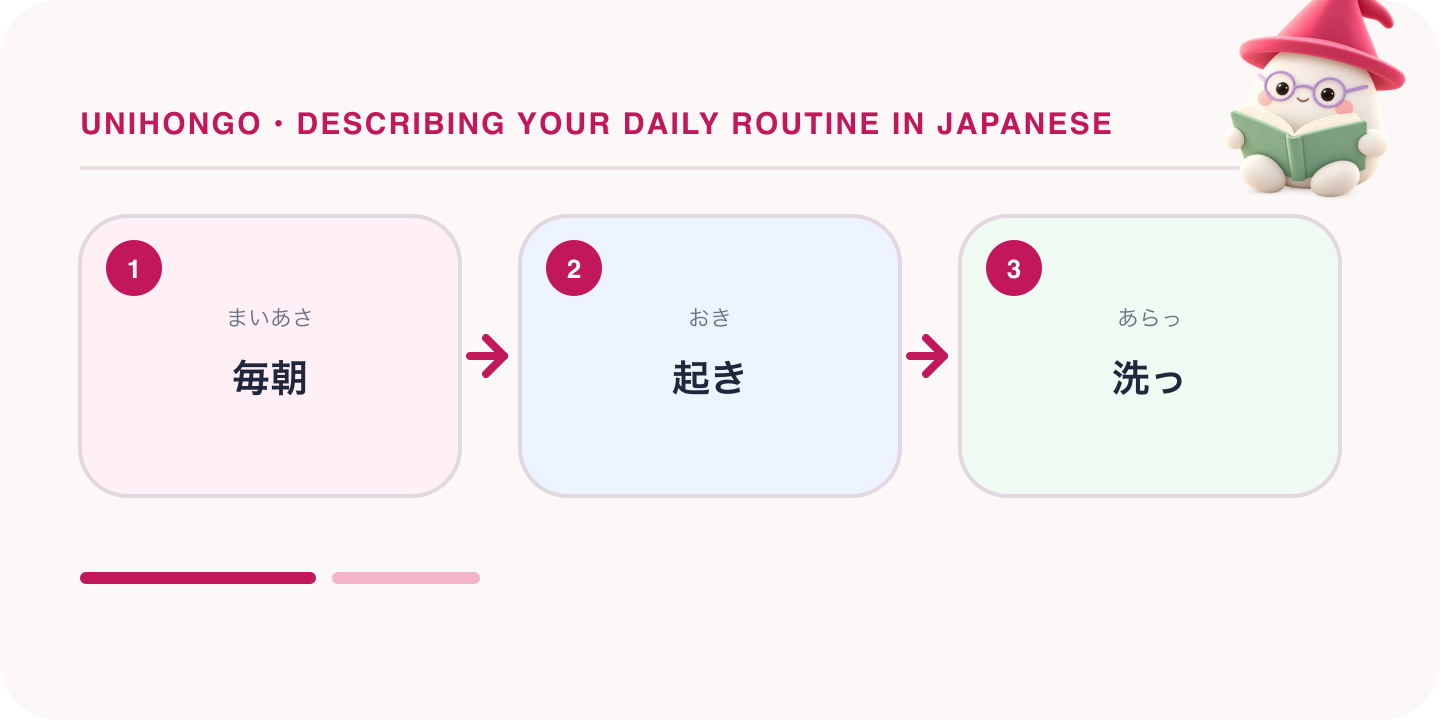
Start with the morning. Okimasu is to get up, kao o araimasu is to wash your face, and ha o migakimasu is to brush your teeth. Asagohan o tabemasu is to eat breakfast, kōhī o nomimasu is to drink coffee, and kigaemasu is to get changed. Ie o demasu is to leave the house, with o because you are leaving a place, and densha ni norimasu is to get on the train.
The daytime verbs are hatarakimasu (work), shigoto o shimasu (do your work), and benkyō shimasu (study), with hirugohan o tabemasu for lunch. The evening runs uchi ni kaerimasu (go home), bangohan o tsukurimasu (cook dinner), ofuro ni hairimasu (have a bath) or shawā o abimasu (take a shower), terebi o mimasu, and finally nemasu. Learn them in this order and the sequence itself becomes a memory aid.
| Japanese | Romaji | Meaning |
|---|---|---|
| 毎朝六時に起きます。 | Maiasa roku-ji ni okimasu. | I get up at six every morning. |
| 顔を洗って、歯を磨きます。 | Kao o aratte, ha o migakimasu. | I wash my face and brush my teeth. |
| 七時半に家を出ます。 | Shichi-ji han ni ie o demasu. | I leave the house at half past seven. |
| 六時ごろうちに帰ります。 | Roku-ji goro uchi ni kaerimasu. | I get home around six. |
| 十一時に寝ます。 | Jūichi-ji ni nemasu. | I go to bed at eleven. |
Nemasu covers both going to bed and sleeping, and okimasu covers both waking and getting up, so you do not need extra verbs for them. Uchi ni kaerimasu is written in kana here because the kanji for home can be read ie or uchi, and uchi is the everyday reading with kaeru.
Ni with clock times, nothing with relative words
A clock time takes ni: roku-ji ni, hachi-ji han ni, gogo san-ji ni. So do days of the week and dates, which the days and dates post on this blog covers. Relative time words take nothing: kesa (this morning), kyō (today), maiasa (every morning), maiban (every evening), mainichi (every day), asa, and yoru. The test is whether the word points to a fixed spot on a clock or calendar.
The most common learner error is maiasa ni okimasu, a direct translation of every morning at. The other is dropping ni after a clock time, which is understood but sounds clipped. Goro, meaning around, sits between the two: roku-ji goro ni and roku-ji goro are both fine, and many speakers drop the ni.
| Japanese | Romaji | Meaning |
|---|---|---|
| 今朝は七時に起きました。 | Kesa wa shichi-ji ni okimashita. | This morning I got up at seven. |
| 毎晩十時にお風呂に入ります。 | Maiban jū-ji ni ofuro ni hairimasu. | Every evening I have a bath at ten. |
| 朝はコーヒーだけ飲みます。 | Asa wa kōhī dake nomimasu. | In the morning I only have coffee. |
| 九時から五時まで働きます。 | Ku-ji kara go-ji made hatarakimasu. | I work from nine to five. |
Frequency words: itsumo, taitei, tokidoki, and the negatives
Frequency words sit before the verb phrase and need no particle. Itsumo is always, taitei is usually, yoku is often, tokidoki is sometimes, and tama ni is occasionally. Two more only work with a negative verb: amari, meaning not much, and zenzen, meaning not at all. Amari asagohan o tabemasen is the natural way to say you do not usually eat breakfast, and a positive verb after amari is a mistake native speakers notice at once. Counted frequency uses shū ni or tsuki ni plus a number of times: shū ni san-kai, tsuki ni ichi-do.
| Japanese | Romaji | Meaning |
|---|---|---|
| 朝はたいていパンを食べます。 | Asa wa taitei pan o tabemasu. | In the morning I usually eat bread. |
| 時々朝ご飯を抜きます。 | Tokidoki asagohan o nukimasu. | I sometimes skip breakfast. |
| 週に三回ジムに行きます。 | Shū ni san-kai jimu ni ikimasu. | I go to the gym three times a week. |
| 夜はあまりテレビを見ません。 | Yoru wa amari terebi o mimasen. | I do not watch much television at night. |
Linking steps: sorekara, sono ato, te kara, and mae ni
The simplest link is a separate sentence starting with sorekara (and then) or sono ato (after that). Both are fine in speech and give you a breath between steps. The next level joins two actions in one sentence with the te form: okite, kao o aratte, asagohan o tabemasu. Only the final verb carries the tense, so a whole morning can end in one masu or one mashita.
To make the order explicit, use te kara after the first action: asagohan o tabete kara, ha o migakimasu (after eating breakfast, I brush my teeth). To say before, use the dictionary form plus mae ni: neru mae ni hon o yomimasu (before sleeping, I read a book). Mae ni takes the dictionary form even when the whole sentence is past, so kinō, neru mae ni hon o yomimashita is correct.
| Japanese | Romaji | Meaning |
|---|---|---|
| 朝ご飯を食べてから、歯を磨きます。 | Asagohan o tabete kara, ha o migakimasu. | After breakfast I brush my teeth. |
| 会社に行く前に、コーヒーを飲みます。 | Kaisha ni iku mae ni, kōhī o nomimasu. | Before going to work, I have a coffee. |
| 寝る前に、本を読みます。 | Neru mae ni, hon o yomimasu. | Before bed, I read a book. |
| うちに帰ってから、晩ご飯を作ります。 | Uchi ni kaette kara, bangohan o tsukurimasu. | After getting home, I cook dinner. |
| それから、お風呂に入ります。 | Sorekara, ofuro ni hairimasu. | And then I have a bath. |
| その後、少しテレビを見ます。 | Sono ato, sukoshi terebi o mimasu. | After that I watch a little television. |
Te kara marks a strict sequence, so use it when the order matters, for example when you brush your teeth only after breakfast. When you simply list what happens, the plain te form chain is enough and sounds less laboured, and sorekara is the word to reach for when you need a pause.
The te iru habitual
The te iru form is taught first as an action in progress, but it also describes a settled habit. Maiasa hashitte imasu means I run every morning as a standing practice, and kaisha de hataraite imasu describes your job rather than this minute. Kayoimasu, to attend regularly, is almost always used this way: jimu ni kayotte imasu.
Both the masu form and the te iru form are correct for habits. The difference is emphasis: mainichi benkyō shimasu states the fact, and mainichi benkyō shite imasu presents the habit as a continuing part of your life, which is what someone expects when they ask what you are doing these days.
| Japanese | Romaji | Meaning |
|---|---|---|
| 毎朝三十分走っています。 | Maiasa sanjuppun hashitte imasu. | I run for thirty minutes every morning. |
| 週末はジムに通っています。 | Shūmatsu wa jimu ni kayotte imasu. | At weekends I go to the gym regularly. |
| 最近、毎日日本語を勉強しています。 | Saikin, mainichi Nihongo o benkyō shite imasu. | Recently I have been studying Japanese every day. |
| 銀行で働いています。 | Ginkō de hataraite imasu. | I work at a bank. |
A weekday versus a weekend
Heijitsu is a weekday and shūmatsu is the weekend. Setting them up with wa lets you contrast two routines in one breath: heijitsu wa roku-ji ni okimasu ga, shūmatsu wa ku-ji goro made nete imasu. The ga in the middle means but, made after a time means until, and nete imasu is the state of being asleep.
Weekend verbs shift towards leisure: sōji shimasu (clean), sentaku shimasu (do the laundry), kaimono ni ikimasu (go shopping), tomodachi ni aimasu (meet friends), and nani mo shimasen (do nothing), which is a perfectly good answer. Said aloud a few times, the contrast becomes a ready-made reply to Monday-morning small talk.
| Japanese | Romaji | Meaning |
|---|---|---|
| 平日は六時に起きますが、週末は九時ごろまで寝ています。 | Heijitsu wa roku-ji ni okimasu ga, shūmatsu wa ku-ji goro made nete imasu. | On weekdays I get up at six, but at weekends I sleep until around nine. |
| 土曜日は掃除と洗濯をします。 | Doyōbi wa sōji to sentaku o shimasu. | On Saturdays I clean and do the laundry. |
| 週末は何もしません。 | Shūmatsu wa nani mo shimasen. | At the weekend I do nothing. |
Yesterday: the past-tense version
Every routine sentence becomes a report of yesterday by changing masu to mashita and masen to masen deshita. Kinō wa at the front sets the frame. The time words and particles stay the same, and te kara and mae ni are unchanged because only the final verb changes tense, so a well-drilled routine pays off twice.
Past-tense routines are where real conversation happens, because colleagues ask what you did at the weekend and hosts ask what time you got in. The verb conjugation post on this blog covers the full past-tense system, but for routine talk the masu to mashita switch is enough.
| Japanese | Romaji | Meaning |
|---|---|---|
| 昨日は七時に起きました。 | Kinō wa shichi-ji ni okimashita. | Yesterday I got up at seven. |
| 朝ご飯を食べませんでした。 | Asagohan o tabemasen deshita. | I did not eat breakfast. |
| 昨日は残業しました。 | Kinō wa zangyō shimashita. | Yesterday I worked overtime. |
| 寝る前に、メールをチェックしました。 | Neru mae ni, mēru o chekku shimashita. | Before bed, I checked my email. |
| 昨日は十二時ごろ寝ました。 | Kinō wa jūni-ji goro nemashita. | Yesterday I went to bed around twelve. |
Asking someone about their routine
Routine questions are the safest questions in Japanese, because they are personal enough to be interesting and impersonal enough to ask a new colleague. Nan-ji ni asks what time, nani o asks what, and dono kurai asks how long. Put the frame first: maiasa nan-ji ni okimasu ka. Replies come back in the same shape, so listen for the verb at the end and the time word before it, then add a short reaction such as hayai desu ne (that is early).
| Japanese | Romaji | Meaning |
|---|---|---|
| 毎朝何時に起きますか? | Maiasa nan-ji ni okimasu ka? | What time do you get up every morning? |
| 通勤にどのくらいかかりますか? | Tsūkin ni dono kurai kakarimasu ka? | How long does your commute take? |
| 一時間ぐらいかかります。 | Ichi-jikan gurai kakarimasu. | It takes about an hour. |
| 週末は何をしていますか? | Shūmatsu wa nani o shite imasu ka? | What do you do at weekends? |
| 五時起きですか。早いですね。 | Go-ji oki desu ka. Hayai desu ne. | You get up at five? That is early. |
Reference table: routine verbs and what they take
| Verb | Romaji | Takes | English |
|---|---|---|---|
| 起きる | okiru | 六時に roku-ji ni | get up |
| 止める | tomeru | 目覚まし時計を mezamashi-dokei o | turn off (the alarm) |
| 洗う | arau | 顔を kao o | wash (your face) |
| 磨く | migaku | 歯を ha o | brush (your teeth) |
| 剃る | soru | ひげを hige o | shave |
| する | suru | 化粧を keshō o | put on make-up |
| 食べる | taberu | 朝ご飯を asagohan o | eat (breakfast) |
| 飲む | nomu | コーヒーを kōhī o | drink (coffee) |
| 着替える | kigaeru | スーツに sūtsu ni | get changed (into a suit) |
| 出る | deru | 家を ie o | leave (the house) |
| 乗る | noru | 電車に densha ni | get on (the train) |
| 行く | iku | 会社に kaisha ni | go (to work) |
| 働く | hataraku | 会社で kaisha de | work (at a company) |
| する | suru | 仕事を shigoto o | do (your work) |
| 勉強する | benkyō suru | 日本語を Nihongo o | study (Japanese) |
| 休む | yasumu | 昼休みに hiruyasumi ni | take a break (at lunch) |
| チェックする | chekku suru | メールを mēru o | check (email) |
| 帰る | kaeru | うちに uchi ni | go home |
| する | suru | 買い物を kaimono o | do the shopping |
| 作る | tsukuru | 晩ご飯を bangohan o | cook (dinner) |
| 入る | hairu | お風呂に ofuro ni | have (a bath) |
| 浴びる | abiru | シャワーを shawā o | take (a shower) |
| 見る | miru | テレビを terebi o | watch (television) |
| 読む | yomu | 本を hon o | read (a book) |
| する | suru | 掃除を sōji o | clean |
| する | suru | 洗濯を sentaku o | do the laundry |
| 散歩する | sanpo suru | 犬と inu to | go for a walk (with the dog) |
| 消す | kesu | 電気を denki o | turn off (the light) |
| 寝る | neru | 十一時に jūichi-ji ni | go to bed |
The Takes column is the part to memorise with the verb. Kaisha ni ikimasu but kaisha de hatarakimasu, ie o demasu but uchi ni kaerimasu: the particle changes with the verb, not with the noun, so learn each verb with its partner attached.
A full narrated day
Here is a complete weekday in twelve lines. Read it aloud once as written, then replace the times and objects with your own. The structure does not change, so once your version is fluent you can produce it in under a minute, which is the target for the warm-up in the next section.
| Japanese | Romaji | Meaning |
|---|---|---|
| 毎朝六時半に起きます。 | Maiasa roku-ji han ni okimasu. | I get up at half past six every morning. |
| 起きてから、シャワーを浴びます。 | Okite kara, shawā o abimasu. | After getting up, I take a shower. |
| それから、朝ご飯を食べて、コーヒーを飲みます。 | Sorekara, asagohan o tabete, kōhī o nomimasu. | Then I eat breakfast and drink coffee. |
| 八時に家を出て、電車に乗ります。 | Hachi-ji ni ie o dete, densha ni norimasu. | I leave the house at eight and get on the train. |
| 九時から仕事をします。 | Ku-ji kara shigoto o shimasu. | I start work at nine. |
| 十二時に同僚と昼ご飯を食べます。 | Jūni-ji ni dōryō to hirugohan o tabemasu. | At twelve I have lunch with colleagues. |
| 六時に仕事が終わります。 | Roku-ji ni shigoto ga owarimasu. | Work finishes at six. |
| 帰る前に、スーパーで買い物をします。 | Kaeru mae ni, sūpā de kaimono o shimasu. | Before going home, I shop at the supermarket. |
| うちに帰ってから、晩ご飯を作ります。 | Uchi ni kaette kara, bangohan o tsukurimasu. | After getting home, I cook dinner. |
| その後、お風呂に入って、少し日本語を勉強します。 | Sono ato, ofuro ni haitte, sukoshi Nihongo o benkyō shimasu. | After that I have a bath and study a little Japanese. |
| 寝る前に、スマホを見ないようにしています。 | Neru mae ni, sumaho o minai yō ni shite imasu. | I try not to look at my phone before bed. |
| 十一時ごろ寝ます。 | Jūichi-ji goro nemasu. | I go to bed around eleven. |
The eleventh line uses nai yō ni shite imasu, to make a point of not doing something, a natural way to mention a habit you are trying to keep. Skip it if it is beyond your level; the rest of the day is built from the patterns in this guide.
Your routine as a daily speaking warm-up
A routine makes a good warm-up because the content is already decided. You only need to think about how to say it, so all of your attention goes to particles, verb endings, and pronunciation. Two minutes of narrated routine before a lesson gets your mouth moving in Japanese.
- Say your morning aloud in real time while you do it, one sentence per action, from the alarm to the front door.
- Once a week, narrate the same morning in the past tense as if reporting yesterday, so mashita comes as easily as masu.
- Swap one time word each day: replace roku-ji ni with roku-ji goro, then with maiasa, and notice where ni disappears.
- Record your narrated day once a month and compare it with the previous recording, listening for pauses that used to be there.