
Three kanji, one sound
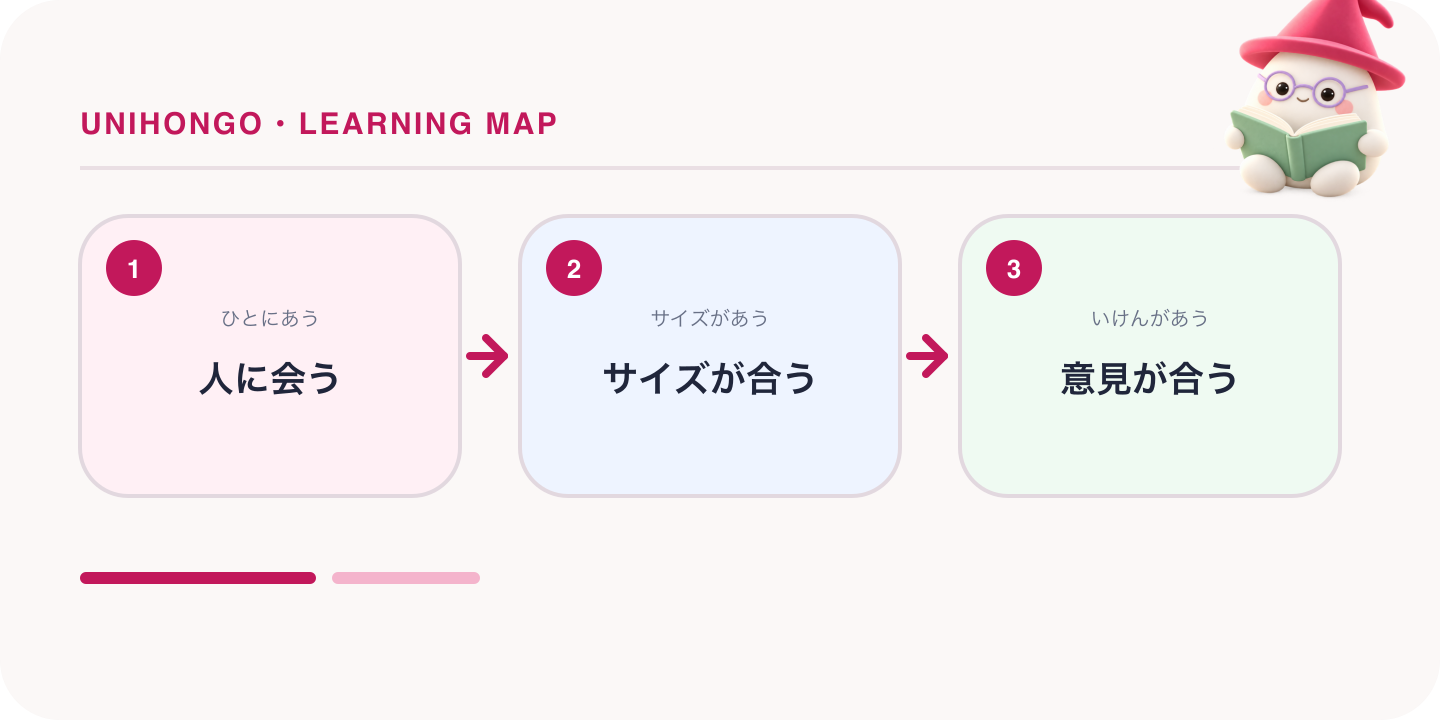
There is a single image under all three kanji: two things coming together. In 会う the two things are people, so the verb means meet. In 合う they are shapes, sizes, opinions or numbers, so the verb means fit, match or be correct. In 遭う one of them is misfortune arriving at you, so the verb means run into something bad. Once you hold that picture, the vocabulary stops looking like coincidence.
Grammatically au is a godan verb ending in u, and it conjugates the same way in every sense: aimasu, aimashita, awanai, atte, atta, and the potential aeru. Learners sometimes stumble on the te form, because the u drops and a small tsu appears: 会って atte, not aute. The past atta is identical in sound to the past of aru, so context and particles keep them apart.
There is also a transitive partner, awaseru, built from 合う. It means to make things match, and it appears everywhere: tokei o awasemasu for setting a watch, chikara o awasemasu for joining forces, kao o awasemasu for meeting face to face. If a sentence has a person deliberately aligning two things, awaseru is usually the verb you want, not au.
The sense table
| Sense | Kanji | Particle | Example |
|---|---|---|---|
| Meet a person, planned | 会 | に ni | 明日、友達に会います ashita, tomodachi ni aimasu |
| Meet up with someone, mutual | 会 | と to | 駅で友達と会います eki de tomodachi to aimasu |
| Bump into someone | 会 | に ni | ばったり先生に会いました battari sensei ni aimashita |
| Meet for the first time | 会 | に ni | 初めてお会いします hajimete o-ai shimasu |
| Encounter, meet by chance | 出会 | に ni | 旅先で出会いました tabisaki de deaimashita |
| A size fits | 合 | が ga | サイズが合いません saizu ga aimasen |
| Something fits a body part | 合 | に ni | 靴が足に合いません kutsu ga ashi ni aimasen |
| Suit a person or a life | 合 | に ni | この仕事は私に合っています kono shigoto wa watashi ni atte imasu |
| Be to someone's taste | 合 | に ni | お口に合いますか o-kuchi ni aimasu ka |
| Go well with something | 合 | に ni | 白ワインは魚に合います shiro wain wa sakana ni aimasu |
| Get on with someone | 合 | が ga | 彼とは気が合います kare to wa ki ga aimasu |
| Have things in common | 合 | が ga | 話が合います hanashi ga aimasu |
| Agree in opinion | 合 | が ga | 意見が合いません iken ga aimasen |
| Schedules line up | 合 | が ga | 予定が合えば行きます yotei ga aeba ikimasu |
| An answer is correct | 合 | が ga | 答えが合っています kotae ga atte imasu |
| Figures add up | 合 | が ga | 計算が合いません keisan ga aimasen |
| A clock is right | 合 | が ga | 時計が合っていません tokei ga atte imasen |
| Meet with an accident | 遭 | に ni | 事故に遭いました jiko ni aimashita |
| Get caught in the rain | 遭 | に ni | 雨に遭いました ame ni aimashita |
| Be robbed | 遭 | に ni | 泥棒に遭いました dorobō ni aimashita |
| Have a rough experience | 遭 | に ni | ひどい目に遭いました hidoi me ni aimashita |
| Suit someone, of clothes | 似合 | に ni | そのシャツ似合いますね sono shatsu niaimasu ne |
| Be in time for | 間に合 | に ni | 電車に間に合いました densha ni ma ni aimashita |
| Be mistaken | 間違 | が ga | 答えが間違っています kotae ga machigatte imasu |
| Set or align something | 合わせ | を o | 時計を合わせます tokei o awasemasu |
The particle column is the fastest way to tell the senses apart in speech, where no kanji is visible. A person marked with ni before au is a meeting; a thing marked with ga before au is a match; a misfortune marked with ni is 遭う. If you can hear the particle, you have already understood the sentence.
Meeting people with 会う
会う takes ni for the person, and the place takes de: eki de tomodachi ni aimasu. To is also possible and shifts the feeling toward a mutual arrangement, which is why to au often turns up with plans and ni au with someone you happened to see. Both are natural; ni is the safer habit while you are building fluency, and it is the only choice when the other person is senior to you.
Two related verbs are worth adding early. Deau means to come across someone or something, including a book or an idea, and it carries a hint of significance: tabisaki de omoshiroi hito ni deaimashita. Battari plus au is the everyday way to say you bumped into someone unexpectedly, and the negative atte imasen is how Japanese expresses not having seen someone for a while.
| Japanese | Romaji | Meaning |
|---|---|---|
| 明日、友達に会います。 | Ashita, tomodachi ni aimasu. | I am meeting a friend tomorrow. |
| 駅前で三時に会いましょう。 | Ekimae de san-ji ni aimashō. | Let us meet in front of the station at three. |
| 昨日、ばったり先生に会いました。 | Kinō, battari sensei ni aimashita. | Yesterday I bumped into my teacher. |
| 彼女とはもう一年会っていません。 | Kanojo to wa mō ichi-nen atte imasen. | I have not seen her for a year now. |
| また会えるのを楽しみにしています。 | Mata aeru no o tanoshimi ni shite imasu. | I am looking forward to being able to see you again. |
| 旅先で面白い人に出会いました。 | Tabisaki de omoshiroi hito ni deaimashita. | I came across an interesting person while travelling. |
Polite and humble ways to say you met
In business Japanese, plain aimashita about a client sounds blunt. The humble o-ai suru lowers your own action, and o-me ni kakaru lowers it further; the latter is literally to be placed before someone's eyes, and it is the phrase to use with a company president or an important guest. When you are talking about the listener's meeting rather than your own, switch to the respectful o-ai ni naru.
The frame around the verb carries the register, so the same event can be said three ways: aimashita among friends, o-ai shimashita to a client, o-me ni kakarimashita to someone considerably senior. The honorifics guide covers the wider system, but this one verb is worth drilling because introductions come first in every business relationship.
| Japanese | Romaji | Meaning |
|---|---|---|
| 初めてお会いします。よろしくお願いします。 | Hajimete o-ai shimasu. Yoroshiku onegai shimasu. | This is our first meeting. I look forward to working with you. |
| お目にかかれて光栄です。 | O-me ni kakarete kōei desu. | It is an honour to meet you. |
| 昨日、社長にお目にかかりました。 | Kinō, shachō ni o-me ni kakarimashita. | I met the company president yesterday. (very humble) |
| 部長にはもうお会いになりましたか。 | Buchō ni wa mō o-ai ni narimashita ka. | Have you already met the manager? (respectful, about the listener) |
| 先日はお会いできてうれしかったです。 | Senjitsu wa o-ai dekite ureshikatta desu. | I was glad to be able to meet you the other day. |
Matching, fitting and suiting with 合う
合う describes two things agreeing in shape, size, taste or purpose. The item that does the matching takes ga, and the thing it matches against takes ni: kono kutsu wa watashi no ashi ni aimasen. When no second item is mentioned, ga alone is enough, which is why a fitting room sentence is simply saizu ga aimasen.
The suiting sense is broad and very useful. A job can suit you, a climate can suit you, a wine can suit a dish. Note that clothes looking good on a person is not 合う but niau, a frozen compound covered further down; kono fuku wa watashi ni aimasen means it does not fit, while niaimasen means it does not look right on me. Getting those two apart saves a lot of confusion in shops.
| Japanese | Romaji | Meaning |
|---|---|---|
| このサイズは私に合いません。 | Kono saizu wa watashi ni aimasen. | This size does not fit me. |
| 靴が足に合わなくて、痛いです。 | Kutsu ga ashi ni awanakute, itai desu. | The shoes do not fit my feet and they hurt. |
| お口に合いますか。 | O-kuchi ni aimasu ka. | Is it to your taste? |
| この仕事は私に合っていると思います。 | Kono shigoto wa watashi ni atte iru to omoimasu. | I think this job suits me. |
| このネクタイはスーツによく合います。 | Kono nekutai wa sūtsu ni yoku aimasu. | This tie goes well with the suit. |
| 白ワインは魚に合います。 | Shiro wain wa sakana ni aimasu. | White wine goes well with fish. |
Ki ga au and the social senses
A cluster of high-frequency expressions uses 合う to describe people matching each other. Ki ga au means you get on, hanashi ga au means you have things to talk about, shumi ga au means your interests overlap, and iken ga au means you agree. All of them take ga for the thing that matches, and the other person is marked with to: kare to wa ki ga aimasu.
These are the sentences that make small talk work, because they let you say why you like someone without sounding formal. The negative is equally useful and much softer than a direct criticism: iken ga aimasen deshita reports a disagreement without blaming anyone, which is exactly the tone a Japanese workplace prefers.
| Japanese | Romaji | Meaning |
|---|---|---|
| 彼とは気が合います。 | Kare to wa ki ga aimasu. | He and I get on well. |
| 話が合う人と話すのは楽しいです。 | Hanashi ga au hito to hanasu no wa tanoshii desu. | It is fun to talk with someone you click with. |
| 残念ながら、意見が合いませんでした。 | Zannen nagara, iken ga aimasen deshita. | Unfortunately we did not see eye to eye. |
| 予定が合えば、ぜひ行きます。 | Yotei ga aeba, zehi ikimasu. | If our schedules match, I would love to go. |
| 趣味が合う友達がほしいです。 | Shumi ga au tomodachi ga hoshii desu. | I would like friends who share my interests. |
Answers, clocks and figures that are correct
合う also means being correct, in the sense of tallying with reality. An answer, a total, a receipt and a clock can all match or fail to match. The stative atte imasu is the normal form here, because you are describing a current state rather than a moment of matching: kono kotae wa atte imasu ka.
When a person does the aligning, switch to awaseru. Tokei o awasemasu means you set the watch; tokei ga atte imasu means the watch is showing the right time. This transitive and intransitive pairing works the same way as many other Japanese verb pairs, and the transitive and intransitive verb guide gives the wider pattern if you want to generalise it.
| Japanese | Romaji | Meaning |
|---|---|---|
| この答えは合っていますか。 | Kono kotae wa atte imasu ka. | Is this answer correct? |
| 計算が合いません。 | Keisan ga aimasen. | The figures do not add up. |
| レシートと金額が合いません。 | Reshīto to kingaku ga aimasen. | The amount does not match the receipt. |
| この時計、少し合っていないみたいです。 | Kono tokei, sukoshi atte inai mitai desu. | This clock seems to be slightly off. |
| 時計を五分早く合わせています。 | Tokei o go-fun hayaku awasete imasu. | I keep my watch set five minutes fast. |
遭う: running into trouble
遭う is the sense learners most often produce wrongly, usually by reaching for a passive form. Japanese prefers jiko ni aimashita to a passive construction, and the thing that happens to you takes ni: ame ni au, suri ni au, taifū ni au. The verb already carries the sense that you were on the receiving end, so no extra grammar is needed.
The strongest member of the family is me ni au, where me means an experience rather than an eye. Hidoi me ni aimashita is the standard way to say you had an awful time of it, and it takes an adjective in front: taihen na me ni au, kowai me ni au. It is common in everyday speech and useful whenever you tell the story of a bad day.
| Japanese | Romaji | Meaning |
|---|---|---|
| 交通事故に遭いました。 | Kōtsū jiko ni aimashita. | I was in a traffic accident. |
| 帰り道でにわか雨に遭いました。 | Kaerimichi de niwaka-ame ni aimashita. | I got caught in a shower on the way home. |
| 旅行中にスリに遭いました。 | Ryokō-chū ni suri ni aimashita. | I was pickpocketed during the trip. |
| ひどい目に遭いました。 | Hidoi me ni aimashita. | I had a terrible time of it. |
| 台風に遭って、飛行機が飛びませんでした。 | Taifū ni atte, hikōki ga tobimasen deshita. | We ran into a typhoon and the plane did not fly. |
| そんな目に遭わないように気をつけてください。 | Sonna me ni awanai yō ni ki o tsukete kudasai. | Please take care not to end up in a situation like that. |
The ~au suffix: doing something to each other
Au attaches to the masu stem of another verb and adds the meaning of doing that action mutually. The rule is mechanical: take the stem, drop masu, add au, and treat the result as a godan verb. Hanasu gives hanashiau, shiru gives shiriau, tasukeru gives tasukeau, mitsumeru gives mitsumeau. Because the action goes both ways, these verbs need two or more participants, and the group is usually marked with de or to.
This is one of the most productive patterns in the language, so recognising it saves you from looking up dozens of entries. When you meet an unfamiliar verb ending in au, split off the last syllables and ask whether the first half is a verb stem you know. If it is, the meaning is almost always that action performed reciprocally.
| Japanese | Romaji | Meaning |
|---|---|---|
| この件について話し合いたいです。 | Kono ken ni tsuite hanashiaitai desu. | I would like to discuss this matter together. |
| 彼とは仕事で知り合いました。 | Kare to wa shigoto de shiriaimashita. | I got to know him through work. |
| 困ったときは助け合いましょう。 | Komatta toki wa tasukeaimashō. | Let us help each other when we are in trouble. |
| 家族とメールで連絡を取り合っています。 | Kazoku to mēru de renraku o toriatte imasu. | I keep in touch with my family by email. |
| 向かい合って座ってください。 | Mukaiatte suwatte kudasai. | Please sit facing each other. |
| Compound | Built from | Meaning | Example |
|---|---|---|---|
| 話し合う hanashiau | 話す hanasu plus au | Discuss together | みんなで話し合いましょう minna de hanashiaimashō |
| 知り合う shiriau | 知る shiru plus au | Get to know each other | 大学で知り合いました daigaku de shiriaimashita |
| 助け合う tasukeau | 助ける tasukeru plus au | Help each other | 家族で助け合います kazoku de tasukeaimasu |
| 見つめ合う mitsumeau | 見つめる mitsumeru plus au | Gaze at each other | 二人は見つめ合いました futari wa mitsumeaimashita |
| 支え合う sasaeau | 支える sasaeru plus au | Support each other | 支え合って生きます sasaeatte ikimasu |
| 分かり合う wakariau | 分かる wakaru plus au | Understand each other | 少しずつ分かり合えます sukoshi zutsu wakariaemasu |
| 競い合う kisoiau | 競う kisou plus au | Compete with each other | チームが競い合います chīmu ga kisoiaimasu |
| 向かい合う mukaiau | 向かう mukau plus au | Face each other | 向かい合って座ります mukaiatte suwarimasu |
| 取り合う toriau | 取る toru plus au | Exchange with each other | 連絡を取り合います renraku o toriaimasu |
| 付き合う tsukiau | 付く tsuku plus au | Keep company, go out with | 一年付き合っています ichi-nen tsukiatte imasu |
| 愛し合う aishiau | 愛する aisuru plus au | Love each other | 二人は愛し合っています futari wa aishiatte imasu |
| 出会う deau | 出る deru plus 会う | Come across, encounter | いい本に出会いました ii hon ni deaimashita |
Tsukiau deserves a note of its own. With a person and a time span it means to be dating, and with a task it means to keep someone company, so kaimono ni tsukiatte kuremasen ka simply asks a friend to come shopping with you. Context, not the verb, decides which one a listener hears.
Machigau, niau, maniau and the frozen compounds
Three compounds look like the reciprocal pattern but are not, and they are among the most used words in the language. Niau means to suit someone, and the person takes ni: sono shatsu wa anata ni niatte imasu. Ma ni au means to be in time, with the deadline or the train marked by ni. Machigau means to be wrong, and its partner machigaeru is what you use when you mistake one thing for another.
Keep machigau and machigaeru apart by asking who is doing what. Kono kotae wa machigatte imasu says the answer is wrong, describing a state. Bangō o machigaemashita says I dialled the wrong number, describing your action. Learners tend to overuse machigaimashita for their own errors, where a native speaker would say machigaemashita or, in casual speech, machigaechatta.
| Japanese | Romaji | Meaning |
|---|---|---|
| そのシャツ、よく似合っていますね。 | Sono shatsu, yoku niatte imasu ne. | That shirt really suits you. |
| この色は私には似合いません。 | Kono iro wa watashi ni wa niaimasen. | This colour does not suit me. |
| ぎりぎり電車に間に合いました。 | Girigiri densha ni ma ni aimashita. | I just made it in time for the train. |
| 急がないと間に合いませんよ。 | Isoganai to ma ni aimasen yo. | If you do not hurry, you will not make it in time. |
| すみません、番号を間違えました。 | Sumimasen, bangō o machigaemashita. | Sorry, I got the number wrong. |
| この答えは間違っています。 | Kono kotae wa machigatte imasu. | This answer is wrong. |
Mistakes to avoid
- Marking the person you meet with o. 会う takes ni or to: tomodachi ni aimasu, never tomodachi o aimasu.
- Using a passive form for accidents. Say jiko ni aimashita rather than building a passive; the verb already means it happened to you.
- Mixing up au and niau in shops. Saizu ga aimasen is about fit; niaimasen is about how it looks on you.
- Saying ma ni aimashita as maniaimashita in writing without the ni. It is three parts, ma ni au, and the ni never disappears.
- Building a reciprocal compound with only one participant. Hanashiaimasu needs at least two people, so hitori de hanashiaimasu is not a sentence.
- Forgetting the small tsu in the te form. It is atte and atta, never aute or auta.