
Why one word carries so much
In Japanese the hand stands for capacity. If your hands are full you have no capacity, if they are empty you are available, and if you put a hand out you have committed yourself to something. Almost every te phrase is a variation on that single picture, which is why the group holds together in memory when a flat vocabulary list does not. Learn the image once and the individual phrases stop looking arbitrary.
The grammar follows the image. Phrases built as te ga plus an intransitive predicate describe a state you are in and are not under your control: te ga aku, te ga tarinai, te ga mawaranai. Phrases built as te o plus a transitive verb describe something you choose to do: te o kasu, te o dasu, te o nuku, te o hiku. Knowing which half a phrase belongs to tells you at once whether you can promise it, apologise with it, or only report it.
A separate guide on kanyōku covers body-part idioms across the whole body, so this post stays with te and goes further into it than a survey can. Expect overlap on two or three famous phrases and new ground everywhere else.
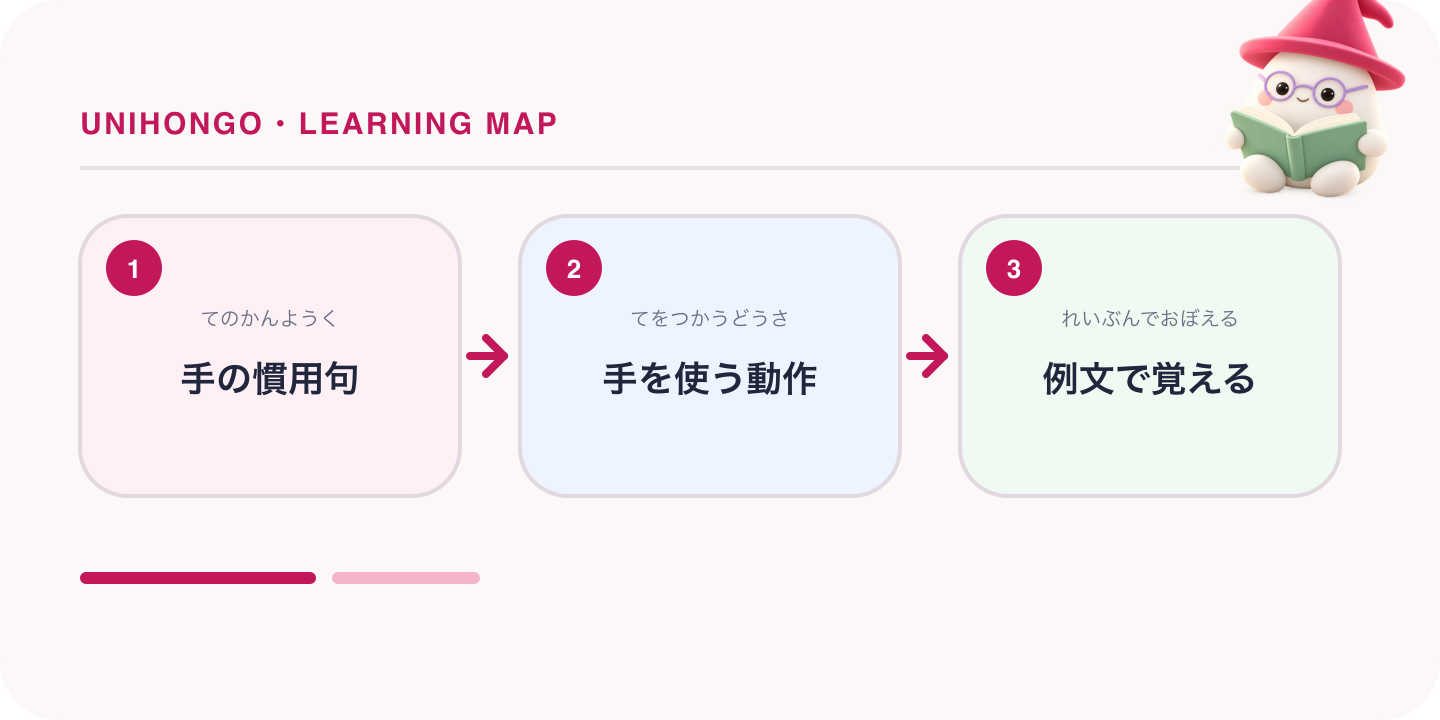
The te phrases at a glance
| Phrase | Literal image | What it means | Register |
|---|---|---|---|
| 手が空く te ga aku | The hands empty out | To become free, to have a moment | Neutral, everyday |
| 手が空いている te ga aite iru | The hands are empty | To be free right now | Neutral |
| 手が離せない te ga hanasenai | The hands cannot be released | Tied up, unable to step away | Neutral, very common at work |
| 手が足りない te ga tarinai | The hands are insufficient | Short-handed | Neutral |
| 人手 hitode | People-hands | Manpower, staff | Neutral noun |
| 人手不足 hitode-busoku | A shortage of people-hands | Staff shortage | Neutral, common in news |
| 手が回らない te ga mawaranai | The hands do not go round | Unable to get to everything | Neutral |
| 手を貸す te o kasu | To lend a hand | To help someone | Neutral |
| 手を借りる te o kariru | To borrow a hand | To get help from someone | Neutral |
| 手伝う tetsudau | The plain verb | To help with a task | Neutral, the safest default |
| お手伝いします otetsudai shimasu | Humble form of the same verb | Let me help you | Polite, safe with anyone |
| 手に入れる te ni ireru | To put into the hand | To obtain, to get hold of | Neutral, transitive |
| 手に入る te ni hairu | To come into the hand | To be obtainable, to turn up | Neutral, intransitive |
| 手につかない te ni tsukanai | It will not stick to the hand | Cannot settle to a task | Neutral |
| 手に負えない te ni oenai | Cannot be carried by the hand | Beyond me, unmanageable | Neutral |
| 手も足も出ない te mo ashi mo denai | Neither hand nor foot comes out | Completely powerless | Slightly casual |
| 手を出す te o dasu | To put a hand out | To take something on, to meddle, to touch | Careful, see the warning below |
| 手を引く te o hiku | To pull the hand back | To withdraw from something | Neutral |
| 手を焼く te o yaku | To burn one's hand | To have real trouble with | Neutral, slightly conversational |
| 手を打つ te o utsu | To strike with the hand | To take measures, to settle on terms | Neutral, business-flavoured |
| 手を抜く te o nuku | To pull the hand out | To cut corners | Neutral, mildly critical |
| 手間 tema | Hand-interval | Effort and time a task costs | Neutral noun |
| 手間がかかる tema ga kakaru | The hand-interval takes | To be laborious | Neutral |
| 手数 tesū | Hand-count | Trouble caused to someone | Neutral to formal |
| お手数ですが otesū desu ga | It is trouble, but | Sorry to trouble you, but | Polite request opener |
| 手数料 tesūryō | Hand-count fee | A service or handling fee | Neutral, banks and forms |
| 手が早い te ga hayai | The hand is fast | Quick to hit, or quick to make advances | Recognise only, do not use |
| 上手 jōzu | Upper hand | Skilful at something | Neutral, everyday compliment |
| 苦手 nigate | Bitter hand | Not good at, uncomfortable with | Neutral, very common |
| 勝手に katte ni | By one's own hand | Without asking, as one pleases | Neutral, often mildly critical |
| 相手 aite | Facing hand | The other party, the person you deal with | Neutral noun |
| 手続き tetsuzuki | Hand-continuation | Formal procedure, paperwork | Neutral, offices and forms |
| 手配 tehai | Hand-arrangement | Arrangements, booking | Neutral, work |
| 手順 tejun | Hand-order | The steps of a procedure | Neutral, work |
| 手元 temoto | At the hand | To hand, in front of me | Neutral |
| 手直し tenaoshi | Hand-fixing | A small revision or touch-up | Neutral, work |
| 手応え tegotae | Hand-response | A sense that something is working | Neutral |
| お手上げ oteage | Hands up | Out of options, giving up | Casual |
Do not try to learn this table in one sitting. Read down the middle column first and let the images settle, then come back and pick the eight or nine that describe your own life. A phrase you have a real use for on Monday morning sticks; a phrase you admire in a table does not.
Availability: who is free and who is buried
This is the group you will hear most, because Japanese offices, kitchens and building sites all need a fast way to say whether a person can be interrupted. Te ga aku is the moment your hands empty, so te ga aitara means once I am free, and te ga aite imasu is the present state. Te ga hanasenai is its opposite and works as a complete, polite excuse: it says you are physically committed, not that you would rather not.
Te ga tarinai and hitode ga tarinai both mean short-handed, but hitode is a plain noun for staff and appears in writing and news, while te ga tarinai is spoken and immediate. Te ga mawaranai is different again: the hands exist but cannot reach everything, so use it when the problem is time rather than headcount.
| Japanese | Romaji | Meaning |
|---|---|---|
| 今、手が空いていますか。 | Ima, te ga aite imasu ka? | Are you free at the moment? |
| 午後なら手が空いています。 | Gogo nara te ga aite imasu. | I am free in the afternoon. |
| 手が空いたら声をかけてください。 | Te ga aitara koe o kakete kudasai. | Give me a shout when you have a moment. |
| すみません、今ちょっと手が離せません。 | Sumimasen, ima chotto te ga hanasemasen. | Sorry, I cannot step away right now. |
| 手が離せないときは、留守番電話に入れてください。 | Te ga hanasenai toki wa, rusuban denwa ni irete kudasai. | When I cannot get to the phone, please leave a message. |
| 週末はどうしても手が足りません。 | Shūmatsu wa dōshitemo te ga tarimasen. | We are simply short-handed at weekends. |
| 人手が足りないので、応援を頼みました。 | Hitode ga tarinai node, ōen o tanomimashita. | We are short-staffed, so I asked for backup. |
| この業界は人手不足が続いています。 | Kono gyōkai wa hitode-busoku ga tsuzuite imasu. | This industry has an ongoing staff shortage. |
| 仕事が多すぎて手が回りません。 | Shigoto ga ōsugite te ga mawarimasen. | There is too much work and I cannot get to it all. |
Helping: lending, borrowing and the plain verb
Te o kasu is to lend a hand and te o kariru is to borrow one, so the direction is built into the verb and you never need to add an English-style preposition. Both are slightly figurative and warm. The plain verb tetsudau is the neutral workhorse and the humble otetsudai shimasu is the version you offer to a customer, a teacher or your partner's mother.
The mistake learners make is offering help with te o kasu to someone senior. Lending implies you are doing them a favour from a position of ease, which can sound casual upward. Otetsudai shimashō ka is the safe offer in any direction, and te o kashite itadakemasen ka is the safe way to ask for help from someone above you.
| Japanese | Romaji | Meaning |
|---|---|---|
| 手を貸していただけませんか。 | Te o kashite itadakemasen ka? | Could you lend me a hand? |
| もちろん、喜んで手を貸します。 | Mochiron, yorokonde te o kashimasu. | Of course, I would be glad to help. |
| 引っ越しのとき、友達の手を借りました。 | Hikkoshi no toki, tomodachi no te o karimashita. | I got a friend's help when I moved. |
| 何かお手伝いしましょうか。 | Nanika otetsudai shimashō ka? | Shall I help with something? |
| 荷物を運ぶのを手伝ってもらえますか。 | Nimotsu o hakobu no o tetsudatte moraemasu ka? | Could you help me carry the luggage? |
| 大丈夫です。一人でできます。 | Daijōbu desu. Hitori de dekimasu. | It is fine, I can manage on my own. |
| 人の手を借りるのが苦手です。 | Hito no te o kariru no ga nigate desu. | I find it hard to ask people for help. |
| 手を貸してくれてありがとうございました。 | Te o kashite kurete arigatō gozaimashita. | Thank you for lending a hand. |
Obtaining and losing control
Te ni ireru and te ni hairu are a transitive and intransitive pair, and choosing the wrong one is the commonest error in this group. You put something into your hand, so kippu o te ni iremashita, but a thing comes into your hand by itself, so kippu ga te ni hairimashita. Use te ni hairu when talking about availability in shops and te ni ireru when you want to credit your own effort.
The opposite direction is control slipping. Te ni tsukanai says a task will not stick to your hands because your mind is elsewhere, and it takes the thing you cannot do as its subject: shigoto ga te ni tsukimasen. Te ni oenai says something is too big to carry, and te mo ashi mo denai is the stronger, more conversational version of being completely stuck.
| Japanese | Romaji | Meaning |
|---|---|---|
| やっと切符を手に入れました。 | Yatto kippu o te ni iremashita. | I finally got hold of a ticket. |
| その本は今どこでも手に入ります。 | Sono hon wa ima doko demo te ni hairimasu. | That book is available everywhere now. |
| 限定品なので手に入りにくいです。 | Genteihin nanode te ni hairi nikui desu. | It is a limited edition, so it is hard to get. |
| 心配で仕事が手につきません。 | Shinpai de shigoto ga te ni tsukimasen. | I am too worried to settle into work. |
| 試験のことが気になって、勉強が手につきませんでした。 | Shiken no koto ga ki ni natte, benkyō ga te ni tsukimasen deshita. | I was anxious about the exam and could not settle into studying. |
| この問題は私の手に負えません。 | Kono mondai wa watashi no te ni oemasen. | This problem is beyond me. |
| 難しすぎて手も足も出ませんでした。 | Muzukashisugite te mo ashi mo demasen deshita. | It was so hard that I could do nothing at all. |
| その計画からは手を引くことにしました。 | Sono keikaku kara wa te o hiku koto ni shimashita. | I decided to pull out of that plan. |
Te o dasu and the phrases to recognise only
Te o dasu is genuinely useful and genuinely risky. With an activity or a field it means to take something on, often with a hint that you should not have: kabu ni te o dasu, atarashii bun'ya ni te o dasu. With an object it means to touch what is not yours. With a person as the target it can mean to hit them or to make a sexual advance, and the listener works out which from context, so a learner cannot control the reading. Keep it for activities and things, never for people.
Te ga hayai has the same problem in a smaller package. It can describe a fast worker, but the two better-known senses are quick to violence and quick to make advances, so it is a recognise-only phrase. When you mean somebody works fast, say shigoto ga hayai desu ne. Te o yaku, by contrast, is safe and very expressive: it means something or someone has genuinely worn you out, and it takes ni for the source of the trouble.
| Japanese | Romaji | Meaning |
|---|---|---|
| 新しい分野に手を出すのは慎重にしています。 | Atarashii bun'ya ni te o dasu no wa shinchō ni shite imasu. | I am cautious about taking on a new field. |
| 株には手を出さないほうがいいですよ。 | Kabu ni wa te o dasanai hō ga ii desu yo. | You would be better off staying away from shares. |
| 人の物に手を出してはいけません。 | Hito no mono ni te o dashite wa ikemasen. | You must not touch other people's things. |
| あれこれ手を出して、どれも終わりません。 | Arekore te o dashite, dore mo owarimasen. | I start all sorts of things and finish none of them. |
| 子どもの反抗期に手を焼いています。 | Kodomo no hankōki ni te o yaite imasu. | I am struggling with my child's rebellious phase. |
| 手が早いは意味が二つあるので、使わないほうが安全です。 | Te ga hayai wa imi ga futatsu aru node, tsukawanai hō ga anzen desu. | Te ga hayai has two meanings, so it is safer not to use it. |
Tema and tesū: the vocabulary of trouble
Tema and tesū both measure effort, but they point in different directions. Tema is the effort a task costs, seen from the task: kono ryōri wa tema ga kakarimasu means the dish is laborious, with no blame attached to anyone. Tesū is trouble imposed on a person, so it appears with the humble o prefix whenever you are the one imposing it.
Tema takes kakaru for the cost and kakeru when a person spends it, and otema o torasete sumimasen apologises for eating someone's time. Tesū appears in the fixed noun tesūryō, the handling fee on a bank transfer or a ticket, which is worth learning as a word in its own right because it turns up on every counter and screen.
| Japanese | Romaji | Meaning |
|---|---|---|
| この料理は手間がかかります。 | Kono ryōri wa tema ga kakarimasu. | This dish takes a lot of work. |
| 手間をかけずに作れるレシピが好きです。 | Tema o kakezu ni tsukureru reshipi ga suki desu. | I like recipes you can make without much effort. |
| お手間を取らせてすみません。 | Otema o torasete sumimasen. | Sorry for taking up your time. |
| 手間を惜しまずに準備しました。 | Tema o oshimazu ni junbi shimashita. | I prepared without sparing any effort. |
| 振込手数料はいくらですか。 | Furikomi tesūryō wa ikura desu ka? | How much is the transfer fee? |
| お手数をおかけしました。 | Otesū o okake shimashita. | I am sorry for the trouble I caused you. |
| 手っ取り早い方法はありますか。 | Tettoribayai hōhō wa arimasu ka? | Is there a quicker way to do it? |
Otesū desu ga, the polite request opener
This is the single most useful item on the page. Otesū desu ga sits at the front of a request and means roughly it is a bother, but. It signals that you know you are adding work to someone's day, which is exactly the move Japanese politeness expects before an imperative, however softened. The stronger version otesū o okake shimasu ga is common in email and in careful speech.
The reply you will hear is usually a light dismissal: tondemonai desu, ie ie, or a straightforward shōchi shimashita if the person is accepting the task. Among friends the same opener sounds like a form letter, so swap it for warui kedo or chotto onegai ga aru n da kedo.
| Japanese | Romaji | Meaning |
|---|---|---|
| お手数ですが、ご確認をお願いいたします。 | Otesū desu ga, gokakunin o onegai itashimasu. | Sorry to trouble you, but please check this. |
| お手数ですが、こちらにご記入ください。 | Otesū desu ga, kochira ni gokinyū kudasai. | Sorry to trouble you, but please fill this in here. |
| お手数ですが、折り返しご連絡いただけますでしょうか。 | Otesū desu ga, orikaeshi gorenraku itadakemasu deshō ka? | Sorry to trouble you, but could you get back to me? |
| お忙しいところお手数ですが、ご返信ください。 | Oisogashii tokoro otesū desu ga, gohenshin kudasai. | I know you are busy, but please reply. |
| お手数をおかけしますが、よろしくお願いいたします。 | Otesū o okake shimasu ga, yoroshiku onegai itashimasu. | Sorry for the trouble, and thank you in advance. |
| とんでもないです。すぐに対応します。 | Tondemonai desu. Sugu ni taiō shimasu. | Not at all. I will deal with it right away. |
| 悪いけど、ちょっと手伝ってくれない? | Warui kedo, chotto tetsudatte kurenai? | Sorry, but could you give me a hand? (casual) |
Speed, skill and cutting corners
Jōzu is written with the characters for upper and hand, and it is the ordinary word for skilful. It is worth noticing here because it shows the same metaphor working in a compound rather than a phrase, and because its partner nigate, the bitter hand, is how you say you are not good at something without the harshness of dekimasen. Te o nuku is the phrase for doing a job at less than full effort, and it is mild but clearly critical, so use it about yourself or about a task rather than about a colleague to their face.
| Japanese | Romaji | Meaning |
|---|---|---|
| 田中さんは仕事が早いです。 | Tanaka-san wa shigoto ga hayai desu. | Tanaka works quickly. |
| 料理がお上手ですね。 | Ryōri ga ojōzu desu ne. | You are a good cook. |
| 人前で話すのが苦手です。 | Hitomae de hanasu no ga nigate desu. | I am not comfortable speaking in front of people. |
| 手を抜かずに最後までやります。 | Te o nukazu ni saigo made yarimasu. | I will see it through without cutting corners. |
| ここは少し手直しが必要です。 | Koko wa sukoshi tenaoshi ga hitsuyō desu. | This part needs a little touching up. |
| 手応えのある仕事です。 | Tegotae no aru shigoto desu. | It is work that gives a real sense of achievement. |
Words where te has gone underground
A last group has the same character but no longer feels like a metaphor. Tetsuzuki is the word for any formal procedure, from a phone contract to a residence card renewal, and it is the noun you want at every counter. Tehai is making arrangements, tejun is the ordered steps of a process, temoto is what you have in front of you, and aite is the other party in any interaction, from a conversation partner to an opponent in a match. Katte ni means doing something without asking, and it usually carries mild criticism.
| Japanese | Romaji | Meaning |
|---|---|---|
| 引っ越しの手続きはもう済みましたか。 | Hikkoshi no tetsuzuki wa mō sumimashita ka? | Have you finished the paperwork for the move? |
| ホテルの手配はこちらでします。 | Hoteru no tehai wa kochira de shimasu. | We will arrange the hotel at our end. |
| 手順を確認してから始めましょう。 | Tejun o kakunin shite kara hajimemashō. | Let us check the steps before we start. |
| 手元に資料がありません。 | Temoto ni shiryō ga arimasen. | I do not have the documents to hand. |
| 話す相手がいると上達が早いです。 | Hanasu aite ga iru to jōtatsu ga hayai desu. | You improve faster when you have someone to talk to. |
| 勝手に決めてしまってすみません。 | Katte ni kimete shimatte sumimasen. | Sorry for deciding without asking. |
| もうお手上げです。 | Mō oteage desu. | I am out of options. |
How to make these automatic
- Learn each phrase glued to its particle: te ga aku, te o kasu, te ni ireru. The particle is the memory hook, not decoration.
- Sort any new te phrase into state or action the moment you meet it, then you will know whether you can promise it.
- Keep te o dasu for activities and objects only, and never build a sentence with a person as its target.
- Put otesū desu ga in front of three requests you already make every week, and say them aloud until the opener arrives before the request does.
- Say te ni ireru and te ni hairu in a pair every time you practise, using the same noun, so the transitive and intransitive halves never blur.
- Replace one vague busy sentence a day with a precise one: instead of isogashii desu, choose te ga hanasemasen, te ga tarimasen or te ga mawarimasen.