

The kanji: 職 and 人
Shokunin is written 職人. The first kanji, 職, means occupation, job or trade. You see it in shokugyō, occupation, shūshoku, finding employment, and shokuba, workplace. The second, 人, simply means person. So the literal meaning is a person of a trade.
Although 職 is used for all kinds of jobs, the compound shokunin has a clear focus: skilled work done with the hands and body, learned through long practice. An accountant or a salaryman is not a shokunin in the ordinary sense, while a roofer, a joiner or a sushi chef is.
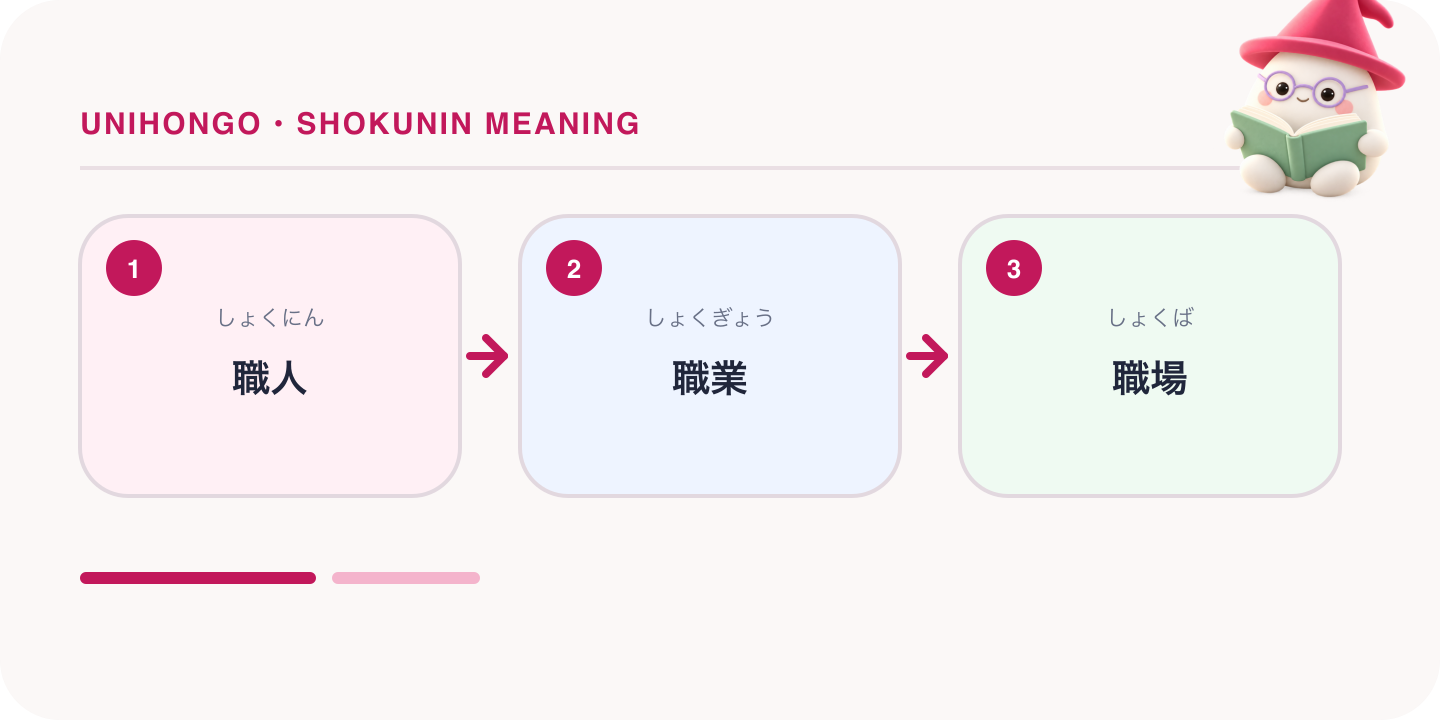
| Word | Reading | Meaning |
|---|---|---|
| 職 | shoku | Occupation, job, trade |
| 職人 | shokunin | Craftsperson, skilled tradesperson |
| 職業 | shokugyō | Occupation |
| 職場 | shokuba | Workplace |
| 就職 | shūshoku | Getting a job |
| 職人技 | shokunin-waza | Craftsman's skill, masterly technique |
What shokunin means in everyday Japanese
In daily life, shokunin is often a practical word. On a building site you may hear about the shokunin-san who will come to do the plastering or the flooring, and a renovation company may say its own shokunin do the work. Here the word is simply tradespeople, with the polite -san added out of respect.
The word also names traditional craftspeople in fields such as lacquerware, ceramics, woodwork, textiles, metalwork and paper. Some regions are famous for particular crafts, and the people who make them are proud to be called shokunin. In food, sushi chefs, soba makers and wagashi confectioners are often described as shokunin, especially at small specialist shops.
What unites these uses is trained skill that takes years to acquire and cannot easily be replaced by a manual or a machine.
| Japanese | Romaji | Meaning |
|---|---|---|
| 職人さんが明日来ます。 | Shokunin-san ga ashita kimasu. | The tradesperson is coming tomorrow. |
| 父は大工の職人です。 | Chichi wa daiku no shokunin desu. | My father is a skilled carpenter. |
| この店は寿司職人が一人で握っている。 | Kono mise wa sushi shokunin ga hitori de nigitte iru. | At this shop a single sushi chef makes everything. |
| 職人の手作りです。 | Shokunin no tezukuri desu. | It's handmade by a craftsperson. |
| まさに職人技ですね。 | Masa ni shokunin-waza desu ne. | That's true craftsmanship. |
Shokunin kishitsu: the craftsman's temperament
Shokunin kishitsu, also read shokunin katagi, describes the personality associated with craftspeople. The positive side is pride, a refusal to cut corners, patience with repetitive practice and a focus on the work rather than on money or recognition. The negative side is stubbornness, a short temper with interruptions and difficulty accepting new methods or customer requests.
Japanese speakers use the phrase in both ways, and tone matters. Kare wa shokunin kishitsu da, he has a craftsman's temperament, can be admiring when said about a chef who remakes a dish because it is not quite right, or wry when said about a colleague who will not listen to feedback. It is used for people outside traditional crafts too, such as engineers, editors or programmers who care intensely about quality.
A related word is kodawari, a strong personal insistence on how something should be done. A shop that advertises its kodawari no ramen is proud of its particular methods, and a shokunin is expected to have kodawari.
| Japanese | Romaji | Meaning |
|---|---|---|
| 職人気質の人 | shokunin kishitsu no hito | A person with a craftsman's temperament |
| 彼は職人気質で妥協しない。 | Kare wa shokunin kishitsu de dakyō shinai. | He has a craftsman's temperament and never compromises. |
| こだわりが強い | kodawari ga tsuyoi | Particular, with strong standards |
| 頑固な職人 | ganko na shokunin | A stubborn craftsman |
| 手を抜かない | te o nukanai | Not to cut corners |
Takumi, meijin and tatsujin: words for mastery
Several words describe high levels of skill, and they are not interchangeable. Takumi, 匠, is a literary word for a master craftsman and for the skill itself; it appears in shop names, advertising and television programmes about traditional work. Meijin, 名人, is a master or virtuoso, used for experts in crafts, performing arts and games, and it is also a formal title in shōgi and go. Tatsujin, 達人, is an expert who has reached a high level, often in martial arts or in hobbies, and it is used playfully too.
Kurōto, a professional or expert, is the opposite of shirōto, an amateur. Puro, from professional, is the casual everyday version.
| Japanese | Romaji | Meaning |
|---|---|---|
| 匠 | takumi | Master craftsman, masterly skill |
| 匠の技 | takumi no waza | A master's craftsmanship |
| 名人 | meijin | Master, virtuoso; a title in shōgi and go |
| 達人 | tatsujin | Expert, adept |
| 玄人 | kurōto | Professional, expert |
| 素人 | shirōto | Amateur, layperson |
| 料理の達人 | ryōri no tatsujin | A master of cooking |
Deshi, minarai and the language of apprenticeship
Many crafts have traditionally been learned through apprenticeship, and Japanese has a clear vocabulary for it. The master is the shishō, a teacher in arts and crafts, or the oyakata, the boss of a workshop or crew. The learner is the deshi, a disciple or pupil, and a new trainee is a minarai, literally someone who learns by watching.
Minarai reflects a real idea about learning a craft: watching, cleaning, preparing and repeating basic tasks before being trusted with the main work. A well-known saying in the sushi world describes years spent cooking rice before shaping sushi. Versions of the saying differ, and modern training schools and shops vary a great deal, so treat it as a description of a tradition rather than a rule.
Minarai is also used in ordinary jobs. A name badge reading minarai or kenshūchū, in training, tells customers that the staff member is new.
| Japanese | Romaji | Meaning |
|---|---|---|
| 師匠 | shishō | Master, teacher of an art or craft |
| 親方 | oyakata | Master of a workshop, boss of a crew |
| 弟子 | deshi | Disciple, apprentice, pupil |
| 弟子入りする | deshiiri suru | To become someone's apprentice |
| 見習い | minarai | Apprentice, trainee |
| 見習い期間 | minarai kikan | Probation or training period |
| 研修中 | kenshūchū | In training |
Shokunin in modern Japanese
Traditional craft careers are widely discussed in Japan today, especially the question of who will take them over. You will read about kōkeisha busoku, a shortage of successors, in news about workshops and small family businesses, and about young people choosing to train as craftspeople. Terms such as dentō kōgei, traditional crafts, and monozukuri, the culture of making things, often appear in the same articles.
The word has also spread into playful everyday use. Japanese speakers add shokunin to a narrow skill to describe someone who does one thing extremely well or obsessively, such as an Excel shokunin who builds elaborate spreadsheets. The tone is humorous and affectionate, and it shows how strongly the word is tied to the idea of dedicated, repetitive mastery.
| Japanese | Romaji | Meaning |
|---|---|---|
| 後継者不足 | kōkeisha busoku | Shortage of successors |
| 伝統工芸 | dentō kōgei | Traditional crafts |
| ものづくり | monozukuri | Making things, the craft of manufacturing |
| 職人を目指している。 | Shokunin o mezashite iru. | I'm aiming to become a craftsperson. |
| 彼はエクセル職人だ。 | Kare wa ekuseru shokunin da. | He's an Excel wizard. |
The Western image versus the Japanese word
In English, shokunin is usually used as a term of high praise, often linked to documentary portraits of master sushi chefs and to the idea of devoting a lifetime to perfecting one skill. That spirit is recognisable to Japanese speakers, but the Japanese word is broader and more down to earth.
| English usage | Japanese usage |
|---|---|
| An inspiring ideal of lifelong dedication | A normal word for skilled tradespeople and craftspeople |
| Always praise | Neutral as a job, praise or mild criticism as a temperament |
| Mainly about sushi and knives | Carpenters, plasterers, potters, confectioners and many more |
| Used for any passionate professional | Used jokingly for niche skills, seriously for trained hand work |
Using shokunin in conversation
For learners, shokunin is a friendly and useful word. You can use it to praise workmanship, to ask about how something was made, and to describe people you admire. At a craft shop or workshop visit, questions about how long training takes or how something is made show real interest and usually lead to a good conversation.
| Japanese | Romaji | Meaning |
|---|---|---|
| これは職人さんが作ったんですか。 | Kore wa shokunin-san ga tsukutta n desu ka. | Was this made by a craftsperson? |
| 一人前になるまで何年かかりますか。 | Ichininmae ni naru made nannen kakarimasu ka. | How many years does it take to become fully qualified? |
| 細かいところまで丁寧ですね。 | Komakai tokoro made teinei desu ne. | It's careful right down to the small details. |
| 職人の技を間近で見られて感動しました。 | Shokunin no waza o majika de mirarete kandō shimashita. | I was moved to see a craftsperson's skill up close. |
| 私も仕事では職人気質なところがあります。 | Watashi mo shigoto de wa shokunin kishitsu na tokoro ga arimasu. | I have a bit of a craftsman's temperament at work too. |
Ichininmae, fully fledged or qualified, is a key word in this world. It describes the point at which an apprentice can be trusted to work independently, and it is also used for young adults who have become independent in life.