

What ara and ara ara mean
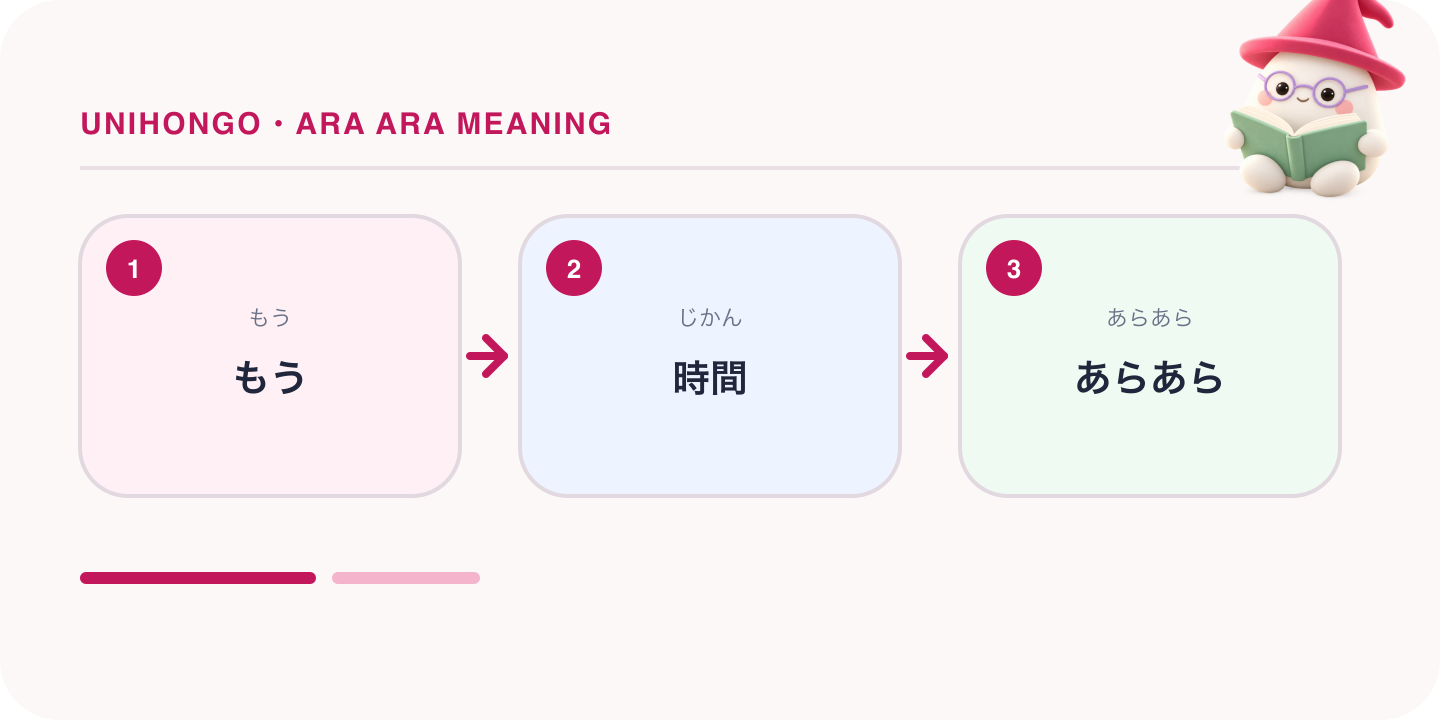
Ara is a kandōshi, an interjection, that marks a small surprise or the moment you notice something. It is roughly oh or oh my: ara, mō konna jikan, oh, is it that late already? It does not carry strong shock; it is the gentle reaction to something unexpected but not alarming.
Doubling it to ara ara stretches the feeling out and usually adds a layer of sympathy or amusement. When a toddler knocks over a cup, a parent says ara ara with a small sigh, meaning oh dear, look what happened. When a friend turns up soaked from the rain, ara ara means oh no, look at you. The feeling is warm rather than critical.
| Japanese | Romaji | Meaning |
|---|---|---|
| あら、もうこんな時間。 | Ara, mō konna jikan. | Oh, is it that late already? |
| あらあら、こぼしちゃったね。 | Ara ara, koboshichatta ne. | Oh dear, you've spilled it, haven't you? |
| あらあら、びしょ濡れじゃない。 | Ara ara, bishonure ja nai. | Oh my, you're soaking wet. |
| あら、雨だわ。 | Ara, ame da wa. | Oh, it's raining. |
| あら、いらっしゃい。 | Ara, irasshai. | Oh, welcome, come in. |
| あらまあ | ara mā | Oh my goodness (softer, older-sounding) |
Who really says ara ara
In real life you are most likely to hear ara and ara ara from women, and the association grows stronger with age. Mothers talking to small children, grandmothers, shop owners greeting regular customers and neighbours chatting in the street all use it. Younger women use it too, but many prefer e?, uso or yabai in casual speech, so ara can sound slightly mature or refined.
This is a tendency, not a rule. Some men use ara, sometimes in regional speech and sometimes in a relaxed, joking way, and in writing or quoted speech you will find it in all kinds of mouths. Still, for most learners, especially men, the safest assumption is that ara reads as feminine, and ara ara even more so.
- Parents and grandparents reacting to a child's small accident
- Neighbours meeting unexpectedly: ara, Tanaka-san, konnichiwa
- Shopkeepers greeting a familiar face: ara, hisashiburi
- Someone noticing a small problem: ara, kagi wa doko kashira
- Mild sympathy for a friend's bad luck: ara ara, taihen datta ne
Ara versus are, oya and e
Japanese has a whole family of short reactions, and choosing the right one matters more than the word itself. Are? with a rising tone is the gender-neutral huh? or that's strange, used when something does not match your expectations: are, saifu ga nai, huh, my wallet's gone. It focuses on confusion, whereas ara focuses on noticing.
Oya and oya oya are the traditional counterparts to ara, often linked to older men, meaning well now or well well. E? is a quick, sharp what? of surprise used by everyone, and ē? stretched out shows disbelief or disappointment. Uwa is a startled wow or yikes. Knowing these lets you react naturally without sounding like a character.
| Reaction | Feeling | Typical speaker |
|---|---|---|
| あら ara | Soft surprise, noticing | Women, often older |
| あらあら ara ara | Oh dear, gentle concern or amusement | Women, mothers |
| あれ? are? | Huh? something is odd | Anyone |
| おや oya | Well now, mild surprise | Men, often older |
| おやおや oya oya | Well well, amused concern | Older speakers |
| え? e? | What? quick surprise | Anyone |
| うわ uwa | Whoa, yikes | Anyone, casual |
If you want one safe, neutral set, learn ā for realising, are? for confusion, e? for surprise and uwa for being startled. These fit almost any speaker in casual conversation.
Tone and intonation
The meaning of ara depends heavily on how you say it. A short, light ara with a slight rise sounds like a pleasant surprise. A falling, drawn-out ara ara with a small sigh sounds sympathetic. A sharp ara! can even show displeasure, as when someone notices a rude remark: ara, sō, oh, is that so, said coolly, can be quite pointed.
Ara is often followed by sentence-final particles that also colour the speech, such as wa, kashira and no yo, which traditionally sound feminine. Ara, sō na no? oh, really? and ara, ii wa ne, oh, how nice are typical examples. In modern speech these endings are less common among younger speakers, which is one reason ara can sound a little mature.
| Japanese | Romaji | Meaning |
|---|---|---|
| あら、そうなの? | Ara, sō na no? | Oh, really? |
| あら、いいわね。 | Ara, ii wa ne. | Oh, how nice. |
| あら、どうしたの? | Ara, dō shita no? | Oh, what's the matter? |
| あら、鍵はどこかしら。 | Ara, kagi wa doko kashira. | Now, where are my keys, I wonder? |
| あら、そう。 | Ara, sō. | Oh, is that so. (can sound cool or pointed) |
The anime ara ara stereotype
In anime, manga and games, ara ara is often the signature line of a particular character type: a calm, confident, slightly older woman, the onee-san or motherly figure, who is amused by the younger characters around her. She says ara ara with a smile when the hero is flustered, which gives the phrase a teasing, knowing tone.
This usage is built on the real one. The character is using ara ara exactly as a mother would, with gentle amusement, but the context turns it into playful teasing. Outside Japan, the phrase has become a meme and is sometimes used with a flirtatious meaning that everyday Japanese does not have. Japanese viewers recognise the character type, but they do not treat ara ara itself as flirtatious.
- Real life: ara ara as caring oh dear from a parent or older woman
- Anime: ara ara as a calm, amused, teasing line from an onee-san character
- Online meme: ara ara used jokingly, sometimes with flirty overtones
- In all three, the core feeling is gentle amusement, not shock
When learners should and should not say it
If you are a woman and ara fits your natural speaking style, it is perfectly fine in casual conversation, especially in its gentle sympathetic sense. Many learners pick it up naturally from living with a host family or spending time with older friends.
If you are a man, or if you learned the phrase mainly from anime, be careful. Said sincerely, ara ara can sound like an imitation of a character, which may amuse your friends but also makes it hard to be taken seriously. In any formal or work setting it is best avoided by everyone; a polite a, sō desu ka or sore wa taihen deshita ne is more appropriate.
| Situation | Ara ara? | Safer alternative |
|---|---|---|
| Friend spills a drink | Fine for many women | Ā, daijōbu? |
| Colleague's bad news | Too casual | Sore wa taihen deshita ne |
| Joking about anime | Fine if friends get it | Use it knowingly |
| Meeting a client | Avoid | A, sō desu ka |
| Noticing a mistake | Casual only | Are? or a, machigaeta |
Useful phrases that go with ara ara
Ara ara rarely stands alone. It is usually followed by a comment on what happened, a question or a reassurance, and learning these follow-up lines is more useful than the interjection itself. Even if you never say ara ara yourself, you will hear these combinations from shopkeepers, host mothers and neighbours.
| Japanese | Romaji | Meaning |
|---|---|---|
| あらあら、大丈夫? | Ara ara, daijōbu? | Oh dear, are you all right? |
| あらあら、大変だったね。 | Ara ara, taihen datta ne. | Oh dear, that must have been hard. |
| あらあら、そんなに泣かないで。 | Ara ara, sonna ni nakanaide. | Oh dear, don't cry like that. |
| あら、久しぶり! | Ara, hisashiburi! | Oh, it's been ages! |
| あらあら、困ったわね。 | Ara ara, komatta wa ne. | Oh dear, what a problem. |
| あら、気がつかなかった。 | Ara, ki ga tsukanakatta. | Oh, I didn't notice. |
Notice how often ara ara pairs with ne. The particle invites agreement and softens the sentence, which fits the caring tone of the interjection.