
Samurai or bushi: two words for the warrior
The word samurai grew out of saburau, an old verb meaning "to serve" or "to attend on someone". A samurai was, first of all, a man in service to a lord. Bushi is built from bu (武), "military", and shi (士), a man of rank, and names the warrior class itself.
In English, samurai covers everything. In Japanese the two words have different flavours: samurai is the vivid word of stories, bushi the careful word of textbooks. The cards give the four terms that learners most often ask about.
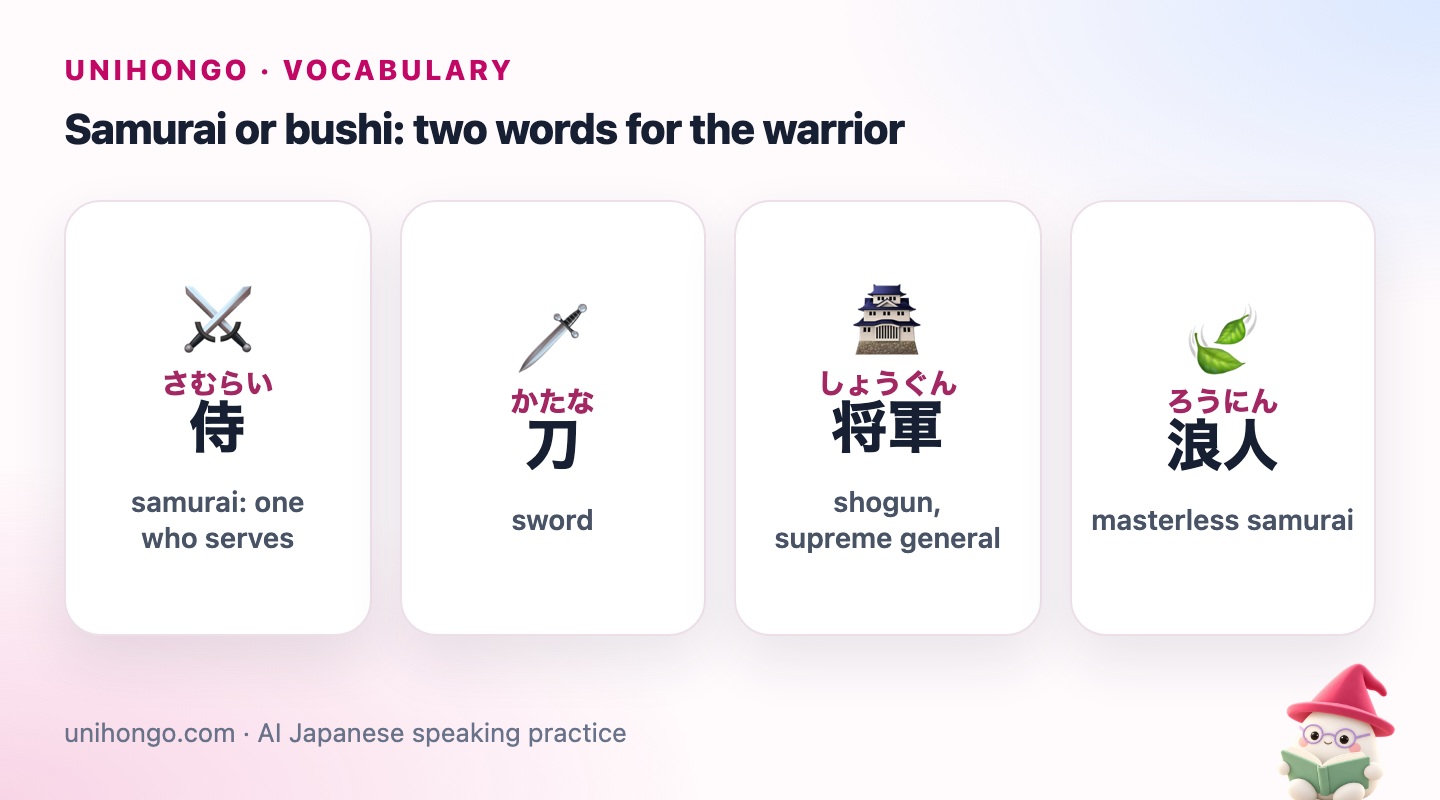
| Japanese | Romaji | Meaning |
|---|---|---|
| 侍 | samurai | samurai: one who serves |
| 刀 | katana | sword |
| 将軍 | shōgun | shogun, supreme general |
| 浪人 | rōnin | masterless samurai |
| 武士 | bushi | warrior (the formal term) |
| 大名 | daimyō | feudal lord of a domain |
| 殿 | tono | lord (as his retainers said it) |
Ranks and roles: shōgun, daimyō, tono, rōnin
Shōgun (将軍) means "general": shō is "commander" and gun is "army". The title is short for seii taishōgun (征夷大将軍), and for centuries the shōgun was the military ruler of the country. Below him, the daimyō (大名) were the lords who governed their own domains.
Retainers called their lord tono (殿) or tonosama. The same kanji, read dono, is still used after names on certificates and formal notices, where it is a stiff, official kind of "Mr" or "Ms". You will read it far more often than you will hear it.
A samurai who lost his master, through the lord's death or disgrace, became a rōnin (浪人). The first kanji means "wave", and the word suggests a person who drifts. Fiction loves the wandering rōnin, and the modern meaning of the word keeps the idea of someone between places.
Seppuku and harakiri: the same kanji, two readings
Both words are written with the kanji for "cut" (切) and "belly" (腹). Seppuku puts them in the Chinese order and reads them with on readings, the sounds that came from Chinese. Harakiri puts belly first and uses kun readings, the native Japanese words hara and kiri.
This is a pattern across the whole language. On-reading compounds sound formal and technical, and kun-reading words sound plain and physical. So seppuku is the term used in history books and formal speech, while harakiri is the blunt everyday version, and the one that happened to travel abroad. It is a grim historical subject, and Japanese people do not joke about it lightly.
| Japanese | Romaji | Meaning |
|---|---|---|
| 切腹 | seppuku | ritual suicide (formal term) |
| 腹切り | harakiri | belly-cutting (plain term) |
Period-drama speech: sessha and de gozaru
Historical dramas are called jidaigeki (時代劇), and they have their own dialect. A samurai character calls himself sessha (拙者), a humble "I" that literally means "clumsy person", and ends his sentences with de gozaru. Fans of the swordsman Kenshin in Rurouni Kenshin will know both. This is the samurai branch of the stock speech styles that Japanese fiction gives to its character types.
| Japanese | Romaji | Meaning |
|---|---|---|
| 拙者 | sessha | I (humble, samurai speech) |
| でござる | de gozaru | am, is, are (archaic) |
| かたじけない | katajikenai | I am most grateful (archaic) |
| おぬし | onushi | you (archaic) |
| 御意 | gyoi | as you wish, my lord (archaic) |
| 拙者は田中でござる。 | Sessha wa Tanaka de gozaru. | I am Tanaka. (period drama) |
| 私は田中です。 | Watashi wa Tanaka desu. | I am Tanaka. (modern polite) |
Nobody speaks like this today. Say de gozaru in a shop and people will smile and assume you learned Japanese from anime. One piece did survive, however. Gozaimasu, the very polite ending in arigatō gozaimasu and ohayō gozaimasu, comes from the same gozaru.
Sword idioms that people still use
The samurai are gone, but their swords are still in the language. These expressions appear in newspapers, offices and classrooms.
| Japanese | Romaji | Meaning |
|---|---|---|
| 真剣勝負 | shinken shōbu | a contest in deadly earnest |
| 真剣に | shinken ni | seriously, in earnest |
| 太刀打ちできない | tachiuchi dekinai | to be no match for |
| 切羽詰まる | seppa tsumaru | to be driven into a corner |
| 抜き打ち | nukiuchi | without warning, surprise |
| 元の鞘に収まる | moto no saya ni osamaru | to get back together |
Shinken (真剣) is a real sword, as opposed to a wooden one, and from that came the everyday adjective for "serious". Tachiuchi is crossing swords, tachi being a long sword, so being unable to do it means the opponent is out of your league.
Seppa are the small metal washers on each side of the sword guard. The usual explanation is that when they jam, the blade cannot be drawn, and you are stuck. Nukiuchi is drawing and striking in a single motion, before the other person is ready. Moto no saya ni osamaru, "to settle back into the original scabbard", is said of a couple who separate and then reunite.
The idioms in sentences you can say
All of these are at a normal polite level and have nothing warlike about them in modern use.
| Japanese | Romaji | Meaning |
|---|---|---|
| 真剣に考えています。 | Shinken ni kangaete imasu. | I'm thinking about it seriously. |
| あの人には太刀打ちできません。 | Ano hito ni wa tachiuchi dekimasen. | I'm no match for that person. |
| 今日、抜き打ちテストがありました。 | Kyō, nukiuchi tesuto ga arimashita. | We had a pop quiz today. |
| 切羽詰まって、友達に相談しました。 | Seppa tsumatte, tomodachi ni sōdan shimashita. | At my wits' end, I asked a friend for advice. |
Rōnin today: the student between exams
Ask a Japanese eighteen-year-old about rōnin and you will hear about exams, not swords. A student who fails to enter the university they want, and spends the next year preparing to try again, is a rōnin or rōninsei. The verb is rōnin suru. One extra year is ichirō and two years is nirō.
The opposite is gen'eki (現役), literally "active duty", which describes a student who enters straight from high school. The humour of the samurai image is still felt: the student, like the warrior, belongs to no institution for a while.
| Japanese | Romaji | Meaning |
|---|---|---|
| 浪人生 | rōninsei | student retaking entrance exams |
| 今、浪人しています。 | Ima, rōnin shite imasu. | I'm retaking my entrance exams. |
| 一浪しました。 | Ichirō shimashita. | I took one extra year to get in. |
| 現役 | gen'eki | straight from high school |
Parts of the sword, for museums and games
Castle museums and many games label sword parts in Japanese. Katana is the general word for a single-edged sword, and nihontō (日本刀), "Japanese sword", is the term used for the craft as a whole. Knowing saya and tsuba also makes the idioms above easier to picture.
| Japanese | Romaji | Meaning |
|---|---|---|
| 日本刀 | nihontō | Japanese sword |
| 鞘 | saya | scabbard |
| 鍔 | tsuba | sword guard |
| 柄 | tsuka | hilt, handle |
| 刃 | ha | cutting edge |