
Enjoy in Japanese: four phrases for four situations
Instead of one word for every situation, Japanese gives you a phrase for each: a general have fun, enjoy your meal, enjoy your stay, and enjoy your trip.
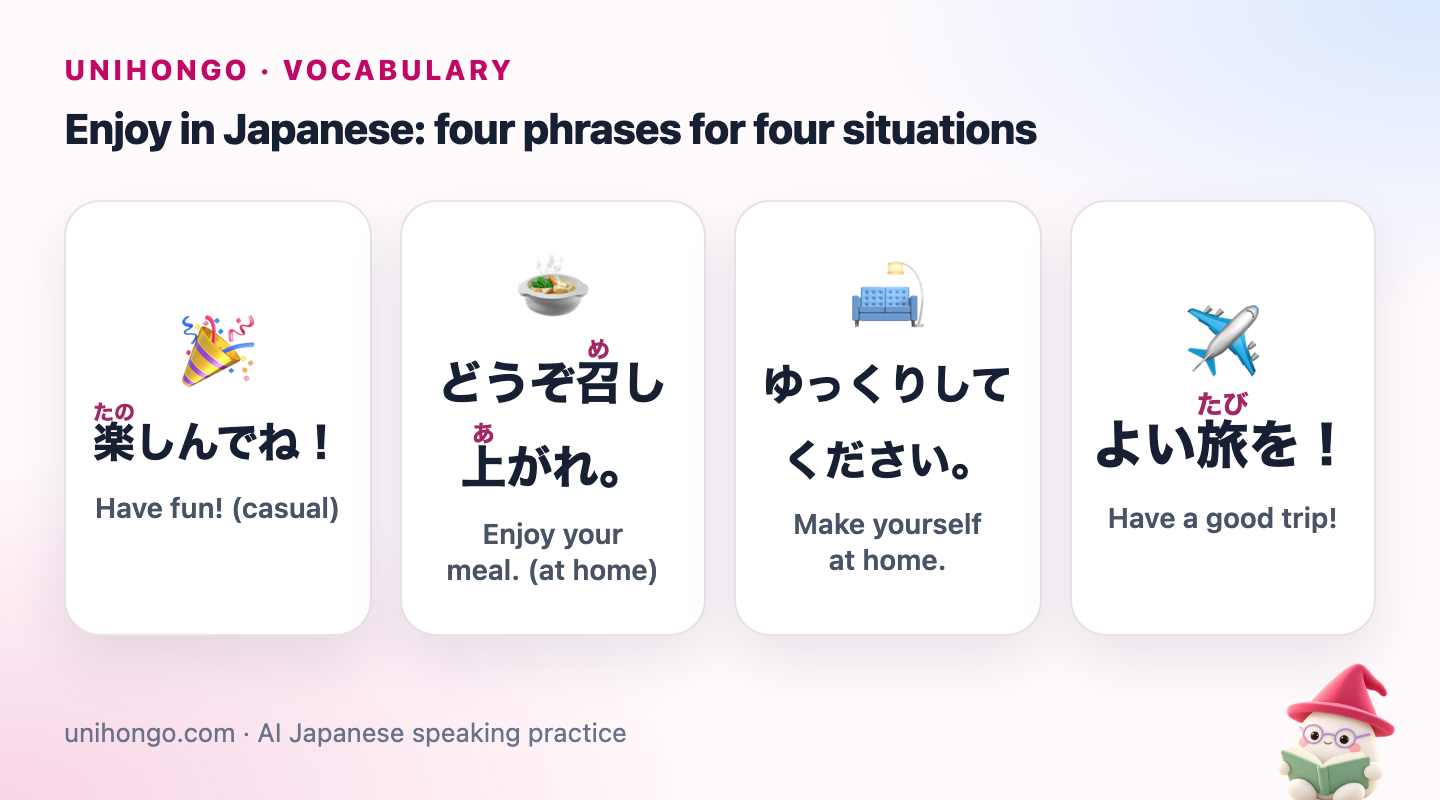
| Japanese | Romaji | Meaning |
|---|---|---|
| 楽しんでね! | Tanoshinde ne! | Have fun! (casual) |
| どうぞ召し上がれ。 | Dōzo meshiagare. | Enjoy your meal. (at home) |
| ゆっくりしてください。 | Yukkuri shite kudasai. | Make yourself at home. |
| よい旅を! | Yoi tabi o! | Have a good trip! |
Why enjoy is often not translated directly
In English, enjoy works as a quick, all-purpose wish: enjoy, here you go, have fun. Japanese wishes are usually tied to what the person is about to do, and the warmth comes from the host's care rather than from the word enjoy. Handing someone a cup of tea, you say dōzo, please, go ahead. Welcoming someone into your home, you say yukkuri shite kudasai, take it easy and relax. Seeing someone off on a trip, you say ki o tsukete, take care, as often as tanoshinde.
So when you want to say enjoy in Japanese, ask first what the person is doing. The right phrase usually follows from that, and it will sound much more natural than a direct translation.
Tanoshimu and tanoshinde: the verb itself
Tanoshimu (楽しむ) means to enjoy or have fun. Its te-form, tanoshinde, is the base of the wishes: tanoshinde ne, have fun; tanoshinde kudasai, please enjoy it; tanoshinde kite ne, go and have fun, said to someone leaving for an event or a trip.
When you talk about your own enjoyment afterwards, Japanese speakers usually use the adjective tanoshii, fun, rather than tanoshimu: tanoshikatta desu, it was fun, is more natural than tanoshimimashita, I enjoyed it, in conversation. Tanoshimimashita is fine in writing, such as a thank-you note.
Do not confuse it with tanoshimi, looking forward to. Tanoshimi ni shite imasu means I'm looking forward to it, which is about the future, not about enjoying something now.
| Japanese | Romaji | Meaning |
|---|---|---|
| 楽しんでください。 | Tanoshinde kudasai. | Please enjoy it. (polite) |
| コンサート、楽しんできてね。 | Konsāto, tanoshinde kite ne. | Have fun at the concert. |
| すごく楽しかったです。 | Sugoku tanoshikatta desu. | It was really fun. |
| 京都の旅行を楽しみました。 | Kyōto no ryokō o tanoshimimashita. | I enjoyed my trip to Kyoto. (more written) |
| 楽しみにしています。 | Tanoshimi ni shite imasu. | I'm looking forward to it. |
Enjoy your meal: dōzo and meshiagare
When you serve food at home, the simplest phrase is dōzo, here you go. Dōzo meshiagare, from the respectful verb meshiagaru, to eat, is a warm phrase that a parent or host says after placing food on the table. It sounds homely and slightly old-fashioned, and many people use it a little playfully. The polite version is dōzo meshiagatte kudasai.
Restaurant staff rarely say meshiagare. They usually say go-yukkuri dōzo, please take your time, when they bring your food. The person eating replies itadakimasu before eating, and gochisōsama deshita at the end, which is also how a guest thanks a host.
| Japanese | Romaji | Meaning |
|---|---|---|
| どうぞ。 | Dōzo. | Here you go. / Help yourself. |
| どうぞ召し上がってください。 | Dōzo meshiagatte kudasai. | Please enjoy your meal. (polite) |
| ごゆっくりどうぞ。 | Go-yukkuri dōzo. | Please take your time. (staff) |
| いただきます。 | Itadakimasu. | Thank you for the food. (before eating) |
| ごちそうさまでした。 | Gochisōsama deshita. | Thank you for the meal. (after eating) |
Enjoy your stay: yukkuri shite kudasai
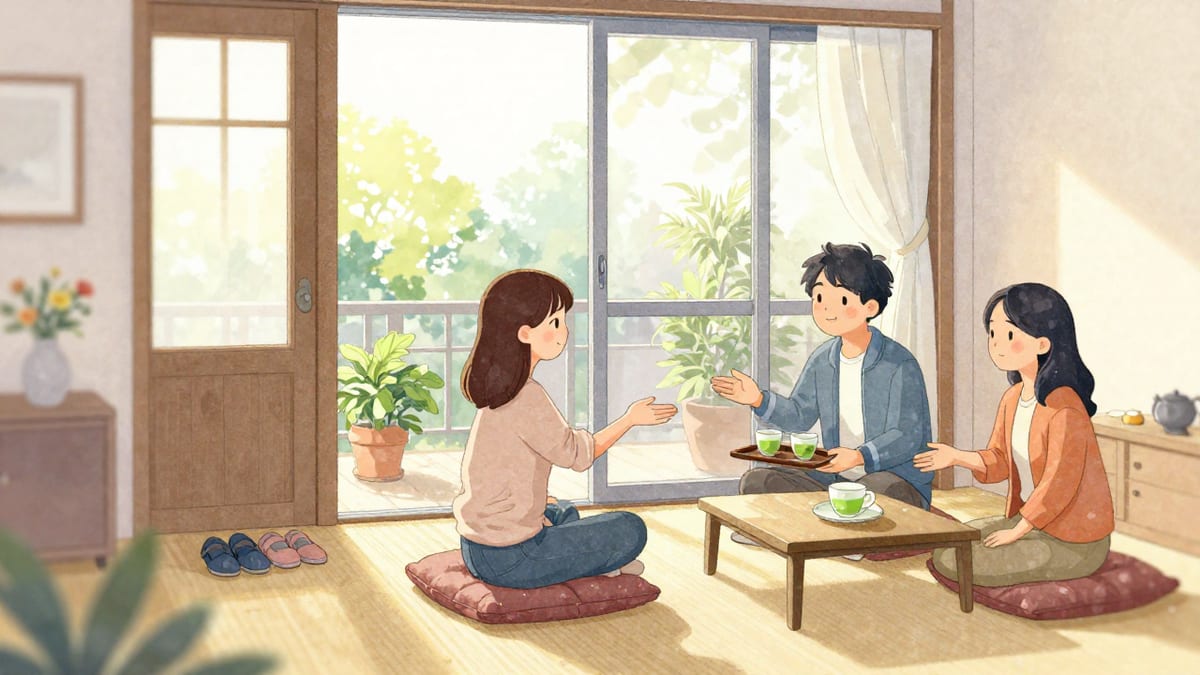
Yukkuri means slowly or at leisure, so yukkuri shite kudasai means please take your time, make yourself at home. It is what a host says when a guest arrives, and yukkuri shite itte ne, stay and relax, is the casual version among friends. Kutsuroide kudasai, please relax, is similar and a little more formal.
At hotels and inns, staff say go-yukkuri o-sugoshi kudasai, please enjoy your stay. The guest's reply is a simple arigatō gozaimasu, and when entering someone's home, o-jama shimasu, sorry to intrude, is the polite greeting.
| Japanese | Romaji | Meaning |
|---|---|---|
| ゆっくりしていってね。 | Yukkuri shite itte ne. | Stay and relax. (casual) |
| どうぞ、くつろいでください。 | Dōzo, kutsuroide kudasai. | Please make yourself comfortable. |
| ごゆっくりお過ごしください。 | Go-yukkuri o-sugoshi kudasai. | Please enjoy your stay. (hotel, formal) |
| お邪魔します。 | O-jama shimasu. | Sorry to intrude. (entering a home) |
Enjoy your trip, the party, the show
For a friend leaving on a trip, tanoshinde kite ne, go and have fun, is natural, often with ki o tsukete. Yoi tabi o, have a good trip, is a little more formal and common in writing and messages. A warm extra line is o-miyage banashi, tanoshimi ni shiteru ne, I can't wait to hear all about it.
For an event, name it: pātī, tanoshinde ne; matsuri, tanoshinde kite. Shop staff and organisers may say o-tanoshimi kudasai, please enjoy, a polite set phrase used before a show or a course meal.
| Japanese | Romaji | Meaning |
|---|---|---|
| 旅行、楽しんできてね。 | Ryokō, tanoshinde kite ne. | Have fun on your trip. |
| 気をつけて行ってらっしゃい。 | Ki o tsukete itterasshai. | Take care and have a good trip. |
| お土産話、楽しみにしてるね。 | O-miyage banashi, tanoshimi ni shiteru ne. | I can't wait to hear all about it. |
| どうぞお楽しみください。 | Dōzo o-tanoshimi kudasai. | Please enjoy. (staff, formal) |
Saying you enjoyed it: replies and thank-yous
When someone wishes you a good time, the reply is simple thanks: arigatō, tanoshinde kuru ne, thanks, I'll have fun. Politely, arigatō gozaimasu, tanoshinde kimasu. Afterwards, the most natural way to say you enjoyed something is with the adjective tanoshii in the past: tanoshikatta, it was fun, or for food, oishikatta desu, it was delicious.
Japanese thank-yous often look back at the shared time. After a party or a visit, kyō wa arigatō, hontō ni tanoshikatta, thanks for today, it was really fun, is warm and common, and many people send a short message the same evening repeating it. Politely, o-maneki itadaki arigatō gozaimashita, thank you for inviting me, fits a more formal host.
For hobbies and ongoing activities, enjoy is often expressed with tanoshinde imasu or with ki ni itte imasu, I'm really liking it: Nihon no seikatsu o tanoshinde imasu, I'm enjoying life in Japan, is a good answer when people ask how you are finding things.
| Japanese | Romaji | Meaning |
|---|---|---|
| ありがとう、楽しんでくるね。 | Arigatō, tanoshinde kuru ne. | Thanks, I'll have fun. |
| 今日はありがとう。本当に楽しかった。 | Kyō wa arigatō. Hontō ni tanoshikatta. | Thanks for today. It was really fun. |
| お招きいただき、ありがとうございました。 | O-maneki itadaki, arigatō gozaimashita. | Thank you for inviting me. (polite) |
| 日本の生活を楽しんでいます。 | Nihon no seikatsu o tanoshinde imasu. | I'm enjoying life in Japan. |
Mini dialogue and common mistakes
| Japanese | Romaji | Meaning |
|---|---|---|
| いらっしゃい!どうぞ上がって。 | Irasshai! Dōzo agatte. | Host: Welcome! Come on in. |
| お邪魔します。 | O-jama shimasu. | Guest: Thanks for having me. |
| ゆっくりしていってね。はい、どうぞ召し上がれ。 | Yukkuri shite itte ne. Hai, dōzo meshiagare. | Host: Make yourself at home. Here, enjoy. |
| わあ、おいしそう。いただきます! | Wā, oishisō. Itadakimasu! | Guest: Wow, that looks delicious. Thank you! |
- Saying enjoi shite kudasai as a polite wish: the loanword sounds playful. Use tanoshinde kudasai.
- Saying meshiagare as a customer: it is said by the person serving, not the one eating.
- Mixing up tanoshinde (enjoy it) and tanoshimi (looking forward to it).
- Answering how was it with tanoshimimashita in casual talk: tanoshikatta is more natural.
- Wishing only tanoshinde to a traveller: ki o tsukete often comes first in Japanese.