
Nakanaka in four everyday lines
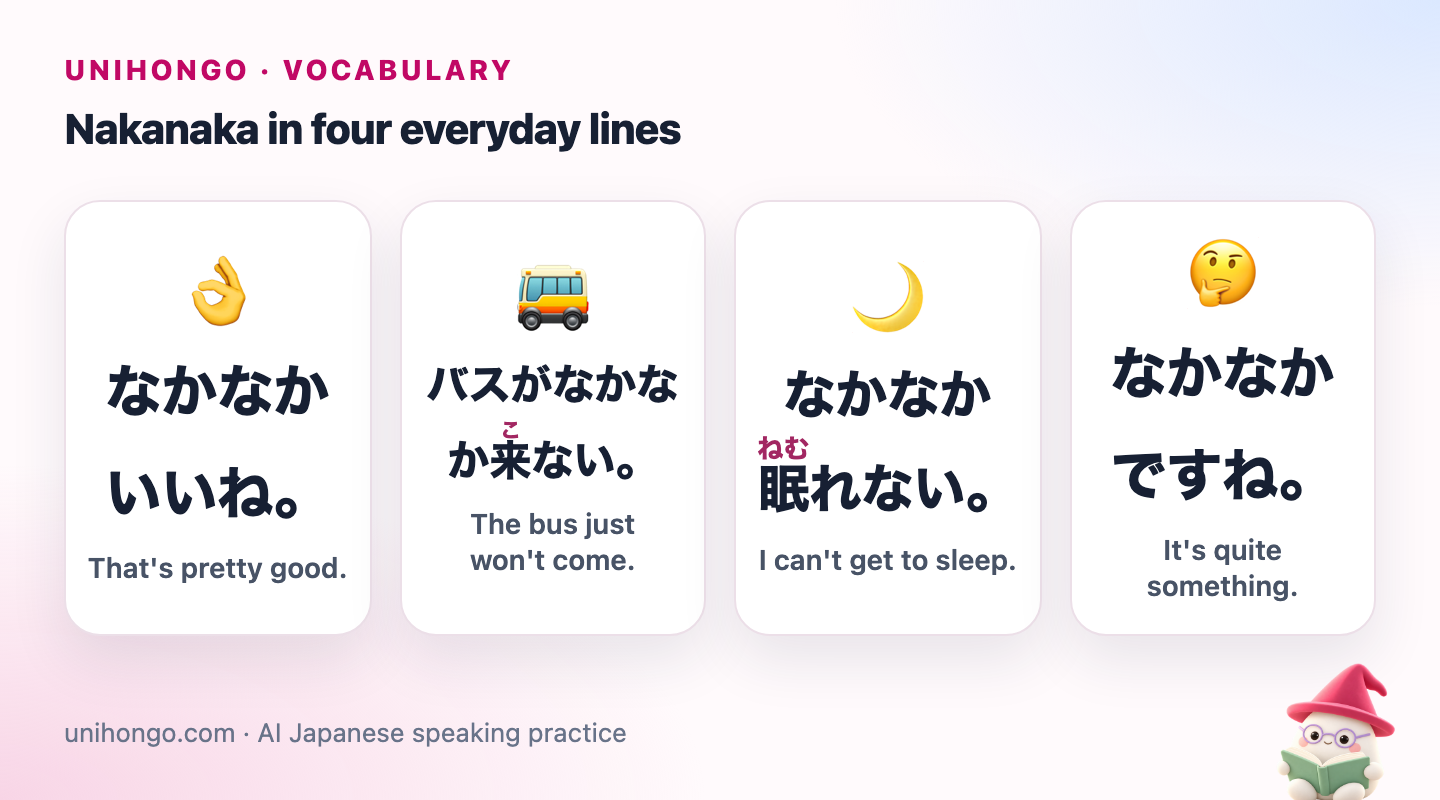
These four lines show the whole range of nakanaka. The first is restrained praise. The second and third use a negative: something will not happen, however long you wait or try. The fourth is the short reply nakanaka desu ne, which you will hear in all kinds of conversations.
The trick is to look at what comes after nakanaka. A positive word, ii, oishii, jōzu, makes it praise. A negative verb, konai, nemurenai, dekinai, makes it 'not easily'.
| Japanese | Romaji | Meaning |
|---|---|---|
| なかなかいいね。 | Nakanaka ii ne. | That's pretty good. |
| バスがなかなか来ない。 | Basu ga nakanaka konai. | The bus just won't come. |
| なかなか眠れない。 | Nakanaka nemurenai. | I can't get to sleep. |
| なかなかですね。 | Nakanaka desu ne. | It's quite something. |
The word and its kanji
Nakanaka can be written 中々 or 中中, using 中 (middle) with the repetition mark 々. In everyday writing hiragana, なかなか, is far more common, and that is the safe choice. The kanji does not help much with the modern meaning, so think of nakanaka as a word to learn by its grammar.
It is an adverb, so it sits before the word it modifies: nakanaka ii, nakanaka konai. It can also become an adjective-like word with no before a noun, nakanaka no ude, quite a skill, or stand alone with desu: nakanaka desu ne. The register is neutral: it works in casual speech, polite speech and writing.
| Japanese | Romaji | Meaning |
|---|---|---|
| なかなかの腕前ですね。 | Nakanaka no udemae desu ne. | That's quite some skill. |
| なかなかのものだ。 | Nakanaka no mono da. | It's really quite something. |
| この店、なかなかおいしいよ。 | Kono mise, nakanaka oishii yo. | This place is pretty tasty. |
Nakanaka no + noun is slightly more formal and admiring than nakanaka ii. You will hear it in reviews, on television and from older speakers praising someone's craft or a well-made dish.
Quite, pretty: praise with restraint
With a positive adjective or verb, nakanaka means 'quite', 'pretty' or 'rather', with a hint of surprise: it is better than I expected. Nakanaka oishii is 'this is actually pretty tasty'. Nakanaka yaru ne is 'you're pretty good', said with a grin when someone does better than expected, for example in a game.
This restraint is part of its charm. Japanese praise is often understated, and nakanaka sounds honest rather than exaggerated. But because it compares the result with an expectation, it also sounds like a judgement. A teacher can say nakanaka ii to a student, a senior to a junior, a friend to a friend. Said upwards, to a manager about their presentation, nakanaka yokatta desu can sound as if you are grading them, and as if you expected less.
To praise a superior, use totemo or sasuga instead: totemo benkyō ni narimashita, I learned a lot, or sasuga desu ne, just what I'd expect from you.
| Japanese | Romaji | Meaning |
|---|---|---|
| なかなかおいしいね、これ。 | Nakanaka oishii ne, kore. | This is actually pretty tasty. |
| 日本語、なかなか上手ですね。 | Nihongo, nakanaka jōzu desu ne. | Your Japanese is quite good. (teacher to student) |
| なかなかやるね! | Nakanaka yaru ne! | You're pretty good! (in a game) |
| とても勉強になりました。 | Totemo benkyō ni narimashita. | I learned a lot. (safe to a superior) |
Not easily: nakanaka with a negative
With a negative verb, nakanaka means that something does not happen easily or quickly, despite waiting or effort. Basu ga nakanaka konai, the bus just won't come. Nakanaka nemurenai, I can't get to sleep. Kanji ga nakanaka oboerarenai, I just can't memorise the kanji. The verb is often in the potential form, because the point is that you try and it is hard.
This use is extremely common and completely neutral; you can say it to anyone. It expresses patience, mild frustration or sympathy, not failure. Nakanaka kimaranai, it just won't get decided, is how people describe a long meeting, and nakanaka aenai ne, we never manage to meet, is a warm line between friends who are busy.
A useful positive twist is nakanaka dekinai koto, something not just anyone can do. Sore wa nakanaka dekinai koto da yo is high praise: that's something few people could do.
| Japanese | Romaji | Meaning |
|---|---|---|
| 漢字がなかなか覚えられない。 | Kanji ga nakanaka oboerarenai. | I just can't memorise the kanji. |
| 会議がなかなか終わらない。 | Kaigi ga nakanaka owaranai. | The meeting just won't end. |
| 最近なかなか会えないね。 | Saikin nakanaka aenai ne. | We never manage to meet lately. |
| 風邪がなかなか治らなくて。 | Kaze ga nakanaka naoranakute. | My cold just won't go away. |
| それはなかなかできないことだよ。 | Sore wa nakanaka dekinai koto da yo. | That's something few people could do. |
Nakanaka desu ne, and the soft no
Nakanaka desu ne on its own is a flexible reply. Looking at a friend's new garden, it means 'it's quite something'. Asked whether Japanese is hard, it means 'it's not easy, is it', with a smile. Asked about a difficult project, it can mean 'well, it's tough', without complaining in detail.
In business, a related line does important work. Sore wa nakanaka muzukashii desu ne, 'that's rather difficult', is very often a polite refusal. The speaker is not inviting you to try harder; they are saying no without saying no. If you hear it after a request, it is wise to offer an alternative or ask what would be possible.
| Japanese | Romaji | Meaning |
|---|---|---|
| 日本語は難しいですか。 | Nihongo wa muzukashii desu ka. | Friend: Is Japanese hard? |
| そうですね、なかなかです。 | Sō desu ne, nakanaka desu. | You: Well, it's not easy. |
| 来週までにできますか。 | Raishū made ni dekimasu ka. | Client: Could you do it by next week? |
| それはなかなか難しいですね… | Sore wa nakanaka muzukashii desu ne... | Supplier: That would be rather difficult... (soft no) |
| では、いつ頃なら可能でしょうか。 | Dewa, itsu goro nara kanō deshō ka. | Client: Then around when would be possible? |
Nakanaka, kanari, totemo and zenzen
Learners often swap nakanaka with other degree words. Each has its own feeling, and the table shows the difference. Kanari is a more neutral 'considerably', describing an amount. Totemo is plain 'very'. Zenzen with a negative is 'not at all', a complete no, while nakanaka with a negative is 'not easily', a struggle.
| Japanese | Romaji | Meaning |
|---|---|---|
| 今日はかなり寒い。 | Kyō wa kanari samui. | It's really quite cold today. |
| とてもおいしいです。 | Totemo oishii desu. | It's very tasty. (polite) |
| 全然わからない。 | Zenzen wakaranai. | I don't understand at all. |
| なかなかわからない。 | Nakanaka wakaranai. | I'm struggling to understand it. |
| Word | Feeling | Example |
|---|---|---|
| nakanaka + positive | Quite, better than expected; evaluative | Nakanaka ii: pretty good |
| kanari | Considerably, a large degree; more neutral | Kanari samui: really quite cold |
| totemo | Very, plain and safe in any register | Totemo oishii: very tasty |
| nakanaka + negative | Not easily, despite effort or waiting | Nakanaka konai: just won't come |
| zenzen + negative | Not at all, completely | Zenzen konai: doesn't come at all |
Mini dialogue: the first homemade curry
A learner cooks Japanese curry for the first time for a Japanese friend. Listen for both meanings of nakanaka, and notice how the friend's restrained praise is warm, not lukewarm.

| Japanese | Romaji | Meaning |
|---|---|---|
| どう?初めて作ったんだけど。 | Dō? Hajimete tsukutta n da kedo. | Leo: How is it? It's my first try. |
| うん、なかなかおいしい! | Un, nakanaka oishii! | Yui: Mm, it's actually pretty good! |
| 本当?ルーがなかなか溶けなくて焦ったよ。 | Hontō? Rū ga nakanaka tokenakute asetta yo. | Leo: Really? The roux wouldn't melt, I panicked. |
| 初めてでこれなら、なかなかだよ。 | Hajimete de kore nara, nakanaka da yo. | Yui: For a first try, that's pretty impressive. |
| 次はもっと辛くしてみる。 | Tsugi wa motto karaku shite miru. | Leo: Next time I'll make it spicier. |
Yui's nakanaka oishii is real praise between friends; nothing about it is lukewarm. If Leo wanted bigger praise, he might hear meccha oishii, but understated nakanaka is common and sincere. Leo's own nakanaka tokenakute uses the negative meaning: the roux would not melt however much he stirred.
Common learner mistakes with nakanaka
- Praising a superior with nakanaka. It sounds like an evaluation; use totemo, sasuga or thank them for what you learned.
- Reading nakanaka + negative as 'not at all'. Nakanaka dekinai is 'I can't do it easily', not zenzen dekinai, 'I can't do it at all'.
- Using it as a plain 'very'. Nakanaka adds 'more than expected'; for simple emphasis, totemo is the neutral choice.
- Missing the soft no. Sore wa nakanaka muzukashii desu ne after a request usually means no; offer an alternative instead of pushing.
- Writing it in kanji in casual messages. 中々 is correct but hiragana なかなか looks more natural in most everyday writing.
Ten minutes with Mocchi on nakanaka
- Type: '/quiz nakanaka, kanari, totemo and zenzen: ten sentences with a blank, one at a time.' Mocchi explains each answer and remembers the pairs you confuse.
- Ask Mocchi to /explain the sentence Sore wa nakanaka muzukashii desu ne in a business email, so you see how the soft no is built.
- Turn the four core lines into flashcards with /create-flashcards, a photo for each, and play them in Kotoba Tank: hear the line, hit the right card.