

The most common surnames
Surveys of Japanese surnames consistently place a handful of names at the top. Satō is widely reported as the most common, followed by Suzuki, with Takahashi, Tanaka, Itō, Watanabe, Yamamoto, Nakamura, Kobayashi and Katō making up the rest of the usual top ten. Different surveys, based on phone directories, public records or samples, give slightly different orders, especially between Itō and Watanabe, so treat the ranking as approximate.
Regional differences are strong. Some names are far more common in particular parts of the country than the national rankings suggest, and Okinawa has its own set of common surnames, such as Higa and Kinjō, which are rare elsewhere.
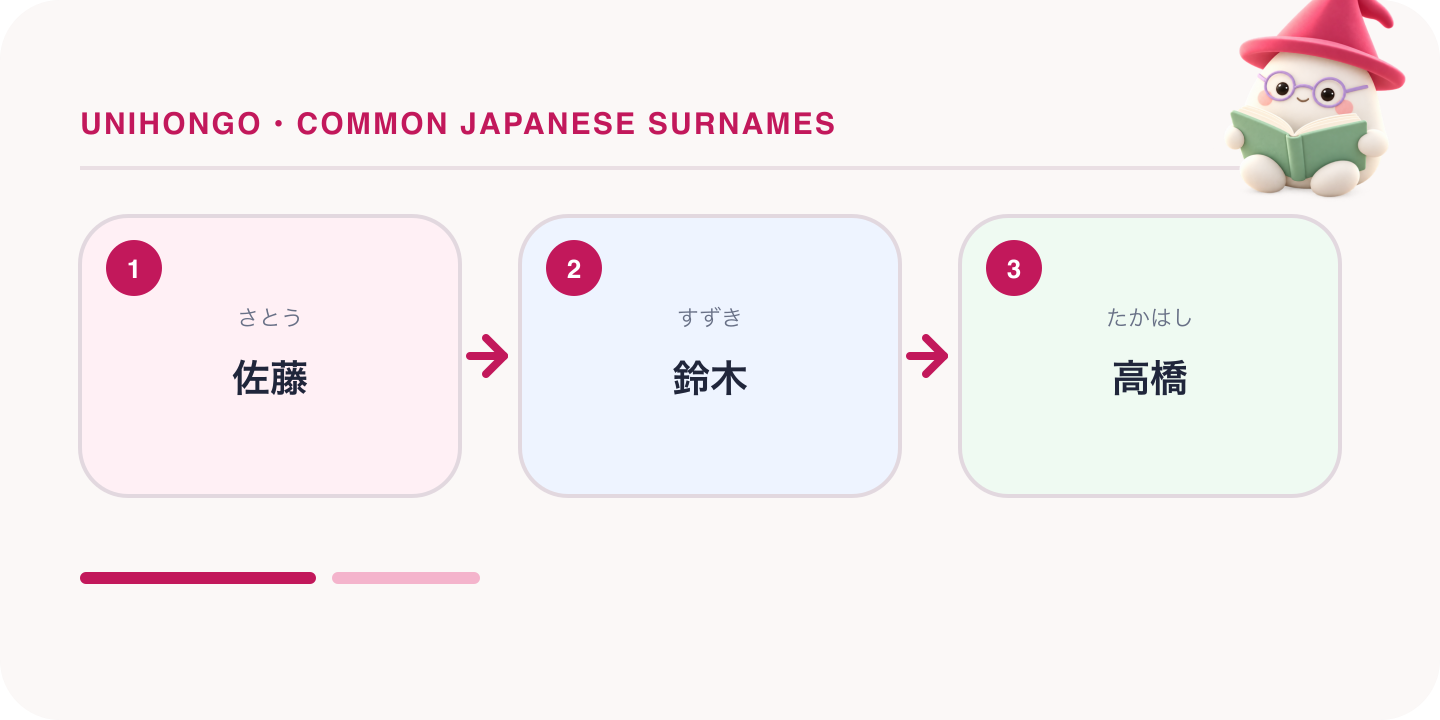
| Surname | Reading | Literal kanji meaning |
|---|---|---|
| 佐藤 | Satō | Help + wisteria |
| 鈴木 | Suzuki | Bell + tree |
| 高橋 | Takahashi | High + bridge |
| 田中 | Tanaka | Rice field + middle |
| 伊藤 | Itō | (phonetic i) + wisteria |
| 渡辺 | Watanabe | Cross + vicinity |
| 山本 | Yamamoto | Mountain + base, origin |
| 中村 | Nakamura | Middle + village |
| 小林 | Kobayashi | Small + woods |
| 加藤 | Katō | Add + wisteria |
The next group of familiar names
Just below the top ten comes a group of names you will meet constantly in offices, schools and on television. Many repeat the same building blocks: Yoshida and Yamada use ta, Yamaguchi and Matsumoto combine nature words, and Sasaki uses the repetition mark 々 to double the previous kanji.
Saitō deserves a special mention because it is written in several variant forms, 斎藤, 斉藤, 齋藤 and 齊藤. They are all read Saitō, but each family uses its own form, and getting it right on a letter or email matters.
| Surname | Reading | Literal kanji meaning |
|---|---|---|
| 吉田 | Yoshida | Good fortune + rice field |
| 山田 | Yamada | Mountain + rice field |
| 佐々木 | Sasaki | Help + help + tree |
| 山口 | Yamaguchi | Mountain + mouth, entrance |
| 松本 | Matsumoto | Pine + base |
| 井上 | Inoue | Well + above |
| 木村 | Kimura | Tree + village |
| 林 | Hayashi | Woods |
| 斎藤 | Saitō | Purification + wisteria |
| 清水 | Shimizu | Clear + water |
The kanji that surnames are built from
Most common surnames are built from a small set of kanji for landscape and place. That is because many families took or were given names describing where they lived: by the rice field, at the foot of the mountain, in the middle village. Commoners in Japan were required to register surnames in the 1870s, and many chose or were given names linked to their surroundings.
Learn these elements and you can read a large share of the names on a class list or an office floor plan. Notice that many have more than one reading depending on position in the name.
| Kanji | Common readings in names | Meaning and examples |
|---|---|---|
| 田 | ta, da | Rice field: Tanaka, Yamada, Yoshida |
| 山 | yama | Mountain: Yamamoto, Yamaguchi, Nakayama |
| 川 | kawa, gawa | River: Kawaguchi, Ishikawa, Nakagawa |
| 中 | naka | Middle: Nakamura, Tanaka, Nakajima |
| 本 | moto | Base, origin: Yamamoto, Matsumoto, Hashimoto |
| 木 | ki, gi | Tree: Kimura, Suzuki, Sasaki |
| 村 | mura | Village: Nakamura, Kimura, Nishimura |
| 井 | i | Well: Inoue, Ishii, Sakurai |
| 野 | no | Field, plain: Ono, Hirano, Kitano |
| 島 | shima, jima | Island: Nakajima, Kojima, Shimada |
| 藤 | fuji, tō, dō | Wisteria: Fujita, Satō, Kondō |
| 橋 | hashi, bashi | Bridge: Takahashi, Ishibashi, Hashimoto |
| 原 | hara, wara | Plain, field: Ishihara, Hara, Kuwahara |
| 森 | mori | Forest: Mori, Morita, Ōmori |
Many surnames ending in tō, such as Satō, Itō, Katō, Saitō and Kondō, use 藤, wisteria. These names are traditionally linked to the powerful Fujiwara clan, whose name begins with the same kanji, though the story of any individual family is usually impossible to trace.
Why the same kanji sound different
Two sound changes explain most of the variation. The first is rendaku, sequential voicing: when a word follows another in a compound, its first consonant often becomes voiced. That is why kawa becomes gawa in Nakagawa, ta becomes da in Yamada, and hashi becomes bashi in Ishibashi. Rendaku is not completely predictable, which is why Nakata and Nakada both exist.
The second is that 藤 has a native reading, fuji, and a Sino-Japanese reading, tō, which becomes dō in names such as Kondō and Endō. On top of this, some name kanji have readings that are almost never used outside names, and some families keep an old or regional reading. The result is that even native speakers are sometimes unsure how to read a surname.
| Surname | Possible readings | Note |
|---|---|---|
| 河野 | Kōno / Kawano | Both are common |
| 上村 | Uemura / Kamimura | Varies by family and region |
| 東 | Higashi / Azuma | Same kanji, different names |
| 中田 | Nakata / Nakada | Voiced or unvoiced ta |
| 角田 | Kakuta / Tsunoda / Sumida | Several readings exist |
| 小野 | Ono | Here 小 is o, not ko |
Asking how a name is read
Because readings vary, Japanese people routinely ask about names, and it is never rude to do so politely. Business cards often print the reading in small kana or romaji, and forms have a furigana line above the name box for exactly this reason.
Use the polite forms below when meeting someone at work, and the simpler ones with classmates. Once you know the reading, repeat it back with san to confirm, and try to remember the kanji too, since you will need it for emails.
| Japanese | Romaji | Meaning |
|---|---|---|
| お名前は何とお読みすればよろしいですか。 | O-namae wa nan to o-yomi sureba yoroshii desu ka. | How should I read your name? (polite) |
| このお名前はどう読みますか。 | Kono o-namae wa dō yomimasu ka. | How do you read this name? |
| カワノさんですか、コウノさんですか。 | Kawano-san desu ka, Kōno-san desu ka. | Is it Kawano or Kōno? |
| 漢字はどう書きますか。 | Kanji wa dō kakimasu ka. | How is it written in kanji? |
| 斉藤さんの斉は、どちらの字ですか。 | Saitō-san no sai wa, dochira no ji desu ka. | Which character is the sai in your Saitō? |
| ふりがなをお願いします。 | Furigana o onegai shimasu. | Please add the reading in kana. |
Using surnames with san, sama and kun
In Japan, adults generally address each other by surname plus an honorific. San is the default for colleagues, neighbours, shop staff and acquaintances. Sama is more formal and is used for customers and on letters and emails. Kun is often used for boys and younger men, and by some seniors for juniors at work, while chan is for children and close friends.
Never add san to your own name. When introducing yourself, just say your surname: Tanaka desu. In a business context, when speaking to someone outside your company about a colleague, many people also drop the san and say just the surname, because you are speaking about your own side.
| Japanese | Romaji | Meaning |
|---|---|---|
| 田中さん、おはようございます。 | Tanaka-san, ohayō gozaimasu. | Good morning, Tanaka-san. |
| 佐藤様でいらっしゃいますか。 | Satō-sama de irasshaimasu ka. | Are you Mr or Ms Satō? (very polite) |
| 鈴木と申します。 | Suzuki to mōshimasu. | My name is Suzuki. (humble) |
| 高橋は今、席を外しております。 | Takahashi wa ima, seki o hazushite orimasu. | Takahashi is away from their desk. (about a colleague, to an outsider) |
| 山本先生、質問があります。 | Yamamoto-sensei, shitsumon ga arimasu. | Professor Yamamoto, I have a question. |
Why the surname comes first
Japanese names follow the East Asian order: family name, then given name. Tanaka Hanako is Hanako of the Tanaka family. In speech and writing in Japanese, this order is fixed, and the given name is used mainly by family and close friends.
In English, many Japanese people have traditionally reversed their names, to Hanako Tanaka, to match Western order. The Japanese government announced in 2019 that its official English documents would use surname-first order, often with the surname in capitals, as in TANAKA Hanako. Both orders are still common in international settings, so if you are unsure which part is the surname, ask.
- Surname is myōji or sei; given name is namae or mei. Namae can also mean full name.
- Forms often have separate boxes labelled 姓 for surname and 名 for given name.
- Under current law, a married couple shares one surname, so many people change their surname when they marry.
- Estimates of how many different surnames exist in Japan vary widely, but they run to many tens of thousands.
Common mistakes and reviewing the name kanji
- Adding san to your own name. Say Tanaka desu, never Tanaka-san desu about yourself.
- Using a given name too early. Wait until you are invited; surname plus san is the safe default.
- Guessing a reading and never checking. Ask once, politely, then remember it.
- Ignoring variant kanji. 斉藤 and 斎藤 are different names to the people who carry them.
- Dropping the long vowel. Satō and Katō have a long o; saying Sato or Kato can sound like a different word to native ears.
Surnames are one of the best kanji workouts there is, because the same fifteen or so building blocks appear again and again. Review 田, 山, 川, 中, 本, 木, 村, 藤 and 橋 in Unihongo's free learning games, then test yourself on a real list, such as a class register or a set of business cards, and read every name aloud with san.