
What are you doing in Japanese: four versions
The same question changes a lot with the situation and the tone. These four cover the casual chat, the right-now check-in, the polite question, and the scolding.
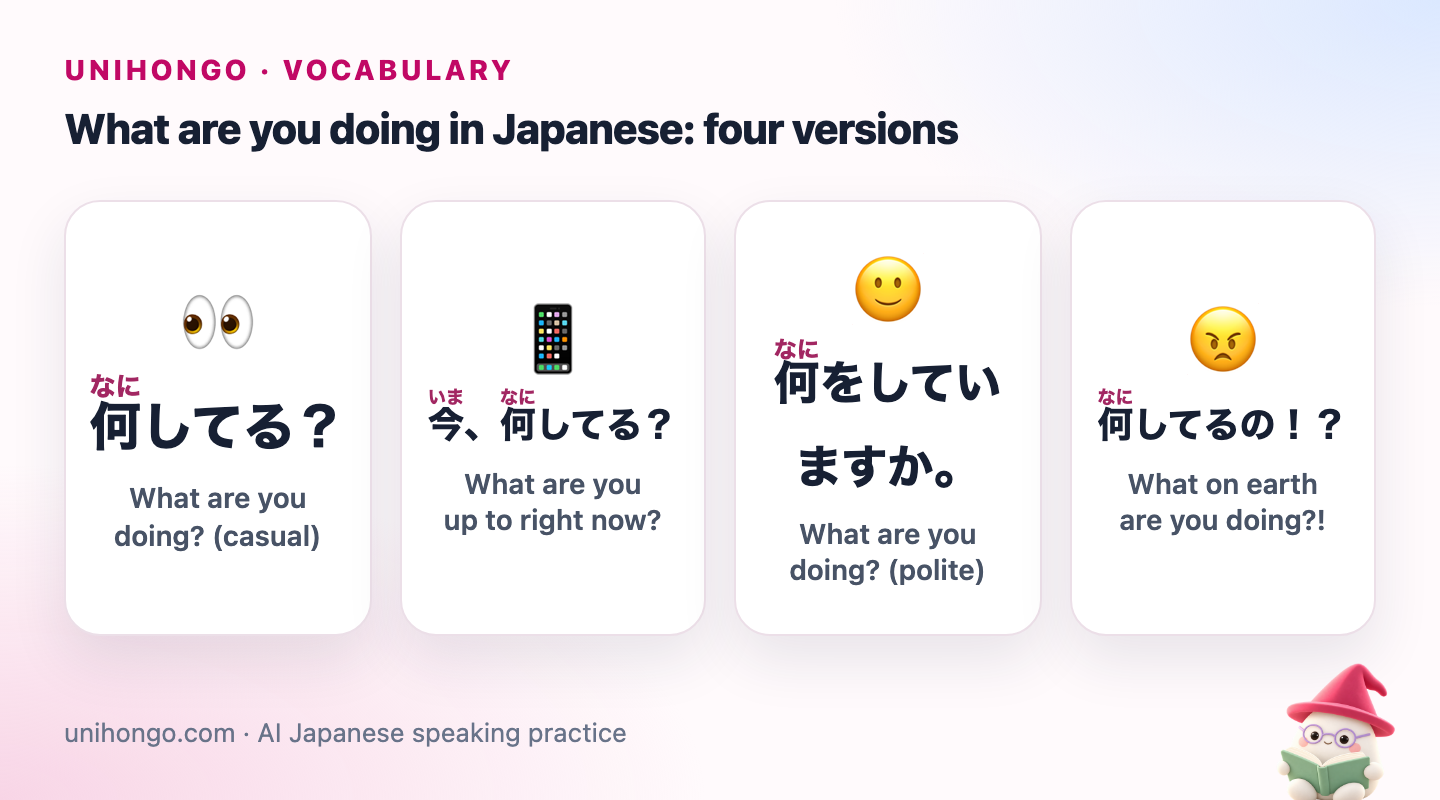
| Japanese | Romaji | Meaning |
|---|---|---|
| 何してる? | Nani shiteru? | What are you doing? (casual) |
| 今、何してる? | Ima, nani shiteru? | What are you up to right now? |
| 何をしていますか。 | Nani o shite imasu ka. | What are you doing? (polite) |
| 何してるの!? | Nani shiteru no!? | What on earth are you doing?! |
The te-iru form behind the question
Shite iru (している) is the te-iru form of suru, to do. Te-iru describes an action in progress, like English -ing, and also a habit or ongoing state. In speech the i drops out, so shite iru becomes shiteru, and that is the form you will hear in almost every casual question.
Because te-iru covers habits, nani o shite imasu ka can mean what do you do as well as what are you doing. Shūmatsu wa nani o shite imasu ka asks what you usually do at weekends, and o-shigoto wa nani o shite imasu ka asks about your job. The respectful sarete imasu raises the politeness for someone you want to honour.
| Japanese | Romaji | Meaning |
|---|---|---|
| 今、何をしていますか。 | Ima, nani o shite imasu ka. | What are you doing now? |
| 週末は何をしていますか。 | Shūmatsu wa nani o shite imasu ka. | What do you do at weekends? |
| お仕事は何をされていますか。 | O-shigoto wa nani o sarete imasu ka. | What do you do for work? (respectful) |
| 何をしましたか。 | Nani o shimashita ka. | What did you do? |
Casual: nani shiteru? and how friends reply
Nani shiteru? is the friendly check-in. Nani shiteru no? adds a softer, more curious no, and is very common. Nani shiten no? is a slurred casual version you will hear among young people. Nani yatteru? uses yaru, a rougher verb for do, and is fine between close friends.
Replies are usually short and use te-iru too: gohan tabeteru, I'm eating; uchi de gorogoro shiteru, lazing around at home; benkyō shiteru, studying. Betsu ni, nani mo, nothing much, is the classic shrug. Add hima, I'm free, and you have signalled that you are open to plans.
| Japanese | Romaji | Meaning |
|---|---|---|
| 別に、何も。 | Betsu ni, nani mo. | Nothing much. |
| 家でゴロゴロしてる。 | Ie de gorogoro shiteru. | Just lazing around at home. |
| ご飯食べてる。 | Gohan tabeteru. | I'm eating. |
| テレビ見てた。 | Terebi miteta. | I was watching TV. |
| 暇だよ。どうしたの? | Hima da yo. Dō shita no? | I'm free. What's up? |
Polite: asking colleagues, teachers and strangers
The textbook nani o shite imasu ka is grammatically fine, but asked of a colleague or a stranger out of the blue it can sound nosy, like checking up on them. In polite situations, Japanese usually asks with a reason. If you are curious about something you can see, nani o shite iru n desu ka or nani o tsukutte iru n desu ka, what are you making, sounds interested rather than suspicious.
If you really want to know whether someone is busy, ask that instead: ima, o-jikan yoroshii desu ka, do you have a moment now? That is what most people mean at work when they would say what are you doing in English.
| Japanese | Romaji | Meaning |
|---|---|---|
| 何をしているんですか。 | Nani o shite iru n desu ka. | What are you doing? (curious, polite) |
| 何を作っているんですか。 | Nani o tsukutte iru n desu ka. | What are you making? |
| 今、お時間よろしいですか。 | Ima, o-jikan yoroshii desu ka. | Do you have a moment now? |
| 楽しそうですね。何をしているんですか。 | Tanoshisō desu ne. Nani o shite iru n desu ka. | That looks fun. What are you doing? |
Texting: ima nani shiteru?
In messages the question is often written in hiragana or a mix: 今なにしてる? or いま何してるー? with a stretched vowel to sound relaxed. Many people use it as a lead-in, so the next message is often an invitation: hima nara, nomi ni ikanai? if you're free, want to grab a drink?
Replies in texts are even shorter than in speech: ima densha, on the train now; neteta, I was asleep; shigoto chū, at work. Nani shiteta no? asks what someone was doing, for example after they did not reply for hours, and can sound slightly suspicious between partners, so add a smile emoji if you only mean to be curious.
| Japanese | Romaji | Meaning |
|---|---|---|
| 今なにしてる? | Ima nani shiteru? | What are you up to? (relaxed text) |
| 今、電車。 | Ima, densha. | On the train right now. |
| 寝てた。 | Neteta. | I was asleep. |
| 暇なら、飲みに行かない? | Hima nara, nomi ni ikanai? | If you're free, want to grab a drink? |
| 何してたの? | Nani shiteta no? | What were you doing? |
Tone: when it sounds like an accusation
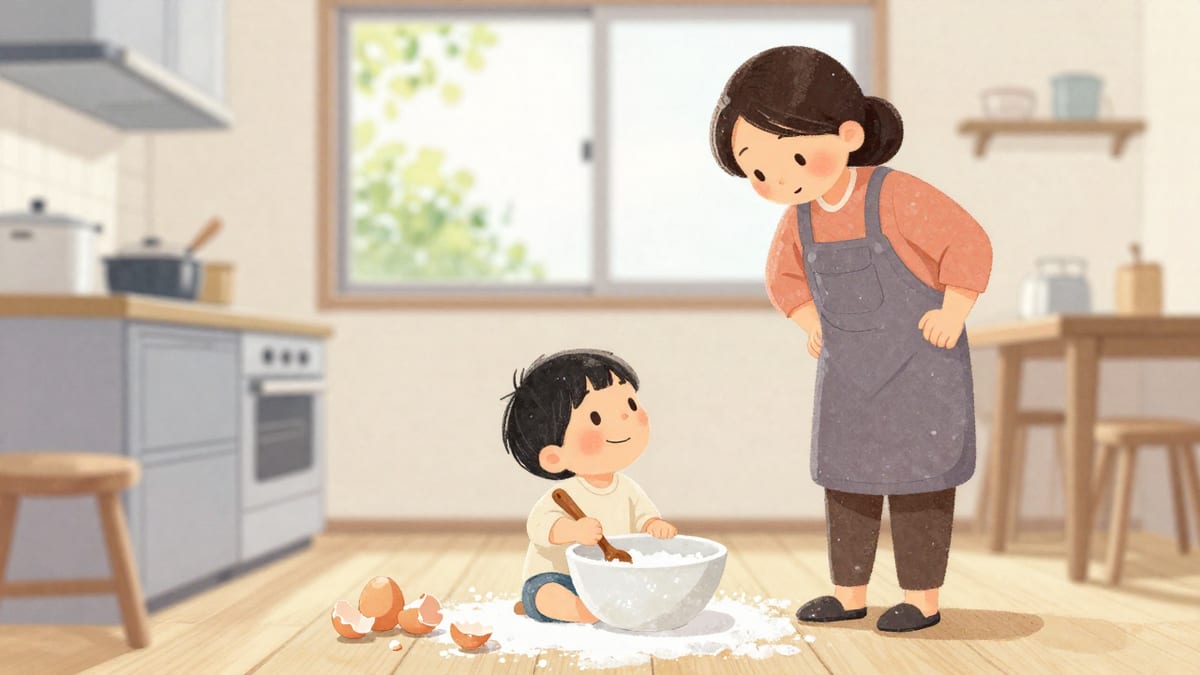
The same words can be a friendly question or a scolding. When a parent finds a child covered in flour, nani shiteru no!? with a sharp, falling tone means what on earth are you doing. Chotto, nani yatteru no! is stronger. Between adults, a sudden nani shiteru n desu ka! said sharply is a complaint, for example to someone cutting in line.
To keep the question friendly, soften the tone, add a comment first, or explain why you are asking: tanoshisō da ne, nani shiteru no? looks fun, what are you doing? A smile and a rising intonation do most of the work.
| Japanese | Romaji | Meaning |
|---|---|---|
| ちょっと、何やってるの! | Chotto, nani yatteru no! | Hey, what are you doing?! (scolding) |
| 何してるんですか! | Nani shiteru n desu ka! | What do you think you're doing?! (sharp) |
| 楽しそうだね。何してるの? | Tanoshisō da ne. Nani shiteru no? | Looks fun. What are you doing? (friendly) |
Answering when someone asks you
When a colleague, a teacher or a shop clerk asks what you are doing, answer with the te-iru form and, if it helps, a reason: shiryō o tsukutte imasu, I'm preparing documents; tomodachi o matte imasu, I'm waiting for a friend. A short explanation keeps the answer friendly and stops it from sounding defensive.
If someone asks because you look lost, the question may be an offer of help in disguise: dō shimashita ka or nani ka o-sagashi desu ka, are you looking for something. A clear answer such as eki o sagashite imasu, I'm looking for the station, turns it into a helpful exchange.
Among friends, it is also fine to bounce the question back: betsu ni. sotchi wa?, nothing much, you? That keeps a lazy chat going, which is often the whole point of nani shiteru.
| Japanese | Romaji | Meaning |
|---|---|---|
| 友だちを待っています。 | Tomodachi o matte imasu. | I'm waiting for a friend. |
| 会議の資料を作っています。 | Kaigi no shiryō o tsukutte imasu. | I'm preparing documents for a meeting. |
| 駅を探しています。 | Eki o sagashite imasu. | I'm looking for the station. |
| 別に。そっちは? | Betsu ni. Sotchi wa? | Nothing much. You? (casual) |
Mini dialogue and common mistakes
| Japanese | Romaji | Meaning |
|---|---|---|
| もしもし、今何してる? | Moshimoshi, ima nani shiteru? | Friend: Hello, what are you up to? |
| 家で掃除してた。どうしたの? | Ie de sōji shiteta. Dō shita no? | You: I was cleaning at home. What's up? |
| 駅前にいるんだけど、お茶しない? | Ekimae ni iru n da kedo, ocha shinai? | Friend: I'm by the station. Want to get a coffee? |
| いいね、すぐ行く! | Ii ne, sugu iku! | You: Sounds good, I'll be right there! |
- Nani o shimasu ka for right now: it means what will you do. Use shite iru.
- Anata wa nani o shite imasu ka: anata sounds distant and blunt. Drop it, or use the person's name.
- Asking a colleague nani o shite imasu ka out of the blue: ask o-jikan yoroshii desu ka instead.
- Using nani yatteru with people you should be polite to: yaru is casual and can sound rough.
- Forgetting tone: a flat or sharp nani shiteru no can sound like a scolding.