
Sukebō in four words
Four words carry the basic idea of skateboarding in Japanese: the activity, the first trick everyone learns, the phrase for landing it and the place you do it. Sukebō is clipped from sukētobōdo, the way Japanese often shortens long loanwords to four syllables. Ōrī, the ollie, is the jump that almost every other trick builds on.
Notice the verb in the invitation: sukebō ni norō, let's ride the skateboard. Noru, to ride or to get on, is used with ni for boards, bikes, trains and horses alike.
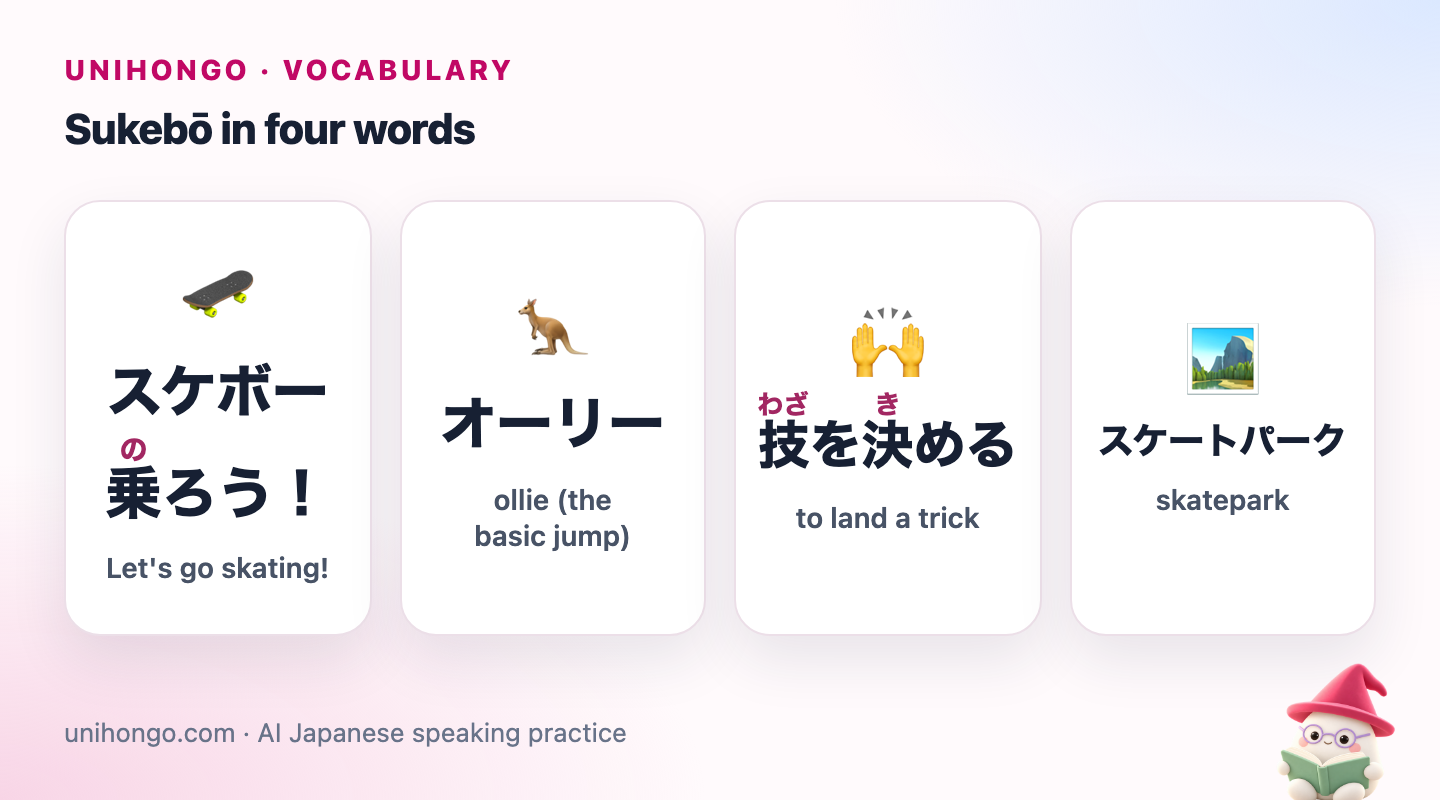
| Japanese | Romaji | Meaning |
|---|---|---|
| スケボー乗ろう! | Sukebō norō! | Let's go skating! |
| オーリー | ōrī | ollie (the basic jump) |
| 技を決める | waza o kimeru | to land a trick |
| スケートパーク | sukēto pāku | skatepark |
| スケボーに乗る | sukebō ni noru | to ride a skateboard |
| 技 | waza | trick, technique |
The board and the gear
Board parts are katakana from English, and skate shops in Japan use the same terms. The board itself is the dekki, the metal axles are torakku, the wheels are wīru, and the small rings inside them are bearingu. The rough sheet on top is dekki tēpu, deck tape.
Protective gear is often required at public skateparks, especially for children, and rules vary from park to park. Herumetto and pads, often called purotekutā, are worth bringing.
| Japanese | Romaji | Meaning |
|---|---|---|
| デッキ | dekki | deck, the board |
| トラック | torakku | trucks |
| ウィール | wīru | wheels |
| ベアリング | bearingu | bearings |
| ヘルメット | herumetto | helmet |
| プロテクター | purotekutā | protective pads |
| ウィールを替えたいです。 | Wīru o kaetai desu. | I want to change my wheels. |
| 初心者におすすめのデッキはどれですか。 | Shoshinsha ni osusume no dekki wa dore desu ka. | Which deck do you recommend for a beginner? |
In a skate shop, a complete board ready to ride is a konpurīto, complete. Torakku is also the word for a truck on the road; context makes it clear.
Stance and trick names
Stance words are the same as in English skating culture. Most trick names are too, pronounced in Japanese rhythm, so kickflip becomes kikkufurippu and grind becomes guraindo. Saying them with the right number of beats is what makes them understood.
Skaters also talk about style with a few loanwords. Sutorīto, street, means skating obstacles like rails, stairs and ledges, while toranjishon or bōru skating happens in curved bowls and ramps. If someone asks dotchi kei?, which type are you?, they want to know whether you are more of a street or a bowl skater. A simple sutorīto ga suki desu is a fine answer.
| Japanese | Romaji | Meaning |
|---|---|---|
| グーフィーです。 | Gūfī desu. | I ride goofy. |
| キックフリップを練習しています。 | Kikkufurippu o renshū shite imasu. | I'm practising kickflips. |
| レールでグラインドできる? | Rēru de guraindo dekiru? | Can you grind the rail? (casual) |
| まだドロップインが怖い。 | Mada doroppu in ga kowai. | Dropping in still scares me. |
| English | Japanese | What it is |
|---|---|---|
| Regular | regyurā | Left foot forward |
| Goofy | gūfī | Right foot forward |
| Kickflip | kikkufurippu | The board flips along its length |
| Shove-it | shōbitto | The board spins under your feet |
| Manual | manyuaru | Riding on two wheels |
| Drop in | doroppu in | Entering a ramp from the top |
Trying, landing and falling
Skating is mostly trying and falling, and the Japanese verbs for that are worth knowing. Yatte miru or charenji suru is to try; kimeru or meiku suru is to land; korobu is to fall. When a trick almost works, friends say oshii!, so close, and when it finally works, the reaction is often just yatta! or kimatta!
Kimatta is the intransitive form of kimeru: the trick got landed. You will hear both: kimeta!, you nailed it, and kimatta!, it worked.
| Japanese | Romaji | Meaning |
|---|---|---|
| やってみる | yatte miru | to give it a try |
| メイクした! | Meiku shita! | I landed it! |
| 決まった! | Kimatta! | It worked! You landed it! |
| 惜しい! | Oshii! | So close! |
| もう一回! | Mō ikkai! | One more time! |
| 今日は十回ぐらい転んだ。 | Kyō wa jukkai gurai koronda. | I fell about ten times today. |
Mō ikkai, one more time, is what you say to yourself after every failed attempt. Counting tries uses kai: ikkai, nikai, sankai.
As in skateparks around the world, encouragement in Japan often comes as a sound rather than a word: people tap their boards on the ground or the coping when someone lands a hard trick. Joining in is a friendly way to be part of the session, even before you can say much in Japanese.
Skatepark etiquette and taking turns
Public skateparks work on the same unwritten rules as everywhere: watch the flow, take turns on each section and do not stand where people land. A section, sekushon, is one obstacle or area: a ramp, a rail, a box. Japanese skaters often signal their turn with a short word or a nod, and asking politely is always welcome, especially at a new park.
Children and beginners share the parks, and many parks have time slots or areas for them. Being patient with small kids is part of the culture.
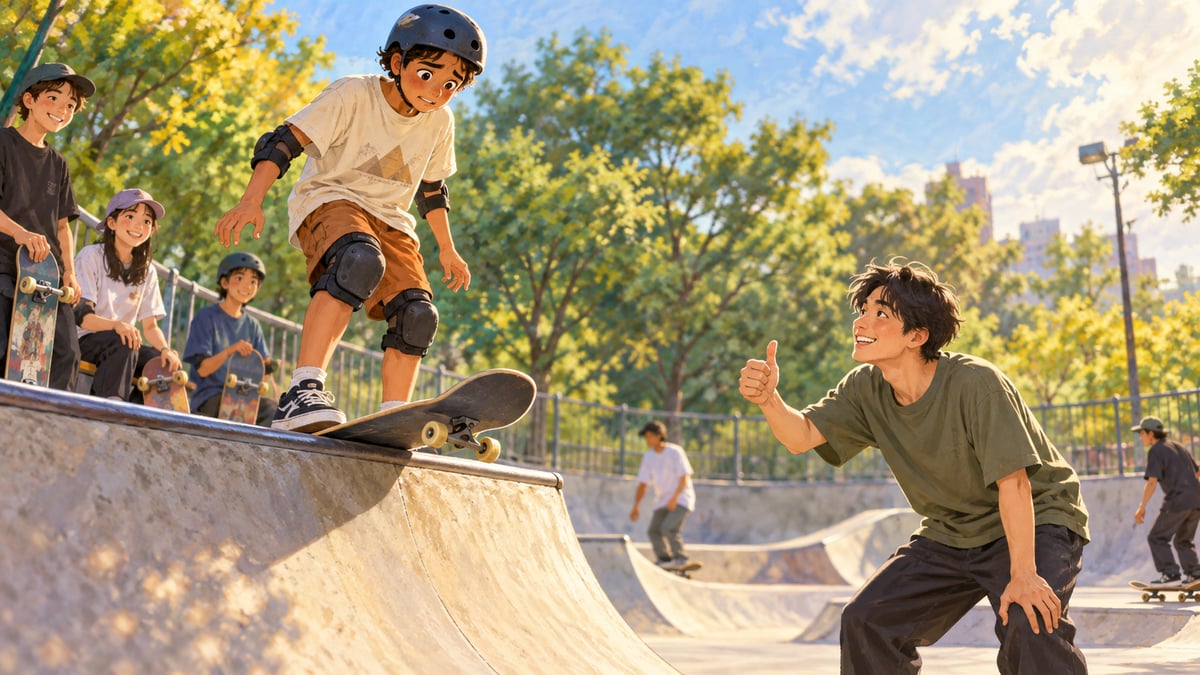
| Japanese | Romaji | Meaning |
|---|---|---|
| 次、いいですか。 | Tsugi, ii desu ka. | Can I go next? |
| お先にどうぞ。 | Osaki ni dōzo. | You go first. |
| 前、通ります! | Mae, tōrimasu! | Coming through in front! |
| すみません、ぶつかりそうでした。 | Sumimasen, butsukarisō deshita. | Sorry, I nearly ran into you. |
| このセクション、初心者でも使えますか。 | Kono sekushon, shoshinsha demo tsukaemasu ka. | Can beginners use this section too? |
Injuries and where you can skate
Scrapes and sprains are part of skating. Surimuku is to scrape your skin, and nenza is a sprain. If you get hurt at a park, other skaters will usually check on you with daijōbu?
Outside the park, be careful. Many public spaces in Japan ban skateboarding, and the sign usually says sukebō kinshi or sukētobōdo kinshi, skateboarding prohibited. The main concerns are safety and noise, sōon. Respecting these rules keeps skaters welcome.
| Japanese | Romaji | Meaning |
|---|---|---|
| 膝を擦りむいた。 | Hiza o surimuita. | I scraped my knee. |
| 足首を捻挫したかも。 | Ashikubi o nenza shita kamo. | I may have sprained my ankle. |
| スケボー禁止 | sukebō kinshi | no skateboarding |
| この辺で滑れる場所はありますか。 | Kono hen de subereru basho wa arimasu ka. | Is there anywhere around here I can skate? |
Suberu, to glide, is also used for skating: suberi ni iku, to go skating. Subereru basho, a place where you can skate, is the phrase to use when asking locals for a park.
Mini dialogue: meeting a skater at the park
| Japanese | Romaji | Meaning |
|---|---|---|
| さっきのキックフリップ、きれいだったね。 | Sakki no kikkufurippu, kirei datta ne. | Skater: That kickflip earlier was clean. |
| ありがとう。でも、十回に一回しか決まらない。 | Arigatō. Demo, jukkai ni ikkai shika kimaranai. | You: Thanks. But I only land it one time in ten. |
| スケボー歴はどのぐらい? | Sukebō reki wa dono gurai? | Skater: How long have you been skating? |
| 二年ぐらい。ここ、よく来るの? | Ninen gurai. Koko, yoku kuru no? | You: About two years. Do you come here a lot? |
| 週末はだいたいいるよ。また一緒に滑ろう。 | Shūmatsu wa daitai iru yo. Mata issho ni suberō. | Skater: I'm here most weekends. Let's skate together again. |
Reki, history, attached to an activity means how long you have done it: sukebō reki ninen, two years of skating. Skaters usually switch to casual speech quickly, but start polite with older people or staff.
Write your session, then fix it with Mocchi
After your next session, write three sentences about it in Japanese and send them with /correct. Mocchi corrects them, explains each change, such as noru taking ni, and remembers the slips you make most so a later /review can test them. Then warm up your word order in Sentence Builder, putting Japanese chunks in the right order, before you try retelling the session aloud. A few minutes after each session is enough to make the words stay.
Common learner mistakes
- Saying sukēto when you mean skateboarding. Sukēto usually means ice skating; say sukebō.
- Using o with noru. You ride on a board: sukebō ni noru.
- Pronouncing trick names in English rhythm. Kikkufurippu has seven beats in Japanese, counting each small tsu.
- Skating where it is banned because nobody is watching. Look for a skatepark instead.
- Cutting in at a busy section. Wait, make eye contact and ask tsugi, ii desu ka.