
Practice Japanese Verb Pairs With Mocchi: 開ける and 開く

To practice Japanese transitive and intransitive pairs, begin with the event you want to describe. Ask Mocchi to compare someone opening a door with the door opening, then choose the verb and particles together instead of guessing from a verb ending alone.

Mocchi compares someone opening a door with a door opening and highlights the different Japanese verb choices
What you need to know

Practice Japanese Verb Pairs With Mocchi: 開ける and 開く

Verb pairs can be difficult because their meanings are related while their sentence roles differ. A learner may know both translations and still describe the wrong event or attach the wrong particle. Use a clear scene and explain whether the sentence presents someone acting on an object or focuses on a change happening to it. Learn the pair as vocabulary in complete sentences, then practice another event before trying to derive a universal rule from the forms.

Picture the event before choosing the verb.

Read the verb and particles as one sentence relationship.

Learn useful pairs explicitly in context.

Do not rely on a single ending shortcut for every pair.

Describe the event before using the grammar labels

Imagine two simple scenes. In one, a person reaches for a door and opens it. In another, the description focuses on the door opening. Explain which scene your sentence should present. Mocchi can then connect that intention to the Japanese vocabulary and particles. This makes the labels transitive and intransitive useful descriptions of a relationship rather than terms you must understand before attempting the example.

Keep cause and sentence focus separate. A real event may have a cause even when the sentence does not name it. The practice asks how you are presenting the event in language, not whether objects can change without anything causing the change.

Read the verb and particle choices together

ドアを開けます presents opening the door, with the door as the object of the action. ドアが開きます describes the door opening. Ask Mocchi to compare the complete sentences, not only the last verb. Then explain which event each sentence would fit and make a new example before looking at the original pair again.
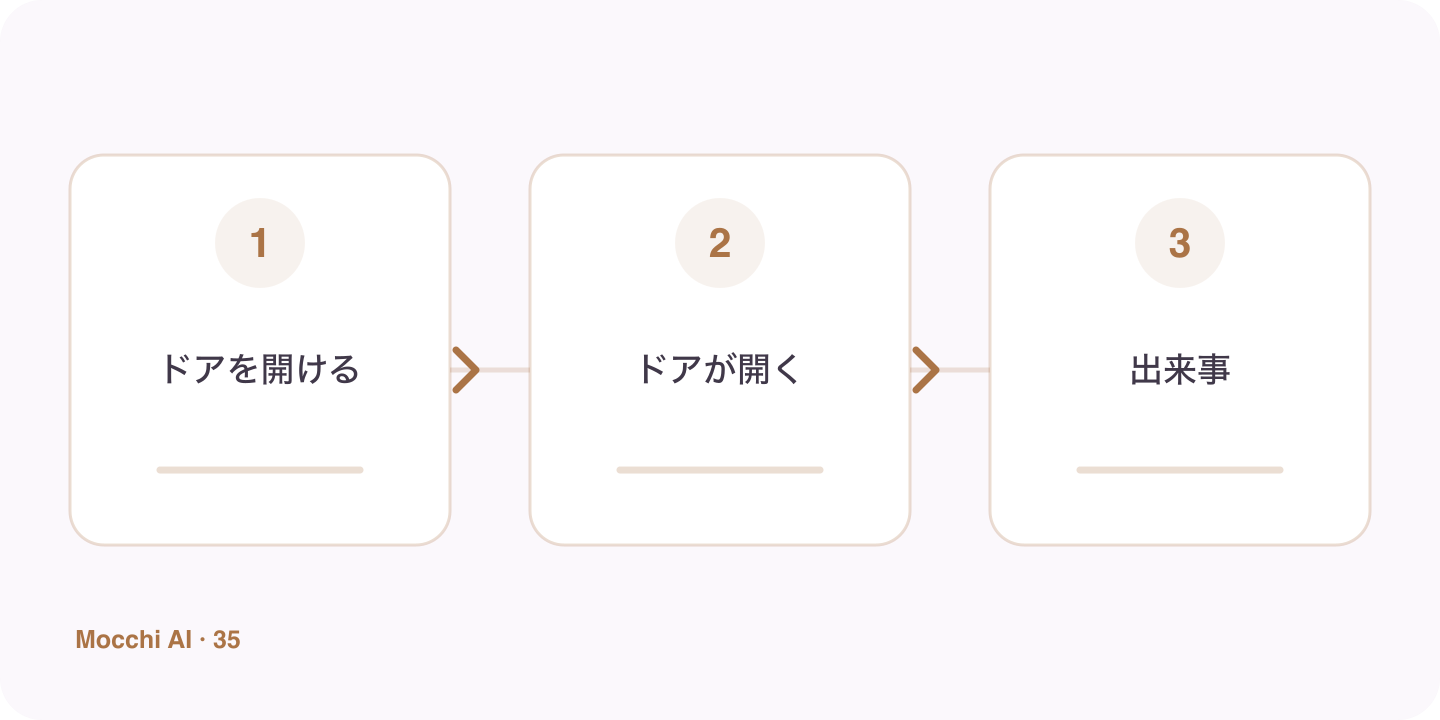
A person acting on a door is contrasted with a description of the door's change of state
First decide which event you are describing, then choose the verb and particles that express it.
JapaneseRomajiMeaning
ドアを開けます。Doa o akemasu.I open the door.
ドアが開きます。Doa ga akimasu.The door opens.

Learn a small number of useful pairs in context

Choose pairs that appear in your reading or everyday goals and keep an example sentence for each member. Adding ten unfamiliar pairs at once can make their similar forms harder to separate. Ask Mocchi to use familiar nouns and a clear event, then expand the set after you can explain the first contrast without relying on a translated label.

Diagnose whether the mistake concerns words or roles

If you know which event is intended but retrieve the wrong verb, practice the vocabulary pair directly. If you choose the right verb but reverse the particles, revisit the participant relationship. If the event itself is unclear, return to a simple scene description. These are different weak steps, so the next exercise should not be identical in every case.

Check transfer with another event

After the door example is reliable, ask for another familiar event or a sentence from a short passage. Describe the intended focus and choose the wording before seeing a model. Keep a review note on the exact confusion if it returns. Mocchi's support is most useful when it connects that observation to a fresh task, rather than treating one successful repetition as proof that every related verb pair is now predictable.

Key points

A practical way to improve

Ask Mocchi for a scene where a person opens a door and another where the door opens. Explain the focus of each event, then make the corresponding Japanese sentence. Change the object or use a different familiar pair and try again. If you reverse the verbs, draw or describe the event in plain language before returning to the Japanese form.

  1. 1

    Choose one clear goal

    Focus each session on a situation or skill you can actually use.

  2. 2

    Practice actively

    Say complete answers aloud instead of only reading or recognizing Japanese.

  3. 3

    Review and repeat

    Keep useful corrections and revisit the same skill until it feels natural.

FAQ

Frequently asked questions

Can I identify every pair from the verb ending?

No single ending shortcut reliably explains every pair. Notice useful patterns, but learn the actual words and check them in complete sentences rather than guessing all unfamiliar verbs from one example.

Does an intransitive sentence mean no one caused the event?

Not necessarily. The sentence can focus on the event or change without naming a person acting on an object. Avoid adding a claim about the real-world cause unless the context supports it.

Why should I practice particles with the verbs?

The verb choice and participant roles shape the sentence together. Learning only the dictionary forms can leave you unable to express the intended event accurately when you need a full sentence.

Match the whole sentence to the event

Use Mocchi to connect a useful verb pair with roles and particles you can explain.