
What emoi means in one minute
Emoi is an i-adjective that describes something which stirs your emotions in a way that is hard to put into words. The feeling is usually soft and bittersweet: nostalgia, a little loneliness, beauty, the sense that a moment will not last. Typical emoi things are sunsets, film photos with grain and warm colours, old school buildings, summer festivals, last trains, and songs tied to a season of your life.
It is casual slang, at home on social media and among friends. It is almost always positive: calling a photo emoi is a compliment.
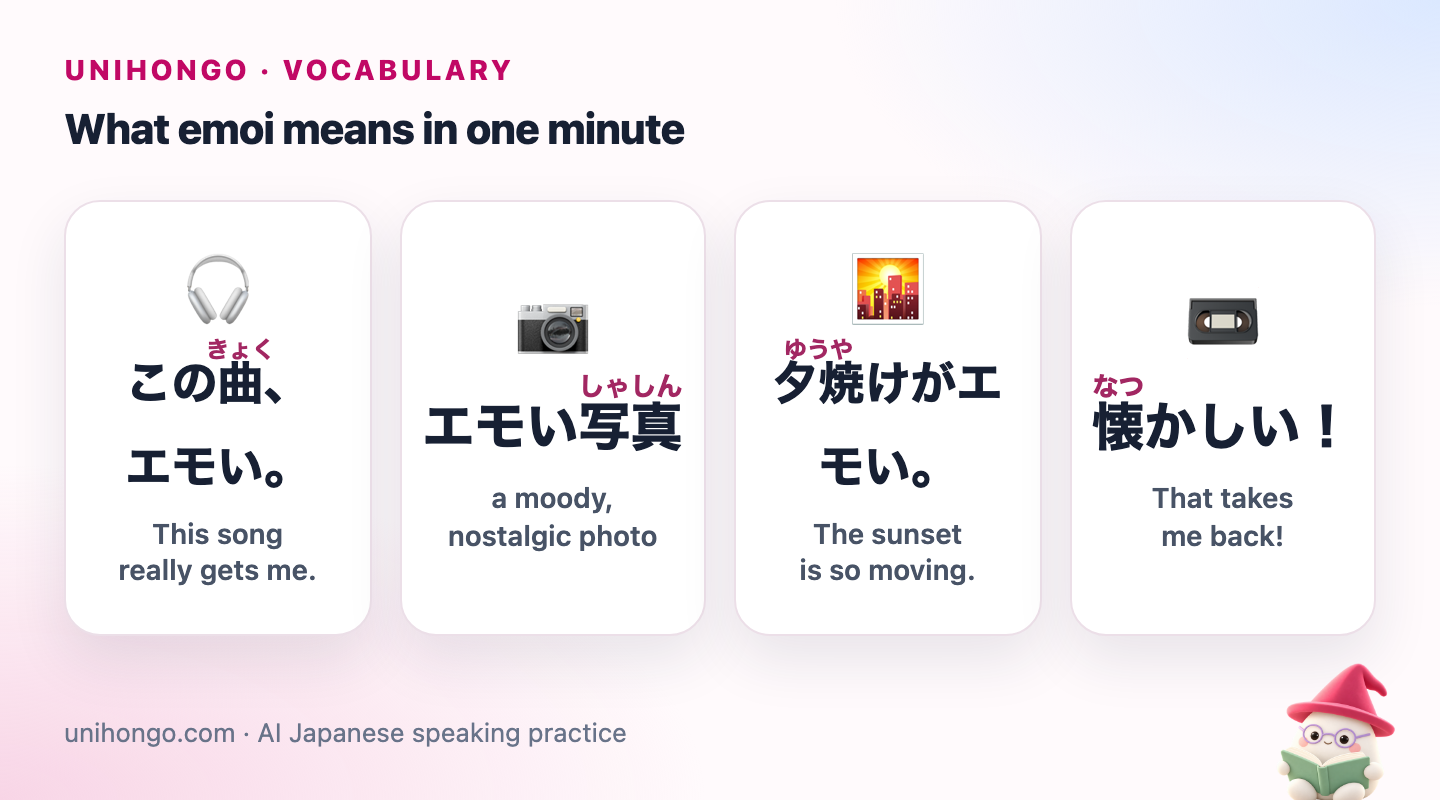
| Japanese | Romaji | Meaning |
|---|---|---|
| この曲、エモい。 | Kono kyoku, emoi. | This song really gets me. |
| エモい写真 | emoi shashin | a moody, nostalgic photo |
| 夕焼けがエモい。 | Yūyake ga emoi. | The sunset is so moving. |
| 懐かしい! | Natsukashii! | That takes me back! |
Where emoi comes from
Emoi was formed from the English word emotional. The first part, emo, was taken into Japanese and given the i-adjective ending, the same way young people turned other borrowed words into adjectives. It had circulated in music fan circles for years before it spread widely on social media in the second half of the 2010s, and it is now understood by most people, though it still feels youthful.
It is written in katakana, エモい, because the root is a loanword. It conjugates normally, and you will also see emosugiru (way too moving) and the noun-like emo (the emo feeling) in captions.
| Japanese | Romaji | Meaning |
|---|---|---|
| エモい | emoi | moving, nostalgic, atmospheric |
| エモかった。 | Emokatta. | It was so moving. |
| エモすぎる。 | Emosugiru. | It's almost too moving. |
| めっちゃエモいね。 | Metcha emoi ne. | That's really moving, isn't it? |
Every real use of emoi, with examples
Emoi appears wherever people share a mood: under photos, in comments on songs, in conversations about places and seasons, and when friends remember something together. Notice that it can describe a scene with no personal memory attached, which is where it differs from natsukashii.
| Japanese | Romaji | Meaning |
|---|---|---|
| フィルムで撮るとエモくなるね。 | Firumu de toru to emoku naru ne. | Shooting on film makes everything look moody. |
| 誰もいないホーム、エモい。 | Dare mo inai hōmu, emoi. | An empty platform is so atmospheric. |
| 夏の終わりってエモいよね。 | Natsu no owari tte emoi yo ne. | The end of summer always feels bittersweet. |
| この歌詞、エモすぎて泣いた。 | Kono kashi, emosugite naita. | These lyrics got me so much I cried. |
| 昔の教室、エモかった。 | Mukashi no kyōshitsu, emokatta. | Seeing our old classroom was so moving. |
| その写真、エモいね! | Sono shashin, emoi ne! | That photo is so moody! |
Emoi vs natsukashii, setsunai and kandō
Emoi is convenient because it is vague. The older words are precise, and they work in any register, so they are worth knowing even if you love emoi.
| Japanese | Romaji | Meaning |
|---|---|---|
| このお菓子、懐かしい! | Kono okashi, natsukashii! | This snack takes me back! |
| 切ないラブソングだね。 | Setsunai rabu songu da ne. | What a heart-aching love song. |
| 映画に感動しました。 | Eiga ni kandō shimashita. | I was moved by the film. (polite) |
| 手紙を読んで、じーんとした。 | Tegami o yonde, jīn to shita. | Reading the letter gave me a lump in my throat. |
| Word | Feeling | Example use |
|---|---|---|
| emoi (エモい) | Vague, bittersweet, atmospheric | A film photo, a sunset, a song |
| natsukashii (懐かしい) | Nostalgic for your own past | A snack you ate as a child |
| setsunai (切ない) | Aching, wistful, heart-wrenching | Unrequited love, a farewell |
| kandō (感動) | Being deeply moved | A film, a performance, a kind act |
| jiin to suru (じーんとする) | A warm lump in the throat | A touching speech or letter |
Who says emoi, and where it does not fit
Teenagers, students and people in their twenties and thirties use emoi freely, and many older people understand it from television and social media. Still, it remains casual slang. In a presentation, an email to a client, a conversation with your host family's grandparents or a job interview, it sounds too loose. Choose kandō shimashita, natsukashii desu or kokoro ni hibikimashita (it resonated with me) instead.
Some people also find emoi overused, because it can be stuck on anything with a filter. If you want to sound thoughtful, use emoi to start, then explain the feeling with a more precise word.
| Japanese | Romaji | Meaning |
|---|---|---|
| とても感動しました。 | Totemo kandō shimashita. | I was very moved. (polite) |
| 心に響きました。 | Kokoro ni hibikimashita. | It really resonated with me. (polite) |
| 懐かしい気持ちになりました。 | Natsukashii kimochi ni narimashita. | It made me feel nostalgic. (polite) |
Replies and learner mistakes
When a friend says a photo or song is emoi, the natural reply is to share the feeling. Wakaru (I know, right?) is the classic response, and you can add why it feels that way to keep the conversation going.
| Japanese | Romaji | Meaning |
|---|---|---|
| わかる、エモいよね。 | Wakaru, emoi yo ne. | I know, it's so moving, right? |
| 色がいいよね。 | Iro ga ii yo ne. | The colours are great, aren't they? |
| 高校のころ思い出す。 | Kōkō no koro omoidasu. | It reminds me of high school. |
- Mistake 1: using emoi to mean emotional about a person, as in she is very emotional. For someone who cries easily, say namida moroi; for someone moody, say kibun ya.
- Mistake 2: using emoi for strong anger or fear. It is a soft, bittersweet feeling, not a dramatic one.
- Mistake 3: using it in polite or formal speech. Switch to kandō or natsukashii.
- Mistake 4: writing it in hiragana. Katakana エモい is the standard spelling because it comes from English.
Other feeling words you will see online
Emoi lives alongside a few other words that people use to react to photos, songs and stories online. Yabai (やばい) began as dangerous and now means anything extreme, from amazing to awful, so the tone tells you which. Nakeru (泣ける), literally can cry, means a story or song is a tear-jerker. Tōtoi (尊い), precious or sacred in standard Japanese, is fan slang for something so wholesome it is almost too much, often a friendship between two characters. Torihada ga tatsu, to get goosebumps, works for a powerful song or performance.
All of these except torihada are casual. Like emoi, they are fun with friends and online, and out of place in an email to your manager.
| Japanese | Romaji | Meaning |
|---|---|---|
| この景色、やばい。 | Kono keshiki, yabai. | This view is unreal. |
| 泣ける映画だった。 | Nakeru eiga datta. | It was a real tear-jerker. |
| 二人の関係、尊い。 | Futari no kankei, tōtoi. | Their bond is so precious. (fan slang) |
| 鳥肌が立った。 | Torihada ga tatta. | It gave me goosebumps. |
Mini dialogue: film camera at the beach
Two friends are on a seawall at the end of summer, one with a film camera. Notice how emoi starts the conversation and natsukashii and setsunai add detail.
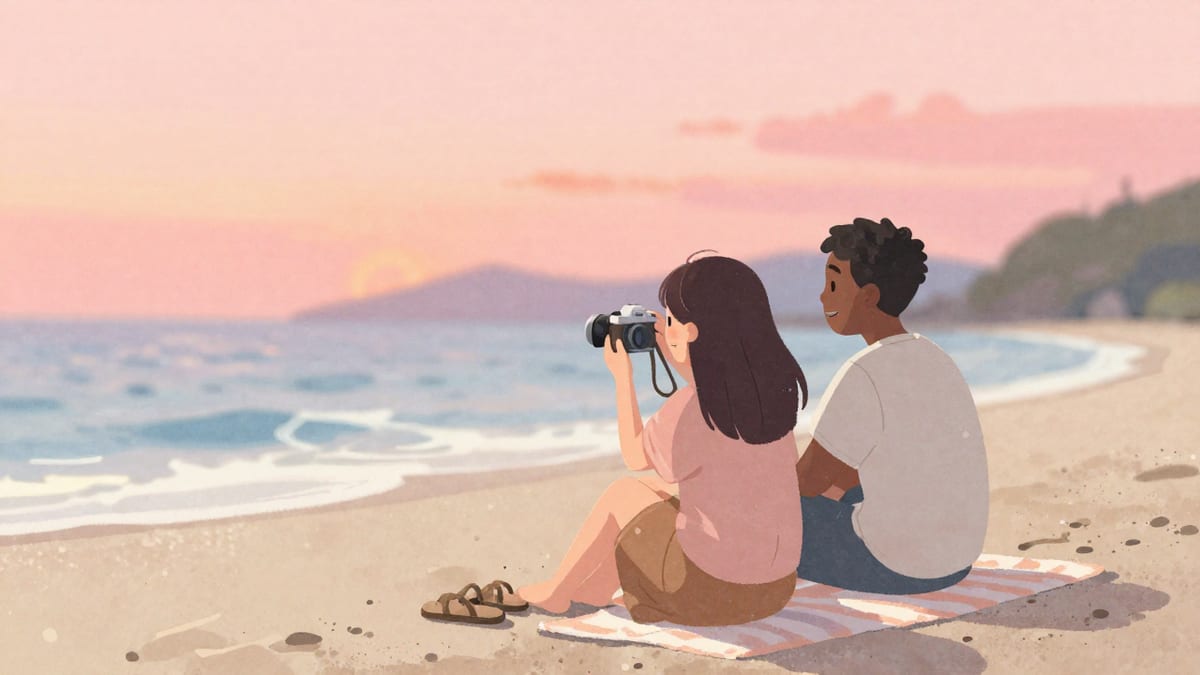
| Japanese | Romaji | Meaning |
|---|---|---|
| 見て、今の空、エモくない? | Mite, ima no sora, emokunai? | Hana: Look, isn't the sky so moody right now? |
| 本当だ。一枚撮ろう。 | Hontō da. Ichimai torō. | Omar: You're right. Let's take one. |
| フィルムだと、もっとエモくなるよ。 | Firumu da to, motto emoku naru yo. | Hana: On film it'll look even more atmospheric. |
| なんか懐かしい気持ちになるね。 | Nanka natsukashii kimochi ni naru ne. | Omar: It makes me feel kind of nostalgic. |
| 夏が終わるの、ちょっと切ないね。 | Natsu ga owaru no, chotto setsunai ne. | Hana: Summer ending is a little sad, isn't it? |
| また来年も来よう。 | Mata rainen mo koyō. | Omar: Let's come back next year. |