
Yatsu in four everyday lines
Listen to friends in a shop, a café or a kitchen, and you will hear yatsu constantly. Almost every time, it means one or thing, and it follows a word that describes the object: a colour, a size, a time, a short clause. The fourth line below is the people sense, warm in this case.
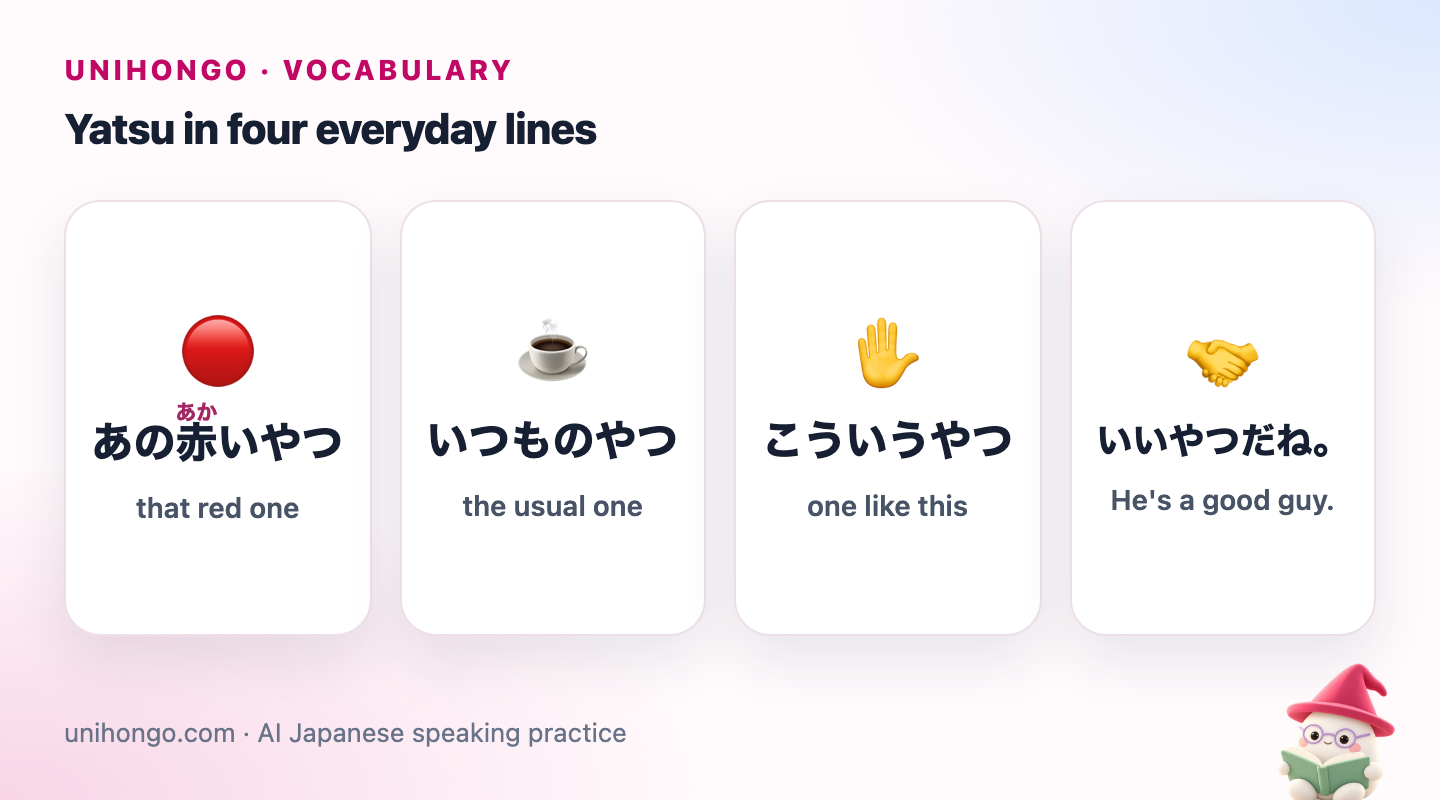
| Japanese | Romaji | Meaning |
|---|---|---|
| あの赤いやつ | ano akai yatsu | that red one |
| いつものやつ | itsumo no yatsu | the usual one |
| こういうやつ | kō iu yatsu | one like this |
| いいやつだね。 | Ii yatsu da ne. | He's a good guy. |
Yatsu for things: the casual 'one'
In English you say the red one, the big one, the one from yesterday. Casual Japanese says akai yatsu, ōkii yatsu, kinō no yatsu. The kanji is 奴, but in this sense people nearly always write it in hiragana.
Yatsu never stands alone in this sense. It needs something in front: an adjective (akai yatsu), a noun with no (konbini no yatsu, the one from the convenience store), or a whole clause (kinō katta yatsu, the one I bought yesterday). This makes it a flexible way to describe things you cannot name.
| Japanese | Romaji | Meaning |
|---|---|---|
| 大きいやつ取って。 | Ōkii yatsu totte. | Pass me the big one. |
| コンビニのやつでいいよ。 | Konbini no yatsu de ii yo. | The one from the convenience store is fine. |
| 昨日買ったやつ、どこ? | Kinō katta yatsu, doko? | Where's the one I bought yesterday? |
| もっと安いやつない? | Motto yasui yatsu nai? | Isn't there a cheaper one? |
'...tte yatsu': the thing called...
Put tte, the casual quoting particle, in front of yatsu and you get the thing called... or what they call.... It is how people talk about something they have heard of, something new to them, or a trend they find a little funny. The tone is casual and often amused.
It is also a lifesaver when you know a word but are not sure it is the right one: you put it in quotes with tte yatsu, and the listener will correct you or confirm it.
| Japanese | Romaji | Meaning |
|---|---|---|
| これがタコパってやつ? | Kore ga takopa tte yatsu? | So this is what they call a takopa? |
| 推し活ってやつだね。 | Oshikatsu tte yatsu da ne. | That's what they call fan activity, right? |
| 名前は忘れたけど、丸くて平たいやつ。 | Namae wa wasureta kedo, marukute hiratai yatsu. | I forgot the name, but it's a round, flat one. |
| それそれ、そういうやつ! | Sore sore, sō iu yatsu! | That's it, that kind of thing! |
Oshikatsu (推し活) is the hobby of actively supporting a favourite performer or character. The pattern works with any trend word: whatever is new, ...tte yatsu frames it as the thing everyone is talking about.
Yatsu when choosing, ordering and remembering
Among friends, yatsu is everywhere in small decisions: which flavour, which size, which film. Itsumo no yatsu, the usual one, is a typical line when a friend offers to buy you a drink, and dotchi no yatsu?, which one?, is how you ask for details. The pattern noun or adjective plus yatsu ga ii says what kind you want.
Yatsu also helps you point back to something from an earlier conversation. Kono mae hanashita yatsu, the thing I told you about the other day, saves you from repeating the whole story, and the listener usually knows at once what you mean.
In each of these lines, a shop clerk or a teacher would hear no instead: itsumo no de ii desu, amakunai no ga ii desu. The structure stays exactly the same; only the one word changes.
| Japanese | Romaji | Meaning |
|---|---|---|
| いつものやつでいい? | Itsumo no yatsu de ii? | Is the usual okay? |
| どっちのやつ? | Dotchi no yatsu? | Which one? |
| 甘くないやつがいいな。 | Amakunai yatsu ga ii na. | I'd like one that isn't sweet. |
| この前話したやつ、見た? | Kono mae hanashita yatsu, mita? | Did you watch the one I told you about? |
Yatsu for people: rough, warm or rude
About people, yatsu means guy, fellow, someone, and it is always informal. Its feeling depends on the words around it. Ii yatsu (a good guy) and omoshiroi yatsu (a funny guy) are warm and common, especially among male friends. Hen na yatsu (a weird guy) and iya na yatsu (a nasty person) are critical. Aitsu, koitsu and soitsu are the rough pronouns built from the same root, and yatsura means those guys.
Two rules keep you safe. Do not use yatsu about anyone older or senior to you, or about people you do not know well. And avoid it where the person can hear, unless you are close enough to joke. For a fuller look at pronouns such as kare, kanojo and aitsu, see our guide to third-person pronouns.
| Japanese | Romaji | Meaning |
|---|---|---|
| あいつ、本当にいいやつだよ。 | Aitsu, hontō ni ii yatsu da yo. | That guy is a really good guy. |
| 面白いやつだな。 | Omoshiroi yatsu da na. | What a funny guy. (casual, often male) |
| 変なやつ。 | Hen na yatsu. | Weird guy. |
| 優しい人ですね。 | Yasashii hito desu ne. | She's a kind person. (polite) |
Yatsu, no, mono, hito: which one when
| Japanese | Romaji | Meaning |
|---|---|---|
| あの赤いのをください。 | Ano akai no o kudasai. | That red one, please. (polite) |
| 一番小さいのはありますか。 | Ichiban chiisai no wa arimasu ka. | Do you have the smallest one? |
| Word | Refers to | Register | Example |
|---|---|---|---|
| yatsu | Things or people | Casual; rough for people | akai yatsu, ii yatsu |
| no | Things (the one) | Neutral, works in polite speech | akai no o kudasai |
| mono | Things in general | Neutral to formal | atarashii mono |
| hito / kata | People | Neutral / respectful | ii hito, ano kata |
The no swap is the most useful. Akai yatsu becomes akai no, and the sentence is ready for a shop counter. Kinō katta yatsu becomes kinō katta no. You lose nothing in meaning and gain politeness.
Scenario: shopping for the one you cannot name
You are in a pottery shop with your friend Mao. You want a small bowl you saw on a high shelf, but you do not know the word for its style. With Mao, yatsu is perfect. When the shop owner comes over, you switch to no.
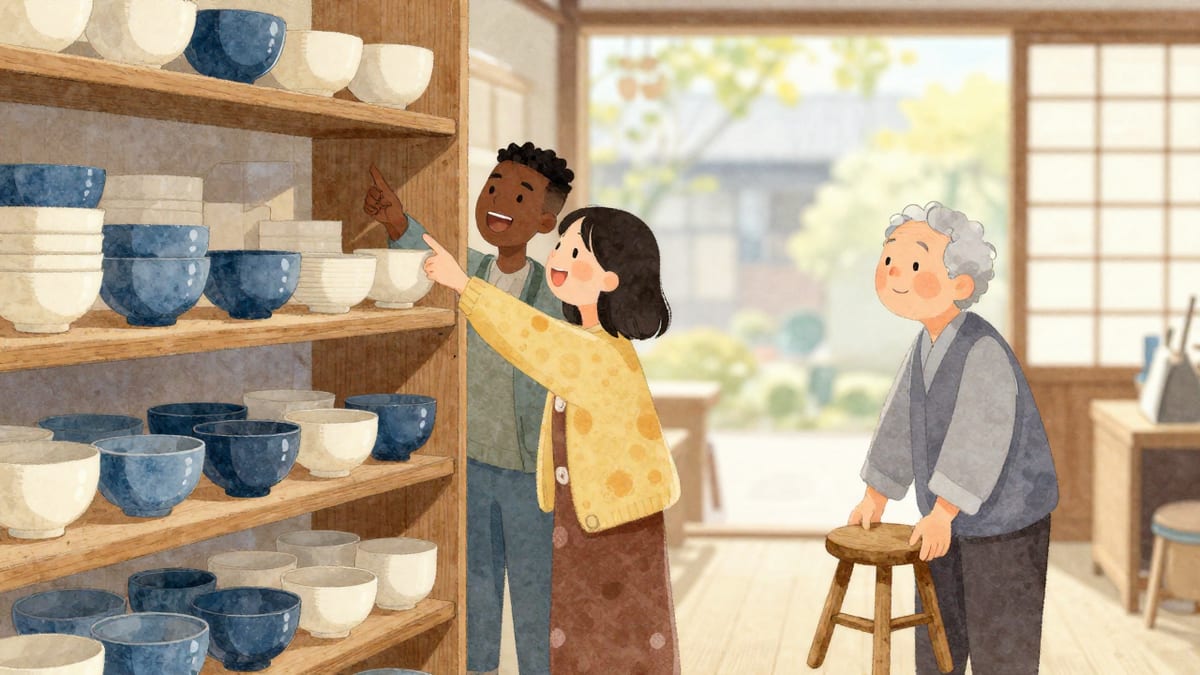
| Japanese | Romaji | Meaning |
|---|---|---|
| ねえ、上の棚の青いやつ、かわいくない? | Nē, ue no tana no aoi yatsu, kawaikunai? | You: Hey, isn't the blue one on the top shelf cute? |
| どれ?丸いやつ? | Dore? Marui yatsu? | Mao: Which? The round one? |
| そうそう、ちょっと小さいやつ。 | Sō sō, chotto chiisai yatsu. | You: Yes, the slightly smaller one. |
| すみません、あの青いのを見せてもらえますか。 | Sumimasen, ano aoi no o misete moraemasu ka. | You: Excuse me, could I see that blue one? |
| はい、こちらですね。 | Hai, kochira desu ne. | Owner: Certainly, this one? |
| そうです。もう少し大きいのもありますか。 | Sō desu. Mō sukoshi ōkii no mo arimasu ka. | You: Yes. Do you also have a slightly bigger one? |
Common mistakes with yatsu
If you remember one thing, make it this: yatsu about objects is a casual helper you can use every day with friends, and yatsu about people is a strong spice you add only when you know the group well.
- Using yatsu with shop staff or in polite sentences: switch to no or mono.
- Saying ano yatsu for an object: that means that guy. Say are, or add a description.
- Using yatsu about a teacher, a boss or a friend's parent: always hito or kata.
- Writing 奴 in a casual message about things: hiragana やつ looks natural.
- Thinking yatsu is always negative: ii yatsu is one of the warmest things a friend can say about someone.