
What ikemen means in one minute
Ikemen is a noun meaning a handsome man, and it works like an adjective with da or na no: kare wa ikemen da, he's handsome. It is friendly, light and used by people of all ages, though most often by younger people and on television. The katakana spelling is standard.
Its second life is just as useful. When someone does something cool or kind, such as holding a door, paying quietly or standing up for a friend, Japanese speakers say the action is ikemen. That use is about character, not looks.
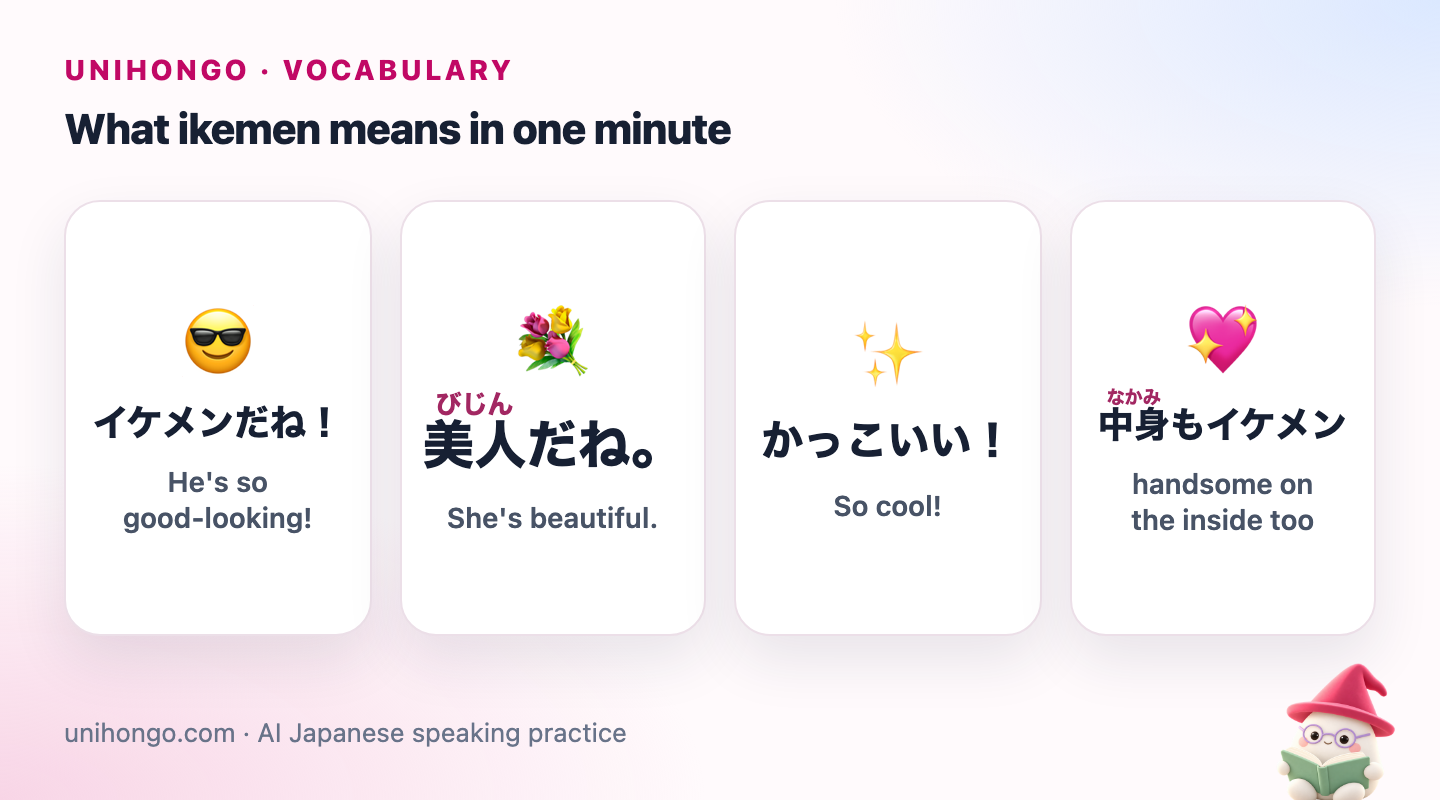
| Japanese | Romaji | Meaning |
|---|---|---|
| イケメンだね! | Ikemen da ne! | He's so good-looking! |
| 美人だね。 | Bijin da ne. | She's beautiful. |
| かっこいい! | Kakkoii! | So cool! |
| 中身もイケメン | nakami mo ikemen | handsome on the inside too |
Where ikemen comes from
The first half is ike, from ikete iru or iketeru (イケてる), slang for cool, attractive or with it. The second half is usually explained in one of two ways: the English word men, or men (面), an informal word for face. Both explanations are widely repeated, and it may be that the pun on both helped the word catch on. It spread through magazines and television from the late 1990s and is now standard casual Japanese.
Ikemen largely replaced the older loanword hansamu (ハンサム), which still exists but sounds a little old-fashioned. Bidanshi (美男子), a handsome man, is formal or literary.
| Japanese | Romaji | Meaning |
|---|---|---|
| イケてる | iketeru | cool, attractive (slang) |
| 面 | men | face (informal) |
| ハンサム | hansamu | handsome (a little old-fashioned) |
| 美男子 | bidanshi | a handsome man (formal, literary) |
Every real use of ikemen, with examples
Here is ikemen in the situations you will meet it: talking about actors and characters, reacting to a photo, describing someone to a friend, and praising behaviour. Ikemen sugiru (too handsome) is a common exaggeration, and you will see compounds such as ikemen haiyū, handsome actor.
| Japanese | Romaji | Meaning |
|---|---|---|
| あの俳優、イケメンすぎる。 | Ano haiyū, ikemen sugiru. | That actor is unbelievably handsome. |
| お兄さん、イケメンだね。 | Onīsan, ikemen da ne. | Your older brother is good-looking. |
| どんな人?イケメン? | Donna hito? Ikemen? | What's he like? Handsome? |
| 荷物を持ってくれるなんて、イケメン! | Nimotsu o motte kureru nante, ikemen! | You carried my bags? What a gentleman! |
| 行動がイケメンだね。 | Kōdō ga ikemen da ne. | That was such a cool thing to do. |
| 彼女、性格がイケメンなんだよ。 | Kanojo, seikaku ga ikemen nan da yo. | She's got such a cool, dependable personality. |
Ikemen, bijin, kawaii, kakkoii and otokomae
Japanese has several words for attractive people, and they are not interchangeable. The table shows what each one usually describes.
| Word | Meaning | Usually describes |
|---|---|---|
| ikemen (イケメン) | Handsome man | Men; also cool behaviour |
| bijin (美人) | Beautiful person | Mostly women; elegant beauty |
| kirei (きれい) | Beautiful, pretty | Anyone or anything; neat and lovely |
| kawaii (かわいい) | Cute, adorable | Anyone, pets, things |
| kakkoii (かっこいい) | Cool, good-looking | Anyone; style and attitude |
| otokomae (男前) | Manly, dashing | Looks or gutsy behaviour; a bit old-style |
Bijin is grammatically neutral, but in practice it is used mostly for women. Kakkoii is the safest compliment for anyone's style or attitude.
There are also words for kinds of looks rather than levels of attractiveness. Shōyu-gao (soy-sauce face) and sōsu-gao (sauce face) are playful labels for softer and more strongly defined features. They come and go as media fads and some people find face-typing awkward, so it is better to recognise them than to use them.
Giving compliments, and replying to them
Compliments about looks are common among friends, but in Japan people often deflect them rather than accept them outright. A light iya iya (no, no) or sonna koto nai yo (that's not true) is a normal, friendly response, not a sign that the compliment failed. Saying thank you warmly is also perfectly fine, especially among younger people.
Be careful at work and with people you do not know well. Comments on a colleague's appearance can make people uncomfortable, so stick to praising their work, their ideas or their kindness.
Compliments about a third person are much easier. Telling a friend that their brother is ikemen, or that a character in a drama is ikemen, is light gossip and rarely awkward. Saying it straight to a man's face is bolder: among close friends it is a fun tease, but from someone he has just met it can feel like flirting, so think about the message you want to send. If you are the one being complimented, a smile and a short reply are enough; you do not need to compliment back immediately, although many people do, with a quick light line of their own.
| Japanese | Romaji | Meaning |
|---|---|---|
| いやいや、そんなことないよ。 | Iya iya, sonna koto nai yo. | No, no, not at all. (casual) |
| ありがとう、うれしい。 | Arigatō, ureshii. | Thanks, that makes me happy. |
| そう言っていただけてうれしいです。 | Sō itte itadakete ureshii desu. | I'm glad you think so. (polite) |
| 照れるなあ。 | Tereru nā. | You're making me blush. |
Common learner mistakes
- Using ikemen for a woman's looks. Say bijin or kirei. Ikemen for a woman works only for cool behaviour, and only playfully.
- Calling a coworker or teacher ikemen to their face. Even as praise, comments on looks can feel inappropriate at work.
- Using hansamu and expecting it to sound current. It is understood, but ikemen sounds natural today.
- Forgetting that ikemen is a noun. Say ikemen da or ikemen na hito, not ikemen-i.
- Overusing ikemen sugiru. It is a playful exaggeration for celebrities, not something to say about every man you meet.
Ikemen's cousins: iketeru, ikebo and ikeoji
The ike- part of ikemen has produced a small family of playful words. Iketeru on its own means looks good or is cool, and you can say it about hair, clothes or a café. Ikebo (イケボ) is short for ike voice, an attractive voice, and is popular among anime and game fans talking about voice actors. Ikeoji (イケおじ) means an attractive older man, a little like silver fox. These are casual, light words, and like most slang their popularity rises and falls, so treat them as fun extras rather than core vocabulary.
And if looks come up, many people like to add a line that puts character first.
| Japanese | Romaji | Meaning |
|---|---|---|
| 今日の髪型、イケてるね。 | Kyō no kamigata, iketeru ne. | Your hair looks great today. |
| この声優さん、イケボだね。 | Kono seiyū-san, ikebo da ne. | This voice actor has such a great voice. |
| イケおじって感じ。 | Ikeoji tte kanji. | He's a real silver fox. |
| 顔より性格が大事。 | Kao yori seikaku ga daiji. | Personality matters more than looks. |
Mini dialogue: an ikemen move on the stairs
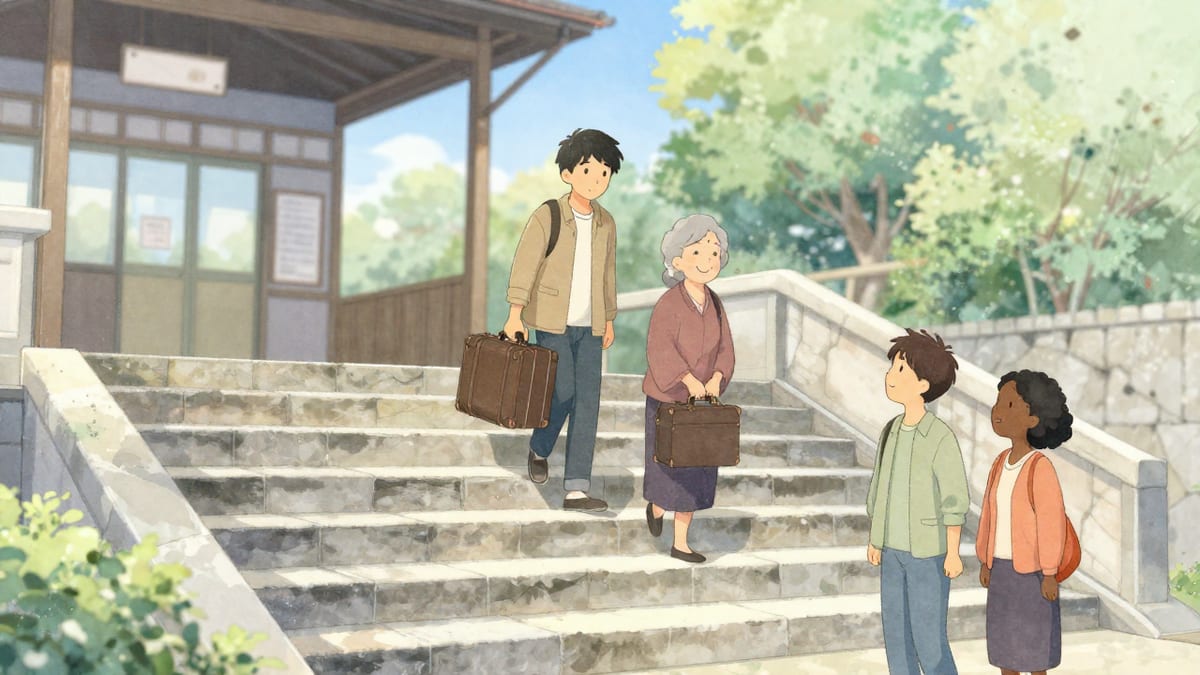
Two friends at a station see a young man help an older woman carry her suitcase up the stairs. Notice that ikemen praises the action first.
| Japanese | Romaji | Meaning |
|---|---|---|
| 見て、あの人。 | Mite, ano hito. | Chloe: Look at that guy. |
| おばあさんのスーツケース、運んであげてる。 | Obāsan no sūtsukēsu, hakonde ageteru. | Chloe: He's carrying the old lady's suitcase for her. |
| うわ、行動がイケメン。 | Uwa, kōdō ga ikemen. | Riku: Wow, what a cool move. |
| 顔もイケメンだったよ。 | Kao mo ikemen datta yo. | Chloe: He was handsome, too. |
| 中身も外見もイケメンか。 | Nakami mo gaiken mo ikemen ka. | Riku: Handsome inside and out, huh. |
| 私たちも見習おう。 | Watashitachi mo minaraō. | Chloe: We should follow his example. |