
Yoyū in one minute
Yoyū is written 余裕. 余 means surplus or remainder, as in amaru (to be left over), and 裕 means abundance or plenty, as in yūfuku (wealthy). Put together, they describe a surplus: whatever is left over beyond what you strictly need.
The word is written yoyū in standard romaji, with a long u, and you will also see yoyuu or yoyu online. Say it with three beats, yo-yu-u, holding the final vowel.
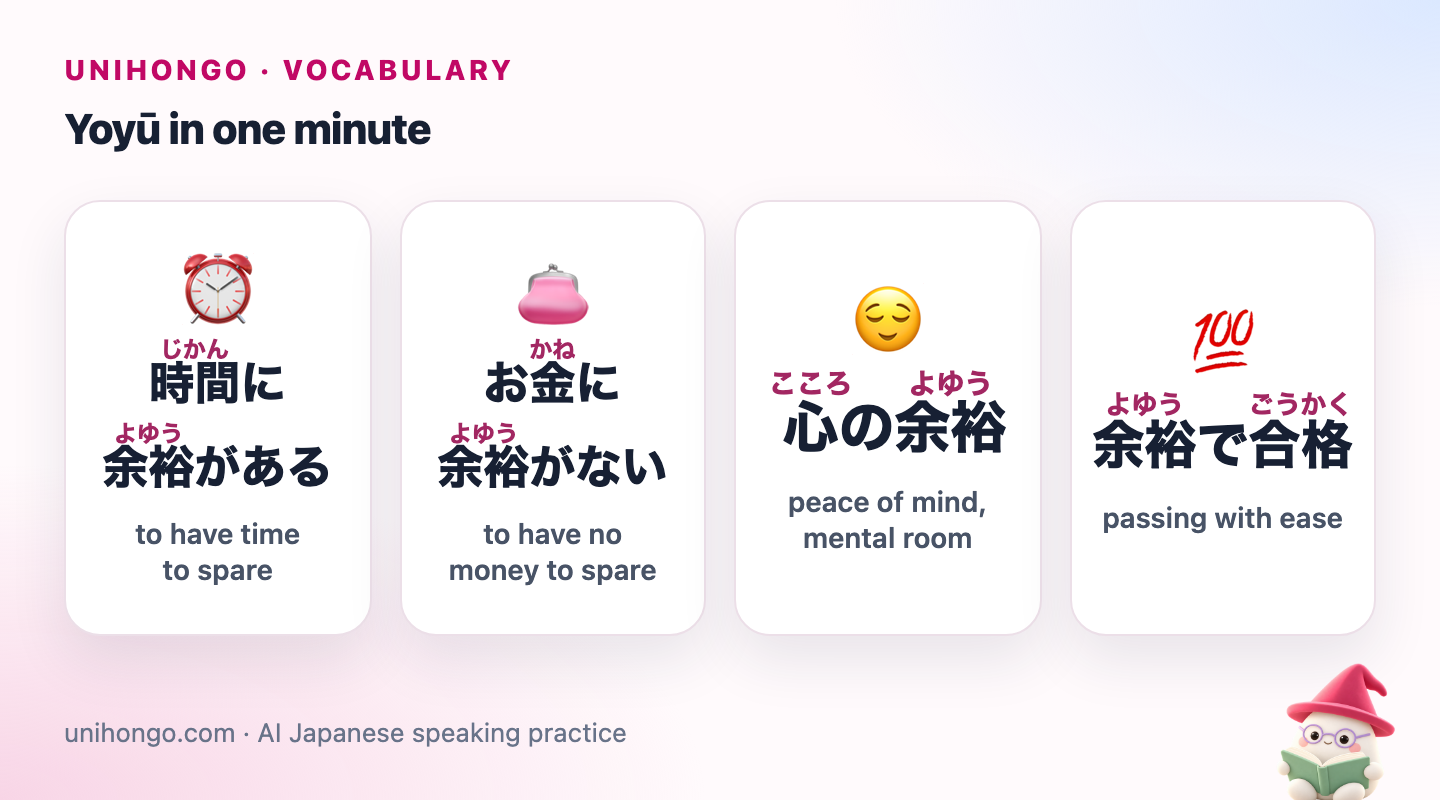
| Japanese | Romaji | Meaning |
|---|---|---|
| 時間に余裕がある | jikan ni yoyū ga aru | to have time to spare |
| お金に余裕がない | okane ni yoyū ga nai | to have no money to spare |
| 心の余裕 | kokoro no yoyū | peace of mind, mental room |
| 余裕で合格 | yoyū de gōkaku | passing with ease |
Time, money and space
The most common uses are practical. With time, yoyū means a buffer: you leave the house early, you build slack into a schedule, you have a few minutes before the meeting. With money, it means having something left after the essentials. With space, it means room: seats on a train, a bag that is not full, an apartment with space for guests.
The thing that has or lacks yoyū takes ni: jikan ni yoyū ga aru, okane ni yoyū ga nai, seki ni yoyū ga aru.
| Japanese | Romaji | Meaning |
|---|---|---|
| 余裕を持って出発しましょう。 | Yoyū o motte shuppatsu shimashō. | Let's leave with time to spare. |
| まだ時間に余裕があります。 | Mada jikan ni yoyū ga arimasu. | We still have some time. |
| 今月はお金に余裕がなくて。 | Kongetsu wa okane ni yoyū ga nakute. | Money's a bit tight this month. |
| 席にはまだ余裕があります。 | Seki ni wa mada yoyū ga arimasu. | There are still seats available. |
| スーツケースに余裕がない。 | Sūtsukēsu ni yoyū ga nai. | There's no room left in my suitcase. |
Mental room: kokoro no yoyū
Yoyū also describes your state of mind. Kokoro no yoyū or kimochi no yoyū is the inner space that lets you stay patient, notice others and laugh at small problems. When you are exhausted or overloaded, that space disappears, and Japanese speakers say they have no yoyū.
People often link this to kindness: when you have yoyū, you can be considerate; when you do not, you snap. Admitting yoyū ga nakatta is a natural, honest way to apologise for being short with someone.
Yoyū is also something people admire in others. An older colleague who stays relaxed when a project goes wrong, a parent who laughs when a toddler spills juice, a host who never looks rushed: all of them seem to have yoyū. Yoyū no aru otona, an adult with room to spare, is a common ideal, especially in magazines and lifestyle writing. It describes not wealth or free time, but a calm way of carrying yourself.
| Japanese | Romaji | Meaning |
|---|---|---|
| 最近、心の余裕がない。 | Saikin, kokoro no yoyū ga nai. | I've had no headspace lately. |
| 余裕がなくて、きつく言ってしまった。 | Yoyū ga nakute, kitsuku itte shimatta. | I was stretched thin and spoke too harshly. |
| 余裕のある大人になりたい。 | Yoyū no aru otona ni naritai. | I want to be a calm, unhurried adult. |
| 彼女はいつも余裕があるね。 | Kanojo wa itsumo yoyū ga aru ne. | She always seems so composed. |
Yoyū de and yoyū!: doing it with ease
With the particle de, yoyū becomes an adverb: easily, comfortably, with room to spare. You pass a test yoyū de, catch a train yoyū de, finish a task yoyū de. In casual speech, especially among young people, yoyū on its own is a confident reply meaning no problem, easy.
Yoyū shakushaku (余裕綽々) is the four-character version: utterly calm, with plenty in reserve. It is a slightly literary phrase, often used about athletes or rivals who look unbothered, and it can carry a hint of cockiness.
| Japanese | Romaji | Meaning |
|---|---|---|
| 余裕で間に合った。 | Yoyū de maniatta. | I made it in plenty of time. |
| 明日のテスト、大丈夫? ― 余裕! | Ashita no tesuto, daijōbu? — Yoyū! | Tomorrow's test OK? — Easy! (casual) |
| 彼は余裕綽々だった。 | Kare wa yoyū shakushaku datta. | He was totally calm and unbothered. |
| 余裕ぶってる場合じゃないよ。 | Yoyū butteru baai ja nai yo. | This is no time to act so relaxed. |
Yoyū at work and in exams
At work, yoyū appears constantly in planning. Managers ask for schedules with yoyū built in, teams worry when there is no yoyū before a deadline, and a colleague who says ima chotto yoyū ga nai is politely telling you they cannot take on more right now. It is softer than isogashii (busy), because it describes your capacity rather than complaining.
In exam season, teachers tell students to arrive with yoyū and to leave yoyū at the end to check answers. After the exam, friends compare: yoyū datta, it was easy, or girigiri datta, I only just made it.

| Japanese | Romaji | Meaning |
|---|---|---|
| スケジュールに余裕を持たせましょう。 | Sukejūru ni yoyū o motasemashō. | Manager: Let's build some slack into the schedule. |
| すみません、今ちょっと余裕がなくて。 | Sumimasen, ima chotto yoyū ga nakute. | Employee: Sorry, I'm a bit swamped right now. |
| 来週なら余裕があります。 | Raishū nara yoyū ga arimasu. | Employee: I'll have more room next week. |
| じゃあ、締め切りは金曜にしよう。 | Jā, shimekiri wa kin'yō ni shiyō. | Manager: Then let's make the deadline Friday. |
| 試験には余裕を持って行ってください。 | Shiken ni wa yoyū o motte itte kudasai. | Teacher: Please leave early for the exam. |
| 時間に余裕があったら、見直しをしよう。 | Jikan ni yoyū ga attara, minaoshi o shiyō. | If you have time left, check your answers. |
How to reply when someone has no yoyū
When a friend or colleague tells you yoyū ga nai, they are usually not asking for advice. They are explaining why they are slow to reply, why they turned something down, or why they seem tense. The kind response is to show understanding and lighten the load: tell them not to worry, offer to wait, or offer help if you can actually give it.
If you are the one who has to say no, yoyū ga nakute plus an alternative is one of the gentlest refusals in Japanese. It puts the reason on your capacity, not on the other person's request, which helps keep the relationship comfortable.
| Japanese | Romaji | Meaning |
|---|---|---|
| そっか、無理しないでね。 | Sokka, muri shinaide ne. | I see. Don't push yourself. (casual) |
| 急がなくて大丈夫ですよ。 | Isoganakute daijōbu desu yo. | There's no rush at all. |
| 何か手伝えることある? | Nanika tetsudaeru koto aru? | Is there anything I can help with? (casual) |
| 落ち着いたら連絡してね。 | Ochitsuitara renraku shite ne. | Get in touch when things calm down. |
| 今週は余裕がないので、来週でもいいですか。 | Konshū wa yoyū ga nai node, raishū demo ii desu ka. | I'm stretched this week, so would next week be OK? |
Related words: yutori, hima, girigiri, rakushō
| Japanese | Romaji | Meaning |
|---|---|---|
| ゆとりのある生活がしたい。 | Yutori no aru seikatsu ga shitai. | I want a life with some breathing space. |
| 今日は暇です。 | Kyō wa hima desu. | I'm free today. |
| ギリギリ間に合った。 | Girigiri maniatta. | I only just made it. |
| こんなの楽勝だよ。 | Konna no rakushō da yo. | This is a piece of cake. (casual) |
| Word | Meaning | Difference from yoyū |
|---|---|---|
| Yutori (ゆとり) | Room, breathing space, relaxation | Softer, about a relaxed lifestyle |
| Hima (暇) | Free time, nothing to do | Free time itself, not a margin |
| Girigiri (ギリギリ) | Only just, at the last moment | The opposite: no margin at all |
| Rakushō (楽勝) | Easy win, a piece of cake | Casual; close to yoyū! |
| Ochitsuki (落ち着き) | Calmness, composure | About behaviour, not resources |
Common learner mistakes: saying yoyū ga arimasu when you mean you are free (use hima desu or jikan ga arimasu); saying yoyū! to a superior; and dropping ni in jikan ni yoyū ga aru.