
The four touches every rally is built from
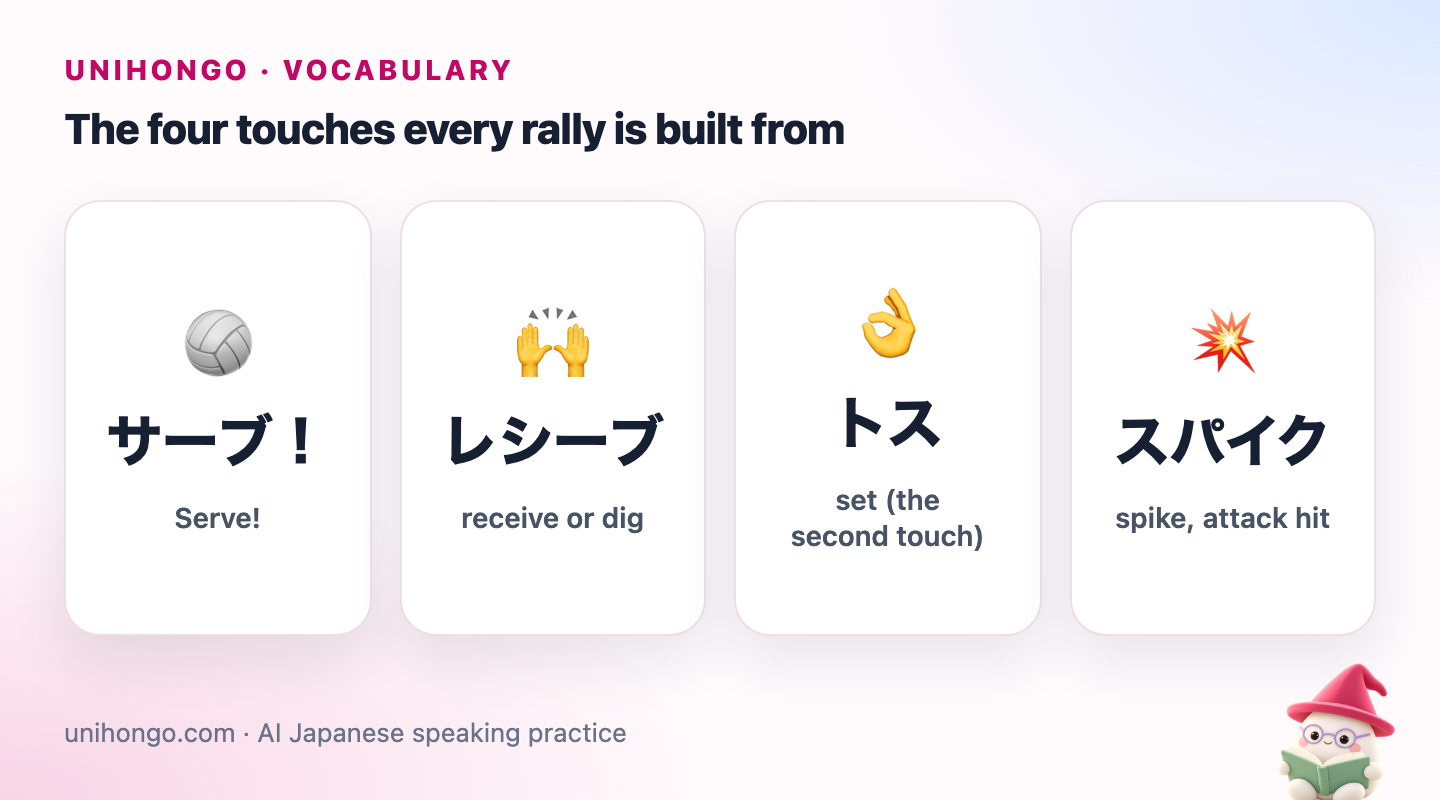
A volleyball rally is a chain of the same few actions, and Japanese names them almost all in katakana. Learn these four first: they are the words a coach uses most, and they appear in every drill. The serve starts the rally, the receive controls the first ball, the set prepares the attack and the spike finishes it.
Note that reshību is wider than the English word receive. It is used for the first contact after a serve and also, very often, for digging an opponent's attack. Some players use the native verb hirou, to pick up, for a desperate dig: yoku hirotta! means great dig!
| Japanese | Romaji | Meaning |
|---|---|---|
| サーブ! | Sābu! | Serve! |
| レシーブ | reshību | receive or dig |
| トス | tosu | set (the second touch) |
| スパイク | supaiku | spike, attack hit |
| ブロック | burokku | block |
| 拾う | hirou | to dig, to save a hard ball |
| 打つ | utsu | to hit, to spike |
| 跳ぶ | tobu | to jump |
Court, gear and the gym
Most amateur volleyball in Japan happens indoors, in a school gym or a public sports hall called a taiikukan. The words for the place and the gear are a mix of loanwords and native Japanese. Two details often surprise visitors: you change into clean indoor shoes at the entrance, and players usually help set up and take down the net and poles before and after practice.
In Japanese, knee pads are usually called sapōtā, from supporter, not knee pads. If you ask for nī paddo people may understand, but hiza sapōtā is the word you will hear.
| Japanese | Romaji | Meaning |
|---|---|---|
| 体育館 | taiikukan | gym, sports hall |
| コート | kōto | court |
| ネット | netto | net |
| エンドライン | endo rain | end line |
| 膝サポーター | hiza sapōtā | knee pads |
| 室内シューズ | shitsunai shūzu | indoor shoes |
| ネットを張りましょう。 | Netto o harimashō. | Let's put up the net. |
| ポールを片付けます。 | Pōru o katazukemasu. | I'll put away the poles. |
Netto o haru, literally to stretch the net, is the verb for putting it up. Helping with setup without being asked is one of the easiest ways to be welcomed by a new team.
Positions and people on the team
Japanese volleyball uses the modern position names, almost all from English. Older players and school coaches may also use simpler names based on where a player hits from: refuto (left), raito (right) and sentā (centre). You will hear both, sometimes in the same sentence.
| Japanese | Romaji | Meaning |
|---|---|---|
| セッター | settā | setter |
| リベロ | ribero | libero |
| エース | ēsu | ace, the team's top hitter |
| キャプテン | kyaputen | team captain |
| 監督 | kantoku | head coach, manager |
| ポジションはどこですか。 | Pojishon wa doko desu ka. | What position do you play? |
| 昔はセッターでした。 | Mukashi wa settā deshita. | I used to be a setter. |
| Position | Japanese | What they do |
|---|---|---|
| Setter | settā | Makes the second touch and runs the attack |
| Libero | ribero | Defensive specialist in a different coloured shirt |
| Outside hitter | autosaido hittā, or refuto | Main attacker from the left side |
| Middle blocker | midoru burokkā, or sentā | Blocks in the middle and hits quick sets |
| Opposite | opojitto, or raito | Attacks from the right, often the strongest hitter |
Ēsu in Japanese usually means the team's best attacker, the player who gets the ball in a tight moment. A serve that scores directly is a sābisu ēsu, service ace. Kantoku is the head coach; an assistant who runs drills is a kōchi (コーチ).
Rule calls and the score
Referees, scorers and teammates use a set of short rule words. Many are English, but not always the English you expect, and some older terms are still common in casual games. For example, a double contact used to be called doriburu (dribble) in Japanese, and many amateur players still say it.
Scores are read with ten: nijūgo ten (25 points). At 24 all you will hear dyūsu, deuce, and a set is counted with the counter setto: dai ni setto, the second set.
| Japanese | Romaji | Meaning |
|---|---|---|
| イン! | In! | In! |
| アウト! | Auto! | Out! |
| タッチネット | tatchi netto | touching the net (a fault) |
| フォアヒット | foa hitto | four hits (a fault) |
| ホールディング | hōrudingu | holding or catching the ball |
| ネットイン | netto in | a serve that clips the net and goes over |
| サーブ権 | sābu ken | the right to serve |
| 二十五点先取です。 | Nijūgo ten senshu desu. | First to twenty-five points. |
What teammates shout on court
This is the vocabulary that textbooks skip and that you hear more than any other. Japanese teams talk constantly: to claim the ball, to praise, to shake off a mistake and to lift the mood before the next serve. The calls are short, casual and shouted, and even very polite adult teams use plain forms on court.
Hai! is the most common way to claim a ball: it is short, clear and impossible to mishear. Donmai, from don't mind, is said to a teammate who has just made an error and means don't worry about it. Mō ippon! is very typical of Japanese volleyball: after a good serve it means do it again, and after a lost point it means let's get the next one.
| Japanese | Romaji | Meaning |
|---|---|---|
| はい! | Hai! | Mine! (claiming the ball) |
| ナイスサーブ! | Naisu sābu! | Nice serve! |
| ドンマイ! | Donmai! | Don't worry about it! |
| もう一本! | Mō ippon! | One more! / Let's get the next one! |
| 切り替えていこう! | Kirikaete ikō! | Let's reset and move on! |
| 声出していこう! | Koe dashite ikō! | Let's hear some voices! |
| カバー! | Kabā! | Cover! (back up the hitter) |
| チャンス! | Chansu! | Free ball! |
Chansu! is shouted when the opponents send back an easy ball. It means this is our chance to set up a full attack, and it is the Japanese equivalent of calling a free ball.
Visiting a local team for the first time
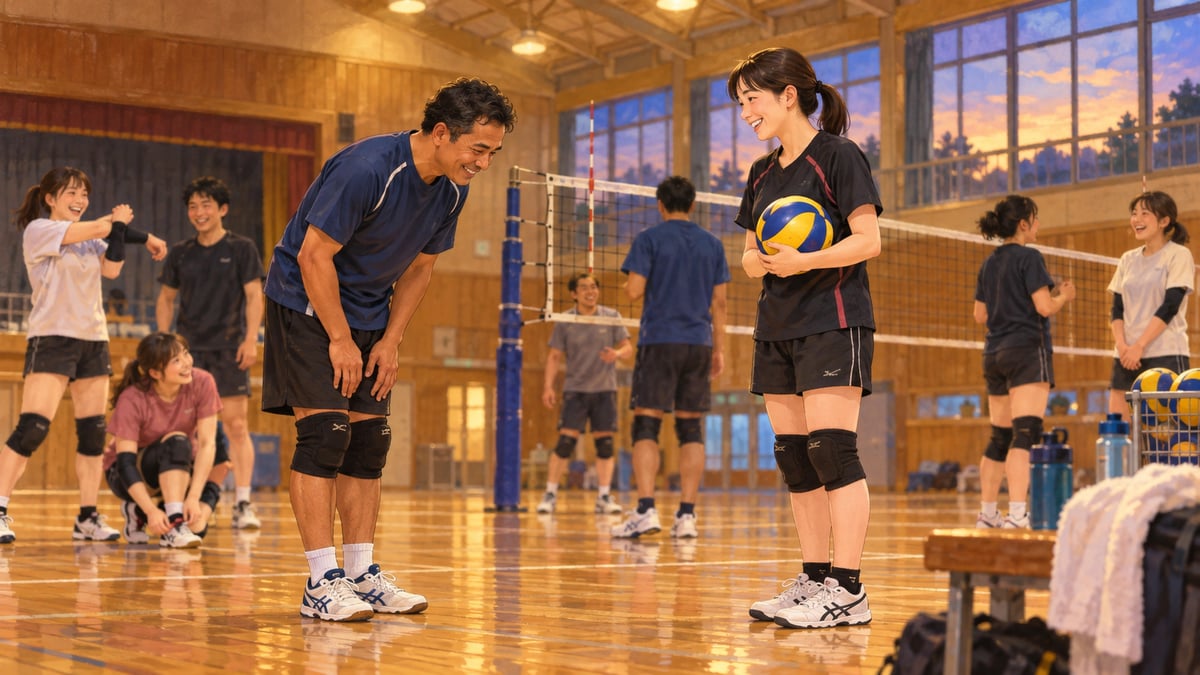
Adult volleyball in Japan is often organised as teams or circles (sākuru) that rent the public gym on fixed evenings. Some are competitive, some are relaxed, and some play nine-a-side, a Japanese format with different rules. The polite move is to contact the team, ask if you can watch a practice, then join in if they invite you.
Use polite Japanese with people you have just met, even if the team is friendly. Once you have played together a few times, teammates will usually switch to casual speech, and you can follow their lead.
| Japanese | Romaji | Meaning |
|---|---|---|
| 見学してもいいですか。 | Kengaku shite mo ii desu ka. | May I watch the practice? |
| 初心者でも大丈夫ですか。 | Shoshinsha demo daijōbu desu ka. | Is it okay for a beginner? |
| 学生のときにやっていました。 | Gakusei no toki ni yatte imashita. | I played when I was a student. |
| 何を持ってくればいいですか。 | Nani o motte kureba ii desu ka. | What should I bring? |
| よろしくお願いします。 | Yoroshiku onegai shimasu. | Thank you for having me. (start of practice) |
| ありがとうございました。 | Arigatō gozaimashita. | Thank you. (end of practice) |
Mini dialogue: the first practice
| Japanese | Romaji | Meaning |
|---|---|---|
| 今日からよろしくお願いします。 | Kyō kara yoroshiku onegai shimasu. | You: I'm joining from today. Nice to meet you all. |
| よろしく!ポジションは? | Yoroshiku! Pojishon wa? | Captain: Welcome! What position? |
| アタッカーです。でも、レシーブは苦手です。 | Atakkā desu. Demo, reshību wa nigate desu. | You: I'm a hitter. But I'm not good at receiving. |
| 大丈夫、練習しよう。まずはパスから。 | Daijōbu, renshū shiyō. Mazu wa pasu kara. | Captain: No problem, let's practise. Passing first. |
| はい、お願いします! | Hai, onegai shimasu! | You: Okay, please! |
Pasu here means warm-up passing in pairs, which almost every practice starts with. Nigate means not good at or uncomfortable with, and it is a modest, natural way to describe a weak point without sounding negative about yourself.
Drill the calls with Mocchi
Type /quiz volleyball rule calls and shouts in Japanese to Mocchi, and it will ask you one at a time what tatchi netto, chansu or mō ippon means, or how to say a phrase yourself. Mocchi keeps track of the calls you mix up and brings them back in later reviews, so the slow ones get faster.
When the calls feel automatic, ask Mocchi for flashcards of the position names and the four touches, pick a photo for each card, and play them in Kotoba Tank: you hear a word and hit the right one, which is close to the split-second listening you need on court.
Common learner mistakes
- Using tosu to mean a casual throw. In volleyball it is the set, a skilled touch.
- Saying nī paddo for knee pads. Most players say hiza sapōtā.
- Staying silent on court because your Japanese is not perfect. A clear hai! is better than a perfect sentence too late.
- Using casual speech with a new team before they do. Start polite and follow their lead.
- Forgetting that barē also means ballet. In a sports context it is volleyball, but say barēbōru if there is any doubt.