
Otona in four everyday lines
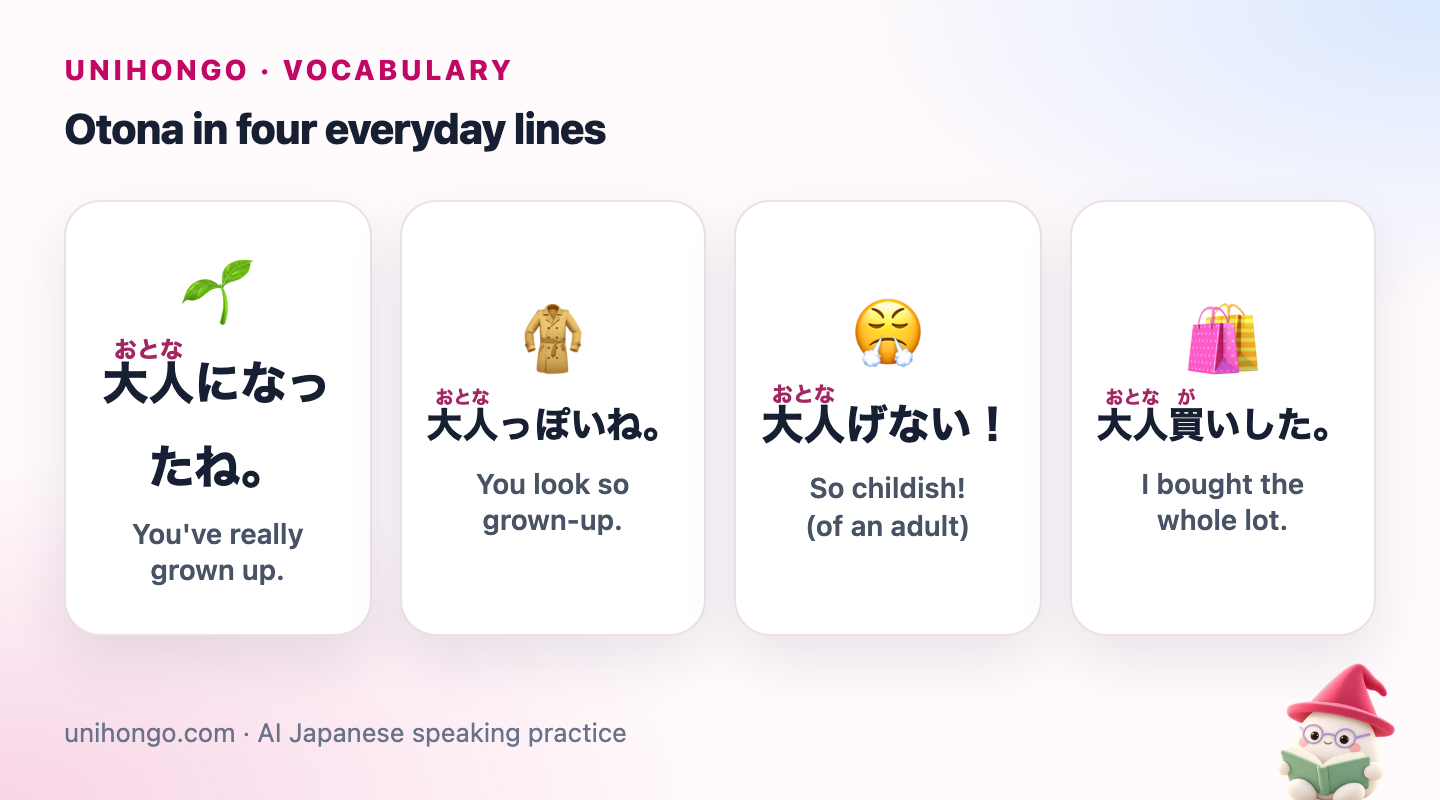
These four lines show the most useful family of otona words. The first is the warm line relatives say to a young person they have not seen for a while. The second is a compliment on style. The third is a criticism of an adult's behaviour. The fourth is a happy confession of a shopping spree.
| Japanese | Romaji | Meaning |
|---|---|---|
| 大人になったね。 | Otona ni natta ne. | You've really grown up. |
| 大人っぽいね。 | Otonappoi ne. | You look so grown-up. |
| 大人げない! | Otonagenai! | So childish! (of an adult) |
| 大人買いした。 | Otonagai shita. | I bought the whole lot. |
The reading of 大人, and otona vs seijin vs shakaijin
大人 is made of 大 (big) and 人 (person), and on their own those kanji are read dai or ō and hito or jin. Together they are read otona, a special reading given to the whole word rather than to each kanji. Japanese has a number of these, such as kyō (今日, today) and kodomo (子供, child), and they simply have to be learned as words.
Otona is the everyday word for adult, but two other words overlap with it. Seijin (成人) is the legal or official adult, used in law, statistics and the coming-of-age ceremony. Shakaijin (社会人) is a working adult, someone who has left school and joined society through work, and it carries a sense of responsibility. The table shows when each is natural.
| Japanese | Romaji | Meaning |
|---|---|---|
| 大人一枚、子ども一枚お願いします。 | Otona ichimai, kodomo ichimai onegai shimasu. | One adult and one child ticket, please. |
| 成人式に出ました。 | Seijinshiki ni demashita. | I attended the coming-of-age ceremony. |
| 社会人になって三年目です。 | Shakaijin ni natte sannenme desu. | It's my third year as a working adult. |
| Word | Meaning | Natural context |
|---|---|---|
| otona | Adult, grown-up | Tickets, daily talk, maturity |
| seijin | Legal or official adult | Law, ceremonies, official documents |
| shakaijin | Working adult | Jobs, manners, responsibility |
| kodomo | Child | Tickets, family, the opposite of otona |
Otona ni naru and otona no ~
Otona ni naru means to grow up, physically or in maturity. Relatives say otona ni natta ne, you've grown up, to a young person at New Year or a family event, and it is warm. Among adults, otona ni natta can also mean someone has calmed down or become more sensible: kare mo otona ni natta na, he's matured.
Otona no + noun builds many fixed phrases. Otona no aji, a grown-up taste, describes bitter, spicy or strong flavours that children usually dislike, such as black coffee or wasabi. Otona no taiō, a grown-up response, means handling something calmly instead of getting upset. Otona no jijō, adult circumstances, is a joking way to avoid explaining something complicated, such as business or money reasons.
| Japanese | Romaji | Meaning |
|---|---|---|
| ブラックコーヒーは大人の味だね。 | Burakku kōhii wa otona no aji da ne. | Black coffee is a grown-up taste. |
| ここは大人の対応をしよう。 | Koko wa otona no taiō o shiyō. | Let's handle this like adults. |
| それは大人の事情ってやつだよ。 | Sore wa otona no jijō tte yatsu da yo. | Let's just say it's 'grown-up reasons'. (joking) |
| 彼も大人になったなあ。 | Kare mo otona ni natta nā. | He's really matured. |
| おとなしい子ですね。 | Otonashii ko desu ne. | What a quiet, well-behaved child. |
A related everyday word is otonashii, quiet, gentle or well-behaved. It is often written 大人しい, with the same kanji as otona, and it is used for calm children, gentle pets and people who rarely make a fuss. It is usually positive, but for an adult it can also suggest someone shy or a little passive, so it depends on the tone.
Otonappoi and kodomoppoi
The suffix ~ppoi means '-ish' or 'like'. Otonappoi is mature-looking or grown-up in style, behaviour or taste. It is a natural compliment for a teenager in a smart outfit, a child who speaks very politely, or a young adult who chose an elegant, calm style. Otonappoi fuku means clothes with a mature, refined look.
Said to an adult, otonappoi can be a compliment on style, but it can also suggest that someone looks older than their age, so read the situation. The opposite, kodomoppoi, means childish. It can be affectionate about a playful friend, but it is a criticism when it describes behaviour, so be careful saying it to someone's face.
| Japanese | Romaji | Meaning |
|---|---|---|
| そのコート、大人っぽくて素敵。 | Sono kōto, otonappokute suteki. | That coat is so elegant and grown-up. |
| 中学生なのに、大人っぽいね。 | Chūgakusei na noni, otonappoi ne. | Only in junior high, but so mature. |
| 彼は子どもっぽいところがある。 | Kare wa kodomoppoi tokoro ga aru. | He has a childish side. |
Otonagenai, and the 大人気 trap
Otonagenai describes an adult behaving in a childish way that does not fit their age: getting angry at a child who won a game, sulking over a small loss, arguing over a last piece of cake. It is a criticism, but very often said with a laugh, even about yourself: otonagenai kedo, kuyashii, 'it's childish, but I'm annoyed'.
Here is the trap. Otonagenai is sometimes written 大人気ない, and 大人気 on its own is usually read dai ninki, 'hugely popular'. So 大人気の店 is a very popular shop, but 大人気ない is otonagenai. The ending nai, and the context, tell you which reading is meant. Many writers use 大人げない in hiragana to avoid the confusion.
| Japanese | Romaji | Meaning |
|---|---|---|
| 子ども相手に本気になるなんて、大人げない。 | Kodomo aite ni honki ni naru nante, otonagenai. | Getting serious against a child? So immature. |
| 大人げないけど、悔しい! | Otonagenai kedo, kuyashii! | It's childish, but I'm so annoyed! |
| この店は大人気です。 | Kono mise wa dai ninki desu. | This shop is hugely popular. |
Otona-gai: buying the whole box
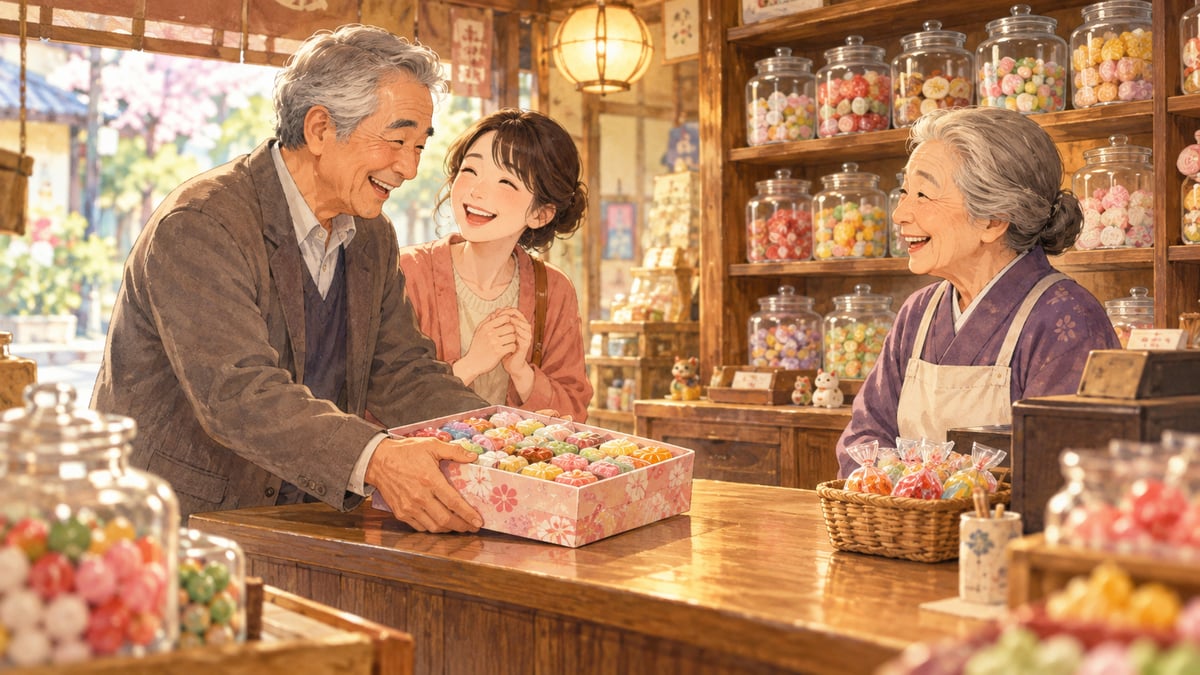
Otona-gai is buying, with an adult's wallet, the thing you could only buy one at a time as a child: a whole box of the snacks that came with a collectible card, every volume of a manga at once, ten capsule toys in a row until you get the one you want. The word mixes nostalgia, a little guilt and a lot of fun.
It is casual and usually a cheerful confession. You can also use it for adult hobbies that involve buying in bulk, such as every colour of a pen you like. The verb is otona-gai suru, and the past otona-gai shichatta, 'I went and bought the whole lot', adds a playful hint of guilt.
| Japanese | Romaji | Meaning |
|---|---|---|
| 子どもの頃のお菓子、箱で大人買いしちゃった。 | Kodomo no koro no okashi, hako de otonagai shichatta. | I bought a whole box of my childhood snacks. |
| 漫画を全巻大人買いした。 | Manga o zenkan otonagai shita. | I bought the entire manga series at once. |
| それは大人買いだね! | Sore wa otonagai da ne! | Friend: Now that's a grown-up shopping spree! |
| 大人になってよかった。 | Otona ni natte yokatta. | This is why being an adult is great. |
Shops sometimes use the word in their own displays to invite nostalgic buyers, and you will see it in online reviews too. Some people joke that otona-gai is the only clear advantage of being an adult.
Mini dialogue: game night with a nephew
At a family gathering, an uncle loses a card game to his eight-year-old nephew. The boy's mother, the uncle's younger sister, steps in. Watch how otonagenai and otona no taiō come up, and how everyone keeps it light.
| Japanese | Romaji | Meaning |
|---|---|---|
| やった!また勝った! | Yatta! Mata katta! | Nephew: Yes! I won again! |
| もう一回!次は負けない! | Mō ikkai! Tsugi wa makenai! | Uncle: One more! I won't lose next time! |
| お兄ちゃん、大人げないよ。 | Onīchan, otonagenai yo. | Mother: Come on, you're being childish. |
| わかった、わかった。大人の対応をします。 | Wakatta, wakatta. Otona no taiō o shimasu. | Uncle: Okay, okay. I'll be the grown-up. |
| じゃあ、お菓子あげる。 | Jā, okashi ageru. | Nephew: Then you can have a sweet. |
Onīchan is how a younger sister often addresses her older brother, even as adults, so the mother uses it here. Notice that the uncle's polite shimasu at the end is a joke: switching to polite form for a moment makes his 'grown-up' promise sound mock-serious.
Common learner mistakes
- Reading 大人 as dainin or daijin. In everyday Japanese it is otona.
- Reading every 大人気 as dai ninki. With nai after it, it is otonagenai.
- Calling an adult otonappoi without thinking. It can imply they look older; praise their style with suteki or oshare instead.
- Using seijin in conversation for 'adult'. It sounds official; otona is the everyday word.
- Using kodomoppoi as a light joke with someone you do not know well. It can sting.
Build an otona word deck with Mocchi
- Ask Mocchi: '/create-flashcards otona, otonappoi, otonagenai, otona-gai, otona no aji, dai ninki, with an example sentence for each.' Pick a photo for each card.
- Review them with /review-flashcards; the cards you find hard come back sooner.
- Play Vocabulary Dash on the games page with your own flashcards, so the words come back at running speed.
- Later, ask Mocchi to /quiz you on otonagenai versus dai ninki; it remembers if the 大人気 trap caught you before.