
The intensity family at a glance
Treat this group as one shelf in your vocabulary, not as separate discoveries. Every word here raises the temperature of the sentence around it, and every word here is casual. The useful skill is not learning them one at a time from video, but learning each one together with the neutral word you would say instead when the room changes.
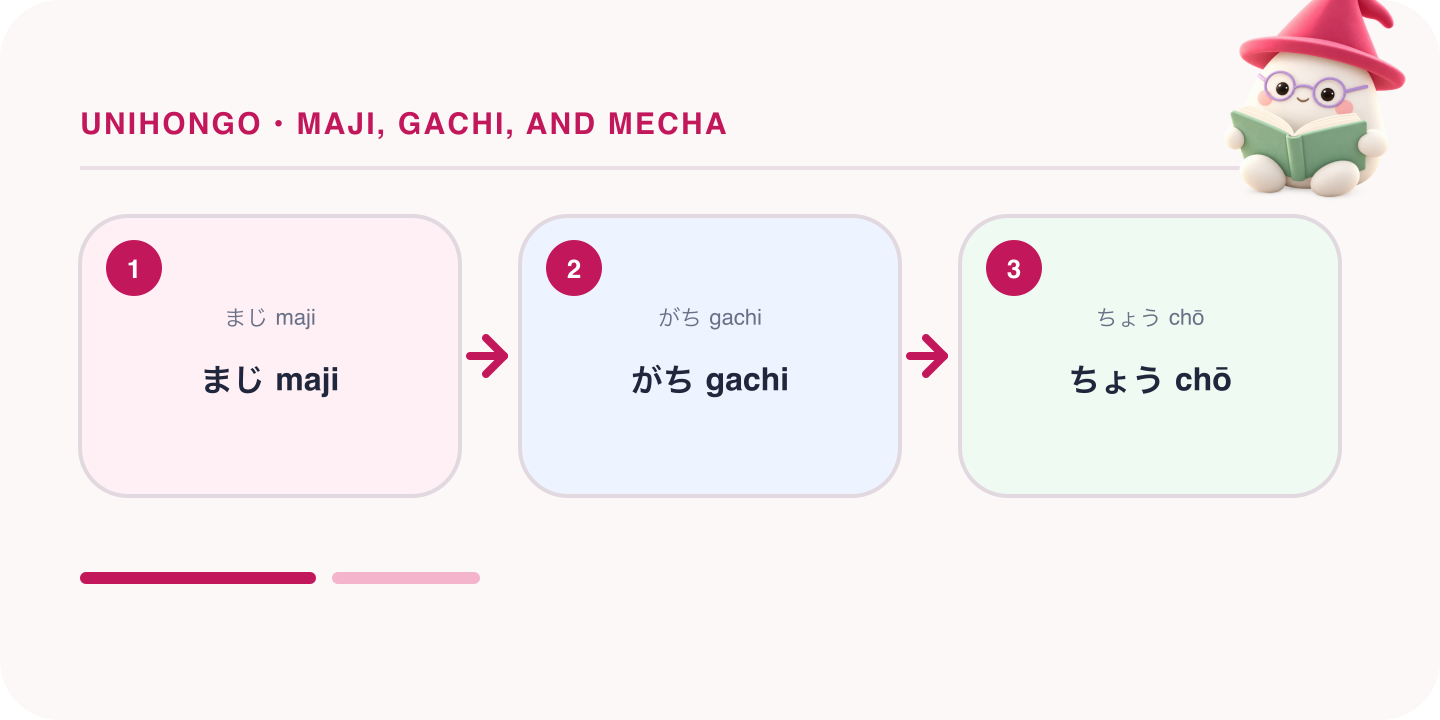
| Slang | Meaning | Register | Neutral equivalent |
|---|---|---|---|
| まじ maji | Seriously, for real, no joke | Casual, very common all ages under about forty | 本当に hontō ni |
| まじで maji de | Seriously; really (adverb) | Casual | 本当に hontō ni |
| まじか maji ka | Are you serious? | Casual reaction | 本当ですか hontō desu ka |
| がち gachi | Genuinely, seriously, hardcore | Casual, younger and internet-flavoured | 本気で honki de |
| がちで gachi de | For real, genuinely (adverb) | Casual | 本当に hontō ni |
| めっちゃ meccha | Extremely, super | Casual, originally Kansai, now nationwide | とても totemo |
| めちゃくちゃ mechakucha | Extremely; also a mess | Casual | 非常に hijō ni |
| ちょう chō | Super, ultra | Casual, slightly older youth slang | とても totemo |
| やばい yabai | Extreme in either direction | Casual | すごい sugoi (still casual) / 大変 taihen |
| 超やばい chō yabai | Unbelievably extreme | Very casual | 非常に困ります hijō ni komarimasu |
Yabai has its own separate post because its meaning flips between good and bad depending on the situation, and internet-only slang such as the abbreviations that live in comments is covered in the internet slang post. This one stays with the intensifiers you also hear out loud.
Maji: the word that says this is not a joke
Maji comes from majime, meaning serious or earnest, and it kept that core. When someone says maji, they are asserting or asking that the statement is not a joke. That is why it works so well as a reaction to news: it is not measuring how big something is, it is testing whether it is true.
You will meet three shapes. Bare maji as a one-word reaction, maji de as an adverb meaning seriously or really, and maji ka as a question meaning are you serious. Maji de also functions as a challenge, as in maji de itteru, which asks whether the other person truly means what they just said.
| Japanese | Romaji | Meaning |
|---|---|---|
| まじ? | Maji? | Seriously? (casual) |
| まじか。 | Maji ka. | You have got to be kidding. (casual) |
| まじで? | Maji de? | For real? (casual) |
| まじで言ってる? | Maji de itteru? | Are you being serious? (casual) |
| まじで助かった。 | Maji de tasukatta. | That seriously saved me. (casual) |
| まじで忙しい。 | Maji de isogashii. | I am seriously busy. (casual) |
| まじで無理。 | Maji de muri. | There is no way I can do that. (casual) |
| それまじ?うそでしょ。 | Sore maji? Uso desho. | Is that for real? No way. (casual) |
The same reactions, said safely
Every casual reaction above has a polite twin, and the twin is not colder. Japanese moves emotion into the sentence rather than into slang, so a longer reaction with hontō ni or a soft sore wa often sounds warmer than the slang version, not stiffer. Practise these as pairs so the safe one is available at the same speed.
| Japanese | Romaji | Meaning |
|---|---|---|
| 本当ですか。 | Hontō desu ka. | Really? (polite) |
| 本当ですか、知りませんでした。 | Hontō desu ka, shirimasen deshita. | Really? I had no idea. (polite) |
| そうなんですか。 | Sō nan desu ka. | Is that so? (polite) |
| それは驚きました。 | Sore wa odorokimashita. | That is surprising. (polite) |
| 本当に助かりました。 | Hontō ni tasukarimashita. | That really helped me. (polite) |
| とても忙しいです。 | Totemo isogashii desu. | I am very busy. (polite) |
| 少し難しいです。 | Sukoshi muzukashii desu. | That is a little difficult. (polite, softened refusal) |
| 非常に大きな違いです。 | Hijō ni ōkina chigai desu. | That is an extremely large difference. (formal) |
Notice sukoshi muzukashii desu standing in for maji de muri. The casual version states an impossibility; the polite version understates it and lets the listener draw the conclusion. That understatement is the normal way to decline in a workplace, and it is a habit worth building early.
Gachi: genuine, not merely strong
Gachi is often glossed as seriously, which hides what it actually does. It comes from gachinko, a word for a real, unfixed contest, so it marks something as the genuine article rather than a casual or performative version. A gachi na fan is someone who is properly committed, not someone who is merely enthusiastic today.
Because of that, gachi attaches to people and commitments as easily as to adjectives. Gachi de yaru means to do something for real rather than half-heartedly. The neutral equivalent is honki de, which means the same thing without the youth register and is safe in most spoken situations.
| Japanese | Romaji | Meaning |
|---|---|---|
| がちで頑張る。 | Gachi de ganbaru. | I am going to give this a real effort. (casual) |
| 彼はがち勢だ。 | Kare wa gachi-zei da. | He is one of the serious ones. (casual) |
| がちで練習してる。 | Gachi de renshū shiteru. | I am practising for real. (casual) |
| それがちで難しい。 | Sore gachi de muzukashii. | That is genuinely hard. (casual) |
| 本気で取り組んでいます。 | Honki de torikunde imasu. | I am tackling it seriously. (polite) |
| 本気で日本語を勉強しています。 | Honki de nihongo o benkyō shite imasu. | I am studying Japanese in earnest. (polite) |
| 真剣に考えています。 | Shinken ni kangaete imasu. | I am thinking about it seriously. (polite) |
| しっかり準備します。 | Shikkari junbi shimasu. | I will prepare properly. (polite) |
Mecha, mechakucha, and chō: pure volume
These three do not add meaning, they add size. Meccha, often written めっちゃ, spread from Kansai speech and is now heard across the country in casual talk. Mechakucha is the fuller form and has a second life as an adjective meaning chaotic or a complete mess, so mechakucha na heya is a very untidy room while mechakucha oishii is extremely tasty.
Chō, written 超, is the same character that appears in ordinary formal vocabulary, but placed in front of an adjective in speech it is casual youth slang. All three attach directly to the adjective with nothing between them, which is why chō ureshii and meccha oishii need no particle. The polite substitutes are totemo for everyday speech and hijō ni when you want formal weight.
| Japanese | Romaji | Meaning |
|---|---|---|
| めっちゃおいしい。 | Meccha oishii. | This is incredibly tasty. (casual) |
| めっちゃ寒いね。 | Meccha samui ne. | It is freezing, is it not. (casual) |
| めちゃくちゃ疲れた。 | Mechakucha tsukareta. | I am completely worn out. (casual) |
| 部屋がめちゃくちゃだ。 | Heya ga mechakucha da. | The room is a total mess. (casual) |
| 超うれしい。 | Chō ureshii. | I am super happy. (casual) |
| 超簡単だった。 | Chō kantan datta. | That was ridiculously easy. (casual) |
| とてもおいしいです。 | Totemo oishii desu. | It is very tasty. (polite) |
| とても疲れました。 | Totemo tsukaremashita. | I got very tired. (polite) |
| 非常に分かりやすい説明でした。 | Hijō ni wakariyasui setsumei deshita. | That was an extremely clear explanation. (formal) |
The register line that actually matters
Here is the rule in one sentence: these words are for people you would speak to in plain form anyway. If you are using -masu and desu with someone, the intensifiers do not belong in the sentence, even if the rest of it is polite. Maji de sumimasen is not a polite apology; the maji cancels the effort the sumimasen is making.
The difficulty for learners is that media gives you no register information. A drama scene and a variety show clip both feel like natural Japanese, and neither tells you that the speaker is a nineteen-year-old talking to a close friend. The polite versus casual guide covers the full system; the practical shortcut here is to sort every new intensifier into a room before you let it into your own speech.
- Manager, client, customer, teacher, stranger, anyone older you do not know well: none of these words, ever.
- Colleague of the same rank you are friendly with: still avoid them in a meeting; they may be fine in the lift.
- Close friend, sibling, classmate you speak plainly with: all of them are normal.
- Written work messages, email, chat with a customer: use hontō ni or hijō ni instead.
- If you are unsure which room you are in, that uncertainty is your answer. Use totemo.
How these look in writing
In messages you will see the same words in several written shapes, and recognising them saves you from looking up a word that does not exist. Maji appears as まじ, マジ and occasionally as 本気 read as maji in stylised writing. Meccha appears as めっちゃ and めちゃ; mechakucha as めちゃくちゃ and sometimes as 目茶苦茶, an old phonetic character spelling rather than a meaningful one. Chō is written 超 or ちょー with a long vowel mark.
Katakana versions such as マジ and チョー usually signal emphasis or a light, informal tone rather than a foreign word. Lengthened vowels do the same work as drawing out a syllable in speech, so まじでー is a softer, more drawn-out maji de. None of this changes the register; a stylish spelling of a casual word is still a casual word.
| Japanese | Romaji | Meaning |
|---|---|---|
| マジで? | Maji de? | For real? (written casual) |
| まじかー。 | Maji kā. | Oh no way. (drawn out, casual) |
| めちゃうまい。 | Mecha umai. | So good. (casual, spoken and written) |
| ちょー楽しかった。 | Chō tanoshikatta. | That was so much fun. (casual) |
| がちでおすすめ。 | Gachi de osusume. | Genuinely recommended. (casual) |
Recognise without producing
There is a real skill in understanding a word fully while choosing not to say it, and it is the right target for everything on this shelf. You need maji ka in your ears because a colleague will say it to you at lunch, and you need to be able to answer naturally rather than freeze. What you do not need is to be the learner who says gachi de to a section manager.
Build the split deliberately. Put the slang in your listening practice, where you meet it in video, songs and casual conversation, and keep your speaking drills in polite forms. Over months the passive set will grow large and your active set will stay clean, which is exactly the profile of an adult who moved to Japan and learned to read the room.
- Add slang to a listening-only list, marked so you never drill it as output.
- For each item, write the neutral equivalent next to it and drill that one aloud.
- When someone uses one at you, reply in your own register rather than mirroring theirs.
- Watch which of your Japanese colleagues use these words and to whom; copy the pattern, not just the word.
- If you do decide to use them with friends, use one at a time; stacking chō and maji together sounds like an imitation.
A two-sided conversation, twice
This is the same exchange with a friend and with a senior colleague. Read both aloud in one sitting. The content is identical, so what you are training is the switch itself, which is the part that fails under pressure.
| Japanese | Romaji | Meaning |
|---|---|---|
| A:まじで?いつ決まったの? | A: Maji de? Itsu kimatta no? | Friend version: For real? When was it decided? |
| B:昨日。めっちゃ急だった。 | B: Kinō. Meccha kyū datta. | Friend version: Yesterday. It was super sudden. |
| A:がちでおめでとう。 | A: Gachi de omedetō. | Friend version: Genuinely, congratulations. |
| B:ありがとう。まじで助かる。 | B: Arigatō. Maji de tasukaru. | Friend version: Thanks. That seriously helps. |
| A:本当ですか。いつ決まったんですか。 | A: Hontō desu ka. Itsu kimatta n desu ka. | Polite version: Really? When was it decided? |
| B:昨日です。急な話でした。 | B: Kinō desu. Kyū na hanashi deshita. | Polite version: Yesterday. It came up suddenly. |
| A:本当におめでとうございます。 | A: Hontō ni omedetō gozaimasu. | Polite version: Many congratulations. |
| B:ありがとうございます。助かります。 | B: Arigatō gozaimasu. Tasukarimasu. | Polite version: Thank you. That is a great help. |
The polite side is one syllable-count longer and does the same social work. If it feels slower, that is a fluency problem rather than a politeness problem, and the fix is repetition rather than reaching back for the casual line.
Common mistakes with intensity slang
- Attaching maji de to a polite sentence and assuming the desu makes it safe; it does not.
- Using gachi to mean very. It means genuinely or in earnest, so gachi oishii sounds off where meccha oishii is fine.
- Reading 超 in a formal compound and assuming the casual meaning; in ordinary vocabulary it is simply a prefix.
- Saying mechakucha about a person's work when you meant extremely good; without a clearly positive adjective it can be heard as a mess.
- Copying the slang of a much younger speaker from video and using it as an adult in a professional setting.
- Stacking intensifiers, as in chō maji de meccha, which sounds like a performance of slang rather than speech.