
Where the word comes from
加減 (kagen) combines 加, add, and 減, reduce. Adding a bit here and taking a bit away there is how you adjust anything, so kagen came to mean degree, balance or adjustment. You still meet it in many compound words that have nothing negative about them at all.
Put ii, good, in front and you get "a good adjustment", which is exactly the old meaning. Over time, the phrase shifted from "a suitable amount" to "only as much as is convenient", and from there to "not properly done". That drift explains why the same two words can praise a bath and criticise a colleague.
| Japanese | Romaji | Meaning |
|---|---|---|
| 加減 | kagen | Degree, adjustment, balance |
| 塩加減 | shio-kagen | How much salt: the seasoning |
| 火加減 | hi-kagen | The strength of the heat when cooking |
| 湯加減 | yu-kagen | The temperature of bath water |
| 手加減する | te-kagen suru | To go easy on someone, hold back |
| お加減はいかがですか。 | O-kagen wa ikaga desu ka. | How are you feeling? (polite, to someone unwell) |
Ii kagen na: sloppy, careless, irresponsible
The most common modern use is as a na-adjective before a noun: ii kagen na hito, an irresponsible person; ii kagen na shigoto, sloppy work; ii kagen na henji, a half-hearted, noncommittal answer. The core idea is that someone did not take the matter seriously enough.
It can describe an attitude as well as a result. Ii kagen na koto o iu means to say things without thinking or checking, including promises you will not keep or facts you have not confirmed. In that sense it sits close to English "making things up" or "talking nonsense".
| Japanese | Romaji | Meaning |
|---|---|---|
| あの人は時間にいい加減だ。 | Ano hito wa jikan ni ii kagen da. | That person is careless about time. |
| いい加減な仕事はしたくない。 | Ii kagen na shigoto wa shitaku nai. | I don't want to do sloppy work. |
| いい加減な返事をしないで。 | Ii kagen na henji o shinaide. | Don't give me a half-hearted answer. |
| いい加減なことを言わないでください。 | Ii kagen na koto o iwanaide kudasai. | Please don't say things you haven't thought through. |
| 説明がいい加減で、すみませんでした。 | Setsumei ga ii kagen de, sumimasen deshita. | I'm sorry my explanation was careless. |
Notice the last line. Criticising your own work with ii kagen is humble and perfectly acceptable. Criticising someone else's work with it is strong, so most people soften it or choose a different word, which we cover below.
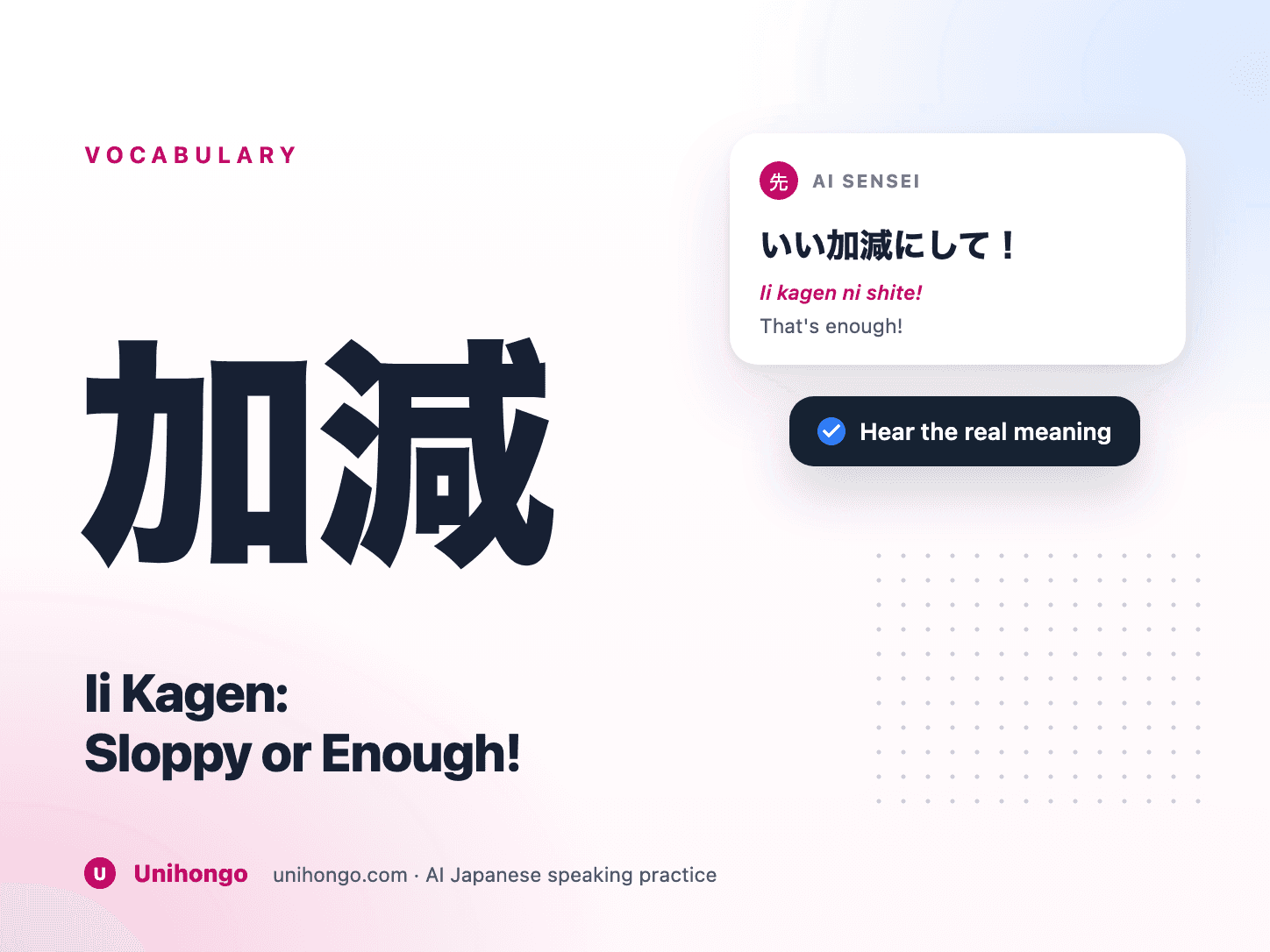
Ii kagen ni shite: "that's enough!"
The set phrase いい加減にして, or in full いい加減にしなさい, means "that's enough", "cut it out" or "give me a break". Literally it is "make it a good degree", in other words, stop before it goes any further. By the time someone says it, they have usually already run out of patience.
The strength depends on the ending. Ii kagen ni shite ne said with a sigh to a friend can be half joking. Ii kagen ni shinasai is what a parent or teacher says to a child. Ii kagen ni shiro is blunt and angry, and in Kansai you will hear ee kagen ni shii ya or ee kagen ni sē, often in comedy.
| Japanese | Romaji | Meaning |
|---|---|---|
| いい加減にしてよ。 | Ii kagen ni shite yo. | Come on, that's enough. (casual, annoyed) |
| もう、いい加減にして! | Mō, ii kagen ni shite! | Oh, cut it out! |
| いい加減にしなさい。 | Ii kagen ni shinasai. | That's enough now. (parent or teacher to a child) |
| いい加減にしろ。 | Ii kagen ni shiro. | Knock it off. (blunt, angry) |
| 冗談もいい加減にして。 | Jōdan mo ii kagen ni shite. | Enough with the jokes. |
Ii kagen as an adverb: "by now, surely"
Used before a verb or adjective, ii kagen means "by now", "high time" or "pretty much". It suggests that enough time has passed or that a limit has been reached. It often sounds fed up: ii kagen akita, I'm sick of it by now; ii kagen tsukareta, I'm pretty worn out at this point.
Ii kagen ni can also appear before a verb in the same sense, especially in requests: ii kagen ni okinasai, it's high time you got up. The adverb use is natural in casual speech and writing, and much less aggressive than the "that's enough!" phrase, because the frustration is aimed at a situation rather than a person.
| Japanese | Romaji | Meaning |
|---|---|---|
| いい加減飽きてきた。 | Ii kagen akite kita. | I'm getting sick of it by now. |
| いい加減おなかがすいた。 | Ii kagen onaka ga suita. | I'm really getting hungry now. |
| いい加減に起きなさい。 | Ii kagen ni okinasai. | It's high time you got up. |
| もういい加減、覚えたでしょう。 | Mō ii kagen, oboeta deshō. | Surely you've learned it by now. |
| この雨、いい加減やんでほしい。 | Kono ame, ii kagen yande hoshii. | I really wish this rain would stop already. |
The neutral sense: "just right"
The original meaning of a suitable degree survives, but mostly in specific situations. You may hear that a bath is at ii kagen, or that food is cooked to ii kagen. Adding chōdo, exactly, makes the positive meaning clear: chōdo ii kagen, just the right amount.
When this sense is intended, some writers use 良い加減 with the kanji for good, to separate it visually from the negative いい加減. In speech the difference is carried by context. If there is any risk of confusion, say chōdo ii or ii guai instead.
| Japanese | Romaji | Meaning |
|---|---|---|
| いい湯加減ですね。 | Ii yu-kagen desu ne. | The bath is a lovely temperature. |
| ちょうどいい加減に焼けた。 | Chōdo ii kagen ni yaketa. | It's grilled just right. |
| 塩加減がちょうどいい。 | Shio-kagen ga chōdo ii. | The seasoning is just right. |
| いい具合ですね。 | Ii guai desu ne. | That's coming along nicely. |
A good rule for learners: use kagen compounds such as shio-kagen and yu-kagen freely, but assume that ii kagen on its own will be heard as negative unless the context is clearly a bath, a stove or a plate of food.
Ii kagen or tekitō?
適当 (tekitō) is the other word learners meet for "careless", and the two overlap. In formal writing, tekitō still means appropriate or suitable: tekitō na kotoba o erabu, choose a suitable word. In everyday conversation, it has become casual, meaning "whatever works", "roughly" or "without much thought", and is sometimes written テキトー.
The key difference is attitude. Tekitō ni suwatte kudasai, sit anywhere, is friendly and relaxed. Tekitō de ii yo means "it doesn't have to be perfect". Ii kagen, by contrast, almost always implies a failure of responsibility. If you want to say "just roughly" without criticising anybody, tekitō is the better choice.
| Expression | Typical meaning | How it sounds |
|---|---|---|
| いい加減な人 | An irresponsible, unreliable person | Critical, strong |
| 適当な人 | A laid-back or careless person | Lighter, can be affectionate |
| いい加減にして | That's enough, stop it | Angry or exasperated |
| 適当に座って | Sit wherever you like | Friendly and neutral |
| 適当でいいよ | It doesn't need to be perfect | Relaxed, reassuring |
| 適当な言葉 | A suitable word (formal writing) | Neutral, positive |
Softer ways to criticise at work
At work, calling a colleague's report ii kagen is likely to cause offence, and towards a superior it is out of the question. Japanese workplaces usually describe the problem rather than the person: what was missing, what needs checking, what could be clearer.
The phrases below point to the same issue without the judgement built into ii kagen. They pair naturally with the softer correction strategies covered in our guide to correcting someone politely.
| Japanese | Romaji | Meaning |
|---|---|---|
| 少し確認が足りなかったかもしれません。 | Sukoshi kakunin ga tarinakatta kamo shiremasen. | Perhaps it wasn't checked quite enough. |
| もう少し詳しくお願いできますか。 | Mō sukoshi kuwashiku onegai dekimasu ka. | Could you make it a little more detailed? |
| ここの数字、もう一度見てもらえますか。 | Koko no sūji, mō ichido mite moraemasu ka. | Could you take another look at these figures? |
| 私の確認不足でした。 | Watashi no kakunin-busoku deshita. | It was my failure to check. |
| 雑になってしまいました。 | Zatsu ni natte shimaimashita. | I ended up doing it roughly. |
Zatsu, rough or crude, is another useful neighbour. It describes the finish of the work rather than the person's character, so it tends to sound less personal than ii kagen.
Common learner mistakes
- Using ii kagen to mean "good enough". In most sentences it will be heard as careless. Say kore de jūbun desu or chōdo ii desu instead.
- Softening ii kagen ni shite with kudasai and assuming it is now polite. The phrase itself signals anger, whatever the ending.
- Confusing the adverb with the adjective. Ii kagen tsukareta, I'm pretty worn out by now, is about you, not a criticism of anyone.
- Treating tekitō as always negative. Tekitō ni is often just relaxed and friendly, especially in invitations such as tekitō ni tabete ne, help yourself.
- Forgetting na before a noun. It is ii kagen na hito, not ii kagen hito.