
Kodawari and kodawaru in one minute
Kodawari is the noun form of the verb kodawaru, to be particular about something. The thing you care about takes the particle ni: kōhī ni kodawaru, to be particular about coffee. The noun is used in two main ways: as a possession, kodawari ga aru (to have a particular standard), and as a description, kodawari no + noun (something made with that care).
At heart the word describes a personal line you will not cross: the broth must simmer for twelve hours, the beans must be freshly roasted, the font on your slides must be just so. Whether that sounds admirable or tiresome depends on who is talking and about what.
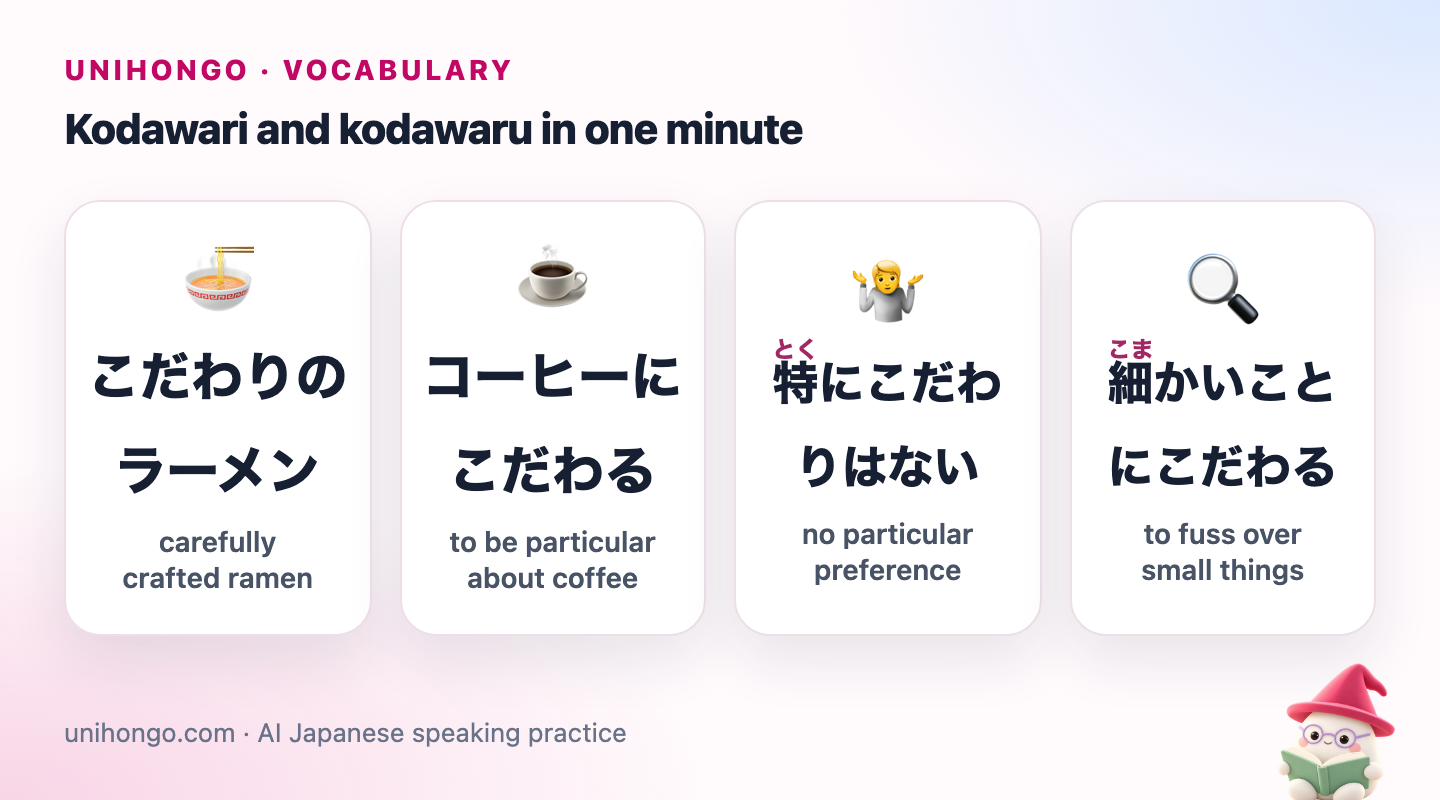
| Japanese | Romaji | Meaning |
|---|---|---|
| こだわりのラーメン | kodawari no rāmen | carefully crafted ramen |
| コーヒーにこだわる | kōhī ni kodawaru | to be particular about coffee |
| 特にこだわりはない | tokuni kodawari wa nai | no particular preference |
| 細かいことにこだわる | komakai koto ni kodawaru | to fuss over small things |
Kodawari in food and shopping
Food is where you will meet kodawari first. Ramen shops, bakeries, cafés and supermarkets use it to promise that a person cared: kodawari no tamago (specially chosen eggs), kodawari no dashi (carefully made stock), the shop's kodawari explained on the wall next to the counter. Menus often have a kodawari no ippin, the signature dish the chef is proudest of.
Chefs and makers also use the verb to describe their own work. Sozai ni kodawaru, to be particular about ingredients, is a classic line in interviews and on websites. Customers use it to praise: kodawari o kanjimasu, you can feel the care that went into it.
| Japanese | Romaji | Meaning |
|---|---|---|
| 素材にこだわっています。 | Sozai ni kodawatte imasu. | We're particular about our ingredients. |
| 当店こだわりの一品です。 | Tōten kodawari no ippin desu. | This is our signature dish. |
| スープに十二時間かけています。 | Sūpu ni jūni jikan kakete imasu. | We spend twelve hours on the broth. |
| こだわりを感じますね。 | Kodawari o kanjimasu ne. | You can really feel the care in it. |
| このお店のこだわりは何ですか。 | Kono omise no kodawari wa nan desu ka. | What is this shop particular about? |
Kodawari is also a word for products well beyond food. Furniture makers, hotels, clothing brands and even train lines talk about their kodawari: the wood they choose, the thread count of the sheets, the design of a seat. When you see it in an advertisement, read it as a promise of care, and judge for yourself.
Personal preferences: what are you particular about?
In everyday conversation kodawari describes personal taste and habits. Friends ask each other about it, and people describe their own: a favourite type of pen, how they make their morning coffee, the brand of running shoes they always buy. It is a friendly, slightly playful topic, and it often leads to longer conversations.
The most useful line for travellers and guests is the negative. When a host asks what you would like to eat or where you would like to sit, tokuni kodawari wa nai desu means you are easy to please, in a polite way.
| Japanese | Romaji | Meaning |
|---|---|---|
| 何かこだわりはありますか。 | Nanika kodawari wa arimasu ka. | Is there anything you're particular about? |
| 朝のコーヒーにはこだわってるんだ。 | Asa no kōhī ni wa kodawatteru n da. | I'm particular about my morning coffee. (casual) |
| 特にこだわりはないです。 | Tokuni kodawari wa nai desu. | I don't have any particular preference. |
| 靴にはちょっとこだわりがあります。 | Kutsu ni wa chotto kodawari ga arimasu. | I'm a bit particular about shoes. |
| どんなところにこだわっていますか。 | Donna tokoro ni kodawatte imasu ka. | What details do you focus on? |
The fussy side: kodawari ga tsuyoi and the old meaning
Kodawaru originally meant to get caught up in things that do not really matter, to be fixated or inflexible. That meaning has not disappeared. When kodawaru is used with words like komakai koto (small things), kako (the past) or katachi (form), it usually means being hung up on something. Kodawaranai, not getting stuck on things, can be praise for a flexible person.
Kodawari ga tsuyoi, literally strong kodawari, sits right on the line. Said about a chef, it is admiration. Said about a colleague who reformats everyone's slides, it means picky. Your tone, and the topic, decide which.
| Japanese | Romaji | Meaning |
|---|---|---|
| 過去にこだわらないで。 | Kako ni kodawaranaide. | Don't get stuck on the past. |
| 形にこだわる必要はありません。 | Katachi ni kodawaru hitsuyō wa arimasen. | There's no need to stick to formalities. |
| 彼はこだわりが強いからね。 | Kare wa kodawari ga tsuyoi kara ne. | Well, he's very particular. (can imply picky) |
| 勝ち負けにこだわらず楽しもう。 | Kachimake ni kodawarazu tanoshimō. | Let's enjoy it without worrying about winning. |
Related words: koru, shokunin, konomi
Kodawari is close to the spirit of the shokunin, the craftsperson who spends a lifetime perfecting one skill, and the two words often appear together in descriptions of knives, pottery, sushi or soba. But kodawari is not only for masters. Anyone can have kodawari about anything, from the way they fold towels to the playlist for a road trip.
The nearest everyday neighbour is koru, to be really into something or to make it elaborate. Koru focuses on the effort and detail you put in, often for a hobby, while kodawaru focuses on the standard you refuse to lower.
| Japanese | Romaji | Meaning |
|---|---|---|
| 最近、料理に凝っています。 | Saikin, ryōri ni kotte imasu. | I've really been getting into cooking lately. |
| 凝ったデザインですね。 | Kotta dezain desu ne. | That's an elaborate design. |
| 私の好みの味です。 | Watashi no konomi no aji desu. | This flavour is just my taste. |
| 職人のこだわりが詰まっています。 | Shokunin no kodawari ga tsumatte imasu. | It's packed with the craftsman's dedication. |
| Word | Meaning | How it differs from kodawari |
|---|---|---|
| Koru (凝る) | To be really into; to make something elaborate | Focus on effort and detail; also used for hobbies |
| Shokunin (職人) | Craftsperson, master artisan | The person; kodawari is often their attitude |
| Konomi (好み) | Taste, preference | Neutral liking, without a sense of commitment |
| Shūchaku (執着) | Attachment, clinging | Clearly negative; obsession |
| Ki ni suru (気にする) | To worry about, mind | About concern, not standards |
At the ramen counter: a short dialogue
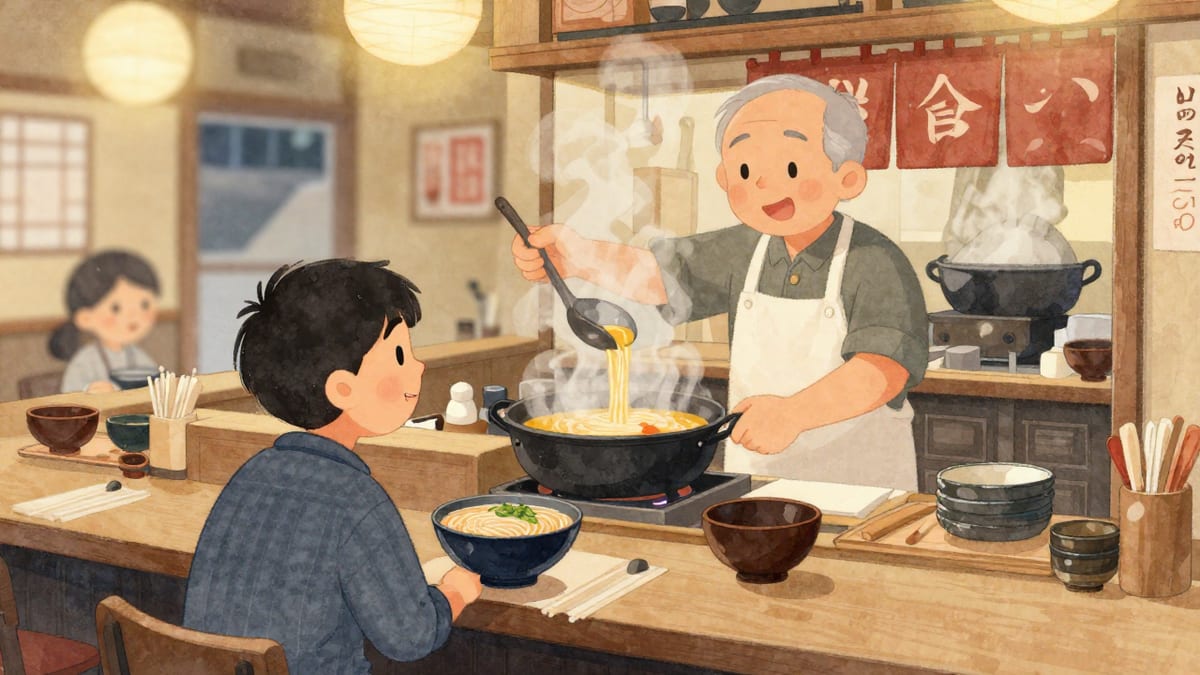
A learner sits at the counter of a small ramen shop and chats with the owner while waiting. Notice how kodawari works as a friendly question and as a source of pride.
| Japanese | Romaji | Meaning |
|---|---|---|
| このお店のこだわりは何ですか。 | Kono omise no kodawari wa nan desu ka. | Customer: What is this shop particular about? |
| スープですね。豚骨を十二時間煮込んでいます。 | Sūpu desu ne. Tonkotsu o jūni jikan nikonde imasu. | Owner: The broth. We simmer pork bones for twelve hours. |
| すごい!麺にもこだわっていますか。 | Sugoi! Men ni mo kodawatte imasu ka. | Customer: Amazing! Are you particular about the noodles too? |
| もちろん。毎朝、店で作っています。 | Mochiron. Maiasa, mise de tsukutte imasu. | Owner: Of course. We make them here every morning. |
| 麺の硬さはどうしますか。 | Men no katasa wa dō shimasu ka. | Owner: How firm would you like your noodles? |
| 特にこだわりはないので、おすすめでお願いします。 | Tokuni kodawari wa nai node, osusume de onegaishimasu. | Customer: I'm not particular, so your recommendation, please. |
Common mistakes
| Japanese | Romaji | Meaning |
|---|---|---|
| いろいろこだわりがあるんですね。 | Iroiro kodawari ga aru n desu ne. | You have lots of particular preferences, don't you? |
| 何でも大丈夫です。 | Nan demo daijōbu desu. | Anything is fine with me. |
- Using the wrong particle: it is kōhī ni kodawaru, not kōhī o kodawaru.
- Saying kodawari ga ōi (many kodawari). Use kodawari ga tsuyoi or iroiro kodawari ga aru.
- Assuming kodawaru is always praise. With komakai koto or kako, it means hung up on something.
- Answering a host's question with nan demo ii desu in a flat tone. Tokuni kodawari wa nai desu sounds friendlier.