

What tsurai means and how it feels
Tsurai describes the experience of enduring something painful. The pain is usually emotional or a long grinding strain: loneliness after a move, the months after a bereavement, a relationship that is falling apart, a job you have to force yourself into every morning, or the exhaustion of caring for a sick parent. What unites these is that they hurt and they go on, and the person has to bear them. That is the core of tsurai.
Grammatically it is an ordinary i adjective. Tsurai desu, it is hard; tsurakatta, it was hard; tsurakunai, it is not hard; tsurakute, being hard and. It can describe a situation, shigoto ga tsurai, work is hard to bear, or a person's state, kanojo wa ima tsurai, she is having a hard time. A noun form, tsurasa, the hardness, also exists, and the compound tsura-sō, looking as if it is hard, describes someone who appears to be struggling.
Tsurai also appears with a nominalised verb: hitori de iru no ga tsurai, being alone is hard to bear. This shape lets you name exactly what hurts.
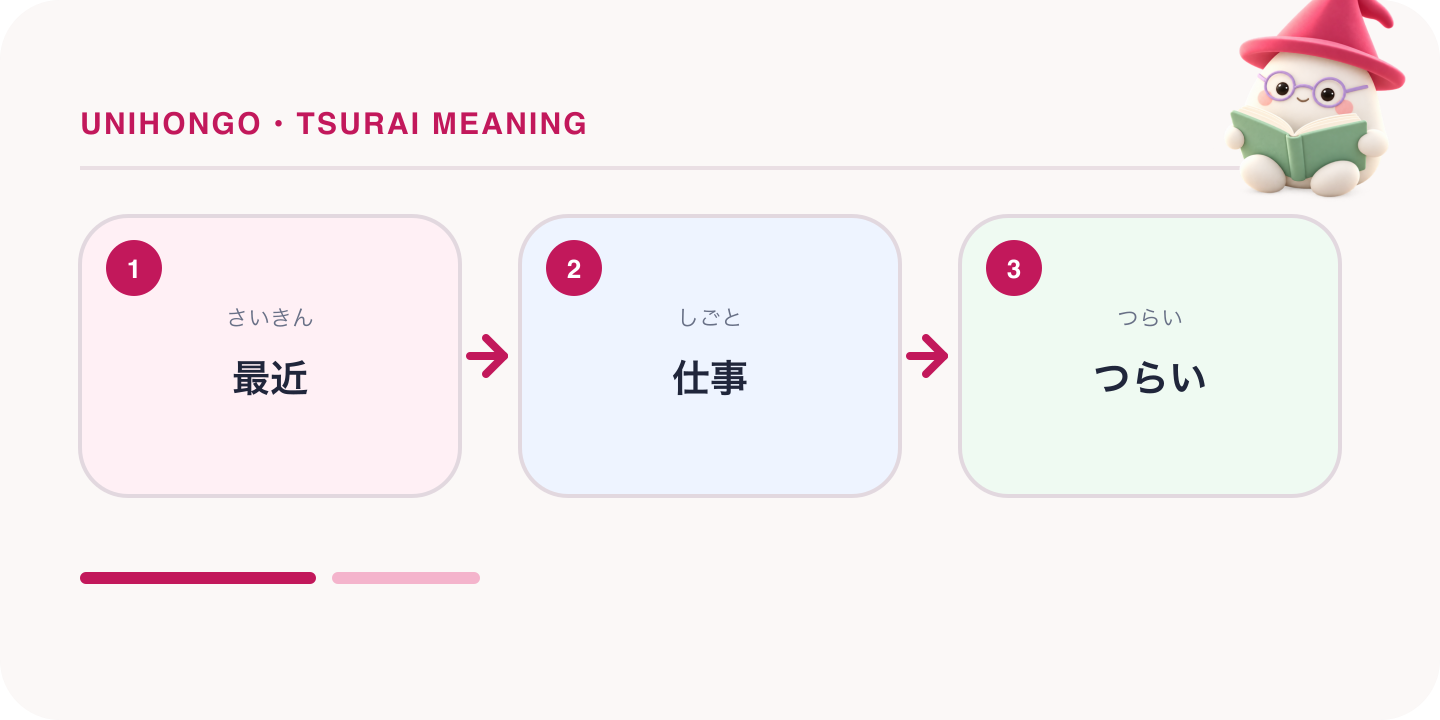
| Japanese | Romaji | Meaning |
|---|---|---|
| 最近、仕事がつらい。 | Saikin, shigoto ga tsurai. | Work has been hard to bear lately. |
| 別れるのはつらいです。 | Wakareru no wa tsurai desu. | Parting is painful. |
| 一人でいるのがつらかった。 | Hitori de iru no ga tsurakatta. | Being alone was hard. |
| 彼はつらそうな顔をしていた。 | Kare wa tsura-sō na kao o shite ita. | He looked as if he was struggling. |
| つらくても続けます。 | Tsurakute mo tsuzukemasu. | Even if it is hard, I'll keep going. |
| 何がそんなにつらいの? | Nani ga sonna ni tsurai no? | What is it that's so hard? |
Tsurai versus taihen, kurushii, kitsui and itai
Learners often reach for tsurai when they mean something else, because English hard covers all of these. Taihen means demanding, a lot of trouble or effort: a busy schedule, moving house, a big project. It describes the situation, not the feeling, and it is polite enough for any setting, which is why taihen desu ne is the all-purpose that sounds tough. Kurushii is closer to suffering: it began as physical, hard to breathe, and it describes crushing pressure, financial strain, illness and guilt. Kitsui is tough in a sharp, immediate way: a hard workout, a tight deadline, a harsh remark, tight clothes. Itai is physical pain, and, in slang, painfully awkward.
The table below puts them together with a rough register and the situation each fits.
| Word | Reading | Core meaning and typical use |
|---|---|---|
| つらい | tsurai | hard to bear emotionally; grief, loneliness, strain |
| 大変 | taihen | demanding, a lot of trouble; busy periods, big tasks |
| 苦しい | kurushii | suffering, suffocating; illness, pressure, poverty, guilt |
| きつい | kitsui | tough, harsh, tight; workouts, deadlines, remarks, clothes |
| 痛い | itai | physically painful; also painfully awkward in slang |
| しんどい | shindoi | exhausting, draining; casual, originally western Japan |
| 厳しい | kibishii | strict, severe; rules, teachers, conditions |
| 悲しい | kanashii | sad; the emotion itself rather than the burden |
| せつない | setsunai | a bittersweet ache; longing, nostalgia |
| やばい | yabai | slang for anything extreme, good or bad |
A single event can take several of these. Losing a job is taihen for the practical mess, tsurai for the blow to the heart, and kurushii for the money worries that follow. Choosing the word tells your listener which part you are talking about.
Tsurai desu ne: sympathy that does not try to fix
One of the most valuable uses of tsurai is aimed at other people. Tsurai desu ne, that must be hard, or sore wa tsurai ne among friends, is the standard way to acknowledge someone's pain. It does not offer advice, it does not minimise, and it does not compete. It simply says I see how hard this is, and in Japanese conversation that recognition is often what people want most.
The past tense does the same for stories: tsurakatta desu ne, that must have been hard, after someone describes a difficult experience. For a long situation, tsurai desu yo ne, with yo ne, shows agreement with a feeling the person has already expressed. Tsurai deshō, it must be hard, is a guess at their state and works well when they have not said anything about feelings yet.
| Japanese | Romaji | Meaning |
|---|---|---|
| それはつらいですね。 | Sore wa tsurai desu ne. | That must be hard. |
| つらかったね。よく頑張ったね。 | Tsurakatta ne. Yoku ganbatta ne. | That was hard. You did so well to get through it. |
| それはつらいでしょう。 | Sore wa tsurai deshō. | That must be difficult for you. |
| つらいよね。わかるよ。 | Tsurai yo ne. Wakaru yo. | It's hard, isn't it. I understand. |
| 今が一番つらい時期ですね。 | Ima ga ichiban tsurai jiki desu ne. | This must be the hardest time. |
The 辛い trap: tsurai or karai?
The kanji 辛い has two readings with unrelated meanings. Read karai, it means spicy, hot, or, of sake, dry. Read tsurai, it means hard to bear. The two never overlap in context: food, drink and taste are karai; feelings and situations are tsurai. But because they share a kanji, learners reading a text can stumble, and a sentence like 辛い仕事 could, in theory, be spicy work. It is not; it is tsurai shigoto, a gruelling job.
Native speakers avoid the ambiguity in casual writing by using hiragana つらい for the feeling, and many novels and messages do the same. The word tsurai also gives us the suffix zurai, attached to verb stems: tabezurai, hard to eat; iizurai, hard to say; wakarizurai, hard to understand. This zurai is the tsurai kanji voiced, and it carries the sense that something is uncomfortable to do, close to nikui but a little softer.
| Japanese | Romaji | Meaning |
|---|---|---|
| このカレーは辛い。 | Kono karē wa karai. | This curry is spicy. |
| 辛い仕事だった。 | Tsurai shigoto datta. | It was a gruelling job. |
| 辛口の日本酒をください。 | Karakuchi no nihonshu o kudasai. | A dry sake, please. |
| ちょっと言いづらいんですが。 | Chotto iizurai n desu ga. | This is a bit hard to say, but. |
| この字は読みづらい。 | Kono ji wa yomizurai. | This writing is hard to read. |
Comforting someone who says tsurai
When a friend or colleague says tsurai, the response is a small ritual with an order. First acknowledge: sore wa tsurai ne. Second, invite them to talk if they want to: hanashitakattara kiku yo, if you want to talk, I'll listen. Third, offer something concrete and small: kondo gohan ikō, let's get a meal soon, or nani ka dekiru koto aru?, is there anything I can do. Only if they ask for advice does advice come.
Japanese comfort tends to avoid two things that English speakers do naturally. It avoids immediate solutions, which can feel dismissive, and it avoids ganbatte, which tells an exhausted person to try harder. Instead you will hear muri shinaide, don't push yourself, yukkuri yasunde, get some rest, and hitori de kakaekomanaide, don't carry it alone. The list below gathers phrases that work, roughly in the order you would use them.
- Sore wa tsurai ne: that's hard (acknowledge first)
- Yoku hanashite kureta ne: thank you for telling me
- Hanashitakattara itsu demo kiku yo: I'll listen whenever you want to talk
- Muri shinaide ne: don't push yourself
- Hitori de kakaekomanaide: don't carry it alone
- Nani ka dekiru koto aru?: is there anything I can do?
- Ima wa yasunde ii to omou: I think it's fine to rest now
- Watashi wa itsu demo mikata da yo: I'm always on your side
With someone you speak politely to, the same ideas become sore wa o-tsurai desu ne, with the honorific o, and muri nasaranaide kudasai, please do not overexert yourself. Both are warm without being intrusive.
Tsurai at work: saying it without sounding like a complaint
Japanese workplaces expect people to bear a certain amount quietly, so a bare tsurai desu to a manager can land as a complaint or, worse, as a hint that you might quit. That does not mean you should never say it. The trick is to attach the feeling to a fact and a request. Describe the situation, say it is honestly tsurai, and ask for a conversation: shōjiki tsurai node, sōdan sasete kudasai.
Among colleagues of equal rank, tsurai is normal and even bonding: kono jiki wa tsurai yo ne, this time of year is tough, isn't it. About a client or a project, kibishii, severe, and taihen are the more neutral words, and kitsui is the everyday word for a tough deadline. In HR contexts and in formal writing, tsurai is often replaced by the noun kutsū, distress, or by the phrase seishinteki ni kibishii, mentally severe, but in a spoken conversation with your manager, plain tsurai is honest and understood.
| Japanese | Romaji | Meaning |
|---|---|---|
| 今のスケジュールは正直つらいので、相談させてください。 | Ima no sukejūru wa shōjiki tsurai node, sōdan sasete kudasai. | The current schedule is honestly hard, so I'd like to discuss it. |
| この時期はつらいよね。 | Kono jiki wa tsurai yo ne. | This time of year is tough, isn't it. |
| 納期がきついです。 | Nōki ga kitsui desu. | The deadline is tight. |
| 先方の要求が厳しいです。 | Senpō no yōkyū ga kibishii desu. | The client's demands are severe. |
| 体調的につらいので、明日は休ませてください。 | Taichōteki ni tsurai node, ashita wa yasumasete kudasai. | I'm not feeling well, so please let me take tomorrow off. |
| つらい時は早めに言ってください。 | Tsurai toki wa hayame ni itte kudasai. | When it gets hard, please tell me early. (a manager) |
Tsurakatta, tsurakute and the other forms
Because tsurai is a regular i adjective, its forms follow the usual pattern. Tsurakatta, it was hard, is the form for stories and for sympathy about the past. Tsurakute, being hard, links to a result: tsurakute nemurenakatta, it was so hard I could not sleep. Tsurakunai, not hard, appears in reassurances: tsurakunai desu ka, is it not too hard for you? Tsurasa is the noun, and tsurai omoi o suru, to go through something painful, is a common set phrase.
Tsurai combines with a few intensifiers. Hontō ni tsurai, really hard; tsurai tsurai, said twice, casual and heartfelt; mō tsurai, I can't take it any more. On social media it is often written つらい, or つらみ, a playful noun form among young people.
| Japanese | Romaji | Meaning |
|---|---|---|
| あの頃は本当につらかった。 | Ano koro wa hontō ni tsurakatta. | Back then it was really hard. |
| つらくて眠れなかった。 | Tsurakute nemurenakatta. | It was so hard I couldn't sleep. |
| つらくないですか。 | Tsurakunai desu ka. | Is it not too hard for you? |
| つらい思いをさせてごめん。 | Tsurai omoi o sasete gomen. | I'm sorry I put you through that. |
| もうつらい。 | Mō tsurai. | I can't take it any more. |
Common mistakes with tsurai
The first mistake is using tsurai for physical pain. A sore back is itai, not tsurai, although a long illness that wears you down can be tsurai. The second is using tsurai for a busy but happy week; that is taihen or isogashii. Tsurai always carries hurt, and saying it about a fun trip with lots of walking will puzzle people.
The third is reading 辛い as karai in a sentence about feelings, or typing 辛い for spicy when the reader will assume tsurai from context. The fourth is replying to someone's tsurai with ganbatte; the kinder reply is tsurai ne, muri shinaide. And the fifth is saying tsurai desu to a manager with nothing attached. Add the situation and a request, and the same word becomes professional.
| Japanese | Romaji | Meaning |
|---|---|---|
| 腰が痛い。 | Koshi ga itai. | My back hurts. (itai, not tsurai) |
| 今週は忙しくて大変だった。 | Konshū wa isogashikute taihen datta. | This week was busy and demanding. (taihen, not tsurai) |
| つらいね。無理しないで。 | Tsurai ne. Muri shinaide. | That's hard. Don't push yourself. (not ganbatte) |
| 長い闘病がつらかった。 | Nagai tōbyō ga tsurakatta. | The long illness was hard to bear. |