
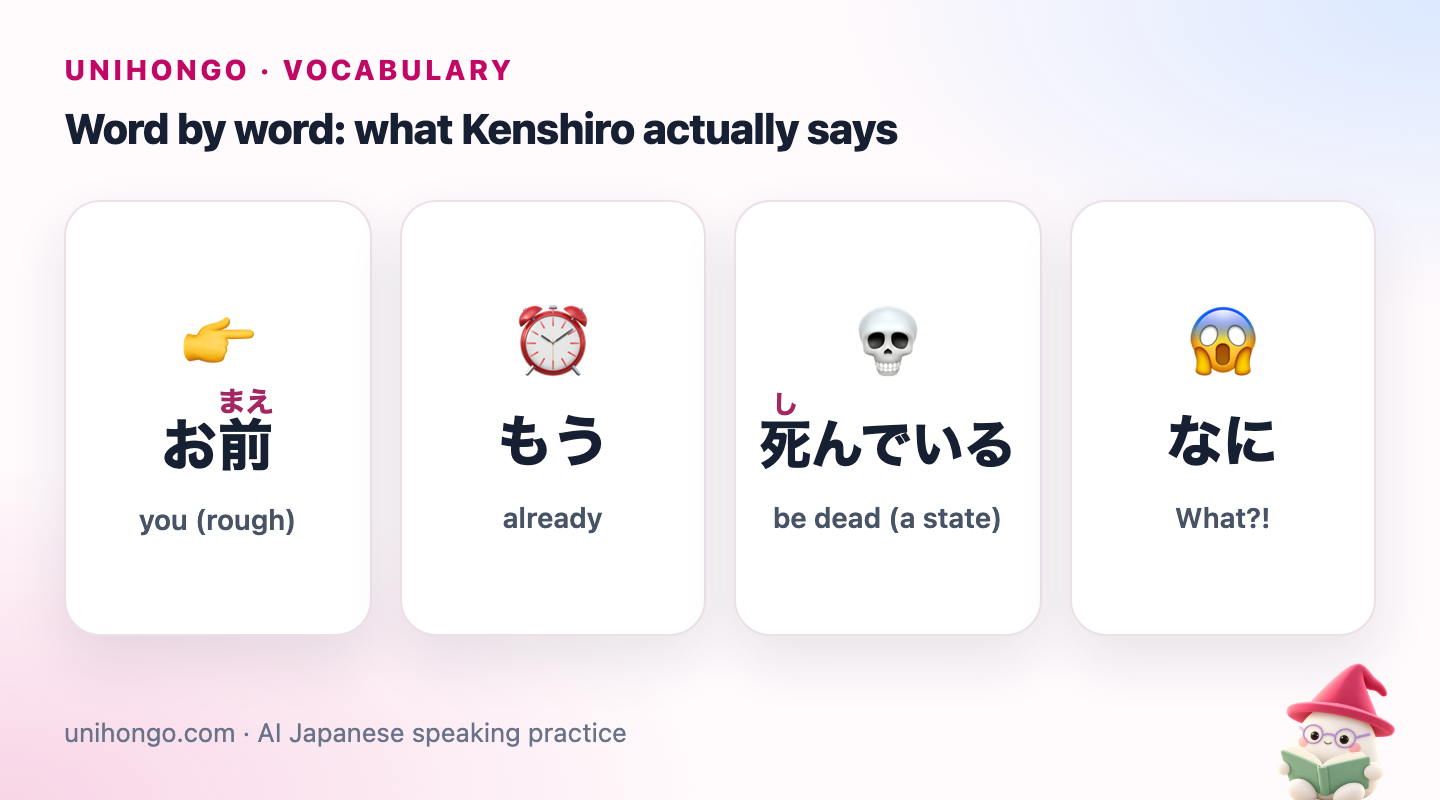
Word by word: what Kenshiro actually says
The sentence has a topic and a comment. Omae wa sets up "as for you". Mō shinde iru delivers the news: "already in the state of having died". Japanese needs no separate word for "are", because iru at the end does that job.
The fourth card is the reply. In the series, Kenshiro's opponents answer in various ways, but the internet settled on one: a shocked nani, "what?!". Together the two lines are a complete tiny dialogue, which is one reason they are so easy to remember.
| Japanese | Romaji | Meaning |
|---|---|---|
| お前 | omae | you (rough) |
| もう | mō | already |
| 死んでいる | shinde iru | be dead (a state) |
| なに | nani | What?! |
| お前はもう死んでいる。 | Omae wa mō shinde iru. | You are already dead. |
Shinde iru: dead, not dying
English speakers see te iru and think "is doing". That works for activity verbs, which take time: tabete iru is "is eating" and yonde iru is "is reading". It fails for verbs that describe an instant change. Shinu, "to die", is one of them. You are alive, then you are not, and te iru describes the state that follows the change.
So shinde iru is "has died and is now dead". That is exactly Kenshiro's point: the change has already happened and the opponent has simply not noticed. The same logic runs through daily Japanese.
| Japanese | Romaji | Meaning |
|---|---|---|
| 結婚している。 | Kekkon shite iru. | (I) am married. |
| 窓が開いている。 | Mado ga aite iru. | The window is open. |
| 電車が止まっている。 | Densha ga tomatte iru. | The train is stopped. |
| 財布が落ちている。 | Saifu ga ochite iru. | A wallet is lying on the ground. |
None of these mean "is getting married", "is opening" or "is falling". Each one reports the result of a change that is finished. Once you hear te iru this way, a large part of everyday Japanese falls into place.
The reply: nani
Nani (なに, also written 何) is simply "what". Shouted alone with a sharp rise, it means "What?!" or "What did you say?!". It is the natural sound of a villain who has just been given bad news.
In real conversation, a bare nani is blunt. Friends use it all the time, but to anyone else it sounds like a challenge. Softer reactions do the same job without the edge.
| Japanese | Romaji | Meaning |
|---|---|---|
| えっ、何ですか。 | E, nan desu ka. | Oh, what is it? (polite) |
| 本当ですか。 | Hontō desu ka. | Really? (polite) |
| なんだって。 | Nan datte. | What did you say?! (casual) |
Why omae is rough
Omae is written お前, and long ago it was a respectful way to refer to someone of high rank, roughly "the honourable person before me". Over the centuries it slid down the scale, as several Japanese words for "you" have done. Today it is rough. Men use it toward juniors and close friends, and people use it in anger.
Anime heroes say omae constantly because it sounds strong and direct. In daily life, Japanese speakers mostly avoid saying "you" at all. They use the listener's name, a title, or nothing.
| Romaji | Feeling | Who can use it safely |
|---|---|---|
| Tanaka-san | Neutral and polite: the normal choice | Everyone |
| anata | Distant; fine in forms and textbooks, odd face to face | Use sparingly |
| kimi | Familiar, spoken from above, common in songs | Bosses to juniors, some close friends |
| omae | Rough; talks down, or shows closeness between men | Close male friends, fiction |
| temē | A fighting insult | Fiction only |
Mō plus te iru in everyday sentences
Mō means "already" and sits right before the verb phrase. Add a te iru form and you can report where things stand at this moment. This is one of the most common patterns in messages between people who are trying to meet.
| Japanese | Romaji | Meaning |
|---|---|---|
| もう着いている。 | Mō tsuite iru. | I'm already here. |
| もう食べている。 | Mō tabete iru. | (They) are already eating. |
| もう始まっている。 | Mō hajimatte iru. | It has already started. |
| もう知っている。 | Mō shitte iru. | I already know. |
| もう寝ている。 | Mō nete iru. | (She) is already asleep. |
| もう着いています。 | Mō tsuite imasu. | I'm already here. (polite) |
Look at the first two rows. Tsuku, "to arrive", is a change verb, so mō tsuite iru is a result: the arriving is done and the speaker is there. Taberu is an activity verb, so mō tabete iru is in progress: the eating has started and continues. If the meal is over, use the past instead: mō tabeta, "I already ate".
In casual speech the i of iru usually disappears: mō tsuiteru, mō neteru. Kenshiro's full shinde iru is slow and deliberate, which is part of its weight.
The opposite: mada with te inai
The natural partner of mō is mada, "not yet" or "still". To say that something has not happened yet, Japanese uses mada with the negative te inai, not with the simple past. This pair covers a huge share of daily questions and answers.
| Japanese | Romaji | Meaning |
|---|---|---|
| もう着いた? | Mō tsuita? | Are you there yet? (casual) |
| まだ着いていない。 | Mada tsuite inai. | I'm not there yet. |
| まだ食べていません。 | Mada tabete imasen. | I haven't eaten yet. (polite) |
| まだ始まっていません。 | Mada hajimatte imasen. | It hasn't started yet. (polite) |
Should you quote the line?
Among friends who know the meme, of course. Japanese people know the line well, and delivering it in a deep voice with a pointed finger is a reliable joke. Said as a quotation, the rough omae is part of the fun.
Outside a joke, the sentence combines a rough pronoun with a statement about death, so it has no polite use. Take the frame instead. Swap in a safe subject and a safe verb, and Kenshiro's grammar becomes something you can say every day: densha wa mō kite imasu, "the train is already here".