

Breaking down wabi and sabi
Wabi comes from the verb wabu, which originally meant to feel forlorn, to languish or to live in reduced circumstances. Over time, especially in the world of tea, that sense of poverty and solitude was turned around into something admired: the calm dignity of a simple life with few possessions.
Sabi comes from the verb sabiru, to grow old, faded or desolate. In poetry it came to describe the beauty of things marked by time: weathered wood, fading colours, a quiet autumn scene. Sabi is also the sound of rust, written 錆び, and many people connect the two ideas, although the rust kanji is different from the one used in wabi-sabi.
Put together, wabi-sabi is not a single ancient term but a pairing of two aesthetic ideas that overlap. People usually treat it as one mood: simple, quiet, imperfect and touched by age.
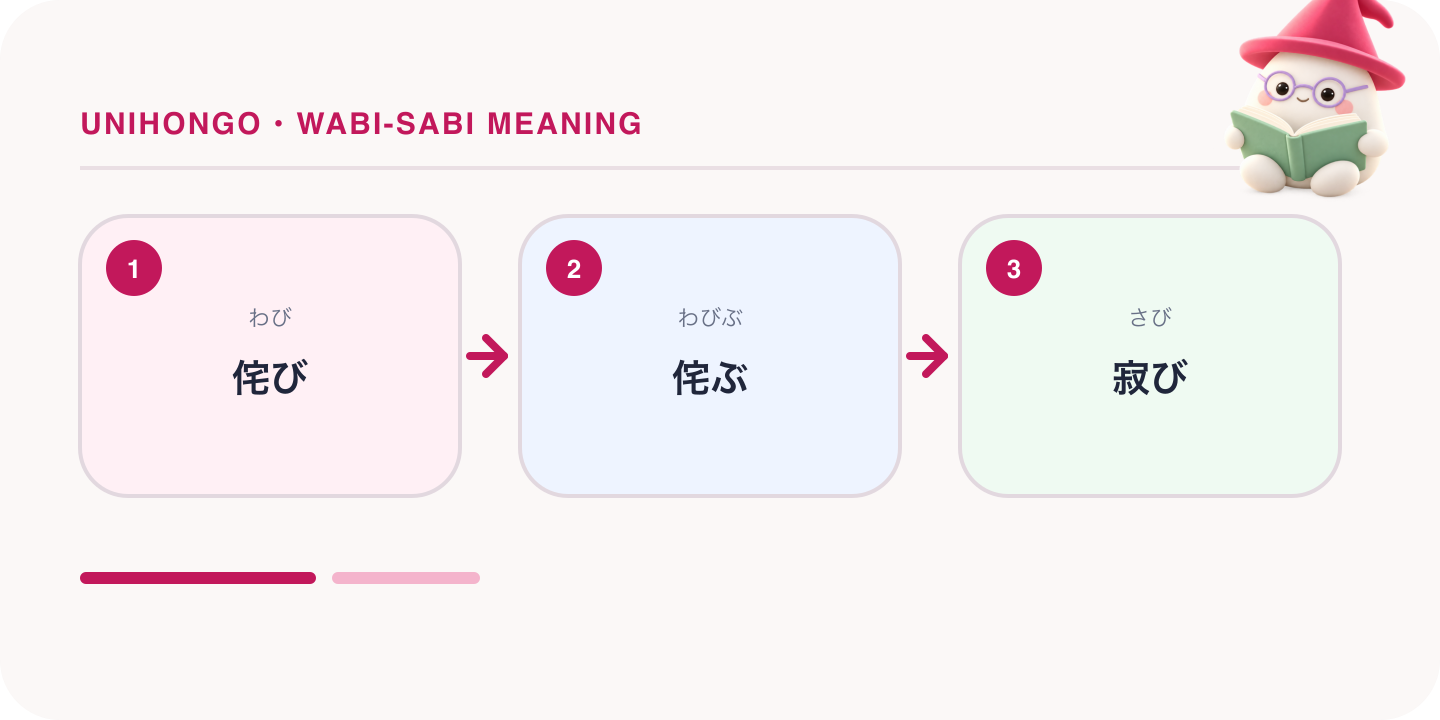
| Word | Reading | Core sense |
|---|---|---|
| 侘び | wabi | Quiet, modest beauty; simplicity found in restraint |
| 侘ぶ | wabu | Old verb: to feel forlorn, to live humbly |
| 寂び | sabi | The beauty of age, weathering and stillness |
| 寂びる | sabiru | To grow old and faded, to become desolate |
| 錆び | sabi | Rust (different kanji, often associated) |
Where the idea comes from
Wabi is closely tied to the tea ceremony, sadō or chadō. The style known as wabi-cha, tea in the wabi spirit, favoured small rustic rooms, plain rough bowls and quiet seasonal decoration over expensive imported Chinese wares. Sen no Rikyū, the sixteenth-century tea master, is the name most associated with refining that style.
Sabi is closely tied to haiku, and especially to the poet Matsuo Bashō and his school, where it described a lonely, mellow tone in a poem. A classic example of that mood is an old pond, a frog and the sound of water: a small, still scene with a lot of space around it.
Knowing these roots helps you understand why Japanese people reach for wabi-sabi mostly when talking about tea rooms, poetry, temples and old craft objects, rather than about furniture shopping or personal growth.
- Sadō or chadō: the way of tea, where wabi became an ideal.
- Wabi-cha: a simple, rustic style of tea gathering.
- Haiku: where sabi described a quiet, lonely, aged tone.
- Traditional gardens and temples: where visitors most often mention wabi-sabi today.
How Japanese people actually use it today
In modern Japanese, wabi-sabi is a slightly literary phrase. You will read it in travel magazines, museum captions and television programmes about Kyoto, and you will hear it when someone visits a moss garden or an old tea house. It is less common in everyday chat, and people often use it with a small laugh, aware that it sounds grand.
The most natural patterns are wabi-sabi o kanjiru, to feel wabi-sabi, and wabi-sabi ga aru, it has wabi-sabi. People also say someone understands wabi-sabi, which can be sincere or gently teasing, and admit that they do not really understand it themselves.
| Japanese | Romaji | Meaning |
|---|---|---|
| この庭には侘び寂びを感じます。 | Kono niwa ni wa wabi-sabi o kanjimasu. | I feel wabi-sabi in this garden. |
| 古いお寺は侘び寂びがありますね。 | Furui o-tera wa wabi-sabi ga arimasu ne. | Old temples have a real wabi-sabi feel, don't they? |
| 侘び寂びって説明するのが難しい。 | Wabi-sabi tte setsumei suru no ga muzukashii. | Wabi-sabi is hard to explain. |
| 日本人でもよく分かっていないと思う。 | Nihonjin demo yoku wakatte inai to omou. | I think even Japanese people don't fully get it. |
| 侘び寂びが分かる人だね。 | Wabi-sabi ga wakaru hito da ne. | You really understand wabi-sabi, don't you. |
The everyday words hidden inside wabi-sabi
The two halves of wabi-sabi live on in ordinary Japanese in less poetic forms, and these are words you will use far more often. Sabishii, lonely, is written with the same kanji as sabi. Wabishii describes something dreary, bleak or miserable, such as eating instant noodles alone in a cold flat on a holiday.
Sabireta describes a place that has declined and emptied out, such as a shopping street with shutters down. Seeing these everyday relatives explains why wabi-sabi has a faintly melancholy undertone, not just a pleasant rustic one.
| Japanese | Romaji | Meaning |
|---|---|---|
| 一人で寂しい。 | Hitori de sabishii. | I'm lonely on my own. |
| 侘しい夕食だった。 | Wabishii yūshoku datta. | It was a pretty bleak dinner. |
| 寂れた商店街 | sabireta shōtengai | A run-down, emptied-out shopping street |
| 静寂 | seijaku | Silence, stillness |
| わびしい一人暮らし | wabishii hitorigurashi | A lonely, dreary life living alone |
The Western version versus the Japanese word
Outside Japan, wabi-sabi is often used as a style label for interiors and products: handmade ceramics, undyed linen, raw plaster walls and a neutral colour palette. It has also been adopted as a self-help idea about embracing imperfection in yourself and your life. A widely read 1990s English-language book by Leonard Koren helped bring the term to designers and artists abroad.
None of that is wrong exactly, but it is narrower and more commercial than the Japanese usage. In Japan, wabi-sabi is not a look you buy. It usually needs real age, real use or a real setting, and it is felt rather than applied.
| Western usage | Japanese usage |
|---|---|
| An interior design style | A feeling found in tea, temples, gardens and old things |
| Can be bought new | Usually needs genuine age or use |
| A philosophy of self-acceptance | An aesthetic sensibility, rarely a life motto |
| Often explained with confident rules | Often described as hard to put into words |
| Mostly positive and cosy | Has a quiet, lonely, slightly melancholy side |
Related aesthetic words
Wabi-sabi sits in a family of Japanese aesthetic words, and learners often mix them up. Shibui is the most useful in daily life: understated, subtle and refined, often used for an older actor, a dark kimono, a well-worn leather bag or a bitter tea. Mono no aware is the gentle sadness of things passing, closely linked to cherry blossoms. Yūgen is mysterious depth, often discussed in relation to Noh theatre.
| Japanese | Romaji | Meaning |
|---|---|---|
| 渋い | shibui | Understated, subtle, tastefully restrained |
| もののあはれ | mono no aware | The gentle sadness of transience |
| 幽玄 | yūgen | Mysterious, profound depth |
| 儚い | hakanai | Fleeting, short-lived |
| 味がある | aji ga aru | Has character, has charm from age or use |
| 風情がある | fuzei ga aru | Has atmosphere, has a tasteful charm |
| 素朴 | soboku | Simple, rustic, unpretentious |
Talking about wabi-sabi in conversation
When you want to share this feeling in Japanese, the safest approach is to describe what you see and how it makes you feel, then let the other person name it. Words like ochitsuku, to feel calm, natsukashii, nostalgic, and aji ga aru, full of character, carry most of the meaning.
If you do use wabi-sabi, pair it with humility: I don't know if this is the right word, but. Japanese listeners tend to appreciate a foreigner who notices the mood rather than one who lectures about it.
| Japanese | Romaji | Meaning |
|---|---|---|
| この茶碗、味がありますね。 | Kono chawan, aji ga arimasu ne. | This tea bowl has real character. |
| なんだか落ち着きます。 | Nandaka ochitsukimasu. | It feels calming somehow. |
| これが侘び寂びというものですか。 | Kore ga wabi-sabi to iu mono desu ka. | Is this what you call wabi-sabi? |
| 言葉が合っているか分かりませんが、侘び寂びを感じます。 | Kotoba ga atte iru ka wakarimasen ga, wabi-sabi o kanjimasu. | I'm not sure it's the right word, but I feel wabi-sabi. |
| 古いけど、それがいいんです。 | Furui kedo, sore ga ii n desu. | It's old, but that's what makes it good. |
Once you can describe a scene like this, you can hold your own in a conversation at a temple, a ceramics shop or a friend's traditional house, which is where the word naturally comes up.
Common learner mistakes
Most mistakes with wabi-sabi come from importing the English meaning directly. Keep these in mind and you will use the word the way Japanese speakers expect.
- Using it for anything simply messy or broken. Wabi-sabi is a kind of beauty, not a polite word for damage.
- Treating it as a design brand. Japanese speakers rarely call a new product wabi-sabi.
- Saying it constantly. Its weight comes from being used sparingly, in the right setting.
- Reading sabi as plain sadness. Sabi is stillness and solitude more than grief.
- Explaining it to Japanese people with confident rules. Asking what they feel is usually a better conversation.