
Tori: bird, and often chicken
鳥 (tori) is the general word for bird, and it is short and easy. The confusing part is food. On a menu, in a supermarket and in talk about dinner, tori usually means chicken: 焼き鳥 (yakitori) is grilled chicken, and 鶏肉 (toriniku) is chicken meat. The live bird in a farmyard is 鶏 (niwatori), and a chick is ひよこ (hiyoko).
Japanese also has useful group words. 小鳥 (kotori) is any small songbird, 野鳥 (yachō) is a wild bird and 渡り鳥 (wataridori) is a migratory bird, a word also used for people who move from job to job.
| Japanese | Romaji | Meaning |
|---|---|---|
| 朝の鳥の声 | asa no tori no koe | birdsong in the morning |
| 鳥 | tori | bird; chicken (as food) |
| 小鳥 | kotori | small bird, songbird |
| 野鳥 | yachō | wild bird |
| 渡り鳥 | wataridori | migratory bird |
| 鶏 | niwatori | chicken (the live bird) |
| 鶏肉 | toriniku | chicken meat |
| ひよこ | hiyoko | chick |
Birds you meet every day
These are the birds in parks, streets and gardens all over Japan. Children learn them first, and they appear in songs and picture books.
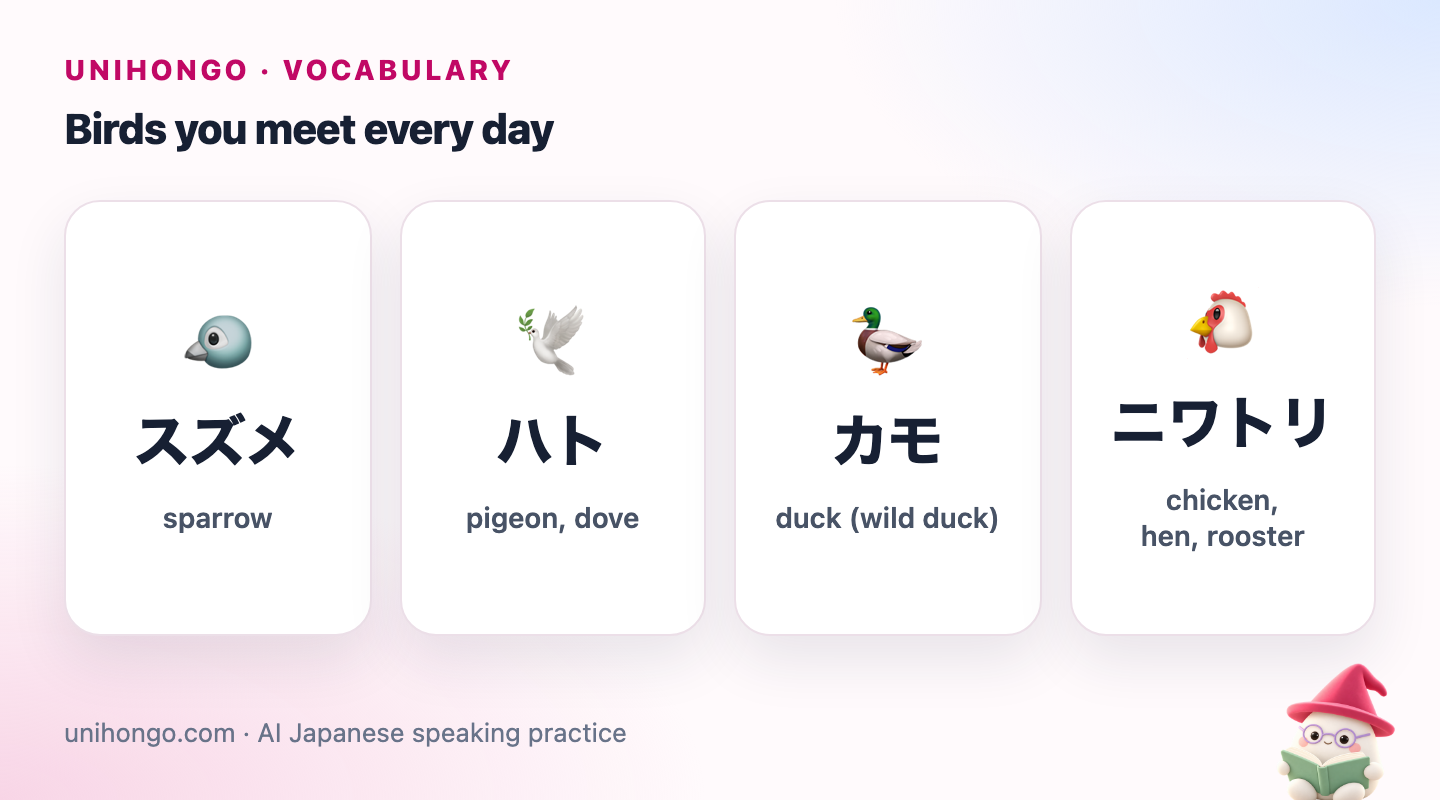
| Japanese | Romaji | Meaning |
|---|---|---|
| スズメ | suzume | sparrow |
| ハト | hato | pigeon, dove |
| カモ | kamo | duck (wild duck) |
| ニワトリ | niwatori | chicken, hen, rooster |
| カラス | karasu | crow |
| ツバメ | tsubame | swallow |
| メジロ | mejiro | Japanese white-eye (small green bird) |
| ヒヨドリ | hiyodori | brown-eared bulbul |
| ムクドリ | mukudori | grey starling |
Crows deserve a special mention. Large crows are common in Japanese cities and are known for opening rubbish bags, which is why many collection points use nets or covers. Swallows often nest under the eaves of shops and stations, and many people see a nest as a good sign and leave it alone. Mejiro, named for the white ring around its eyes (me), is the small green bird you often see drinking nectar from plum and camellia flowers.
Birds with a story: cranes, warblers and owls
Some birds matter in Japan less for how often you see them than for what they mean. You will meet them on New Year cards, wedding decorations, kimono patterns, poems and souvenirs.
| Japanese | Romaji | Meaning |
|---|---|---|
| ツル | tsuru | crane (long life, good fortune) |
| 折り鶴 | orizuru | folded paper crane |
| ウグイス | uguisu | Japanese bush warbler (song of spring) |
| キジ | kiji | green pheasant (often called the national bird) |
| トキ | toki | crested ibis |
| フクロウ | fukurō | owl |
| タンチョウ | tanchō | red-crowned crane |
| ホーホケキョ | hōhokekyo | the bush warbler's song |
The uguisu is heard far more than it is seen. Its song in late winter and spring is a classic seasonal sound, and a beautiful singing voice is sometimes praised by comparing it to the uguisu. Many people also connect the owl with luck because fukurō can be written playfully as 不苦労, no hardship. That is why owl charms and souvenirs are popular, especially as gifts for exams or new jobs. Treat it as a lighthearted custom rather than a deep tradition.
The red-crowned crane, tanchō, lives in eastern Hokkaido, where people travel in winter to watch the cranes dance in the snow. Toki, the crested ibis, almost disappeared in Japan and is now being reintroduced on Sado Island, so it often appears in news about conservation.
Birds by the water and the sea
| Japanese | Romaji | Meaning |
|---|---|---|
| カモメ | kamome | seagull |
| サギ | sagi | heron, egret |
| 白鳥 | hakuchō | swan |
| カワセミ | kawasemi | kingfisher |
| ウ | u | cormorant |
| 鵜飼い | ukai | traditional fishing with cormorants |
| ペンギン | pengin | penguin |
| フラミンゴ | furamingo | flamingo |
Hakuchō is usually written with kanji, 白鳥, literally white bird. Swans spend the winter on lakes in northern Japan, and some towns are known for welcoming them each year. Ukai, cormorant fishing, is a summer evening tradition on a few rivers, where boats with fire baskets guide trained birds. Birds that do not live in Japan, such as penguins and flamingos, use katakana loanwords taken from English or other languages.
Bird sounds, body parts and verbs
Japanese bird calls are written in katakana and are used by children and adults alike. The verb is 鳴く (naku), to sing or call, the same verb used for insects and other animals.
| Japanese | Romaji | Meaning |
|---|---|---|
| チュンチュン | chunchun | sparrow's chirp |
| カーカー | kākā | crow's caw |
| ポッポー | poppō | pigeon's coo |
| コケコッコー | kokekokkō | rooster's crow |
| くちばし | kuchibashi | beak |
| 羽 | hane | feather; wing |
| 巣 | su | nest |
| 卵 | tamago | egg |
| ひな | hina | chick, baby bird |
| さえずる | saezuru | to twitter, chirp |
| 羽ばたく | habataku | to flap its wings |
| 鳥が鳴いていますね。 | Tori ga naite imasu ne. | The birds are singing, aren't they? (polite) |
Birdwatching with a local
Birdwatching is called バードウォッチング (bādowotchingu), a loanword, or 野鳥観察 (yachō kansatsu), a more formal native expression. Many parks and wetlands have regular walks run by volunteers, and older birdwatchers are often happy to show a newcomer what they are looking at. Polite questions and a few bird names will get you a long way.

| Japanese | Romaji | Meaning |
|---|---|---|
| 双眼鏡 | sōgankyō | binoculars |
| あれは何という鳥ですか。 | Are wa nan to iu tori desu ka. | You: What is that bird called? |
| カワセミですよ。運がいいですね。 | Kawasemi desu yo. Un ga ii desu ne. | Birdwatcher: It's a kingfisher. You're lucky. |
| 初めて見ました。きれいですね。 | Hajimete mimashita. Kirei desu ne. | You: It's my first time seeing one. It's beautiful. |
| 双眼鏡、使ってみますか。 | Sōgankyō, tsukatte mimasu ka. | Birdwatcher: Would you like to try the binoculars? |
| いいんですか。ありがとうございます。 | Ii n desu ka. Arigatō gozaimasu. | You: Are you sure? Thank you. |
Nan to iu, literally what is it called, is the natural way to ask for a name. Nan no tori desu ka is understandable, but nan to iu tori desu ka is what native speakers usually say.
Pet birds and loanwords
Small pet birds are popular in Japan, and some have their own words. Native words and katakana loanwords sit side by side, so it helps to know which is which.
| Japanese | Romaji | Meaning |
|---|---|---|
| インコを飼っています。 | Inko o katte imasu. | I have a parakeet. (polite) |
| オウム返し | ōmugaeshi | parroting, repeating someone's words back |
| Word | Type | Meaning and note |
|---|---|---|
| インコ (inko) | Older borrowing, katakana | Parakeet, budgie; the most common pet bird |
| オウム (ōmu) | Older borrowing, katakana | Parrot, cockatoo; also used for repeating words |
| 文鳥 (bunchō) | Kanji word | Java sparrow, a classic Japanese pet bird |
| ペンギン (pengin) | Modern loanword | Penguin, from English |
| スズメ (suzume) | Native word in katakana | Sparrow; katakana is a field-guide convention |
A bird walk with Mocchi
- Ask Mocchi: /vocab birds I can see in a Japanese city park. Mocchi gives you the names with example sentences and keeps track of the ones you miss.
- Say which birds you actually saw today, and ask Mocchi to turn them into cards with /create-flashcards, picking a photo of each bird.
- Play Mocchi Flight with your own flashcards: guide Mocchi through the gate with the right bird name.
- The next time you chat, Mocchi can pick up where you left off and quiz you on hakuchō, fukurō and the other long-vowel names.
Common learner mistakes
- Ordering tori and expecting any bird. On a menu it means chicken.
- Saying fukuro instead of fukurō. フクロ without the long vowel sounds like 袋, bag.
- Saying hakucho with a short u and o. The word is ha-ku-chō, with a long final vowel.
- Using 泣く for birds. Birds and insects 鳴く; people 泣く.
- Feeding crows or pigeons in a city park. It is often discouraged and sometimes prohibited, so check before you share your snack.