
The short answer: an ending, not a word
Japanese sentences often finish with small particles that carry attitude instead of content. Dattebayo is three of those glued together and used as a signature. Translating it piece by piece gives something like "it is, I'm telling you, you know!", which is why many subtitles simply leave it out.
The picture cards show the three pieces and the finished tic. Only the last card is fiction. The first three are everyday Japanese that you will hear in any casual conversation, and the two extra rows show the real pattern that the tic grew from.
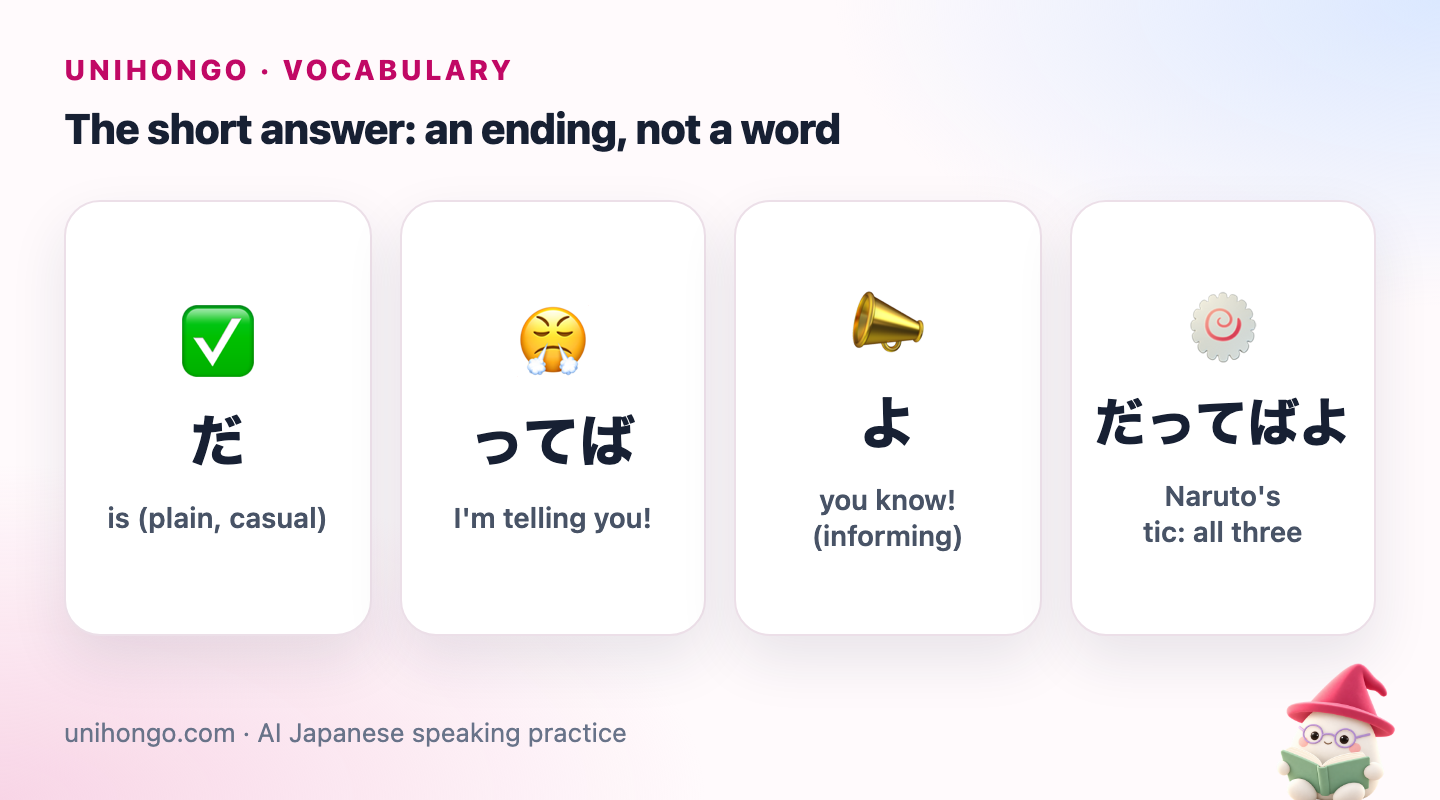
| Japanese | Romaji | Meaning |
|---|---|---|
| だ | da | is (plain, casual) |
| ってば | tteba | I'm telling you! |
| よ | yo | you know! (informing) |
| だってばよ | dattebayo | Naruto's tic: all three |
| 本当だってば。 | Hontō datteba. | It's true, I'm telling you! |
| 行くってば。 | Iku tteba. | I said I'm going! |
Taking the tic apart: da, tteba, yo
Da is the plain form of desu. It follows nouns and na-adjectives: hontō da, "it's true". On its own it sounds blunt and sure of itself, which suits Naruto well.
Tteba is the interesting piece. Dictionaries explain it as a worn-down form of to ieba (と言えば), literally "if I say that". It became a casual particle with two jobs. After a statement it insists: "I already told you, so listen". After a name it calls for attention or scolds gently, as when a child tugs a sleeve and says okāsan tteba, "Mom, come on!".
Yo marks something the speaker wants the listener to know or accept. It is extremely common and perfectly polite after desu and masu. Put together, da plus tteba plus yo is a statement, an insistence and a nudge, all in one breath.
Why the English dub said "Believe it!"
The English dub needed something Naruto could shout wherever the Japanese track had dattebayo. A literal translation was impossible, so the writers chose a short line with the same pushy energy: "Believe it!". It is commonly explained that the phrase was also picked because it fitted the character's mouth movements. It does capture his attitude: Naruto is always demanding that people take him seriously.
It hides one thing from English-speaking fans, though. "Believe it!" sounds like a full sentence with a meaning, while dattebayo is closer to a verbal habit. Fans generally note that the dub used the line most in the early part of the series, and many subtitle tracks never translate the ending at all.
Dattebane and dattebasa: the tic runs in the family
Two relatives share the habit with one particle changed. Kushina Uzumaki, Naruto's mother, ends her sentences with dattebane when she gets excited. Boruto, his son, says dattebasa. English versions often render Kushina's ending with a light "ya know".
The swapped particles are real, too. Ne asks the listener to agree, so dattebane sounds a touch softer. Sa is a breezy, offhand way to assert something in casual speech, so dattebasa sounds cooler and more careless than his father's ending.
| Japanese | Romaji | Meaning |
|---|---|---|
| だってばね | dattebane | Kushina's version, with soft ne |
| だってばさ | dattebasa | Boruto's version, with breezy sa |
Signature endings are a tradition in Japanese fiction
Naruto is far from alone. Japanese writers often give a character a special sentence ending so that readers know who is speaking without a name tag. The linguist Satoshi Kinsui named this kind of stock speech yakuwarigo (役割語), "role language", and fans call the endings kyara gobi (キャラ語尾), "character endings".
Wise old men in manga finish with ja (じゃ), cat-like characters add nya (にゃ), and samurai say de gozaru (でござる). None of this is how real people talk. It is a set of signals that Japanese readers learn from childhood, and a learner who copies them will sound like a cartoon.
Tteba in real life: insisting without a tic
Drop the yo and stop repeating it, and you have something people really say. Tteba appears when the speaker has had to repeat something, or feels unheard. The tone is half complaint, half plea.
| Japanese | Romaji | Meaning |
|---|---|---|
| もういいってば。 | Mō ii tteba. | I said that's enough! |
| 分かったってば。 | Wakatta tteba. | I get it, I told you! |
| 大丈夫だってば。 | Daijōbu datteba. | I'm fine, I keep telling you! |
| ねえ、聞いてってば。 | Nē, kiite tteba. | Hey, listen to me, will you! |
| お兄ちゃんってば。 | Onīchan tteba. | Oh, big brother, honestly! |
Notice where da appears: after the noun-like word daijōbu, but not after the verb forms wakatta and kiite or the adjective ii. All of these are casual. With anyone you address politely, repeat the sentence calmly instead: daijōbu desu yo.
The endings to use instead: yo, ne, yone
If you like the energy of dattebayo, these three small endings give you the same control over attitude, and they work in polite speech.
| Japanese | Romaji | Meaning |
|---|---|---|
| おいしいよ。 | Oishii yo. | It's good, you know. (telling) |
| おいしいね。 | Oishii ne. | It's good, isn't it? (sharing) |
| おいしいよね。 | Oishii yone. | It's good, right? (checking) |
| おいしいですよ。 | Oishii desu yo. | It's good, you know. (polite) |
| そうですね。 | Sō desu ne. | That's right, isn't it. |
| Romaji | What it does | In polite speech? |
|---|---|---|
| yo | Gives the listener new information or a nudge | Yes, after desu or masu, used lightly |
| ne | Shares a feeling and invites agreement | Yes, very common |
| yone | Checks that the listener sees it the same way | Yes |
| tteba | Insists on something already said | No, casual only |
| dattebayo | Marks the speaker as Naruto | No, fiction only |
So, can you ever say dattebayo?
Yes, as a joke among people who know the series. Say a normal sentence, add dattebayo with a grin, and Japanese fans will laugh and know exactly who you are quoting. It works because everybody understands that it is a quotation.
Said seriously to a shop clerk, a teacher or a host family, it lands like speaking English in a pirate voice. The safest habit is to learn the sentence without the tic first, then decorate it for fun. Ramen ga suki da yo is something a real person says. Ramen ga suki dattebayo is something only one ninja says.