

A lot: takusan, ippai, ōku, ōzei
Takusan is the general word for a lot, and it works for anything countable or not: takusan tabemashita, I ate a lot; hon ga takusan arimasu, there are lots of books. It sits before the verb like an adverb, or before a noun with no. Ippai means the same in casual speech and has a second sense of full, so onaka ga ippai is a full stomach and kōhī o ippai is one cup of coffee, where ippai is the counter for cups. Context separates them.
Ōku is the adverbial form of ōi, numerous, and it is a little more formal: ōku no hito, many people, is standard in news and writing. Ōzei is the word for a crowd of people and never for things: eki ni hito ga ōzei imashita, the station was crowded with people. Tappuri is generous, plenty, for portions and time: sōsu tappuri, plenty of sauce.
| Japanese | Romaji | Meaning |
|---|---|---|
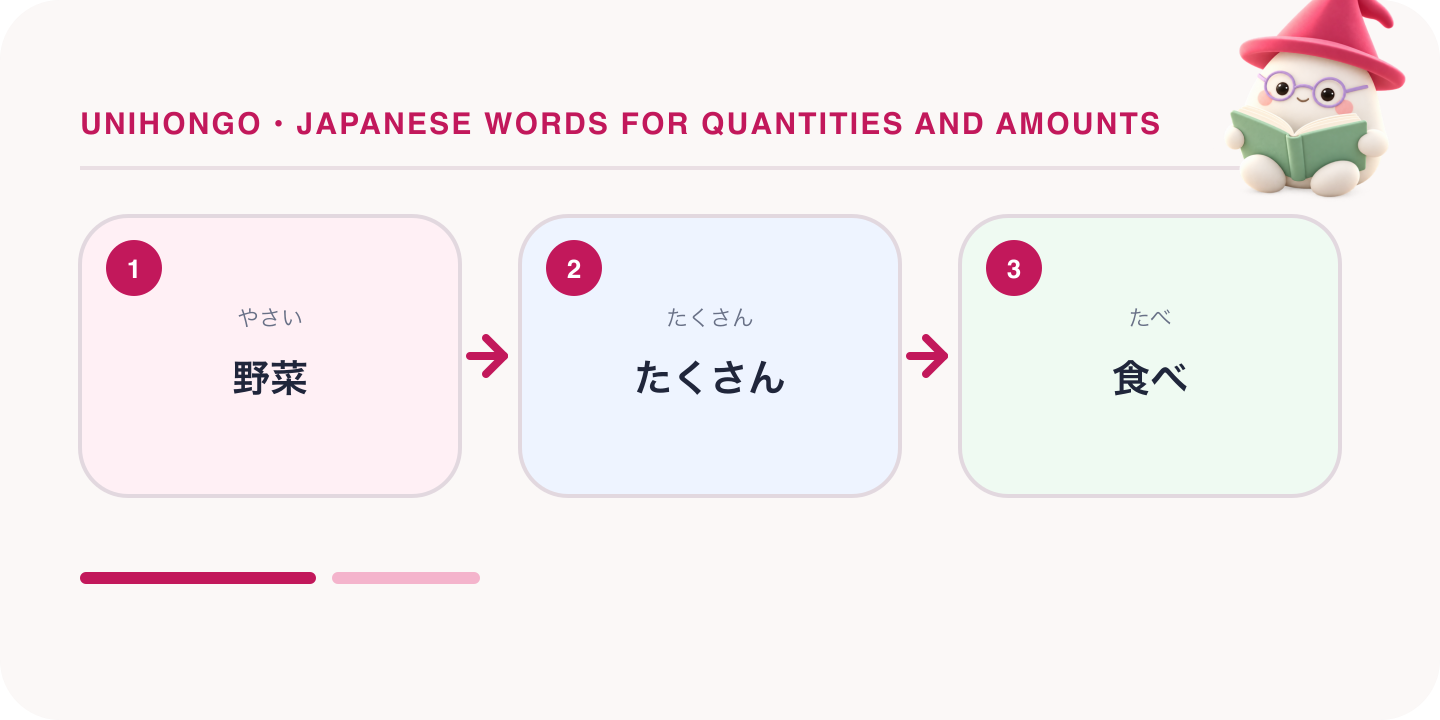
| 野菜をたくさん食べてください。 | Yasai o takusan tabete kudasai. | Please eat lots of vegetables. |
| お祭りに人が大勢来ていました。 | Omatsuri ni hito ga ōzei kite imashita. | Lots of people had come to the festival. |
| 多くの学生がこの辞書を使っています。 | Ōku no gakusei ga kono jisho o tsukatte imasu. | Many students use this dictionary. |
| 冷蔵庫にビールがいっぱい入っている。 | Reizōko ni bīru ga ippai haitte iru. | The fridge is full of beer. |
| ソースはたっぷりでお願いします。 | Sōsu wa tappuri de onegai shimasu. | Plenty of sauce, please. |
A little: sukoshi, chotto, tashō, wazuka
Sukoshi and chotto both mean a little, and in front of a verb they are interchangeable: sukoshi tabemasu, chotto tabemasu. Sukoshi is the one you write and the one you use in a polite request; chotto is the one you say to friends, and it doubles as the all-purpose softener that turns a refusal into a hesitation. Mō sukoshi and mō chotto mean a little more, and are the phrases for asking a cook to go easy or a shopkeeper to add one or two.
Tashō is somewhat or to some extent, a measured word for reports and self-assessment: Nihongo wa tashō hanasemasu, I can speak some Japanese. Wazuka is only a little, slightly, and it stresses how small the amount is: wazuka na chigai, a slight difference. Sukunai is the adjective for few or little, the partner of ōi, and works as a predicate: hito ga sukunai, there are few people. Before a noun it needs a twist, sukunai hito is awkward, so speakers say hito ga sukunai or sukoshi no hito.
| Japanese | Romaji | Meaning |
|---|---|---|
| ご飯は少しでいいです。 | Gohan wa sukoshi de ii desu. | Just a little rice is fine. |
| もうちょっと大きいのはありますか。 | Mō chotto ōkii no wa arimasu ka. | Do you have one a little bigger? |
| 日本語は多少話せます。 | Nihongo wa tashō hanasemasu. | I can speak some Japanese. |
| 今日は客が少ないですね。 | Kyō wa kyaku ga sukunai desu ne. | There are few customers today. |
| 塩をほんの少し加えます。 | Shio o hon no sukoshi kuwaemasu. | Add just a tiny bit of salt. |
All, most and half: zenbu, hotondo, hanbun
The share words describe part of a whole the listener already knows about. Zenbu is all of it: zenbu tabemashita, I ate all of it. Minna also means all, but leans toward people, so minna kimashita is everyone came. Hotondo is most or almost all: hotondo owarimashita, it is almost finished. With a negative, hotondo flips to hardly any: hotondo tabemasen, I hardly eat any. Hanbun is half, and it is a noun, so it takes no before a noun and ni after it as a target: hanbun ni kiru, cut in half.
Two more sit between: daibubun is the greater part, a shade more formal than hotondo, and ichibu is a part, some of it. Nokori is the rest or the leftovers, the word for the half of the pizza you take home. Each of these can be the topic of a sentence with wa: nokori wa ashita tabemasu.
| Japanese | Romaji | Meaning |
|---|---|---|
| 宿題はほとんど終わりました。 | Shukudai wa hotondo owarimashita. | The homework is almost all done. |
| ケーキを半分にしましょう。 | Kēki o hanbun ni shimashō. | Let's split the cake in half. |
| 全部でいくらですか。 | Zenbu de ikura desu ka. | How much is it all together? |
| 残りは明日食べます。 | Nokori wa ashita tabemasu. | I'll eat the rest tomorrow. |
| ほとんどの人が賛成でした。 | Hotondo no hito ga sansei deshita. | Most people were in favour. |
Ordering and shopping amounts
In a shop or restaurant, the quantity words replace numbers whenever the exact figure does not matter. At a market you can hold out a bag and say kore gurai, about this much, or sukoshi ōme ni, a bit on the generous side. Ōme and sukuname, the me forms of ōi and sukunai, are the words for adjusting a portion: gohan wa ōme de, extra rice; kōri wa sukuname de, less ice. Nuki, without, removes something altogether: wasabi nuki de.
The counters this post skips are still there when you need them, and a related post on this site covers them properly. But a learner who knows ōme, sukuname, hanbun and zenbu can get through a supermarket, a café and an izakaya without one. When a shop asks how many, ikutsu, and you do not know the counter, kore o mittsu, three of these, using the generic tsu counter is always accepted.
| Japanese | Romaji | Meaning |
|---|---|---|
| ご飯は大盛りでお願いします。 | Gohan wa ōmori de onegai shimasu. | Extra rice, please. |
| 氷は少なめにしてください。 | Kōri wa sukuname ni shite kudasai. | Less ice, please. |
| これぐらいでいいですか。 | Kore gurai de ii desu ka. | Is about this much okay? |
| みかんをちょっと多めに入れてもらえますか。 | Mikan o chotto ōme ni irete moraemasu ka. | Could you put in a few extra mandarins? |
| 半分だけください。 | Hanbun dake kudasai. | Just half, please. |
| これを三つください。 | Kore o mittsu kudasai. | Three of these, please. |
Crowds, portions and the people rule
Describing a crowd is where the people-versus-things split shows most. Hito ga ōi, there are many people, is the plain statement; ōzei adds the sense of a throng; konde iru, crowded, is what you say about the place itself. For the opposite, suite iru means uncrowded, the word for a quiet train, and gara-gara is nearly empty. A full restaurant is manseki, all seats taken, and a full train is manin.
Portions have their own scale. Tappuri is generous, ōme is a bit more, futsū is normal, sukuname is a bit less, and hon no sukoshi is a token amount. A dish that is too much to finish is ōsugiru, and one that leaves you hungry is sukunasugiru or, more politely, mono tarinai, not quite enough. When you leave food, the polite explanation is onaka ga ippai de, because I am full, which brings ippai back in its other sense.
| Japanese | Romaji | Meaning |
|---|---|---|
| 朝の電車はいつも混んでいます。 | Asa no densha wa itsumo konde imasu. | The morning train is always crowded. |
| 今日は店が空いていますね。 | Kyō wa mise ga suite imasu ne. | The shop is quiet today. |
| 満席なので、少しお待ちください。 | Manseki na node, sukoshi omachi kudasai. | We're full, so please wait a little. |
| この量は多すぎて食べきれない。 | Kono ryō wa ōsugite tabekirenai. | This is too much to finish. |
| もうお腹がいっぱいです。 | Mō onaka ga ippai desu. | I'm already full. |
Quantity words at a glance
The first table collects the words for large and small amounts. The reading column gives the romaji; most of these are written in kanji, though takusan and ippai often appear in hiragana.
| Word | Reading | Meaning |
|---|---|---|
| たくさん | takusan | A lot, many; things or people |
| いっぱい | ippai | A lot; also full |
| 多く | ōku | Many, much; formal, often ōku no |
| 大勢 | ōzei | A large number of people only |
| たっぷり | tappuri | Plenty, generous |
| 多め | ōme | A bit more than usual |
| 少し | sukoshi | A little; careful, polite |
| ちょっと | chotto | A little; casual, also a softener |
| 多少 | tashō | Somewhat, to some extent |
| わずか | wazuka | Only a little, slight |
| 少なめ | sukuname | A bit less than usual |
| ほんの少し | hon no sukoshi | Just a tiny bit |
Shares, negatives and sentence position
The second table covers the share words and the words that need a negative. After it, the list explains where each kind of word goes in the sentence, which is the part learners get wrong most.
| Word | Reading | Meaning |
|---|---|---|
| 全部 | zenbu | All of it |
| みんな | minna | All, everyone; mainly people |
| ほとんど | hotondo | Most, almost all; hardly any with a negative |
| 大部分 | daibubun | The greater part; formal |
| 半分 | hanbun | Half |
| 一部 | ichibu | A part, some |
| 残り | nokori | The rest, leftovers |
| あまり | amari | Not very, not much; with a negative |
| 全然 | zenzen | Not at all; with a negative |
| めったに | mettani | Rarely; with a negative |
- Before the verb, no particle: takusan tabemasu, sukoshi matte, zenbu yomimashita
- Before a noun, add no: takusan no hon, ōzei no hito, hotondo no gakusei
- After the noun and its particle, as a floating quantifier: hon o takusan yomimashita
- Hanbun and ichibu take ni as a target: hanbun ni wakeru, split in half
- Ōme and sukuname take ni or de when ordering: ōme ni, sukuname de
- Amari, zenzen and mettani must be followed by a negative: amari shirimasen
- Zenbu de and minna de mean in total or all together: zenbu de sen en
The floating pattern, noun plus particle plus quantity word plus verb, is the most natural in speech and the one to copy.
Common mistakes with amounts
The first mistake is ōi before a noun. Ōi hito and sukunai hito sound wrong; say hito ga ōi as a predicate, or ōku no hito and takusan no hito before the noun. This is the most frequent slip with quantity words.
The second is amari with a positive verb. Amari tabemasu is not I eat a lot; it is unfinished, and a listener waits for the negative. Say takusan tabemasu for a lot and amari tabemasen for not much. The same holds for zenzen, which only takes a positive in the slang sense of zenzen daijōbu, totally fine.
The third is ōzei for things and takusan for a specific crowd size when you want the throng feeling. Hon ga ōzei arimasu will get a smile; hon ga takusan arimasu is right. When you truly need a number, say it: kore gurai works with a gesture, but futatsu works everywhere.
| Japanese | Romaji | Meaning |
|---|---|---|
| 人が多いですね。 | Hito ga ōi desu ne. | There are a lot of people, aren't there? |
| あまり辛くないので、大丈夫です。 | Amari karaku nai node, daijōbu desu. | It's not very spicy, so it's fine. |
| お酒はめったに飲みません。 | Osake wa mettani nomimasen. | I rarely drink alcohol. |
| 本がたくさんありますね。 | Hon ga takusan arimasu ne. | You have a lot of books. |
| 全然わかりませんでした。 | Zenzen wakarimasen deshita. | I didn't understand at all. |