
Kuso and chikushō meaning, and what adults say instead
Kuso and chikushō are both interjections of frustration: things have gone wrong and you are angry about it. In English, they sit somewhere around damn and dammit. They are rough, and most Japanese speakers associate them with tough characters in fiction, sports players in the heat of a match, or young men among friends.
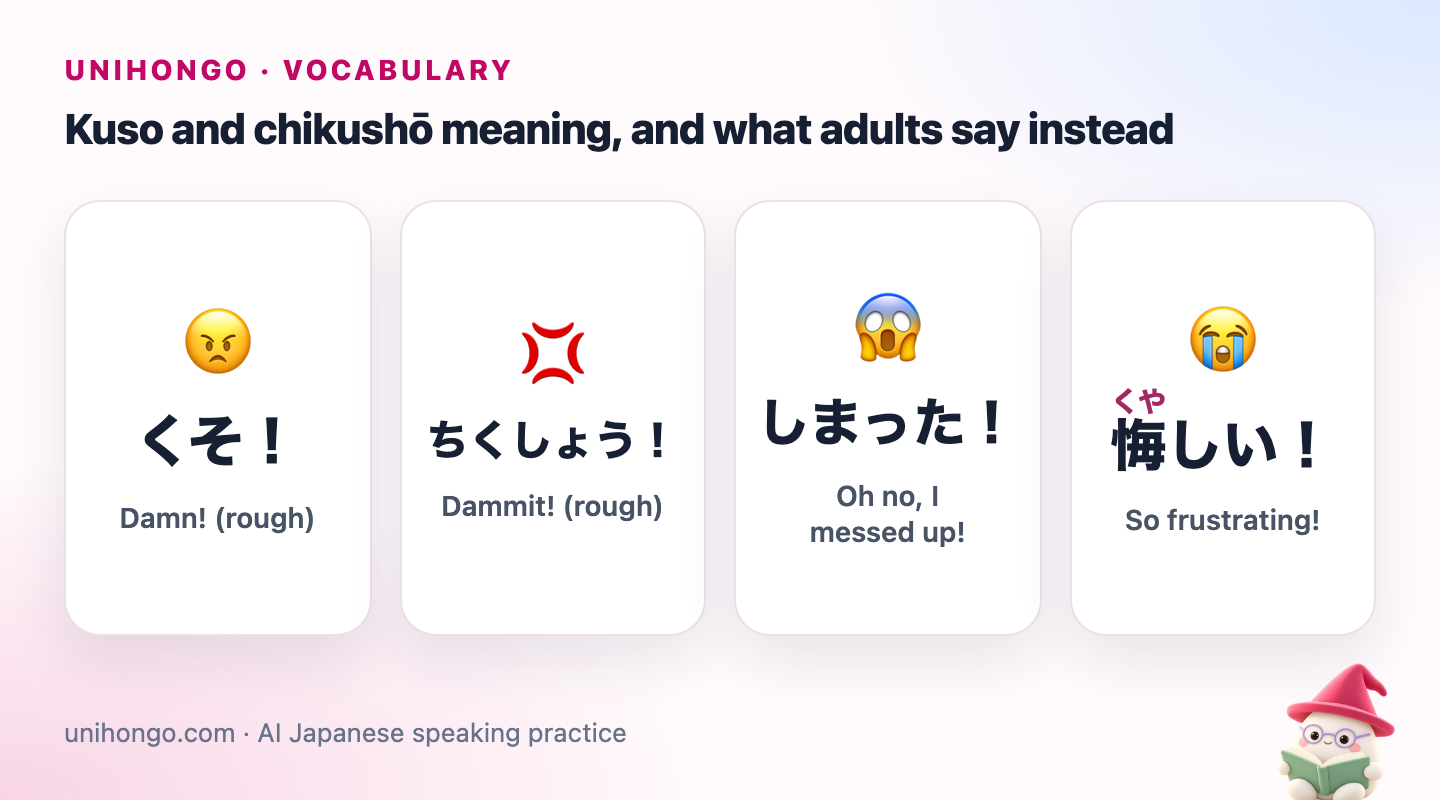
The two words below them are the safe everyday versions you will actually hear from adults around you. Learn all four, then use mostly the last two.
| Japanese | Romaji | Meaning |
|---|---|---|
| くそ! | Kuso! | Damn! (rough) |
| ちくしょう! | Chikushō! | Dammit! (rough) |
| しまった! | Shimatta! | Oh no, I messed up! |
| 悔しい! | Kuyashii! | So frustrating! |
On screen, kuso is often written with a small tsu, くそっ, to show a sharp, cut-off delivery. In speech, it comes out short and hard, often under the breath.
Kuso: literal meaning, interjection and prefix
Literally, kuso (糞) means feces. Children's books and medical settings use politer words, so the bare word already feels crude. As an interjection, kuso! expresses anger at a failure or a setback, often your own.
Kuso also works as a crude intensifier at the front of words, in casual talk and especially online. Kuso-atsui is damn hot, kuso-mazui is disgusting, and kusogē, from kuso and gēmu, is internet slang for a terrible video game. Kusoyarō is an insult aimed at a person, and much stronger: it is fighting talk.
| Japanese | Romaji | Meaning |
|---|---|---|
| くそ、負けた! | Kuso, maketa! | Damn, I lost! |
| 今日はくそ暑いな。 | Kyō wa kuso atsui na. | It's damn hot today. (crude) |
| このゲーム、くそゲーだよ。 | Kono gēmu, kusogē da yo. | This game is total trash. (slang) |
Chikushō: from 'beast' to 'dammit'
Chikushō (畜生) began as a Buddhist word for animals, beings born into a realm considered lower than humans. Calling someone a chikushō was an insult, and over time the word became an interjection of anger and frustration: dammit!
Today it sounds rough and a little old-fashioned, like the voice of a period-drama samurai or a sports manga hero who has just lost. In fast speech it often becomes chikishō, and in anime you may hear chikushō-me, with an extra insulting ending.
| Japanese | Romaji | Meaning |
|---|---|---|
| ちくしょう、また負けた。 | Chikushō, mata maketa. | Dammit, I lost again. |
| ちくしょう、覚えてろよ! | Chikushō, oboetero yo! | Dammit, you'll pay for this! (anime) |
| Expression | Strength | Who you hear it from |
|---|---|---|
| kuso (くそ) | Rough, crude | Anime heroes, young men, gamers |
| chikushō (ちくしょう) | Rough, a bit dated | Anime, sports, period dramas |
| kusoyarō (くそ野郎) | Strong insult at a person | Villains, real fights |
| shimatta (しまった) | Mild, neutral | Anyone, any age |
| kuyashii (悔しい) | Mild, emotional | Anyone who lost or missed out |
Why learners should rarely say them
The issue is not that the words are shocking. It is that they create a character. Japanese speech carries strong signals about gender, age and attitude, and kuso and chikushō signal rough, aggressive and young. From an adult learner at work, a host family's dinner table or a shop counter, they can sound hostile, or so out of place that people laugh.
Among close friends who also use them, in a gaming session or while watching football, a muttered kuso is normal. Outside that, choose a word from the next sections.
- Never at work, even under your breath. Say ā, shimatta or yatte shimatta instead.
- Not in front of children, teachers, older people or customers.
- Not as a joke you picked up from anime with someone you have just met.
- If you hear it from a friend, it is not usually aimed at you. Kuso! after a missed shot is about the shot.
Shimatta, ā mō and saiaku: venting like an adult
These are the frustration words you will hear from coworkers, parents and friends. Shimatta is for the moment you realise a mistake. Yatchatta, I've done it now, is a casual and sometimes sheepish version. Ā mō! is for when things pile up and your patience runs out. Saiaku, the worst, is a strong but socially acceptable verdict on a situation, and tsuite nai means my luck is out.
| Japanese | Romaji | Meaning |
|---|---|---|
| しまった、傘を忘れた。 | Shimatta, kasa o wasureta. | Oh no, I forgot my umbrella. |
| あ、やっちゃった。 | A, yatchatta. | Oops, I've done it now. |
| ああ、もう! | Ā, mō! | Argh! |
| 最悪だ。 | Saiaku da. | This is the worst. |
| 今日はついてないな。 | Kyō wa tsuite nai na. | I'm out of luck today. |
Mō on its own, said with a sigh, is gentle exasperation, often with a loved one: mō, mata? Not again? It is one of the most useful one-syllable reactions in Japanese.
Kuyashii: the frustration of losing
Kuyashii has no perfect English match. It is the burning frustration of losing, falling short or missing out, especially when you nearly made it or when someone else got what you wanted. Athletes say it after a defeat, students after failing by one point, fans after missing tickets. It is honest and widely respected, and it often comes with a promise to try again.
| Japanese | Romaji | Meaning |
|---|---|---|
| あと一点だったのに。悔しい! | Ato itten datta noni. Kuyashii! | Just one point away. So frustrating! |
| 悔しいけど、相手が強かった。 | Kuyashii kedo, aite ga tsuyokatta. | It hurts, but they were stronger. |
| 次は絶対勝つ! | Tsugi wa zettai katsu! | Next time I'll win for sure! |
Sudden reactions: itai, yabai and uso
Many moments where an English speaker might swear are covered in Japanese by short reactions that are not rude at all. Stub your toe and you say itai! or the clipped itete. See something alarming and you say yabai, which in casual speech can mean bad, risky or, confusingly, amazing. Hear shocking news and you say uso!, no way!
These are casual but socially safe, and they make you sound natural in exactly the situations where learners reach for anime swear words.
| Japanese | Romaji | Meaning |
|---|---|---|
| いてて… | Itete... | Ow, ow... |
| やばい、遅刻する! | Yabai, chikoku suru! | Oh no, I'm going to be late! |
| うそ!本当に? | Uso! Hontō ni? | No way! Really? |
| もう、やだ。 | Mō, yada. | Ugh, I hate this. |
Mini dialogue: you missed the last train
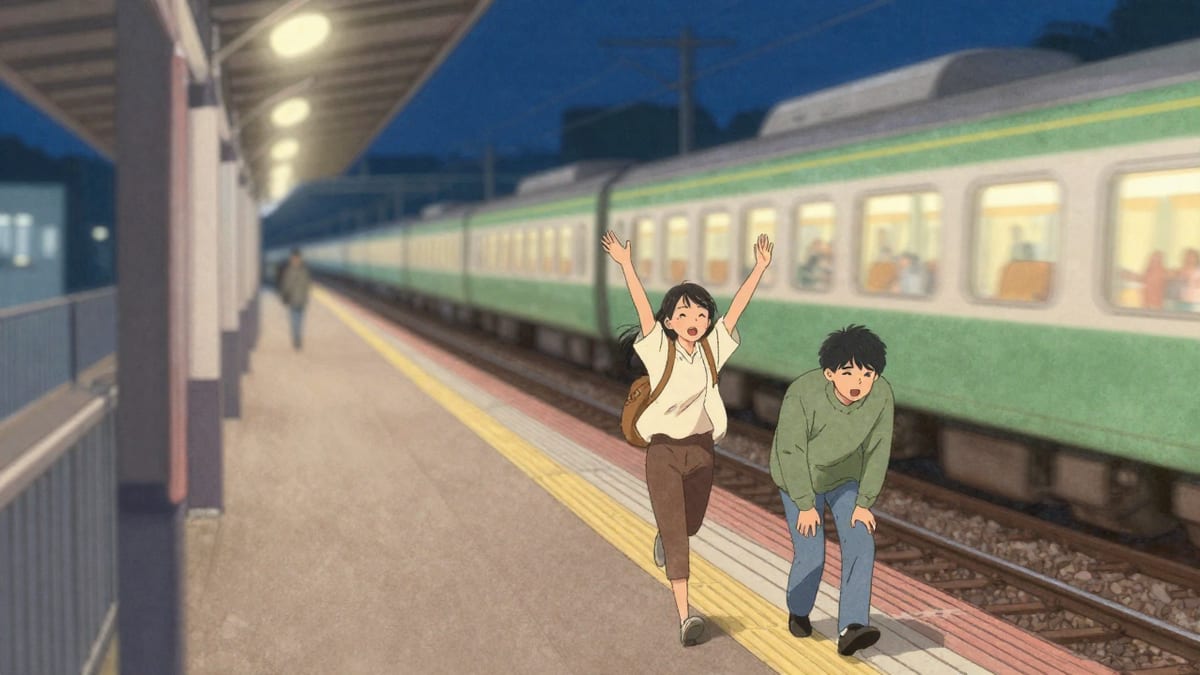
You run down the stairs just as the doors of the last train close. Your friend is with you. This is the moment an anime hero would shout chikushō. Here is how most adults handle it instead, ending with a practical plan.
| Japanese | Romaji | Meaning |
|---|---|---|
| あ、ドアが閉まった! | A, doa ga shimatta! | You: Ah, the doors closed! |
| うそでしょう。終電だよ。 | Uso deshō. Shūden da yo. | Friend: You're kidding. That was the last train. |
| ああ、もう!ついてないな。 | Ā, mō! Tsuite nai na. | You: Argh! Just my luck. |
| タクシーは高いし、最悪。 | Takushī wa takai shi, saiaku. | Friend: And taxis are expensive. The worst. |
| まあ、しょうがないか。 | Mā, shō ga nai ka. | You: Well, it can't be helped. |
| ファミレスで始発を待とうか。 | Famiresu de shihatsu o matō ka. | You: Shall we wait for the first train at a diner? |