
One movement behind many meanings
Start with the door. Japanese doors are labelled 押 for push and 引 for pull, and that is the literal core of 引く: something comes toward you. Every other sense is that movement extended somewhere new. You draw a line across paper, so a line gets pulled. You draw a number out of a total, so subtraction is pulling. You draw a lot out of a box, so kuji o hiku. You draw somebody's eyes toward you, so me o hiku.
Two senses need a little more imagination but still fit. Looking a word up is drawing it out of a dictionary, which is exactly what a paper dictionary felt like. And catching a cold is drawing it in from the air around you, which is why the expression uses o rather than ni. Once you see the movement, you are no longer memorising eight unrelated meanings but eight uses of one.
The practical consequence is that you should never learn hiku alone. Learn the noun and the verb together, because in Japanese the noun is what selects the sense. Kaze o hiku, jisho o hiku and kuji o hiku are single units in the mind of a speaker, and that is how they should sit in yours.
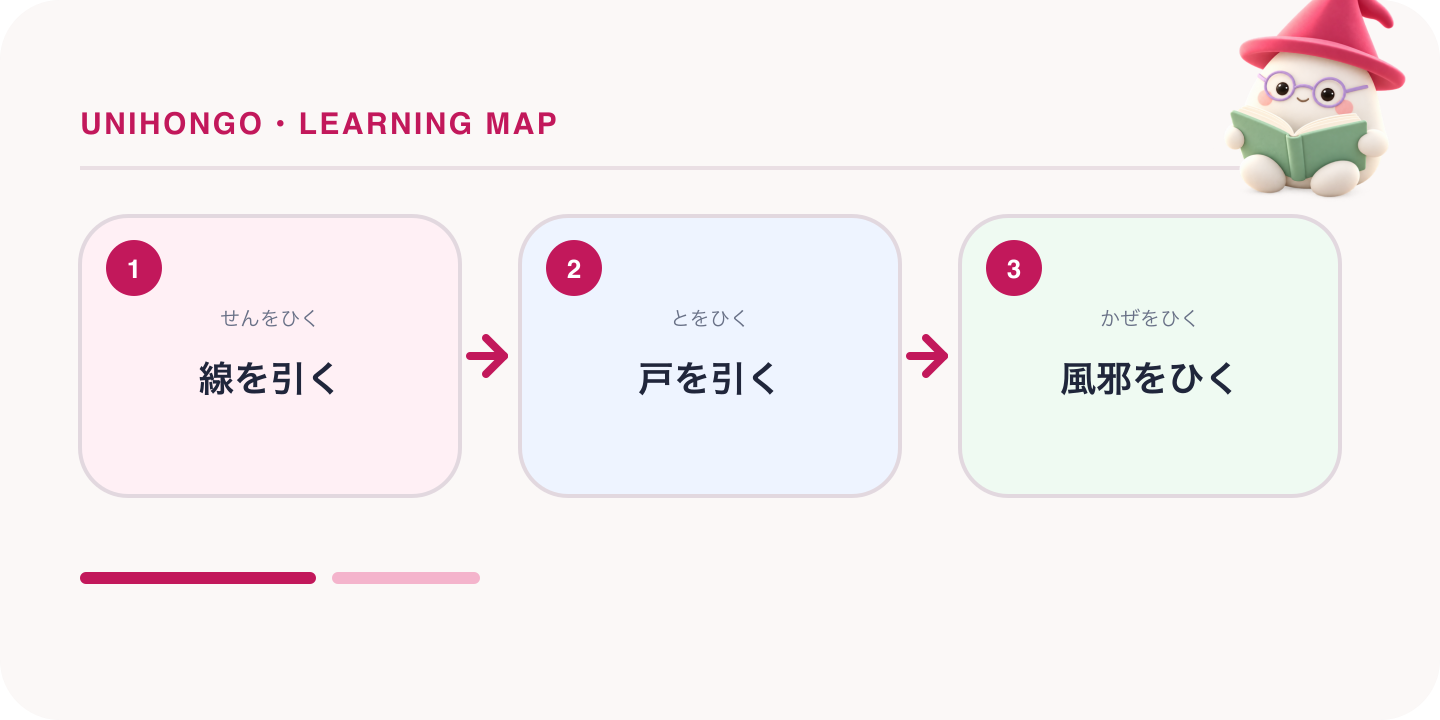
The senses of hiku at a glance
| Sense | Kanji | Typical collocation | Example |
|---|---|---|---|
| Pull something | 引く | ドアを引く doa o hiku | ドアを引いてください Doa o hiite kudasai |
| Lead by the hand | 引く | 手を引く te o hiku | 子どもの手を引きます Kodomo no te o hikimasu |
| Catch a cold | 引く | 風邪を引く kaze o hiku | 風邪を引きました Kaze o hikimashita |
| Look a word up | 引く | 辞書を引く jisho o hiku | 辞書を引きます Jisho o hikimasu |
| Draw a line | 引く | 線を引く sen o hiku | 線を引いてください Sen o hiite kudasai |
| Subtract | 引く | 数を引く kazu o hiku | 十から三を引きます Jū kara san o hikimasu |
| Discount | 引く | 値段を引く nedan o hiku | 千円引きです Sen-en biki desu |
| Attract attention | 引く | 目を引く me o hiku | 看板が目を引きます Kanban ga me o hikimasu |
| Draw a lot | 引く | くじを引く kuji o hiku | くじを引きましょう Kuji o hikimashō |
| Withdraw from something | 引く | 手を引く te o hiku | その件から手を引きます Sono ken kara te o hikimasu |
| Install a line | 引く | 電話を引く denwa o hiku | 水道を引きました Suidō o hikimashita |
| Go down, subside | 引く | 熱が引く netsu ga hiku | 熱が引きました Netsu ga hikimashita |
| Play strings or keys | 弾く | ピアノを弾く piano o hiku | ピアノを弾けます Piano o hikemasu |
| Attract, literary | 惹く | 心を惹く kokoro o hiku | 心を惹かれました Kokoro o hikaremashita |
| Grind | 挽く | 豆を挽く mame o hiku | コーヒー豆を挽きます Kōhī mame o hikimasu |
One entry is missing on purpose. Hiku also covers being run over by a vehicle, normally written 轢く but usually given in kana in news reports as hikareru. It is worth recognising and not worth practising, and the context that carries it is unmistakable.
Pulling in the physical world
The literal sense is the one you will see printed most often, since every glass door in Japan carries osu or hiku. In speech, hiku is the neutral verb for pulling and hipparu is the effortful one. You pull a chair out for somebody with hiku, and you haul a stuck suitcase with hipparu. The te-form is hiite, since 引く is a regular godan verb ending in ku, and the exception iku with its te-form itte does not affect it.
Curtains and blinds also take hiku, which surprises learners who expect a verb like close. And te o hiku in its literal sense means to lead somebody by the hand, most often a child in a crowd, which is a useful and gentle sentence to have ready at a station.
| Japanese | Romaji | Meaning |
|---|---|---|
| ドアを引いてください。 | Doa o hiite kudasai. | Please pull the door. |
| このドアは押すのではなく引きます。 | Kono doa wa osu no de wa naku hikimasu. | This door pulls rather than pushes. |
| 椅子を引いてもらえますか。 | Isu o hiite moraemasu ka? | Could you pull the chair out? |
| カーテンを引きますね。 | Kāten o hikimasu ne. | I will draw the curtains. |
| 子どもの手を引いて歩きました。 | Kodomo no te o hiite arukimashita. | I walked along holding the child by the hand. |
| もう少し強く引っ張ってください。 | Mō sukoshi tsuyoku hippatte kudasai. | Please pull a bit harder. |
| ここを引くと開きます。 | Koko o hiku to hirakimasu. | It opens if you pull here. |
Kaze o hiku: the cold you pull
Kaze o hiku is the single most useful hiku collocation for a learner, because you will need it at work, at school and in a clinic. The verb is fixed and cannot be swapped for aru, motsu or naru. The past form kaze o hikimashita reports that you caught a cold, and the te-iru form kaze o hiite imasu describes the state of having one now, which is the form you usually want when explaining why you sound like that.
Two neighbours are worth keeping separate. Kaze-gimi desu is the mild version, meaning you feel a cold coming on, and it is a very natural thing to say before you commit to being ill. Influenza and other named illnesses take kakaru instead: infuruenza ni kakarimashita. Netsu, a fever, takes aru or deru, so netsu ga arimasu and netsu ga demashita, never netsu o hikimasu.
| Japanese | Romaji | Meaning |
|---|---|---|
| 風邪を引きました。 | Kaze o hikimashita. | I have caught a cold. |
| 風邪を引いているので、今日は休ませていただきます。 | Kaze o hiite iru node, kyō wa yasumasete itadakimasu. | I have a cold, so I would like to take today off. |
| ひどい風邪を引いてしまいました。 | Hidoi kaze o hiite shimaimashita. | I have gone and caught a bad cold. |
| 少し風邪気味です。 | Sukoshi kaze-gimi desu. | I feel a cold coming on. |
| 風邪を引かないように気をつけてください。 | Kaze o hikanai yō ni ki o tsukete kudasai. | Please take care not to catch a cold. |
| 熱はありますか。 | Netsu wa arimasu ka? | Do you have a fever? (what the other person asks) |
| お大事に。早く治るといいですね。 | Odaiji ni. Hayaku naoru to ii desu ne. | Take care. I hope you get better soon. |
Jisho o hiku and other lookups
Jisho o hiku is the standard way to say look a word up, and it has survived the move from paper to phone screens without any difficulty. You can say jisho de hikimashita, using de for the tool, or jisho o hikimashita, treating the dictionary as the thing you draw from. Both are heard, and the second is the older and more idiomatic pattern.
The same verb reaches into more formal territory. Rei o hiku means to cite an example, and sakuin o hiku means to use an index. If you simply want to say look it up on your phone, sumaho de shirabemasu is the neutral modern choice, and the two verbs happily coexist in the same conversation.
| Japanese | Romaji | Meaning |
|---|---|---|
| 辞書を引いてもいいですか。 | Jisho o hiite mo ii desu ka? | May I look it up in a dictionary? |
| この言葉を辞書で引きました。 | Kono kotoba o jisho de hikimashita. | I looked this word up in a dictionary. |
| 分からない漢字は必ず辞書を引きます。 | Wakaranai kanji wa kanarazu jisho o hikimasu. | I always look up kanji I do not know. |
| 最近は辞書を引かないでスマホで調べます。 | Saikin wa jisho o hikanaide sumaho de shirabemasu. | These days I look things up on my phone instead of using a dictionary. |
| 例を引いて説明します。 | Rei o hiite setsumei shimasu. | I will explain by citing an example. |
| 索引を引いたほうが早いですよ。 | Sakuin o hiita hō ga hayai desu yo. | It is quicker to use the index. |
Numbers, lines, and discounts
Subtraction is straightforward: A kara B o hiku, take B from A. The noun hikizan is the arithmetic operation, and biki, the voiced form of the masu-stem, appears everywhere in shops. Sen-en biki is a thousand yen off, ni-wari-biki is twenty percent off, and waribiki is the general word for a discount. Recognising biki on a price tag is a small piece of vocabulary with a large daily return.
Sen o hiku, to draw a line, works for a pen on paper and for the metaphor. Issen o hiku means to draw a firm boundary between yourself and something else, and shita ni sen o hiku, underlining, is what a teacher asks you to do with the important part of a sentence.
| Japanese | Romaji | Meaning |
|---|---|---|
| 十から三を引くと七です。 | Jū kara san o hiku to nana desu. | Ten minus three is seven. |
| 税金を引いた金額です。 | Zeikin o hiita kingaku desu. | That is the amount after tax has been deducted. |
| こちらは千円引きになります。 | Kochira wa sen-en biki ni narimasu. | This one is a thousand yen off. (what the shop assistant says) |
| 二割引きで買えました。 | Ni-wari-biki de kaemashita. | I got it at twenty percent off. |
| ここに線を引いてください。 | Koko ni sen o hiite kudasai. | Please draw a line here. |
| 大事なところに赤で線を引きます。 | Daiji na tokoro ni aka de sen o hikimasu. | I underline the important parts in red. |
| その話とは一線を引きたいです。 | Sono hanashi to wa issen o hikitai desu. | I want to keep a clear line between myself and that matter. |
Attention, lots, and pulling back
Me o hiku and hitome o hiku describe something that catches the eye, usually a sign, a design or a colour. Ki o hiku is about catching somebody's interest, and it is neutral in most contexts, though ki o hikitai can sound like fishing for attention if the person is a colleague rather than a customer. Kanshin o hiku is the more formal version you will see in written Japanese.
Te o hiku has a second, figurative life: to withdraw from a project or a relationship with a business. Mi o hiku is a heavier version about stepping back from a position. And kuji o hiku is the verb for drawing lots, including omikuji at a shrine, which is a piece of vocabulary you will want on any first trip.
One casual usage is worth knowing so it does not confuse you. Among younger speakers hiku on its own can mean to be put off by something, as in sore wa chotto hiku. Don-biki is the noun. It is informal, slightly rude about the other person, and safest to recognise rather than to use.
| Japanese | Romaji | Meaning |
|---|---|---|
| あの看板は目を引きます。 | Ano kanban wa me o hikimasu. | That sign really catches the eye. |
| 子どもの気を引くのが上手ですね。 | Kodomo no ki o hiku no ga jōzu desu ne. | You are good at getting children interested. |
| 若い人の関心を引く工夫が必要です。 | Wakai hito no kanshin o hiku kufū ga hitsuyō desu. | We need ideas that attract younger people's interest. |
| くじを引いて順番を決めましょう。 | Kuji o hiite junban o kimemashō. | Let us draw lots to decide the order. |
| おみくじを引いたら大吉でした。 | Omikuji o hiitara daikichi deshita. | I drew a fortune slip and got the best one. |
| その仕事からは手を引きました。 | Sono shigoto kara wa te o hikimashita. | I pulled out of that job. |
| 話し方に心を惹かれました。 | Hanashikata ni kokoro o hikaremashita. | I was drawn to the way they spoke. |
| それはちょっと引くかも。 | Sore wa chotto hiku kamo. | That is a bit off-putting. (casual) |
Playing an instrument with hiku
弾く is the same sound with a different kanji, and it covers instruments you play with your fingers on strings or keys: piano, guitar, violin, koto, harp. Japanese does not use one verb for all instruments, which is a common source of mistakes. Drums are struck, so taiko o tatakimasu. Wind instruments are blown, so fue o fukimasu and torampetto o fukimasu. When you need a neutral verb for any instrument, ensō shimasu covers them all.
The potential form is hikemasu, so piano o hikemasu ka is how somebody asks whether you play. A modest answer is sukoshi dake desu, and a fuller one is kodomo no koro naratte imashita, I learnt as a child. Hikigatari, singing while accompanying yourself, is a useful noun if you play guitar.
| Japanese | Romaji | Meaning |
|---|---|---|
| ピアノを弾けますか。 | Piano o hikemasu ka? | Can you play the piano? |
| 少しだけギターを弾きます。 | Sukoshi dake gitā o hikimasu. | I play a little guitar. |
| 子どもの頃、バイオリンを習っていました。 | Kodomo no koro, baiorin o naratte imashita. | I learnt the violin as a child. |
| 何か弾いてもらえますか。 | Nanika hiite moraemasu ka? | Could you play something for us? |
| 弾き語りをするのが好きです。 | Hikigatari o suru no ga suki desu. | I like singing while playing. |
| この曲は難しくて弾けません。 | Kono kyoku wa muzukashikute hikemasen. | This piece is too hard for me to play. |
| Instrument | Verb | Example |
|---|---|---|
| ピアノ piano | 弾く hiku | ピアノを弾きます Piano o hikimasu |
| ギター gitā | 弾く hiku | ギターを弾きます Gitā o hikimasu |
| バイオリン baiorin | 弾く hiku | バイオリンを弾きます Baiorin o hikimasu |
| 太鼓 taiko | 叩く tataku | 太鼓を叩きます Taiko o tatakimasu |
| 笛 fue | 吹く fuku | 笛を吹きます Fue o fukimasu |
| トランペット torampetto | 吹く fuku | トランペットを吹きます Torampetto o fukimasu |
| どの楽器でも dono gakki demo | 演奏する ensō suru | 楽器を演奏します Gakki o ensō shimasu |
When hiku means going down
Hiku is also intransitive, and in that use it describes something receding. A fever goes down, a swelling subsides, pain eases, the tide goes out, and the colour drains from a shocked face. These take ga rather than o, which is your signal that nobody is doing the pulling. Netsu ga hikimashita and netsu o hikimashita are not variants of one sentence; the second is simply wrong.
This is a good group to practise at a clinic or pharmacy, because it is exactly how you describe recovery. Sukoshi hiite kimashita, it has come down a little, is a natural answer to a doctor asking how you are today.
| Japanese | Romaji | Meaning |
|---|---|---|
| やっと熱が引きました。 | Yatto netsu ga hikimashita. | My fever has finally come down. |
| 腫れが引くまで冷やしてください。 | Hare ga hiku made hiyashite kudasai. | Keep it cool until the swelling goes down. (what the doctor says) |
| 痛みが少し引いてきました。 | Itami ga sukoshi hiite kimashita. | The pain has eased a little. |
| 潮が引いたら貝を拾えます。 | Shio ga hiitara kai o hiroemasu. | You can collect shellfish once the tide goes out. |
| 驚いて血の気が引きました。 | Odoroite chinoke ga hikimashita. | I was so shocked the blood drained from my face. |
Compound verbs built on hiku
Hiku forms compounds generously, and most of them stay close to the pulling image. Hikidasu is to draw out, used for money at a cash machine and for information from a reluctant speaker, and the noun hikidashi is a drawer. Hikiukeru, to take on a job or a responsibility, is to pull it toward yourself. Hikizuru is to drag. Hikkosu, to move house, began as hikikosu and still conjugates as a godan verb: hikkoshimasu, hikkoshite.
A few nouns are worth adding at the same time, because they appear constantly and are easy once you hear the verb inside them. Hikiwake is a draw in a match, hikizan is subtraction, waribiki is a discount, and hikidashi doubles as a metaphor for the range of ideas somebody has to draw on.
| Japanese | Romaji | Meaning |
|---|---|---|
| ATMでお金を引き出します。 | Ētīemu de okane o hikidashimasu. | I withdraw money at the cash machine. |
| その仕事を引き受けました。 | Sono shigoto o hikiukemashita. | I took that job on. |
| 来月、東京に引っ越します。 | Raigetsu, Tōkyō ni hikkoshimasu. | I am moving to Tokyo next month. |
| 重いかばんを引きずって歩きました。 | Omoi kaban o hikizutte arukimashita. | I walked along dragging a heavy bag. |
| 書類は引き出しの中にあります。 | Shorui wa hikidashi no naka ni arimasu. | The documents are in the drawer. |
| 昨日の試合は引き分けでした。 | Kinō no shiai wa hikiwake deshita. | Yesterday's match was a draw. |
| コーヒー豆をその場で挽きます。 | Kōhī mame o sono ba de hikimasu. | They grind the coffee beans on the spot. |
Conjugation and how to keep the senses apart
Grammatically hiku is easy, which is a relief given how much work it does. It is a regular godan verb ending in ku, so the te-form follows the same rule as kaku and aruku: hiite. Every sense uses the same forms, whether you are pulling a door or catching a cold, and 弾く conjugates identically.
| Form | 引く hiku | Built how |
|---|---|---|
| Polite | 引きます hikimasu | Stem hiki plus masu |
| Te-form | 引いて hiite | Godan ku becomes ite |
| Plain past | 引いた hiita | Te-form with ta |
| Plain negative | 引かない hikanai | A-stem hika plus nai |
| Polite negative | 引きません hikimasen | Stem hiki plus masen |
| Potential | 引ける hikeru | E-stem hike plus ru |
| Passive | 引かれる hikareru | A-stem hika plus reru |
| Volitional | 引こう hikō | O-stem hiko plus u |
| Conditional ba | 引けば hikeba | E-stem hike plus ba |
| Masu-stem noun | 引き hiki | Used in hikidashi, waribiki |
- Store every sense as a two-word unit: kaze o hiku, jisho o hiku, kuji o hiku, sen o hiku, me o hiku. Never revise the verb on its own.
- Check the particle before you speak. O means you are doing the pulling, ga means something is subsiding by itself.
- Keep kaze o hiku for colds only, and use kakaru for named illnesses and aru or deru for a fever.
- Sort instruments into three verbs once and for all: hiku for strings and keys, tataku for percussion, fuku for anything you blow.
- Read door signs aloud for a week, hiku and osu, until the literal meaning is so automatic that the figurative ones have something to hang on.
- Add one new hiku collocation a week rather than learning fifteen at once, and use it in a real sentence about your own day the same day you meet it.