
Mushi: the one word that covers every bug
In English you choose between bug, insect and creepy-crawly. In Japanese, 虫 (mushi) does all three jobs. A spider on the wall is a mushi, an earthworm in the garden is a mushi and a mosquito in your bedroom is a mushi, even though a biologist would not call spiders insects. When you need the precise scientific term, use 昆虫 (konchū). You will see it in museum halls, picture encyclopedias for children and school science lessons.
Mushi also appears in many expressions that have nothing to do with insects, such as 虫の知らせ (mushi no shirase), a premonition, or 泣き虫 (nakimushi), a crybaby. These are worth knowing so that you do not look for a bug where there is none.
| Japanese | Romaji | Meaning |
|---|---|---|
| 虫の声 | mushi no koe | the song of insects on summer and autumn nights |
| 虫 | mushi | bug, insect, any small creepy-crawly |
| 昆虫 | konchū | insect (science and textbook word) |
| 虫が苦手です。 | Mushi ga nigate desu. | I'm not good with bugs. (polite, soft) |
| 泣き虫 | nakimushi | crybaby |
| 弱虫 | yowamushi | coward, wimp (teasing) |
The summer insects everyone knows
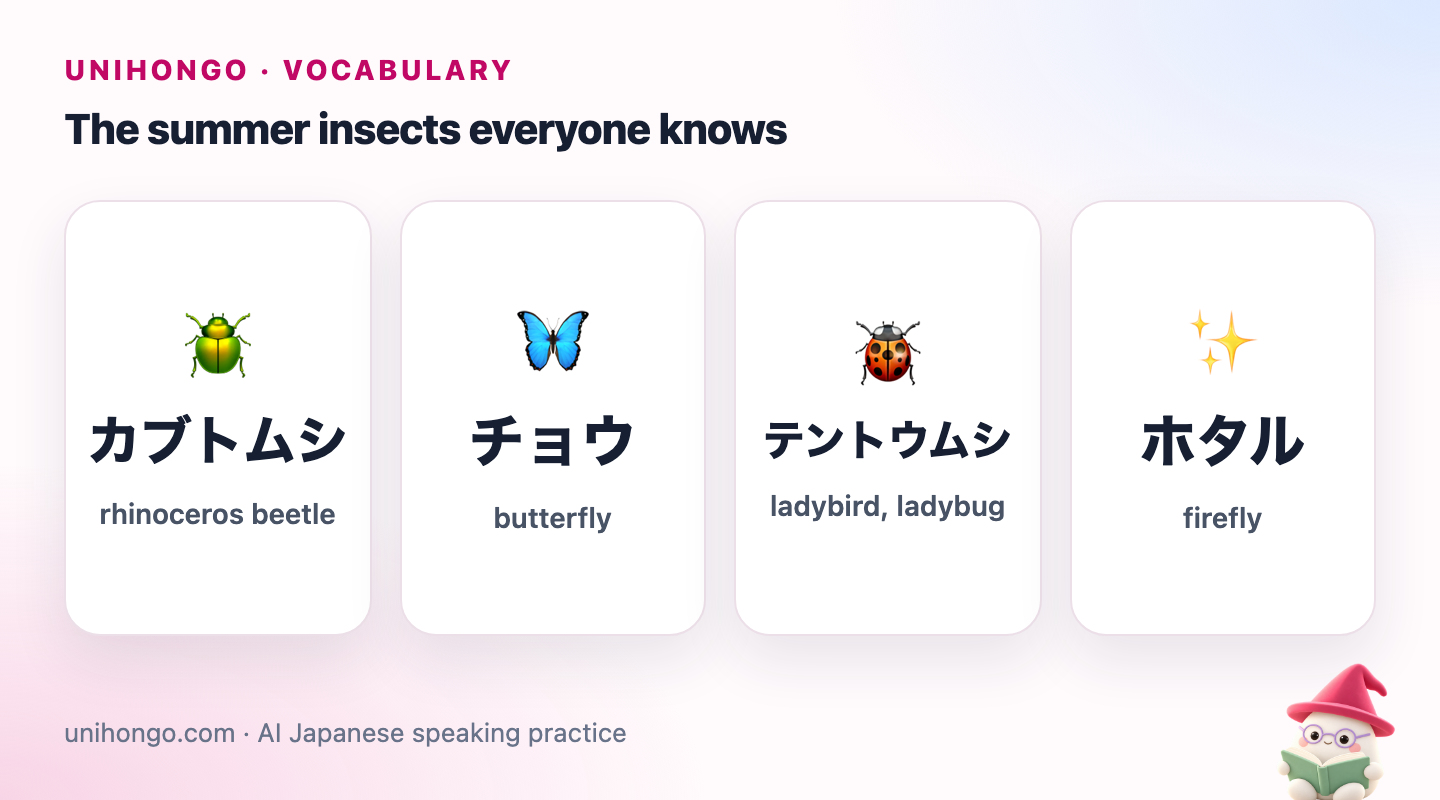
These are the insects you will hear about in songs, picture books, summer holiday diaries and conversations with Japanese friends. Beetles and butterflies are popular with children, and fireflies are something adults go out to see on early summer evenings in some areas.
| Japanese | Romaji | Meaning |
|---|---|---|
| カブトムシ | kabutomushi | rhinoceros beetle |
| チョウ | chō | butterfly |
| テントウムシ | tentōmushi | ladybird, ladybug |
| ホタル | hotaru | firefly |
| クワガタ | kuwagata | stag beetle |
| セミ | semi | cicada |
| トンボ | tonbo | dragonfly |
| バッタ | batta | grasshopper |
| カマキリ | kamakiri | praying mantis |
| スズムシ | suzumushi | bell cricket |
| コオロギ | kōrogi | cricket |
| ちょうちょ | chōcho | butterfly (soft, said to children) |
Chō is the standard word for butterfly, and ちょうちょ (chōcho) or ちょうちょう (chōchō) is the soft version used with children and in a famous nursery song. A moth is ガ (ga), a separate word, although some moths and butterflies look alike. Notice that カブトムシ contains ムシ: kabuto is a samurai helmet, so the name describes the beetle's horned head.
The bugs nobody wants at home
Hot, humid summers mean that every household in Japan knows these words. Mosquitoes are the constant nuisance, and the cockroach is the one that makes people scream. Supermarkets and drugstores have a whole seasonal corner of sprays, coils and traps, and conversations about the first cockroach of the year are a small summer ritual.
Japanese uses 出る (deru), to come out or appear, for pests: gokiburi ga deta, a cockroach showed up. The verb 刺す (sasu), to sting or pierce, is used for mosquitoes and bees, so a mosquito bite is literally being stung.
| Japanese | Romaji | Meaning |
|---|---|---|
| 蚊 | ka | mosquito |
| ゴキブリ | gokiburi | cockroach |
| ハエ | hae | fly (housefly) |
| アリ | ari | ant |
| ハチ | hachi | bee, wasp |
| クモ | kumo | spider |
| ムカデ | mukade | centipede |
| 蚊に刺された。 | Ka ni sasareta. | I got bitten by a mosquito. (casual) |
| かゆい! | Kayui! | It's itchy! |
| ゴキブリが出た! | Gokiburi ga deta! | A cockroach showed up! |
| 虫よけスプレーある? | Mushiyoke supurē aru? | Do you have bug spray? (casual) |
| 蚊取り線香 | katori senkō | mosquito coil |
Hachi covers both bees and wasps in everyday speech. If you need to be precise, ミツバチ (mitsubachi) is a honeybee and スズメバチ (suzumebachi) is a hornet, which people in Japan take seriously on mountain walks in late summer and autumn.
Body parts, life stages and verbs
To describe an insect or follow a children's science programme, you need a handful of body parts and the stages of a life cycle. Japanese school science covers these words early, so even young children know them.
| Japanese | Romaji | Meaning |
|---|---|---|
| 羽 | hane | wing |
| 触角 | shokkaku | antenna, feeler |
| 足 | ashi | leg |
| 幼虫 | yōchū | larva, grub, caterpillar |
| さなぎ | sanagi | pupa, chrysalis |
| 成虫 | seichū | adult insect |
| 飛ぶ | tobu | to fly |
| 鳴く | naku | to sing, chirp (insects and birds) |
| 刺す | sasu | to sting, to bite (mosquitoes, bees) |
| 捕まえる | tsukamaeru | to catch |
| 昆虫の足は六本です。 | Konchū no ashi wa roppon desu. | Insects have six legs. |
Be careful with 鳴く (naku), to make an animal sound, and 泣く (naku), to cry. They sound identical. Insects and birds 鳴く, people 泣く. Caterpillar has its own word, 毛虫 (kemushi), for the hairy kind and 芋虫 (imomushi) for the smooth kind, but yōchū works for any larva.
The sound of cicadas and autumn crickets
Insect sounds are a seasonal marker in Japan. The loud buzz of cicadas means high summer, and different species have their own sound words. The quieter, bell-like chirping of crickets in the evening means summer is ending. Many Japanese people talk about these sounds with affection, and you will hear them in TV dramas and films to set the season. How much people enjoy them varies, of course: some find a cicada outside the window simply too loud.
Sound words are written in katakana, and each cicada is usually named after its call. Learning two or three gives you an easy way to join a conversation about summer.
| Japanese | Romaji | Meaning |
|---|---|---|
| ミンミン | minmin | the call of the minmin cicada |
| ジージー | jījī | the buzzing call of the large brown cicada |
| カナカナ | kanakana | the evening call of the higurashi cicada |
| リーンリーン | rīn rīn | the bell-like song of the bell cricket |
| セミが鳴いてるね。 | Semi ga naiteru ne. | The cicadas are singing. (casual) |
| 夏だなあ。 | Natsu da nā. | It really feels like summer. |
| 鈴虫の声がきれいですね。 | Suzumushi no koe ga kirei desu ne. | The bell crickets sound lovely. (polite) |
| セミがうるさくて眠れない。 | Semi ga urusakute nemurenai. | The cicadas are so loud I can't sleep. |
Notice that insects have a 声 (koe), a voice, in Japanese. English speakers talk about noise or chirping, but Japanese speakers naturally say mushi no koe, the insects' voices, which is why it is the signature line of this post.
Bug catching: a summer childhood tradition
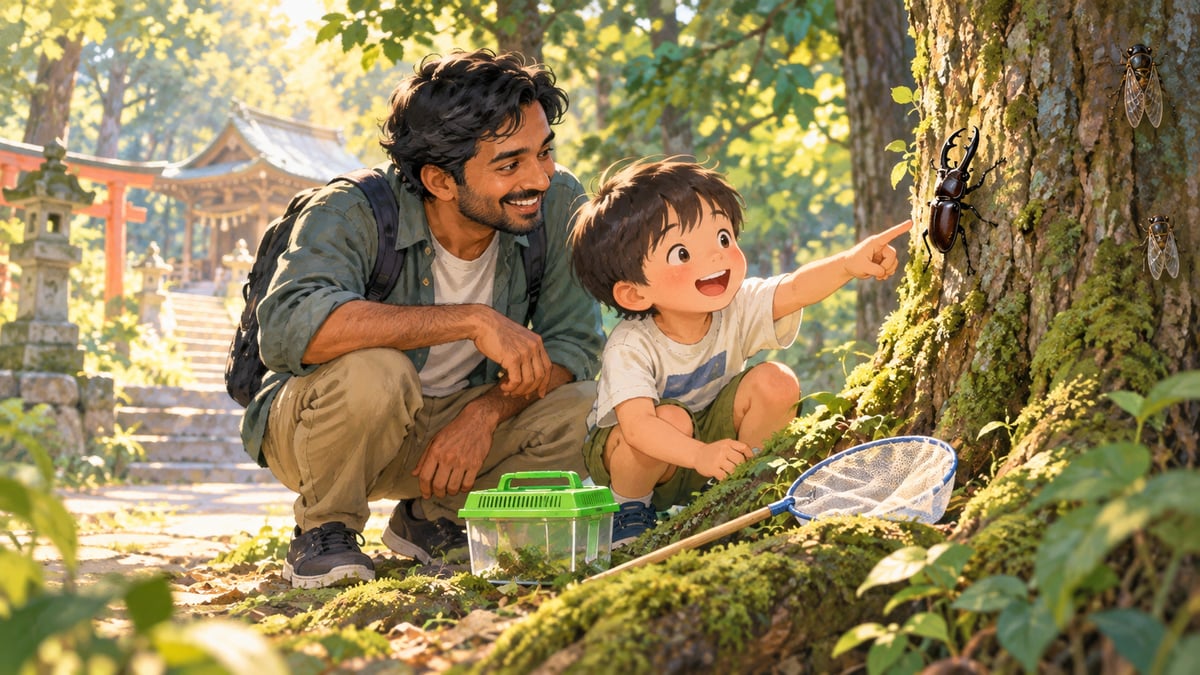
虫取り (mushitori), bug catching, is a classic summer holiday activity. Children head to a park or a wooded shrine with a net and a cage, look for beetles on tree sap early in the morning and catch dragonflies over rice fields. Some keep beetles at home for the summer, feeding them jelly sold for that purpose, and many schools give children an observation diary to fill in.
If you have children, or you spend time with a Japanese family in summer, this is a lovely shared activity and an easy way to practise casual Japanese.
| Japanese | Romaji | Meaning |
|---|---|---|
| 虫取り | mushitori | bug catching |
| 虫取り網 | mushitori ami | bug net |
| 虫かご | mushikago | bug cage, insect case |
| 見つけた! | Mitsuketa! | Child: I found one! |
| どこどこ? | Doko doko? | You: Where, where? |
| あの木の上!クワガタだよ。 | Ano ki no ue! Kuwagata da yo. | Child: Up that tree! It's a stag beetle. |
| すごい!大きいね。 | Sugoi! Ōkii ne. | You: Wow! It's big. |
| 持って帰ってもいい? | Motte kaette mo ii? | Child: Can I take it home? |
| ちゃんとお世話できる? | Chanto osewa dekiru? | You: Can you look after it properly? |
Mini dialogue: a cockroach in the share house
| Japanese | Romaji | Meaning |
|---|---|---|
| ちょっと来て!ゴキブリが出た! | Chotto kite! Gokiburi ga deta! | Roommate: Come here! There's a cockroach! |
| え、どこ? | E, doko? | You: What, where? |
| 冷蔵庫の後ろに入っちゃった。 | Reizōko no ushiro ni haitchatta. | Roommate: It went behind the fridge. |
| スプレー持ってくるね。 | Supurē motte kuru ne. | You: I'll get the spray. |
| 明日、罠を買っておこう。 | Ashita, wana o katte okō. | Roommate: Let's buy traps tomorrow. |
~ちゃった (~chatta) is the casual form of ~てしまった, and here it adds the feeling of oh no, it went and did it. You will hear it constantly in situations like this. If you need to report the problem politely to a landlord, say Heya ni mushi ga dete, komatte imasu, bugs keep appearing in my room and I am having trouble.
Make a bug deck with Mocchi
Open Mocchi and type /create-flashcards insect names from semi to gokiburi. Mocchi makes the cards for your Flash Card list and lets you pick a photo for each one, so if you are squeamish you can choose a cartoon beetle instead of a close-up. When you run /review-flashcards later, the names you keep forgetting come back sooner, and Mocchi remembers which ones gave you trouble the next time you ask for a quiz.
Once the deck exists, load your own flashcards into Kotoba Tank on the games page: you hear a word such as tonbo or kamakiri and have to hit the right picture, which is good listening practice for the long katakana names.
Common learner mistakes
- Using バグ (bagu) for an insect. In Japanese it only means a software bug; a real bug is mushi.
- Saying ka ni kamareta for a mosquito bite. Kamu means to bite with teeth; mosquitoes and bees sasu, sting. Ants and some other bugs can kamu, though.
- Mixing up 鳴く and 泣く in writing. Insects 鳴く; people 泣く.
- Calling every insect konchū in conversation. It sounds like a textbook; mushi is what people say.
- Reading テントウムシ as tentomushi with a short o. The long vowel matters: ten-tō-mu-shi.