
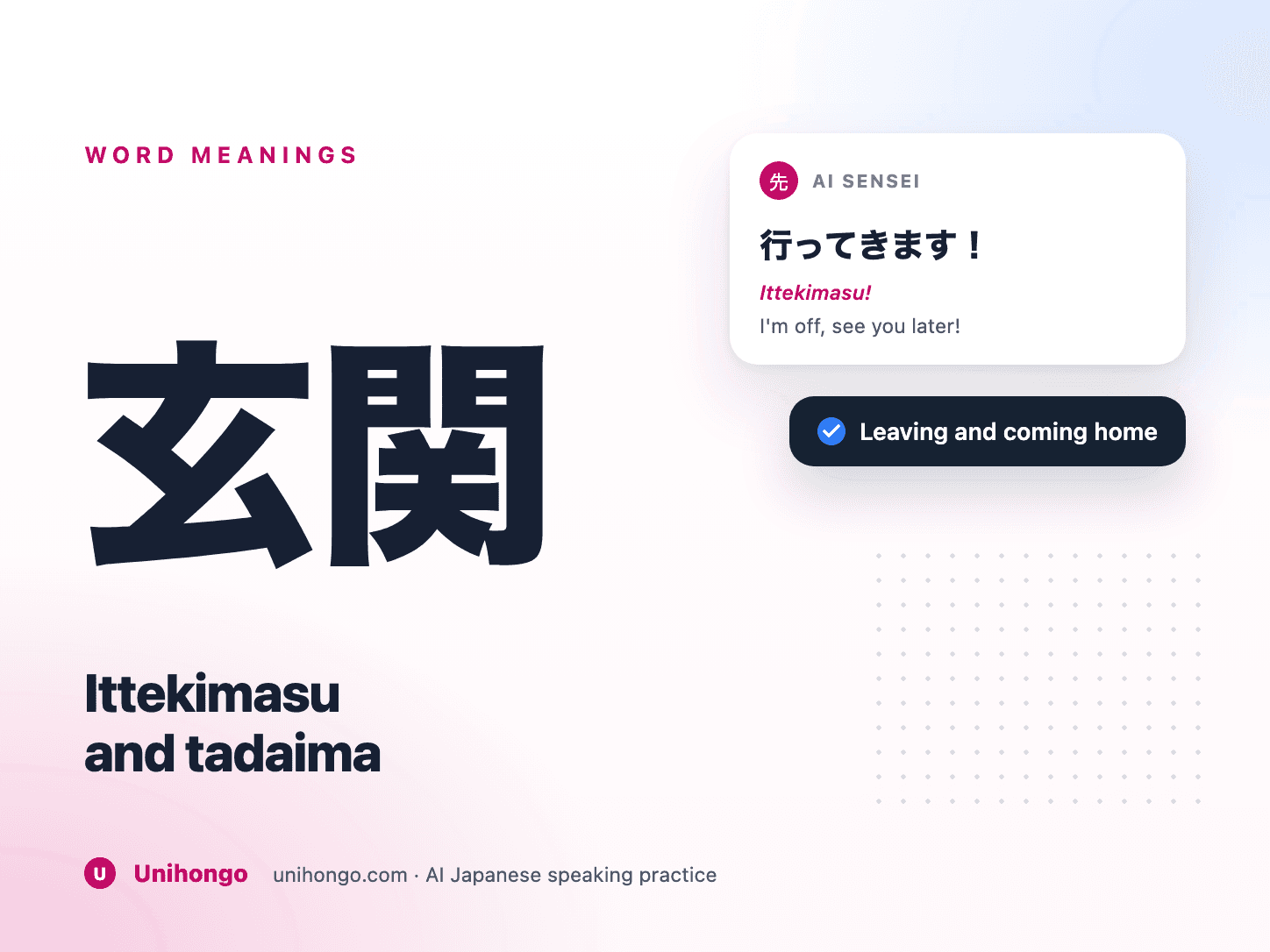
The set of four
The phrases come in two pairs, and each pair is a call and a response. Learners often know tadaima but forget that the person at home is expected to answer, and the answer matters as much as the call.
Children learn the set before they learn to read, which is why it feels so automatic to Japanese speakers and so noticeable when a housemate skips it.
| Japanese | Romaji | Meaning |
|---|---|---|
| 行ってきます。 | Ittekimasu. | I'm off: said by the person leaving |
| 行ってらっしゃい。 | Itterasshai. | See you later: said by the person staying |
| ただいま。 | Tadaima. | I'm home: said by the person returning |
| おかえり。 | Okaeri. | Welcome home: said by the person at home |
| おかえりなさい。 | Okaeri nasai. | Welcome home: a fuller, more polite form |
| Moment | The person moving says | The person staying says |
|---|---|---|
| Leaving the house | I'm going and coming back | Go and come back safely |
| Returning home | I'm back now | Welcome home |
| Stepping out of the office | I'm going out and will return | See you soon |
| Returning to the office | I have just come back | Welcome back, or thanks for your work |
What the words literally mean
Ittekimasu is itte, from iku, to go, plus kimasu, to come: I will go and come back. The coming back is built into the phrase, which is why it carries a small promise and why it is not used when you are leaving for good.
Itterasshai uses the honorific irassharu, so the person staying is politely telling you to go and return. Tadaima is short for tadaima kaerimashita, I have just now returned, and okaeri is short for okaeri nasai, an honorific instruction to come home.
| Japanese | Romaji | Meaning |
|---|---|---|
| ただいま帰りました。 | Tadaima kaerimashita. | I have just returned: the full form |
| お帰りなさい。 | Okaeri nasai. | Welcome home: written with kanji |
| 行ってまいります。 | Itte mairimasu. | I am going out: humble, polite form |
| 行ってらっしゃいませ。 | Itterasshaimase. | Please have a good trip: hotels and service staff |
The same ritual at work
Offices use the set whenever someone leaves the building on business and comes back. It tells everyone where you are without a formal report, and colleagues reply automatically without looking up.
The polite versions are the safe choice. Otsukaresama desu often replaces okaeri nasai when you return, because you have just done some work.
| Japanese | Romaji | Meaning |
|---|---|---|
| 郵便局に行ってまいります。 | Yūbinkyoku ni itte mairimasu. | I'm going to the post office |
| 取引先に行ってきます。 | Torihikisaki ni ittekimasu. | I'm heading out to see a client |
| 三時ごろ戻ります。 | Sanji goro modorimasu. | I'll be back around three |
| ただいま戻りました。 | Tadaima modorimashita. | I'm back |
| お疲れ様です。 | Otsukaresama desu. | Thanks for your work: a common reply |
Homestays, dorms and share houses
In a homestay the set is one of the first things host families notice. Saying it tells them you are out or back, and skipping it can make you seem distant even if you are friendly in every other way.
In dorms and share houses it works the same way among housemates. Add one useful line after ittekimasu and the ritual becomes practical communication.
| Japanese | Romaji | Meaning |
|---|---|---|
| 今日は遅くなります。 | Kyō wa osoku narimasu. | I'll be late today |
| 夕飯はいりません。 | Yūhan wa irimasen. | I won't need dinner |
| 気をつけてね。 | Ki o tsukete ne. | Take care: often added to itterasshai |
| じゃあ、行ってくるね。 | Jā, itte kuru ne. | Right, I'm off: casual |
| おかえり、早かったね。 | Okaeri, hayakatta ne. | Welcome back, that was quick |
Saying it to an empty home
Many people who live alone still say tadaima when they open the door. It marks the shift from outside to home, the same way taking off shoes does, and nobody finds it odd.
It is also said to pets, and in some homes to a family altar or a photograph of a relative who has died. In that setting the word is less a habit than a quiet way of keeping someone included in daily life.
For learners it is a free daily speaking rep. Saying the set out loud, even alone, keeps it automatic for the day you have someone to say it to.
Mistakes and substitutes
The most common error is using the set where you do not belong. A guest leaving a friend's apartment is not going to come back to it as home, so ittekimasu sounds odd; the right phrase is ojama shimashita.
The second is using sayōnara at the front door of your own home, which sounds like a long parting. The third is forgetting to reply when someone else says tadaima.
| Japanese | Romaji | Meaning |
|---|---|---|
| お邪魔します。 | Ojama shimasu. | Sorry to intrude: entering someone's home |
| お邪魔しました。 | Ojama shimashita. | Thank you for having me: leaving someone's home |
| また来ます。 | Mata kimasu. | I'll come again |
| お世話になりました。 | O-sewa ni narimashita. | Thank you for looking after me: leaving a homestay for good |
- Your own home or workplace: the set of four.
- Someone else's home: ojama shimasu and ojama shimashita.
- Leaving for good: o-sewa ni narimashita, not ittekimasu.
- Always answer tadaima with okaeri.